


What is Ruby on Rails and What is it Used for?
Ruby on Rails is a favored framework for web development, offering programmers a powerful toolset to create robust and scalable applications. In this article, we will explore the foundational principles, advantages, limitations, and prospects of Ruby on Rails.

What is Ruby?
Before we dive into Ruby on Rails, let's first understand the foundation upon which it is built – Ruby. Ruby is an elegant and dynamic programming language designed for simplicity and productivity. It was created by Yukihiro Matsumoto in the mid-1990s to make programming enjoyable and accessible. Ruby's syntax is clean and intuitive, resembling natural language, which allows developers to write code that is not only functional but also highly readable.
What is Ruby on Rails (RoR)?
Ruby on Rails is an open-source framework written in the Ruby programming language. It provides developers with a structured and organized way to develop web applications with its Model-View-Controller (MVC) pattern modularizing the code for maintainability. One of the key philosophies behind Rails is Convention over Configuration (CoC). It suggests that the framework should make decisions for developers based on conventions, reducing the need for explicit configuration. By adhering to established conventions, Rails simplifies development by eliminating the need for repetitive decisions and setups.
How does Ruby on Rails Work?
Let's explore Ruby on Rails' architecture in more detail to comprehend how it functions. The ActiveRecord, which manages communication with the database, is at the core of a Rails application. While the View manages the presentation layer (Frontend), the Model provides the data and business logic, and the Controller serves as a bridge between the Model and the View.
When a user requests a Ruby on Rails application:
- It is first intercepted by the Router, which determines the appropriate Controller to handle the request.
- The Controller then interacts with the Model to retrieve or update data from the database.
- Once the necessary data is obtained, the Controller passes it to the View.
- View generates the HTML to be sent back to the user's browser.
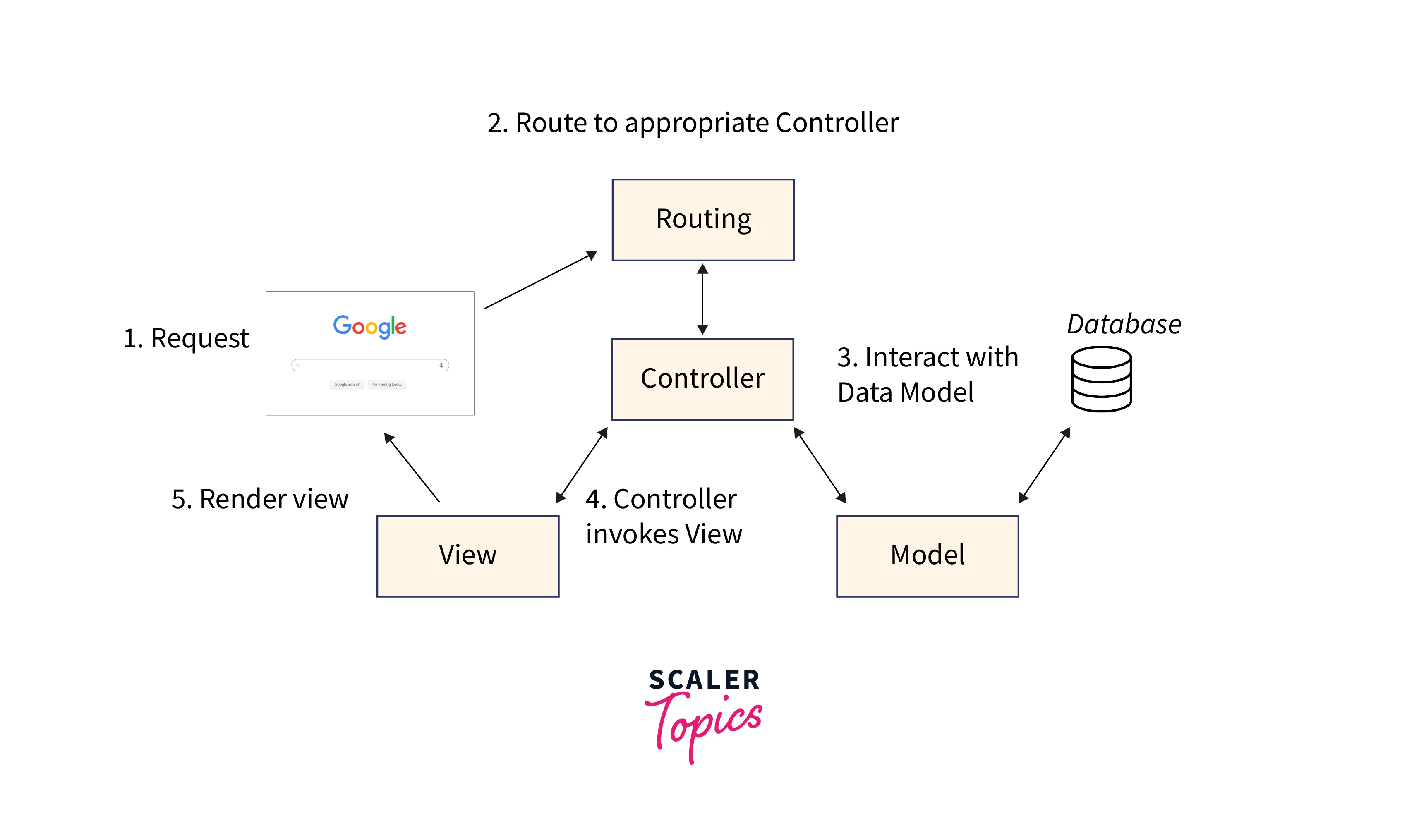
Ruby on Rails Architecture
Ruby on Rails follows the Model-View-Controller(MVC) architecture, where:
- Model:
The model represents the application's data and its business logic. It handles the data storage and retrieval and provides an interface for working with the database without SQL queries. - View:
The view is responsible for presenting the data to the user in a human-readable format. It receives data from the controller and generates the HTML that is sent to the browser. - Controller:
The controller is responsible for handling user input and updating the model. It receives requests from the browser, performs any necessary processing or validation on the input, and updates the model accordingly.
What is Ruby on Rails Used for?
Now that we have a grasp of Ruby on Rails architecture, let's explore its practical applications. Ruby on Rails is incredibly versatile and can be used to build a wide range of web applications.
- Rapid Application Development:
Ruby on Rails is well-suited for projects that require fast-paced development and frequent iterations. Its conventions and code generation capabilities enable developers to quickly build functional prototypes. Hence, due to fast-paced development, it helps in beating the competitors in the market and the overall TAT(Turn-Around-Time) for feature updates is also significantly reduced. - E-commerce Platforms:
Ruby on Rails provides a solid framework for developing e-commerce applications. Its built-in features, such as Active Record associations and validations, make it convenient to handle complex data models and relationships. Gems like Spree Commerce and Solidus offer comprehensive e-commerce solutions. - Social Networking Sites:
Ruby on Rails can be a great choice for developing social networking platforms. Its ability to handle user authentication, user-generated content, and complex data relationships simplifies the process of creating social networking features. - Collaborative Tools and Project Management Systems:
Ruby on Rails is well-suited for building collaborative tools and project management systems. Its real-time communication capabilities, combined with gems like Action Cable and WebSockets, enable developers to create interactive and collaborative features. GitHub is a major example of a collaborative application built over Ruby on Rails.
What Types of Projects Ruby on Rails is Best for?
Ruby on Rails is particularly well-suited for projects that prioritize developer productivity, rapid prototyping, and ease of maintenance. Its convention-based approach and vast ecosystem of open-source libraries and gems enable developers to quickly build and iterate on web applications. Common types of projects are:
- Social-Networking Platform
- E-Commerce Website
- Content Management System
- Software-as-a-Service (SaaS) application
Examples of Ruby on Rails Applications
Let's explore a few examples of successful applications built with this framework:
- GitHub:
The world's largest code hosting and collaboration platform, GitHub, relies heavily on Ruby on Rails. It demonstrates the scalability and reliability of Rails, handling a massive amount of code repositories and user interactions. - Airbnb:
The popular online marketplace for renting accommodations, Airbnb, initially built its platform using Ruby on Rails. The framework's flexibility and rapid development capabilities allowed Airbnb to quickly iterate and grow its business. - Basecamp:
Basecamp, a project management and collaboration tool, has been built and powered by Ruby on Rails since its inception. Rails' emphasis on simplicity and readability aligns well with Basecamp's philosophy of providing a user-friendly and efficient project management experience.
Benefits and Limitations of Using Ruby on Rails
Benefits of Ruby on Rails:
- Developer Productivity:
Ruby on Rails' emphasis on convention over configuration and its extensive set of libraries allow developers to focus on solving business problems rather than dealing with boilerplate code. - Rapid Development:
Rails' code generators, scaffolding, and integrated testing framework enable developers to quickly prototype and iterate on their applications, reducing time-to-market. - Vibrant Community:
Ruby on Rails has a vibrant and supportive community. Its active open-source ecosystem ensures continuous improvement, frequent updates, and a wealth of resources and community-driven plugins.
Limitations of Ruby on Rails:
- Performance:
Ruby is an interpreted language, and hence it is converted to machine code at runtime. Being an interpreted language, Ruby on Rails might not be as efficient as some other frameworks. Alternative frameworks might be more appropriate for applications with high-performance demands. - Learning Curve:
Even though Rails is renowned for being developer-friendly, mastering the framework takes time and effort. The norms and notions may first be too much for beginners to handle. - Flexibility versus Convention:
Convention-based development, which is used in Rails, speeds up development but may have certain limitations on flexibility. Additional settings and modifications may be needed for projects with special requirements or complex structures.
Future of Ruby on Rails
As technology continues to evolve, you might wonder about the future of Ruby on Rails. While newer frameworks and technologies have emerged in recent years, Ruby on Rails remains a robust and mature framework with strong community backing. It continues to receive updates, improvements, and security patches, ensuring its relevance and longevity in the web development landscape. With Rails 7 being released in February 2022, we can see how Ruby on Rails (which came in 2004) continues to get version updates with great optimizations.
Getting Started with Ruby on Rails
Let's walk through the process of creating a simple Rails application. Follow these steps:
-
Install Ruby:
Open the linux terminal and run the following command to install Ruby: -
Install Rails:
Once Ruby is installed, then run the following command to install Rails: -
Create a New Rails Application:
Navigate to the directory where you want to create your Rails application. Then run the following command:Replace "myapp" with the desired name of your application. This command creates a new Rails application with the necessary directory structure and initial files.
-
Application Directory:
Navigate to the application directory using the following command: -
Start the Rails Server:
To launch the Rails server and view your application in a web browser, run the following command:This command starts the server on the default port 3000.
-
Access the Application:
Open your web browser and go to http://localhost:3000. You should see the default Rails welcome page, which means that your application is up and running.
FAQs
Q. Is Ruby on Rails suitable for small-scale projects?
A. Yes, Ruby on Rails can be a great choice for small-scale projects as it offers rapid development capabilities, convention-based configurations, and a supportive community.
Q. Can I use Ruby on Rails for mobile app development?
A. While Ruby on Rails is primarily focused on web application development, it can be used in conjunction with frameworks like RubyMotion or React Native to build mobile applications.
Q. Is Ruby on Rails still relevant in today's web development landscape?
A. Yes! Ruby on Rails continues to be widely used and maintained. It has a mature ecosystem, an active community, and powers many successful applications.
Learn More
Conclusion
- Ruby on Rails is an open-source web application framework written in Ruby, known for its simplicity, elegance, and readability.
- It follows the Model-View-Controller (MVC) architectural pattern, separating the concerns of data, presentation, and logic.
- Ruby on Rails offers rapid development capabilities, thanks to its convention-over-configuration approach and extensive set of libraries and gems.
- It is well-suited for a variety of web development projects, including social networking platforms, e-commerce websites, and content management systems.
- While Ruby on Rails has its limitations, such as performance concerns for high-traffic applications, it remains a popular and mature framework with strong community backing.