




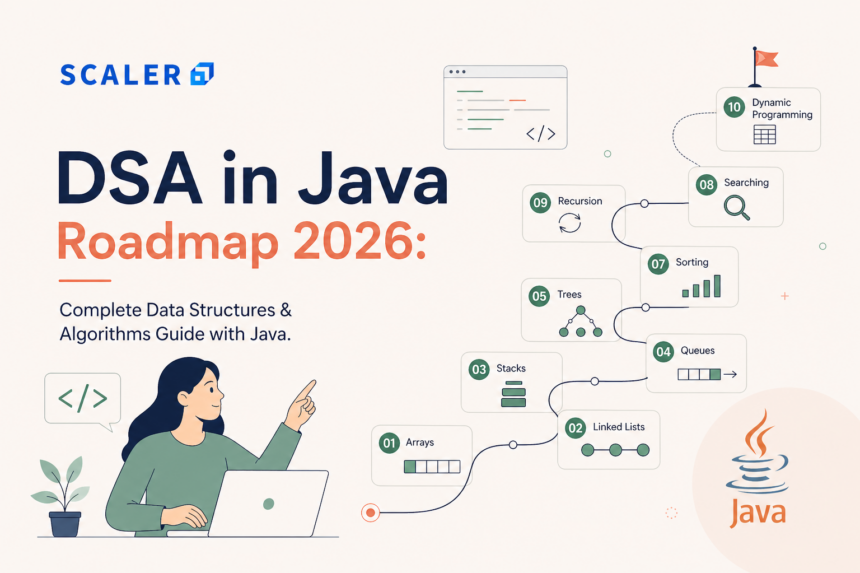
DSA is something almost every developer preparing for placements ends up spending time on, and in India, a lot of that preparation happens using Java. It’s substantially used in interviews, and most standard problems already have Java-based solutions, which makes it a practical choice to stick with.
The part that usually gets confusing is not what to study, but how to study it in Java. You’ll find plenty of DSA roadmaps, but most of them stay language-neutral. When you actually start solving problems, you still have to figure out how things map to Java, what collections to use, how implementations differ, and how to write efficient code.
This roadmap is built around that. It follows the usual DSA flow, but every step is tied to Java, whether it’s using ArrayList instead of arrays, working with HashMap, or understanding how Java handles recursion and memory. If you’re looking for a general overview, you can check the broader DSA roadmap. Here, the focus stays on learning DSA through Java in a way that actually helps during interviews.
Why Learn DSA in Java?
A lot of placement prep in India still happens using Java. In surveys like Stack Overflow’s developer report, Java consistently shows up among the most used languages globally, and it continues to be one of the common choices for interview preparation as well. Most standard DSA problems are already available with Java implementations, so it becomes easier to practice and compare approaches without switching languages.
Transform Your Career
Choose from our industry-leading programs designed for career success
Modern Software and AI Engineering Program
Master full-stack development with AI integration


 +1000 more
Modern Data Science and ML with specialisation in AI
Advanced data science techniques with AI specialization
+1000 more
Advanced AIML with Specialisation in Agentic AI
Deep dive into AIML with focus on Agentic systems
+1000 more
DevOps, Cloud & AI Platform Engineering
Build and manage AI-powered cloud infrastructure
+1000 more
AI Engineering Advanced Certification by IIT-Roorkee
Premier AI engineering certification from IIT-Roorkee

Java also gives you built-in data structures through the Collections Framework. When you’re solving a problem, you’re not writing everything from scratch, you’re using classes like ArrayList for dynamic arrays, HashMap for key-value storage, or PriorityQueue for heap-based problems. For example, something like checking frequency of elements becomes straightforward with a HashMap instead of manually managing arrays.
Another reason is how Java is used in interviews. Many companies that hire through campus placements or product-based roles are comfortable with Java solutions, especially because the syntax is strict and readable. When you explain your approach, having structured code with clear types and methods makes it easier to follow.
If you’re already using Java or planning to, sticking with it for DSA avoids switching context. The way you handle data structures in problems carries over to real applications, so the effort you put into practice doesn’t stay limited to just interviews.
Prerequisites: Java Basics You Need
Before you start with DSA in Java, a few things should already feel familiar:
- You should be able to write basic Java programs without thinking too much about syntax. Things like loops, conditions, and functions should come naturally.
- You’ll be using classes and objects in most problems, so writing a class, creating objects, and using methods should feel normal.
- You should know how to work with common collections like ArrayList, LinkedList, HashMap, and HashSet. Adding elements, accessing them, and understanding when to use each one should not feel new.
- Generics will come up everywhere, so writing things like List<Integer> or Map<String, Integer> should be clear.
- You should also be comfortable reading code. Many problems will require you to understand an approach first and then implement it in Java.
DSA in Java Roadmap: Phase 1 – Foundations (Weeks 1-4)
Arrays & Strings in Java
Arrays are the first thing you’ll work with in DSA. You’ll mostly be iterating, updating values, and handling indices correctly. Small mistakes happen here more than expected, so it’s worth getting used to how indexing behaves in Java.
Most of this feels simple at first, but small mistakes happen here more often than expected.
Along with arrays, ArrayList comes up pretty quickly. It handles resizing on its own, so you don’t have to think about size while adding elements. Using both makes it easier to see when a fixed structure works better and when a dynamic one is needed.
Sorting is often used in this phase. Arrays.sort() is usually enough for most problems at this stage, especially when arranging data helps simplify the logic.
Strings behave a little differently since they can’t be modified directly. When you start changing strings repeatedly, StringBuilder is used instead. Most problems here involve basic operations like traversal, comparison, or building strings step by step.
And so, when you start working with strings in Java, you’ll notice that modifying them repeatedly can get inefficient. That’s where StringBuilder is used, it lets you build or update strings without creating new objects every time.
For example, if you’re reversing or constructing a string step by step, you’ll usually end up doing something like:
String str = “java”;
StringBuilder sb = new StringBuilder();
for (int i = str.length() – 1; i >= 0; i–) {
sb.append(str.charAt(i));
}
System.out.println(sb.toString()); // avaj
This pattern shows up in a lot of problems where strings are modified frequently, and using StringBuilder keeps things efficient.
Time & Space Complexity (Big O)
While solving problems, you’ll start noticing that some solutions take more time than others, even if they give the same result. That difference comes from how many times your code runs and how much extra memory it uses.
A single loop, nested loops, or breaking a problem into smaller parts all affect performance. Over time, you’ll get used to identifying this just by looking at the code, without needing to calculate it every time.
Recursion with Java
Now this topic! You can say that recursion is one of those topics that either clicks quickly or takes a bit of time. But why is that?
It’s because recursion takes a bit of getting used to because the same function keeps calling itself. Writing a few small examples and following each step helps in understanding how it works.
The important part is knowing when the function should stop and how each step moves toward that. Once that is clear, recursion becomes easier to apply to different problems.
DSA in Java Roadmap: Phase 2 – Linear Data Structures (Weeks 5-8)
Linked Lists (Singly, Doubly) in Java
Linked lists feel different from arrays because you’re not working with indices anymore. Each element points to the next, so most of the work is around handling references correctly.
Start with singly linked lists, creating nodes, traversing the list, and inserting or deleting elements. Then move to doubly linked lists where each node keeps track of both previous and next elements.
In Java, you’ll also come across the LinkedList class. It already handles most operations, so you won’t always implement lists from scratch, but understanding how insertion and deletion work internally makes a difference when solving problems.

Free Courses by top Scaler instructors
Stacks & Queues: Java Implementations
Stacks and queues come up often in problems involving order and processing.
A stack follows last-in-first-out, so elements are added and removed from the same end. In Java, you’ll see Stack, but ArrayDeque is more commonly used since it’s more efficient.
Queues follow first-in-first-out. Elements are added at one end and removed from the other. You can use LinkedList or ArrayDeque for this.
Problems here usually involve tracking orders, things like matching parentheses, processing tasks, or handling elements step by step.
You can use stacks for balanced parentheses. The point is to push opening brackets and match them when a closing one appears.
In Java, instead of the older Stack class, ArrayDeque is usually preferred:
ArrayDeque<Character> stack = new ArrayDeque<>();
String str = “()[]{}”;
for (char ch : str.toCharArray()) {
if (ch == ‘(‘ || ch == ‘[‘ || ch == ‘{‘) {
stack.push(ch);
} else {
if (stack.isEmpty()) return false;
stack.pop();
}
}
Problems like this help build intuition for order-based processing.
HashMap, HashSet & Hashing in Java
Once you start using HashMap regularly, you’ll notice how many problems become simpler.
Hashing shows up in a lot of problems, especially when you need fast lookups.
HashMap is used when you need to store key-value pairs, like counting frequencies or tracking data. HashSet helps when you only need to check if something exists.
A lot of brute-force solutions usually get replaced by this approach.
You’ll also come across variations like LinkedHashMap, which keeps insertion order, and TreeMap, which keeps keys sorted.
Most problems here are about using these structures to avoid unnecessary loops. Once you start using them regularly, they become one of the most useful tools while solving DSA questions.
One of the most common uses of HashMap in DSA problems is counting frequencies. Instead of looping multiple times, you can store and update counts in a single pass.
For example:
int[] arr = {1, 2, 2, 3, 1, 2};
HashMap<Integer, Integer> map = new HashMap<>();
for (int num : arr) {
map.put(num, map.getOrDefault(num, 0) + 1);
}
System.out.println(map); // {1=2, 2=3, 3=1}
This kind of approach is used in problems involving duplicates, majority elements, or tracking occurrences.
DSA in Java Roadmap: Phase 3 – Trees & Graphs (Weeks 9-12)
Binary Trees & BST in Java
Tree problems can feel a bit abstract in the beginning.
Tree problems start with understanding how nodes are connected. Each node can have left and right children, and most questions involve traversing these nodes in different ways.
You’ll work with traversals like inorder, preorder, and postorder. These come up repeatedly, so writing them without confusion helps a lot. After that, Binary Search Trees add another layer where values follow an order, left side smaller, right side larger. This makes searching, inserting, and deleting more structured.
In most problems, you’ll start by defining a basic node structure like this:
class TreeNode {
int val;
TreeNode left, right;
TreeNode(int val) {
this.val = val;
this.left = this.right = null;
}
}
Once this is set up, traversal logic, like inorder or preorder becomes easier to implement using recursion.
In Java, you’ll usually define your own TreeNode class and build trees manually for problems. Getting comfortable with recursion here makes a difference, since most tree solutions rely on it.
Scaler Placement Report and Statistics
Scaler learners achieved 2.5x salary growth with average post-Scaler CTC reaching ₹23L.
 Google
 Amazon
 Microsoft
 Flipkart
 Adobe
1200+ more
Adobe
1200+ more
Heaps & Priority Queues
Heaps are mainly used when you need quick access to the smallest or largest element.
In Java, you don’t implement heaps from scratch in most cases. You’ll use the PriorityQueue class, which works as a min-heap by default. Adding elements, removing the smallest, and maintaining order happen automatically.
This shows up in problems like finding top K elements, merging sorted data, or handling streams of numbers. Once you start using PriorityQueue, the pattern becomes clear, add elements, remove based on priority, and keep the structure balanced.
Graphs: BFS, DFS, Dijkstra in Java
Graphs are usually represented using an adjacency list in Java, often with something like HashMap<Integer, List<Integer>> or a list of lists.
Graphs in Java are often represented using an adjacency list. A common way to do this is with a HashMap:
HashMap<Integer, List<Integer>> graph = new HashMap<>();
graph.put(1, new ArrayList<>(Arrays.asList(2, 3)));
graph.put(2, new ArrayList<>(Arrays.asList(1, 4)));
This structure makes it easier to traverse nodes using BFS or DFS.
Traversal is the starting point. BFS uses a queue and moves level by level, while DFS goes deeper using recursion or a stack. These two patterns come up in many problems, so writing them clearly is important.
After that, shortest path algorithms like Dijkstra build on top of this. Here, PriorityQueue is used again to always process the next closest node.
Graph problems can feel heavy at first, but once BFS and DFS are clear, most of the logic starts repeating with small variations.
DSA in Java Roadmap: Phase 4 - Advanced (Weeks 13-18)
Sorting Algorithms: Merge Sort, Quick Sort in Java
By this stage, built-in sorting isn’t enough; you’ll start writing sorting logic yourself. Merge sort is based on dividing the array and merging it back in order, while quick sort works around choosing a pivot and placing elements on either side.
In Java, this usually means working with arrays and handling indices carefully during recursion. Focus on how the array is split, how elements are compared, and how the final sorted result is built.
Dynamic Programming with Java
Dynamic programming comes up when the same subproblems repeat. Instead of recalculating values, you store results and reuse them.
You’ll start with recursion, then move to storing results using arrays or HashMap. After that, converting recursive solutions into iterative ones helps reduce overhead.
Problems like Fibonacci, knapsack, or longest subsequence are common here. The main shift is recognizing when a problem has overlapping work and turning it into a stored solution.
In Java, dynamic programming often starts with storing results in an array so you don’t recompute the same values again.
For example, Fibonacci with memoization:
int[] dp = new int[n + 1];
dp[0] = 0;
dp[1] = 1;
for (int i = 2; i <= n; i++) {
dp[i] = dp[i - 1] + dp[i - 2];
}
This helps in avoiding repeated calculations and improves performance significantly compared to a purely recursive approach.
Greedy Algorithms
Greedy problems involve making the best choice at each step and moving forward with it. The decision is local, but it works for the overall solution.
In Java, this usually involves sorting first and then iterating through data while making choices. Problems like activity selection or interval scheduling follow this pattern.
The key part here is understanding why a greedy choice works, since not every problem can be solved this way.
Backtracking Problems
Backtracking is used when you need to try all possible options and undo choices when they don’t work.
You’ll see this in problems like generating subsets, permutations, or solving constraints. In Java, this often involves recursion along with a list to store the current state.
The pattern stays consistent: choose, explore, and backtrack if needed. It takes some practice, but once the flow is clear, similar problems become easier to handle.
Scaler Alumni and Their Success Stories
DSA in Java Interview Questions & Practice
You might have all the concepts covered and a decent amount of practice done, but interviews don’t feel the same. The pressure, limited time, and the way questions are asked can make things confusing even when you’ve seen similar problems before.
A lot of questions won’t look familiar at first. They’ll be built on things you already know, but slightly twisted, an array problem mixed with hashing, a tree problem that needs recursion, or something that looks new but follows a known pattern. In that moment, the difficulty is not the concept; it’s recognizing what to apply.
The only way to handle that is by being very familiar with patterns from the beginning. When you’ve solved enough variations, you don’t spend time figuring out what to do, you start seeing the approach almost immediately.
If you want to work on that, you can go through a set of commonly asked DSA interview questions grouped by topic and difficulty and solve them step by step instead of picking problems randomly.
Read These Important Roadmaps: More Paths to Career Success
FAQs
Q1. Is Java good for DSA?
Yes, Java works well for DSA. It has built-in data structures like ArrayList, HashMap, and PriorityQueue, so you can focus on solving problems instead of setting everything up from scratch. It’s also commonly used in placements, so you won’t face issues using it in interviews.
Q2. How long does it take to complete DSA in Java?
If you’re consistent, it usually takes around 3-4 months to cover the basics and start solving problems comfortably. Getting fully confident takes longer and depends on how many problems you practice regularly.
Q3. Should I use Java or C++ for DSA?
Both work honeslty. C++ gives slightly faster execution and more control, but Java is easier to manage and has a clean structure. If you already know Java, there’s no strong reason to switch.
Q4: What Java collections are used most in DSA?
You can use ArrayList, HashMap, HashSet, LinkedList, and PriorityQueue the most. These cover most problems related to arrays, hashing, queues, and heaps.
Q5: How many DSA problems should I solve for placements?
We recommend practicing 150-300 problems with proper understanding, which is usually enough to cover common patterns. It matters more that you understand the approach than just increasing the count.
