




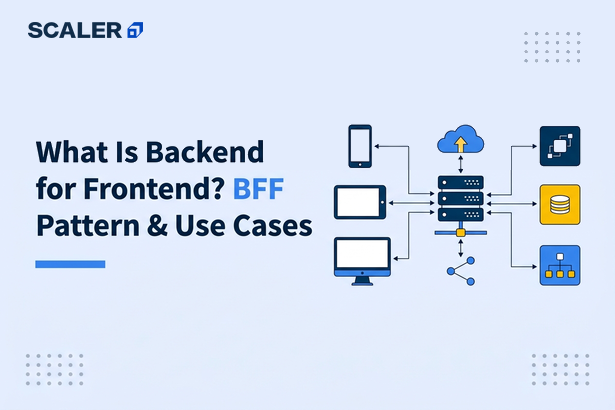
Backend for frontend (BFF) is an architectural pattern in which a dedicated backend layer is created for each type of client, such as a web application, mobile app, smart TV, or voice interface. Instead of making every client communicate directly with multiple backend services, the BFF layer aggregates, transforms, and delivers data in a format tailored to that specific frontend.
The BFF pattern is particularly useful in systems with multiple clients that have different data, performance, and interface requirements. For example, a mobile BFF can return smaller payloads optimized for bandwidth and mobile performance, while a web BFF can provide richer data for a desktop interface.
A BFF typically handles aggregation, response transformation, authentication forwarding, and client-specific orchestration while leaving core business logic and persistent data to downstream services. It can also work alongside an API Gateway, with the gateway handling shared concerns such as routing and rate limiting and the BFF managing frontend-specific requirements.
However, BFF adds another service to deploy and maintain. It is most valuable when an application has multiple distinct clients, several backend services, and frontend teams that need greater control over their API contracts.
What Is Backend for Frontend? BFF Pattern, Benefits & Use Cases
What is backend for frontend? It’s an architectural pattern where you build a dedicated, purpose-specific backend layer for each distinct type of client consuming your system, a mobile app, a web application, a smart TV interface, or a voice assistant, instead of forcing every client through one general-purpose API that tries to satisfy all of them at once.
Rather than a mobile app and a web app both calling the exact same backend and receiving the exact same bloated response, each gets its own tailored layer: a Mobile BFF returns lightweight, minimal payloads optimised for limited bandwidth and smaller screens, while a Web BFF might return richer, more detailed data suited to a desktop experience. The core insight, repeated consistently across engineering literature on this pattern, is simple: a generic backend trying to satisfy multiple very different clients inevitably becomes a bottleneck, both for the teams building it and for the end-user experience it produces.
Transform Your Career
Choose from our industry-leading programs designed for career success
Modern Software and AI Engineering Program
Master full-stack development with AI integration


 +1000 more
AI Forward Deployed Engineer with Specialisation in AI applications
Build and deploy AI solutions for real-world business problems
+1000 more
Modern Data Science and ML with specialisation in AI
Advanced data science techniques with AI specialization
+1000 more
Advanced AIML with Specialisation in Agentic AI
Deep dive into AIML with focus on Agentic systems
+1000 more
DevOps, Cloud & AI Platform Engineering
Build and manage AI-powered cloud infrastructure
+1000 more
AI Engineering Advanced Certification by IIT-Roorkee
Premier AI engineering certification from IIT-Roorkee

What Is BFF? The Precise Definition and Full Form
What is BFF, precisely? The bff full form in software is Backend for Frontend, and the most widely cited working definition frames it this way:
Two words in that definition carry the most weight: thin and owned. Thin means a bff layer should do aggregation, transformation, and orchestration, not implement business logic or own persistent data. Owned means the pattern is as much an organisational choice as a technical one: it lets a frontend team control the shape of their own API contract, rather than depending on a shared backend team’s release schedule and priorities for every change.
The Problem BFF Architecture Solves
The problem bff architecture solves becomes obvious the moment a product supports more than one meaningfully different client. Imagine a platform built from several microservices, a Product Service, a Pricing Service, a Review Service, an Inventory Service, and a Recommendation Service.
Without a BFF, this is what a mobile screen render looks like:
Mobile calls the Product Service. Mobile calls the Pricing Service. Mobile calls the Review Service. Mobile calls the Inventory Service. Mobile calls the Recommendation Service. Five separate round trips, from a mobile device, over a potentially slow connection, with the client itself responsible for combining every response into one coherent screen.
This pattern, the frontend calling multiple backend services directly and stitching the results together itself, works fine for small applications where every client has roughly similar needs. It breaks down once you have genuinely different clients (a data-hungry admin dashboard versus a bandwidth-constrained mobile app) or once the number of downstream services grows large enough that no single frontend team can reasonably track every service’s contract.
| Client Type | What It Actually Needs |
| Web Application | Rich data, detailed content, larger payloads acceptable |
| Mobile App | Lightweight payloads, minimal data, battery and bandwidth conscious |
| Admin Portal | Operational workflows, bulk data, less concerned with payload size |
| Partner API | Structured, versioned contract data for external integrators |
A general-purpose API almost always returns too much data for the mobile client and too little for the admin portal, because it’s trying to serve every row in that table with one shape. Backend for frontend architecture exists specifically to give each of these radically different needs its own tailored layer.
How the BFF Pattern Actually Works
Once a bff pattern is in place, the frontend sends a single request to its own dedicated BFF, rather than calling multiple backend services directly. The BFF layer then does the coordination work the client used to have to do itself.
| BFF Responsibility | What It Does |
| Aggregation | Combines multiple downstream service responses into a single payload |
| Transformation | Converts backend data structures into UI-friendly formats the frontend can use directly |
| Orchestration | Coordinates multiple service calls, including handling partial failures gracefully |
| Auth forwarding | Validates tokens and forwards identity information to downstream services |
| Error translation | Converts internal service errors into meaningful, client-appropriate UI responses |
In many organisations, different clients genuinely have separate BFFs, a Mobile BFF and a Web BFF sitting side by side, each independently deployed, each calling into the same pool of shared downstream microservices, but shaping the output completely differently for their respective frontend.
BFF vs API Gateway: Resolving the Confusion
BFF and API Gateway are two of the most frequently confused terms in this space, and the confusion is understandable, both sit between clients and backend services. But they solve genuinely different problems.
| Dimension | API Gateway | BFF |
| Purpose | General-purpose traffic manager | Client-specific backend |
| Core responsibility | Routing, rate limiting, authentication | Aggregation, transformation, UI orchestration |
| Ownership | Typically owned by a platform/infra team | Typically owned by the frontend team it serves |
| Scope | Single entry point for all clients | One instance per distinct client type |
These two patterns are not competitors, they’re commonly used together. A shared API Gateway handles cross-cutting concerns (routing, rate limiting, top-level authentication) for the entire system, while individual BFFs sit behind it, each shaping data specifically for their client. Understanding this distinction is essential before you can meaningfully evaluate whether your system needs a bff layer at all, an API Gateway, or, very commonly, both.
BFF vs GraphQL: Do You Need Both?
Another common question once teams understand backend for frontend is how it relates to GraphQL, since both address the ‘over-fetching and under-fetching’ problem that plagues rigid REST APIs. The honest answer is that they’re complementary, not competing solutions.
- GraphQL alone: a single, flexible schema lets any client query exactly the fields it needs, powerful, but the schema itself can become a shared bottleneck across very different clients if not carefully namespaced
- BFF alone: each client gets a dedicated backend, but if that backend exposes a rigid REST contract, the frontend still can’t flexibly shape its own queries
- BFF + GraphQL together: separate BFFs per client type, with each BFF exposing a GraphQL API internally, giving frontend teams both dedicated ownership and query flexibility at the same time
This hybrid is explicitly documented as the architecture many large engineering organisations land on at scale, using BFF to establish clear per-client ownership boundaries, and GraphQL within each BFF to keep the query interface flexible rather than locking frontend teams into fixed, versioned REST endpoint shapes.
Benefits of the Backend for Frontend Pattern
The benefits bff architecture delivers go beyond just ‘smaller payloads’, they touch team structure, release velocity, and security posture as much as raw performance.
- Optimised payloads: each client receives exactly the data shape it needs, cutting unnecessary data transfer, especially valuable for mobile and IoT clients
- Frontend team autonomy: the team building a client can evolve its own bff layer’s API contract independently, without waiting on a shared backend team’s roadmap
- Faster iteration: UI changes that need a slightly different data shape can be made in the BFF directly, rather than negotiating a change to a shared, general-purpose API used by every other client
- Cleaner separation of concerns: core domain logic stays in downstream microservices; UI-specific concerns (formatting, aggregation, client-specific auth flows) stay in the BFF
- Client-specific security policies: authentication, rate limiting, and data filtering can be tuned precisely to each client’s actual risk profile and needs
- Democratic governance: frontend teams gain real technology and release autonomy, rather than being downstream dependents of a single shared backend team’s decisions
Real-World Use Cases: Netflix, Spotify, and Beyond
The bff pattern isn’t a theoretical exercise, it’s in production at some of the largest consumer platforms in the world, each with a genuinely different reason for adopting it.
| Company | Client Diversity Driving BFF Adoption | How They Use It |
| Netflix | Web browsers, mobile apps, smart TVs, gaming consoles | Separate experience APIs per device type, thousands of device variants served by a manageable set of client-type BFFs, all reading from the same pool of downstream services |
| Spotify | Web, mobile, desktop, smart device applications | Customised APIs per platform, enabling an optimised experience for each surface |
| SoundCloud | Mobile client vs. web client during scaling | The pattern’s origin, decoupled mobile backend needs from the growing monolith during their 2011–2013 decomposition |
| Airbnb | Web, mobile, partner integrations | Client-specific data shaping across very different consumer surfaces |
| Microsoft | Multiple product surfaces across its ecosystem | Backend for frontend architecture applied across various product lines |
Netflix’s approach is frequently cited as the pattern operating at genuine scale: rather than one API trying to serve every device Netflix runs on, a manageable set of client-type BFFs each serve their specific device category, all drawing from the same underlying pool of downstream microservices, proof that this pattern scales from a handful of clients to genuinely massive device diversity without the underlying services needing to know or care about that diversity at all.

Free Courses by top Scaler instructors
CTA: Build Scalable Backend Architectures
BFF helps teams design APIs around the needs of different clients. Take your backend skills further with Scaler Academy’s Software & AI Engineering Program and learn system design, APIs, and scalable backend architecture through hands-on projects.
Implementing a BFF Layer: A Practical Example
Here’s a simplified but realistic bff layer, aggregating data from three downstream services for a mobile client’s dashboard screen:
// mobile-bff/routes/dashboard.js

app.get('/dashboard', async (req, res) => {

  const userId = req.user.id;

  // Parallel calls to downstream microservices

  const [profile, orders, notifications] = await Promise.allSettled([

userService.getProfile(userId),

orderService.getRecentOrders(userId, { limit: 3 }),

notificationService.getUnread(userId),

  ]);

  // Shape the response specifically for the mobile UI

  res.json({

displayName: profile.value?.name ?? 'Guest',

recentOrderCount: orders.value?.length ?? 0,

unreadCount: notifications.value?.length ?? 0,

  });

});

// mobile-bff/routes/dashboard.js- Promise.allSettled (rather than Promise.all) ensures one failing downstream service doesn’t take down the entire response, a partial dashboard is usually better than none
- The response is deliberately minimal, exactly the three fields the mobile dashboard screen actually renders, not the full profile, order, and notification objects each service would normally return
- This same aggregation logic, if built for a Web BFF instead, would likely return a richer payload, more order history, full notification content, reflecting the web client’s different UI needs
Common Pitfalls and How to Avoid Them
The bff pattern is not a silver bullet, and several recurring failure modes show up consistently across engineering write-ups on real production BFF systems.
The bloated BFF, the most common failure mode:
A BFF that gradually accumulates business logic, validation rules, and even its own database becomes ‘a new monolith in disguise.’ If a BFF starts making business decisions rather than just aggregating and shaping data, it has effectively graduated into a microservice, and should be re-architected and governed as one, not left masquerading as a thin client layer.
- Missing circuit breakers: without them, a slow downstream service can exhaust a BFF’s thread pool, taking the BFF itself down, and with it, the entire frontend it serves; circuit breakers are considered non-negotiable for any production bff layer
- Duplicated logic across BFFs: if every client-specific BFF re-implements the same aggregation logic slightly differently, you’ve traded one bottleneck for several inconsistent ones, shared internal libraries for common aggregation patterns help here
- A BFF that owns a database: the moment a BFF starts persisting its own state, it stops being a thin client layer and needs the same operational rigor (schema migrations, backups, ownership) as any other microservice
- Team ownership drift: a BFF works best when the frontend team that consumes it also owns and maintains it, a BFF maintained by a disconnected backend team recreates the exact bottleneck the pattern was meant to eliminate
When Not to Use the BFF Pattern
Backend for frontend is a deliberate trade-off, you accept real operational complexity (more services to build, deploy, and monitor) in exchange for frontend autonomy and optimised client experiences. It’s not automatically the right call for every system.
- If your microservices already provide sufficiently client-specific functionality on their own, an additional bff layer may just add overhead without a clear payoff
- If frontend and backend changes are tightly coupled and evolve together as one team, maintaining separate BFFs can become more coordination overhead than benefit
- If you only have one client type today with no near-term plans to add more, a general-purpose API is simpler and easier to operate
The pattern earns its complexity at scale, multiple distinct clients, multiple frontend teams, and enough downstream microservices that no single client can reasonably talk to all of them directly. Below that threshold, backend for frontend is often more operational cost than benefit.
Ready to Master System Design and Backend Architecture?
Take your backend engineering skills further with Scaler Academy’s Software & AI Engineering Program. Learn system design, backend architecture, and production-grade software engineering through hands-on projects.
Scaler Placement Report and Statistics
Scaler learners achieved 2.5x salary growth with average post-Scaler CTC reaching ₹23L.
 Google
 Amazon
 Microsoft
 Flipkart
 Adobe
1200+ more
Adobe
1200+ more
FAQs: Backend for Frontend
Q1. What is backend for frontend in software architecture?
Backend for frontend is an architectural pattern where a dedicated backend layer is built for each distinct client type, instead of one general-purpose API serving every client identically.
Q2. What is BFF, and what is its full form in software?
The bff full form in software is Backend for Frontend, a thin, client-specific gateway that aggregates and reshapes downstream service data for exactly one frontend's needs.
Q3. What is the difference between the BFF pattern and an API Gateway?
An API Gateway is a general-purpose entry point handling routing, auth, and rate limiting for all clients, while a bff pattern layer is client-specific, focused on data aggregation and UI-oriented response shaping.
Q4. When should you use bff architecture?
Use bff architecture when you have multiple distinct client types, multiple frontend teams, and enough downstream microservices that a single general-purpose API can no longer serve every client well.
Q5. Should a bff layer own its own database?
No, a bff layer should remain stateless and never own its own database; if it does, it has effectively become a microservice and should be governed with that same operational rigor.
Q6. Which companies use the backend for frontend pattern?
Netflix, Spotify, SoundCloud (where the pattern originated), Airbnb, and Microsoft are all commonly cited real-world adopters of backend for frontend architecture in production.
