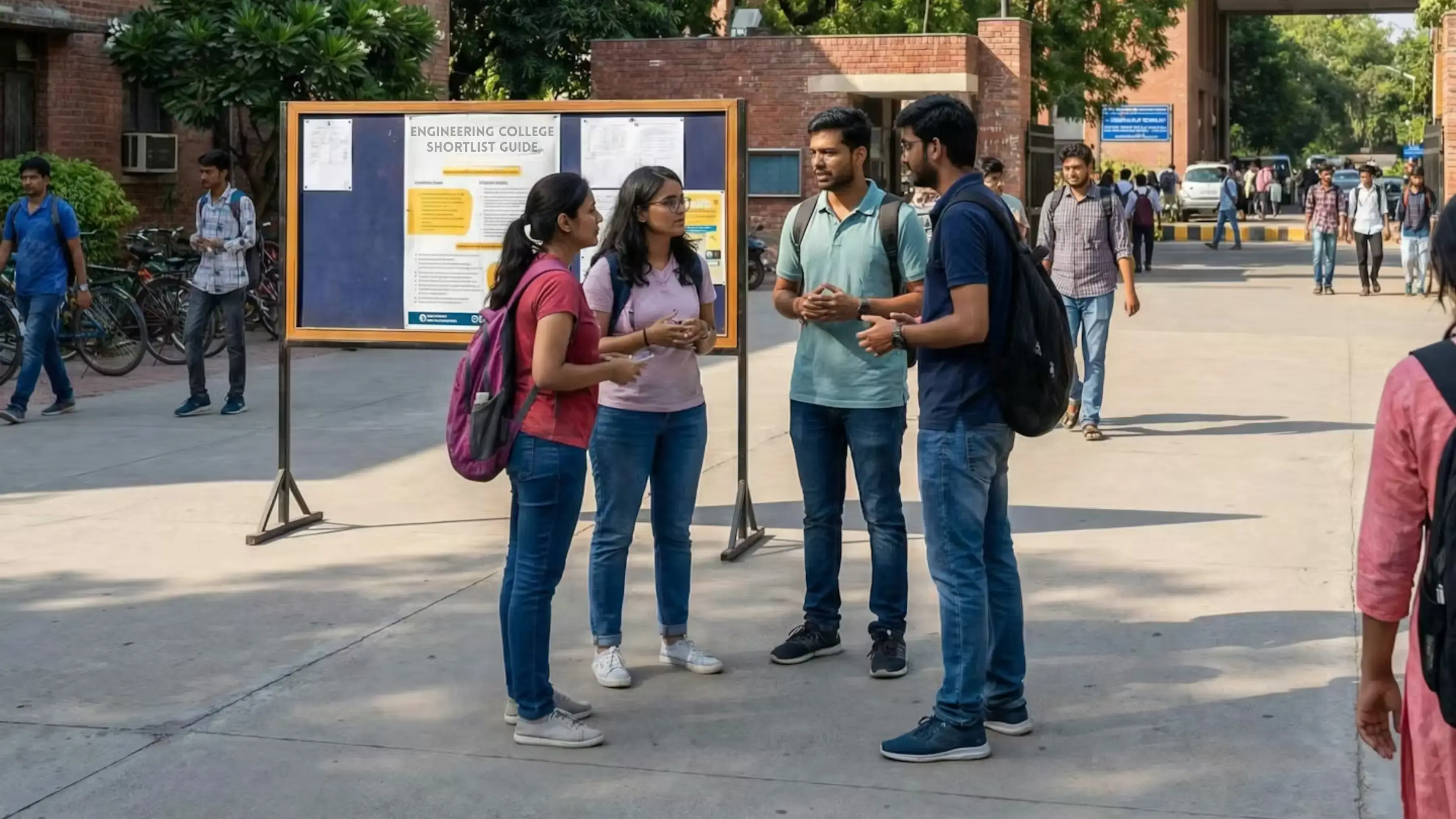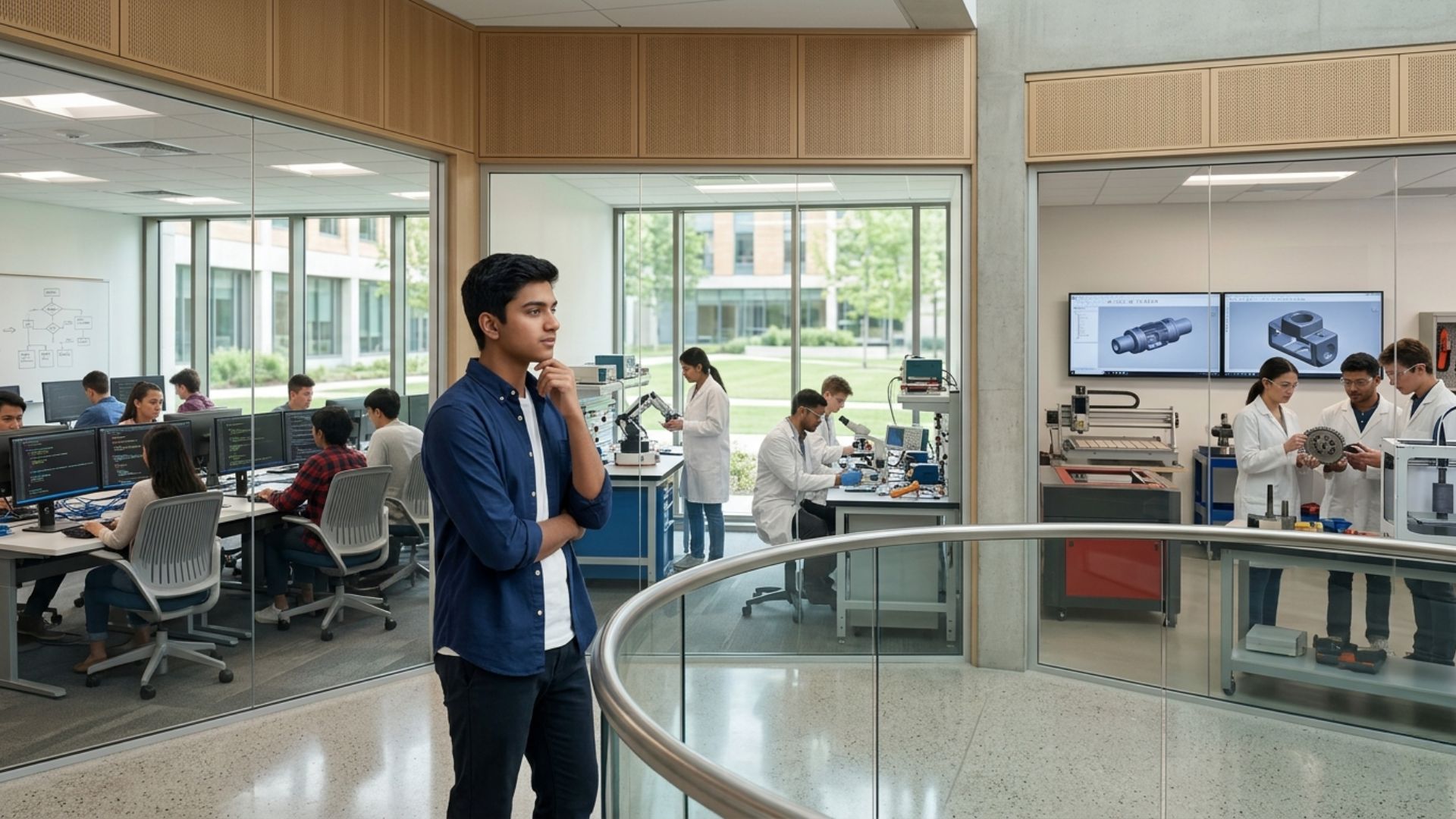
After the 12th exam, every student has one question in their mind, and that is, Which Engineering Branch has future?
Contrary to what is generally practised, choosing the best engineering branch is not only about picking the most popular one. The job market for engineering graduates is constantly evolving and has recently been influenced by AI, automation, data, cybersecurity, semiconductors, electric vehicles, robotics, renewable energy, and other new technologies. As a result, the way companies hire engineers is also changing.
Employers today are looking for engineers not only with a degree but also with the right set of skills to complete a given project. The employees are expected to:
Solve real problems
Work with modern tools
Understand technology clearly
Build practical projects
Keep learning as industries change
There are many areas, like Computer Science, AI, Data Science, and Cybersecurity, where there are ample job opportunities. While studying other areas like Electronics, Mechanical, Electrical and Civil Engineering has long-term scope if the student is well-equipped with the right skills & knowledge to work on projects.
Why Engineering Branch Selection Matters More Today
The common way that students have chosen their specific engineering branch in the past has been based on factors like the cut-off marks of different colleges, suggestions from family and friends, and the placement packages for graduate students in that specific branch. But these factors are not enough when students are trying to understand which engineering branch has future scope and long-term career value.
With recent advancements in technology, the nature of work for an average engineer has changed. Many routine technical tasks, basic code writing, simple testing, and repetitive work traditionally associated with engineering can now be automated.
Whereas engineering functions are increasingly becoming automated, companies now look for engineers who have knowledge of the following:
Technology
Business problems
Product requirements
Data
Automation
Domain-specific applications
You must evaluate a branch from three different angles:
Does the branch have future industry demand?
Can it help the student build practical and adaptable skills?
Does it match the student’s interest and learning style?
A future oriented branch is not necessarily the best for every student. Also, it is important that the student has an interest in this branch. On the other hand, a traditional branch can be as good as for a student who acquires enough modern skills to achieve good career growth in this field.
What Makes an Engineering Branch Future-Ready?
A strong future-focused branch usually has these qualities:
It is growing rapidly, or is linked to growth sectors such as Artificial Intelligence and Software Engineering, Cybersecurity, Electronics and Electrical Engineering, Semiconductors and Analogue Design, Electric Vehicles, Robotics and Mechatronics, Energy and Utilities, and Infrastructure Development.
The engineering discipline allows good flexibility when it comes to future career opportunities.
It allows practical implementation of ideas through projects, internships, labs and actual work.
It helps students continue to add value in an organisation as technology evolves and new tools become available.
So while it is good to understand the potential of an engineering branch in isolation, it is also important to realise the various skills a student can acquire by choosing a particular branch of engineering.
1. Computer Science Engineering
Computer Science Engineering is one of the strongest career options available for students currently.
Computer Science Engineering has applications across various industries, including Finance, Healthcare, Education, E-commerce, Logistics, Manufacturing, Media and Entertainment, and Real Estate Technology, etc.
Here are some careers that a student specialising in Computer Science can pursue:
Software Developer
Backend Engineer
Full Stack Developer
Cloud Engineer
Data Engineer
Cybersecurity Analyst
AI/ML Engineer
Product Engineer
A student who has studied CSE develops strong fundamentals of programming, data structures and algorithms, databases, operating systems, computer networks, etc.
It is also recommended that the student apply the knowledge that they have gained through completing real life projects as many companies today are also looking for candidates who can put what they have learned to use.
If you’re looking for a programme that is focused on CS and AI with a structured learning path and want to understand how modern engineering education is changing to be more practical and industry aligned, then check out Scaler School of Technology’s Computer Science and AI programme .
The Times of India features Scaler School of Technology, a strong choice for CS and AI education in India, delving into how modern tech education is all about product building, applied AI systems and industry-aligned learning.
CSE is best for those interested in Logic, Coding, Problem Solving and Digital Product Development.
2. Artificial Intelligence and Data Science
Artificial Intelligence and Data Science are two fields that will increase in importance in the future. They are no longer limited to use in purely technology-oriented companies and are increasingly used in healthcare, finance, education, retail, logistics, production, customer service, and the creative industries.
Career options in this field include:
AI Engineer
Machine Learning Engineer
Data Scientist
Data Analyst
Data Engineer
NLP Engineer
Computer Vision Engineer
AI is not a shortcut to a career. To develop future applications in AI, students need a solid foundation in computer science basics, as well as Mathematics, Statistics and Python programming. In addition, they need to get familiar with different Machine Learning concepts, learn to work with data, and most importantly, gain practical experience through different projects.
While AI tools may enable students to become more efficient in their studies, it is essential that they have sufficient knowledge of how systems work and do not rely on the system’s output by copying it without understanding the logic behind it.
Studying AI and Data Science could be right for students who enjoy identifying patterns, working with data, automation and intelligent systems.
Students who are confused between Computer Science and Data Science can also read this guide on is data science better than cs to understand the difference.
3. Cybersecurity
As the world becomes increasingly reliant on digital platforms to carry out business, government and personal activities, cybersecurity is becoming increasingly important.
For a company, it is important to secure all apps, websites, payment systems, cloud platforms, data networks, etc. The more digital systems a company has, the more the security risks. There is a strong need for people who can protect the digital world, detect risks, secure applications, monitor networks, prevent data breaches, and handle IT attacks in the right way.
Students interested in the field of Cybersecurity can have a look at the following careers.
Cybersecurity Analyst
Ethical Hacker
Security Engineer
Cloud Security Engineer
SOC Analyst
Application Security Engineer
This branch or specialisation is well suited for students who have an interest in computer networks, systems, in-depth analysis and problem-solving, which involves security.
To have a good career in Cybersecurity, one needs to understand computer networks, operating systems, web security and cloud security. One also needs to know how to write scripts, use security tools, and assess risks.
There is a huge scope in Cybersecurity due to the growth of the digital environment and rising security risks and threats as businesses evolve and adopt more digital solutions.
4. Electronics and Communication Engineering
This discipline has scope for a curious person who wants to understand the technology behind it and, at the same time, learn to work with its hardware.
As India is rapidly progressing towards electronics, including semiconductor design and hardware-driven innovations, ECE is becoming increasingly relevant to many future systems, including semiconductors, IoT, embedded systems, telecom, robotics, smart and automated devices, and communication systems.
ECE students can move into careers such as:
Embedded Systems Engineer
VLSI Engineer
Semiconductor Design Engineer
IoT Engineer
Telecom Engineer
Robotics Hardware Engineer
In order to remain relevant in the future, students of the ECE branch must have knowledge of Digital Electronics, Embedded Systems, C/C++ or Python, VLSI basics, Signal Processing, Sensors, etc., along with the ability to integrate hardware and software.
This is a good field for those who have an interest in designing and developing devices and systems that have physical parts and software that works with them. The study area for this branch includes various types of circuits and communication systems.
5. Mechanical Engineering
Mechanical Engineering is one of the oldest branches of engineering. It has a lot of scope if a Mechanical Engineer is well-versed in the latest industry trends.
The traditional branch of Mechanical Engineering is experiencing renewed relevance and is increasingly being merged with other disciplines such as robotics, electric and hybrid vehicles, automation and control systems, aerospace engineering, product design and development, manufacturing systems and mechatronics. A Mechanical Engineer can specialise in designing, constructing and improving physical systems.
It is very important for a student studying Mechanical Engineering not to be limited to traditional mechanical engineering knowledge. Students should also learn tools and technologies that are commonly used in industries and understand how to solve engineering problems by using data.
Mechanical Engineering can lead to careers such as:
Mechanical Design Engineer
Robotics Engineer
EV Systems Engineer
Manufacturing Engineer
CAD/CAE Engineer
Automation Engineer
This branch of study will interest students who have interests in machines, design, automobiles, robotics, and physical products that can be manufactured.
6. Electrical Engineering
This branch of study has long term potential as the energy, power systems, electric vehicles, automation and renewable energy systems require engineers to design and implement them.
Areas of study in Electrical Engineering include power generation, Smart grids, Electrical machines, Control systems, Electrical systems for EV charging, Industrial automation, and Renewable energy systems.
Students can explore careers such as:
Electrical Design Engineer
Power Systems Engineer
Renewable Energy Engineer
Control Systems Engineer
Automation Engineer
EV Infrastructure Engineer
A future proof engineer in the field of Electrical Engineering should have a thorough knowledge of power systems, electrical machines, control systems, renewable energy and battery systems. They should also have sufficient knowledge of how to apply software and hardware for automation using various tools, along with basic applications of IoT.
For students interested in learning physics, studying and designing circuits, and making energy-related things that function with advanced technology, the branch can be a great fit.
7. Civil Engineering
The importance of Civil Engineering is maintained as societies will always need infrastructure.
A Civil Engineer can be involved in designing a wide variety of infrastructure projects such as roads, bridges, buildings, water supply and sewerage systems, and airport development. Other Civil Engineers are involved in designing and developing railways, planning smart cities, and working on urban development projects. The work of a Civil Engineer is also changing, with more focus on designing sustainable structures that can resist natural disasters. Many Civil Engineers are also required to use BIM tools, carry out digital planning, and manage projects.
Career paths can include:
Civil Engineer
Structural Engineer
Site Engineer
Construction Project Engineer
BIM Engineer
Urban Infrastructure Planner
Green Building Consultant
Civil Engineering may have lower entry-level salaries than some software jobs, but it has strong potential for long-term growth.
This branch is best for those with an interest in construction, planning, civil work, design, and projects that are developed on the ground.
How to Choose the Right Engineering Branch
An engineering branch needs to be chosen by matching three parameters, i.e. scope of the branch, strength of the student and how good the college is where the student is studying.
This is how to choose:
Students who are interested in coding, apps, software and a logical approach to problems can consider Computer Science, AI, Data Science or Cybersecurity courses.
Students who like circuits, devices and communication systems can look at Electronics and Communication Engineering.
Mechanical Engineering is a suitable option for those interested in machines, vehicles, design or manufacturing. Along with core mechanical engineering skills, students can also build knowledge in robotics, Electric Vehicles, automation systems and modern manufacturing processes.
Students interested in power systems, circuits, energy and applied physics can look into Electrical Engineering.
If a student is interested in construction, planning, infrastructure or on-ground project work, Civil Engineering can be a good option for them.
In the end, it is also important to research the various aspects of a college’s engineering program, including the curriculum, faculty, labs, current students’ projects, internship opportunities, level of industry exposure, placement records, and mentorship offered to students.
Students who are comparing branch preference with college quality can refer to this guide on branch vs college which is better before making a final decision.
Students who are not able to choose the right Engineering Branch can watch this video to learn the right way to choose the right branch for them.
Which is the best course in engineering after 12th? | Which branch of engineering should you choose?
Conclusion
Which engineering branch has future in the job market? The future scope in today’s job market for various engineering streams includes Computer Science with specialisation in AI, Data Science, Cybersecurity and Cloud. Also, the future scope for Electronics and Communication Engineering (ECE) has increased due to the presence of semiconductors, growth of IoT, embedded systems and other hardware-led innovations.
Other engineering disciplines like Mechanical Engineering, Electrical Engineering and Civil Engineering also have a lot of value to offer, but they require skills related to automation of processes, Electric and Hybrid Electric Vehicles, Renewable Energy, Robotics, Building Information Modelling (BIM), smart infrastructure development and many other digital tools and techniques used in their respective fields. Although some engineering disciplines may not have as much current demand as the ones mentioned above, they are definitely not obsolete and still have a lot to offer, provided the student acquires skills that can be useful in today’s industry. The best discipline is one that is of interest to a student and helps them gain the required skills for employment in the future.
FAQs
1. Which engineering branch has future scope in India?
CSE, AI, Data Science and Cybersecurity have strong future scope in India. Currently, CSE with AI, data or cybersecurity has high demand because most industries are going digital.
2. Which engineering branch is best for future jobs?
For software-led jobs, Computer Science with AI or Data Science can be a strong option. For hardware-led, semiconductor, IoT and embedded systems jobs, ECE can be a good choice. Mechanical, Electrical and Civil Engineering can also offer good future opportunities when students build updated knowledge of modern tools and techniques used in industry.
3. Which engineering branch has the best salary scope?
CSE, AI, Data Science, Cloud Computing and Cybersecurity often have strong salary potential because digital skills are in high demand. However, salary also depends on the student’s skills, college quality, internships, projects and interview performance. ECE students can also find good scope in semiconductors, embedded systems and hardware-software roles.
4. Which engineering branch is safest from AI?
While engineering disciplines could be affected by AI to some extent, most routine work is more likely to be automated. Engineering students who have a solid grasp of the basic principles of their respective fields and understand how to use AI as a tool will be better prepared to handle the changes AI brings. Ultimately, safe careers in engineering will depend on how well students combine their branch knowledge with practical experience, modern technologies and problem solving skills