AI is capable of performing many of the tasks associated with work that humans do today, such as writing code, designing products, reading documents and summarising them, answering questions, etc. Thus, the big question: will artificial intelligence take away jobs?
AI is already changing the way people work, but that does not mean that all jobs will cease to exist. While there will certainly be many changes to how we currently work, there will also be jobs created that manage the technology that performs some of the work.
In some cases, AI will surely reduce repetitive work, but the role may still exist. In other cases, the way the work is done may change, and people may also be needed to check, guide and manage AI systems.
Instead of asking will AI take away jobs, it is more important to start thinking about and preparing for the type of skills that are going to be needed in workplaces where there is going to be high assistance from AI.
What AI Really Means For Jobs
Tasks that are digital, repetitive and standardised can be automated. This includes making summaries, sorting emails and other documents, sending out standard replies to customers, data entry and the initial creation of standard content.
To understand will AI take away jobs properly, students first need to remember that most jobs consist of more than one task. And no matter how well AI is programmed to replicate human tasks, there are many things a human does better: seeing a situation, understanding another human being’s needs, making decisions, handling a surprise and holding someone accountable for their work.
The World Economic Forum’s Future of Jobs Report 2025 estimates that by 2030, 170 million new jobs could be created and 92 million jobs could be displaced as labour markets change.
Why Some Roles Will Change Faster Than Others
Some roles contain a larger number of repetitive tasks that AI can support or automate.
Examples include:
Basic data entry
Routine report summaries
Standard customer replies
Document classification
Simple content drafts
Repetitive analysis
Scheduling and admin work
Basic code suggestions
Even if AI can handle some tasks in a role, it does not mean the entire role will vanish. Customer support executives will still deal with the odd complex customer complaint, and people in finance teams will still check for exceptions and approve large deals after AI has done a quick number and paper check.
Software developers will still write software but with the aid of AI code suggestions and debugging support. Developers will still need to understand system requirements, check AI-generated outputs and solve real problems in real systems. Students interested in career safety could read this guide on which careers are safe from AI.
Why Human Skills Still Matter In An AI World
While AI can generate answers, it cannot independently guarantee that they are correct, sufficient or safe. Thus, human judgement is still required.
There are many occasions in which people at work need to analyse information and output that has been generated by a computer system. They need to ask questions, analyse information in a particular context, check and verify information generated by the system, communicate with other people, including team members and other stakeholders, and then make a decision about what is best.
A doctor might use AI to analyse reports, but it is the doctor who has all of the patient’s history. A teacher might use AI to generate practice questions for students, but it is the teacher who is guiding the students in their learning and has a good understanding of each student’s needs. A designer may use AI to produce many options for a project, but it is the human who has domain-specific knowledge of the brand, the user and the purpose of the project.
In many areas, AI may add value to people’s work when they know how to use it well and bring strong judgement, creative ideas, responsibility and domain-specific knowledge.
Skills Students Should Build To Stay Relevant
Start learning AI, but build solid foundations first. Learn how to apply it in real-life scenarios.
Important skills include:
Programming basics
Data understanding
Problem-solving
Communication
Critical thinking
Creativity
Domain knowledge
Product thinking
Ethical judgement
Ability to verify AI outputs
Those who only learn to use one tool may struggle. Those with a solid grasp of the fundamental concepts will be able to use many different tools as the tools evolve. They will know what is going on and be able to troubleshoot as necessary.
A student with knowledge of programming and databases can use AI to build better software. A student with knowledge of data can check whether an insight generated by AI actually makes sense. A student with knowledge of their users can check whether an AI feature actually solves a real problem for them.
If you are looking to explore a potential career in AI, you can refer to this guide on how to make a career in AI.
Are Coding, Computer Science, and AI Still Worth Choosing?
Yes, students can still choose coding, Computer Science, or AI if that is what interests them and if they enjoy problem-solving. However, strong Computer Science fundamentals will become even more important as AI enables new ways of coding.
For students choosing to follow a CS or AI-focused track, it is expected that in addition to using AI tools, they will be able to code, implement data structures, work with databases, develop software and build products using AI/ML fundamentals. Additionally, students should learn to test systems, work with users and deal with real-world constraints.
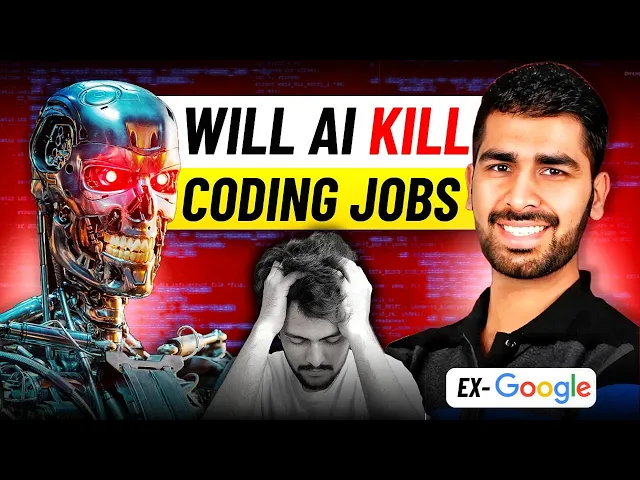
Students can watch this video to understand how coding careers may change and what they should study in order to prepare themselves for the changes that will occur in the workplace.
Will Artificial Intelligence Kill Coding JOBs || What JOBs will be in Demand?
Even as students use AI to write code for assignments, it is very important for them to have a solid grasp of the code they are using and to be able to modify it to complete a task.
How Students Can Prepare For An AI-Driven Workplace
Students must focus on applying AI in their work with software development, data analysis, and building end-to-end workflows to solve real-life problems.
Students should not simply copy AI-generated information without understanding it. Instead, they should focus on how to improve the generated information. Thus, to prepare for the new world of work, students should focus on learning how to code, Computer Science basics, data handling and statistics for simple data analysis, completing software projects, learning to use AI tools responsibly and, most importantly, gaining practical experience through internships and real-world projects.
Programmes like the CS & AI programme offered by Scaler School of Technology, enable students to delve into the world of AI right from the beginning. Students can check how different programmes apply Computer Science, software development and AI/ML through practical learning and real-world projects. Students can also gain hands-on experience through industry exposure.
There are new careers that are being created as a result of AI. NeoSapien, an AI-enabled wearable products startup that was incubated at Scaler Innovation Lab, raised $2 million in seed funding, as reported in a Hindustan Times report, is an example created for product development, engineering, user experience, software, hardware and business, among others.
Conclusion
Will Artificial Intelligence take away jobs? While artificial intelligence is likely to take over some tasks in some jobs, it is unlikely to change every job in the same way.
As a student, you should not fear the impact of AI on work. Learn the subject, learn to use AI for the work that it can do, practise by completing projects and, most importantly, develop skills that are difficult for technology to replicate over time.
The future will hold jobs for students who are able to utilise technology to solve problems, work with AI in a responsible manner and continue to grow as the years go on.
FAQs
Will artificial intelligence take away jobs completely?
AI has the potential to take over routine work, but that does not mean that all work will be taken over by AI and that all jobs will disappear. For most functions, the work that humans do will change rather than disappear entirely.
Which jobs are most affected by AI?
Jobs that involve a lot of repetitive tasks, digital work, basic content creation, data entry, processing of documents, workflows with many predictable steps, etc., might get automated, but that does not mean that the work will vanish completely.
What should students learn to stay relevant in the AI era?
Students should build skills in programming, data, problem-solving, communication, creativity, domain knowledge and the responsible use of AI tools. This means they need to understand how to check AI outputs and use AI for real problems.