




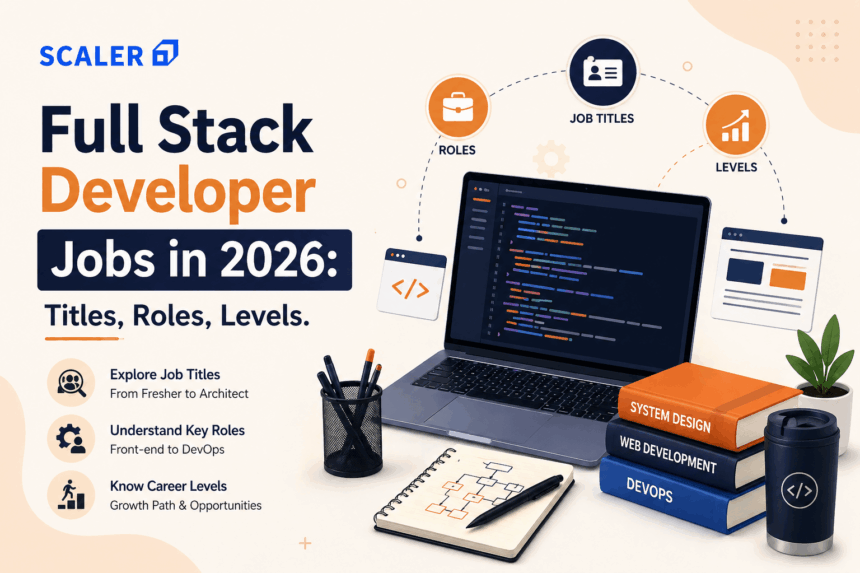
Full stack developer jobs continue to rank among the most in-demand tech careers in 2026. Companies increasingly seek candidates who can handle end-to-end development, which goes from building frontends and managing backends to working with databases and cloud infrastructure.
In this blog, we’ll help you explore job titles in full stack development, including different types of full stack developer roles and their corresponding responsibilities at each stage.
Whether you’re looking at entry-level opportunities as a junior full stack developer or aspiring to leadership positions, this breakdown will help you understand the various full stack job levels and how to grow into them.
What Does a Full Stack Developer Do?
As a full stack developer, you will be responsible for building and maintaining the entire web application, covering everything from the user interface (UI) to the APIs, databases, and cloud deployment. Usually, there are specialists who focus only on frontend or backend; on the other hand, full stack developers handle the complete development cycle.
You’ll have to work closely with designers, product managers, and engineering teams to ensure smooth collaboration and delivery of features. Depending on the project, developers may use different stacks such as:
- MERN (MongoDB, Express, React, Node.js)
- MEAN (MongoDB, Express, Angular, Node.js)
- Django & React
- Spring Boot & Angular
Here are some key responsibilities handled by a full stack developer
Transform Your Career
Choose from our industry-leading programs designed for career success
Modern Software and AI Engineering Program
Master full-stack development with AI integration


 +1000 more
AI Forward Deployed Engineer with Specialisation in AI applications
Build and deploy AI solutions for real-world business problems
+1000 more
Modern Data Science and ML with specialisation in AI
Advanced data science techniques with AI specialization
+1000 more
Advanced AIML with Specialisation in Agentic AI
Deep dive into AIML with focus on Agentic systems
+1000 more
DevOps, Cloud & AI Platform Engineering
Build and manage AI-powered cloud infrastructure
+1000 more
AI Engineering Advanced Certification by IIT-Roorkee
Premier AI engineering certification from IIT-Roorkee

Key Responsibilities of a Full Stack Developer:
- Designing and developing both frontend and backend features
- Integrating APIs and third-party services
- Managing databases and server-side logic
- Debugging and testing to ensure seamless performance
- Deploying applications to cloud or on-prem environments
All these functionalities listed above are expected to be handled by a front-end developer. If you are someone wanting to explore this position as a career option, then do read along for a detailed overview.
Types of Full Stack Developer Jobs
So what roles can you get after gaining a certification and skills to become a full stack developer? Here are some roles you can check out:
1. Junior Full Stack Developer
This is an entry-level role where you’ll work under the guidance of senior engineers. Your focus will be on learning the codebase, fixing bugs, and building small features as part of the team.
Salary: ₹1-7 LPA depending on city and company, with Bengaluru offering slightly higher pay.
2. Full Stack Developer
At this level, you’re expected to handle end-to-end features independently. You’ll work on both frontend and backend components, integrate APIs, and streamline application workflows.
Salary: Mid-level developers typically earn ₹8-18 LPA. MNCs and product firms can offer higher pay ranges.
3. Senior Full Stack Developer
As a senior developer, you lead sprint modules, review peers’ code, and assist junior developers. You’ll also implement CI/CD pipelines and manage deployment workflows.
Salary: Senior full stack developers in Indian tech hubs earn anywhere between ₹15-35 LPA. Locations like Bengaluru may go up to ₹36-37 LPA.
4. Full Stack Engineer
Common in product-based and startup environments, this title indicates a role with deeper responsibilities, focusing on application scalability, implementing DevOps practices, and writing test frameworks.
Salary: full stack engineers in India earn anywhere between ₹10-20 LPA, depending on the company and the person’s experience.
5. Lead Full Stack Developer
This role involves managing a team of developers, defining project architecture, and ensuring delivery timelines are met. It merges technical expertise with leadership.
Salary: Typically ranges from ₹30-50 LPA. Salaries in top product firms or unicorn startups may surpass this significantly.
6. Full Stack Architect
As an architect, you’ll design and oversee large-scale system architecture, coordinate closely with leadership and cross-functional teams, and make critical decisions on tech strategy.
Salary: In the range of ₹24–65 LPA, with metro cities like Bengaluru offering top tiers.
Want to level up your tech skills? Start with a free live masterclass.
Full Stack Developer Job Title Hierarchy
So, which role should you apply for and for what title? Here is a table to simplify your search
| Level | Title Examples | Job Description |
| Entry | Intern, Junior Full Stack Developer | Works under mentorship, assists in feature development, bug fixes, and learning. |
| Associate | Full Stack Developer, Application Developer | Handles both frontend and backend modules, delivers assigned features end-to-end. |
| Mid-Level | Software Engineer, Full Stack Engineer | Works independently, focuses on scalability, integration, and cross-team collaboration. |
| Senior | Senior Developer, Lead Developer | Leads projects or sprint modules, reviews code, mentors juniors, and ensures CI/CD pipelines. |
| Leadership | Full Stack Architect, Engineering Lead | Designs architecture, manages planning, coordinates with product and design teams. |
| Executive | Director of Engineering, VP of Technology | Oversees technical strategy, manages large teams, and drives innovation at scale. |
Freshers often begin as interns or junior developers with salaries ranging from ₹3-6 LPA. With consistent upskilling and 2-3 years of experience, many move into mid-level roles such as software engineer or full stack engineer, where pay can rise to ₹8-15 LPA. Senior and leadership roles usually require 5-10 years of experience, with salaries crossing ₹20 LPA+ in top product companies and startups. This makes full stack development one of the most promising long-term tech careers in the Indian job market.
Let’s get further into each category for a better understanding of each role.
Entry-Level Full Stack Developer Job Titles
When starting out in the industry, freshers usually come across many job openings. While all of them involve some exposure to full stack skills, the responsibilities and focus areas may differ slightly. Here’s a quick breakdown of the most common entry-level roles:
| Title | Notes |
| Junior Full Stack Developer | Usually assigned to support ongoing projects. Focuses on learning coding practices, fixing bugs, and assisting senior developers. |
| Full Stack Developer Intern | Ideal for college students or bootcamp graduates. Interns often work on smaller features, documentation, or testing tasks under guidance. |
| Entry-Level Software Engineer | Broader in scope, covering both backend and frontend tasks. This role may also involve collaborating across teams. |
| Associate Web Developer | Often more frontend-heavy, but designed for learners gradually transitioning into backend development. |
| Web Application Developer | Specializes in building and maintaining UI components while connecting them to APIs and databases. |
Most entry-level positions in India range between ₹3-6 LPA. While titles may differ, the real focus is on gaining experience across the stack. Within 2-3 years, developers can move toward mid-level roles with higher responsibilities and salaries.

Free Courses by top Scaler instructors
Mid-Level Full Stack Job Titles
After gaining some experience of around 2-3 years, full stack professionals are expected to not only write clean code but also contribute to architectural decisions, optimize performance, and guide junior teammates. These are some roles you might transition into after a few years of serving an entry-level role.
| Title | Specialization Scope |
| Full Stack Developer | Handles complete modules, manages both frontend and backend, and collaborates across teams. |
| Software Engineer | Here, developers design, code, and maintain software systems across the stack. |
| Application Developer | Focuses on logic-heavy applications, building scalable and secure web solutions. |
| Systems Developer | Works on deeper infrastructure such as operating systems, integrations, and middleware. |
After exploring entry-level and mid-level roles, it is important to look into senior and leadership roles as well.
Let’s go further!
Senior & Leadership Job Titles in Full Stack
As developers gain expertise, they often move into senior and leadership positions where the focus shifts from just coding to shaping strategies, managing teams, and ensuring the long-term success of projects. These roles require technical mastery, strong communication, and the ability to align technology with business goals.
| Title | Role Highlights |
| Senior Full Stack Developer | Reviews code, mentors juniors, and contributes to project planning. |
| Lead Developer / Tech Lead | Oversees development teams, manages delivery pipelines, and ensures quality. |
| Full Stack Architect | Designs scalable, modular, and high-performing systems. |
| Director of Full Stack Development | Leads multiple teams or large-scale projects with cross-functional coordination. |
| VP of Engineering / Technology | Aligns technical decisions with business strategy and oversees overall engineering vision. |
Senior roles are the most rewarding, and after over 5-6 years of experience, you can surely plan on moving ahead with your title and role befitting your expertise.
Top Industries Hiring Full Stack Developers in 2026
Full stack developer jobs are in demand across industries, whether you’re powering checkout flows, building education platforms, or securing fintech systems. With this skill set, you are in-charge of one of the most important aspects in the said firm.
| Industry | Usage |
| E-commerce | Building dynamic shopping portals, inventory systems, and recommendation engines. |
| FinTech | Developing secure payment gateways, fraud detection systems, and analytics dashboards. |
| EdTech | Creating interactive student portals, LMS platforms, and real-time learning analytics. |
| HealthTech | Managing patient data dashboards, appointment systems, and compliance-focused frontends. |
| SaaS | Designing web-based dashboards, CRM tools, and analytics platforms for subscription services. |
| Startups & SMEs | Scaling MVPs, handling feature ownership, and building end-to-end applications with limited teams. |
Today, companies like Amazon, Flipkart, Zomato, Paytm, Infosys, and TCS are actively hiring full stack developers to manage everything from customer-facing apps to large-scale backend systems.
Most organizations now look for professionals who can own end-to-end product development, which makes full stack expertise one of the most in-demand skill sets in tech hiring today.
Global Opportunities for Full Stack Developers
Full stack developers are not just in demand in India but also across global markets, especially in the US and Europe, where startups and established companies are actively hiring remote talent. With the rise of distributed teams, many organizations prefer skilled developers from India who can work across time zones and deliver end-to-end solutions.
Pay packages are highly lucrative, ranging from ₹25 LPA to ₹60 LPA for remote roles, depending on experience and skillset. Developers can explore opportunities through trusted platforms like Turing, TopTal, Deel, and LinkedIn, which connect professionals directly to international companies.
Some of the most common job titles include Full Stack Engineer, Remote Developer, and Platform Engineer. With the right technical expertise and communication skills, Indian developers can tap into these global opportunities, gaining both financial growth and exposure to international product ecosystems.
Scaler Placement Report and Statistics
Scaler learners achieved 2.5x salary growth with average post-Scaler CTC reaching ₹23L.
 Google
 Amazon
 Microsoft
 Flipkart
 Adobe
1200+ more
Adobe
1200+ more
Skills That Align with Full Stack Job Titles
Full stack roles vary depending on seniority, and each level comes with a different set of responsibilities and skills. This section will help you understand what companies expect for each title can help developers prepare for interviews and career growth.
| Job Title | Required Skills |
| Junior Developer | Strong grasp of HTML, CSS, JavaScript, version control with Git, and basics of Python/Node.js for backend tasks. |
| Full Stack Developer | Proficiency in front-end frameworks like React or Angular, backend expertise in Node.js/Django, working with REST APIs, and handling SQL databases. |
| Senior Developer | Advanced knowledge of system design, exposure to DevOps tools, managing CI/CD pipelines, and containerization with Docker. |
| Architect | Expertise in cloud platforms (AWS, GCP), designing microservices, and building highly scalable architectures. |
| Lead/Director | Skills in team management, implementing agile methodologies, and roadmap planning to align technology with business goals. |
At the entry level, developers focus more on writing clean code and building features. As they move up, the emphasis shifts toward scaling, system architecture, and leadership. By aligning skills with the right job title, professionals can make a clear path from junior roles to leadership positions.
Scaler Alumni and Their Success Stories
How to Advance Your Full Stack Job Title?
If you are someone who is currently stuck in your role and requires change, then do read along for learning ways to accelerate your career growth.
1. Develop Expertise Across the Stack
Progressing in full stack roles requires mastery of front-end frameworks, back-end technologies, and database management. Building proficiency across all layers of development creates a solid foundation for higher-level responsibilities.
2. Integrate DevOps and Cloud Proficiency
Knowledge of CI/CD pipelines, containerization (Docker), and infrastructure-as-code tools such as Terraform, alongside expertise in AWS or other cloud providers, is increasingly expected for senior-level positions.
3. Build and Showcase Practical Projects
Maintaining well-structured GitHub repositories with deployed applications, detailed documentation, and clean code provides tangible proof of capability. This visibility can help strengthen credibility for advanced roles.
4. Seek Mentorship and Professional Certification
Guidance from experienced professionals or enrollment in structured programs accelerates learning and helps navigate the path toward leadership titles.
We have seen at scaler, how students were able to crack interviews by being consistent with the program and seeking guidance through our mentors.
5. Align Your Skills with Emerging Technologies
With the rise of AI and large language model (LLM) integrations in software, developers who adapt to trends such as GenAI-enhanced applications will remain competitive in upcoming full stack roles.
Explore Scaler’s Full Stack Developer Program
Scaler’s program is designed to help professionals strengthen technical depth, acquire industry-relevant skills, and transition confidently into high-impact full stack positions.
The program provides 1:1 mentorship, placement support, covers the latest tools and practices, and conducts live sessions. So, if you are considering a career switch, or even if you are a fresher, Scaler can help with career growth and acceleration with the program.
Similar Career Paths to Full Stack Developer
While many professionals pursue the role of a full stack developer, several adjacent career paths utilize overlapping skill sets and open different growth opportunities:
- DevOps Engineer: Specializes in deployment, automation, and infrastructure management, often complementing development teams.
- Software Architect: Focuses on high-level system design and scalability, with less emphasis on day-to-day coding.
- UI/UX Developer: Concentrates on the visual and interactive elements of applications, catering to frontend-heavy projects.
- Technical Lead: A progression from full stack roles, combining hands-on coding expertise with team leadership and project oversight.
- MLOps Engineer: Bridges software development with machine learning deployment, increasingly relevant as AI-driven applications grow.
A full stack developer hones extremely complex as well as heavily important skill sets. Hence, there are always job opportunities present once you are equipped with desired skills.
Conclusion
Full stack development offers various career opportunities, ranging from entry-level internships to executive positions. This role is deemed favourable for its ability to use both frontend and backend development, making professionals highly adaptable across projects and industries.
With a strong skill set and a well-curated portfolio, full stack developers can progress from coding roles to strategic positions such as software architect, technical lead, and even senior leadership roles like VP of Engineering. This upward mobility makes full stack development a long-term growth pathway in technology.
FAQs
1. What is the typical growth path for full stack developers?
Most full stack developers start as junior or entry-level developers, then progress to mid-level or senior developer roles. With experience, they can move into positions like software architect, technical lead, or even engineering manager and VP of Engineering.
2. Do job titles vary by company size or location?
Yes. In startups, a single “Full Stack Developer” might handle everything from frontend to deployment. In larger enterprises, the same role may be more specialized and split into titles like “Frontend Engineer,” “Backend Engineer,” or “Full Stack Engineer.”
3. Is "Full Stack Engineer" more senior than "Full Stack Developer"?
Not necessarily. The distinction often comes down to company naming conventions. Some firms use “Engineer” to indicate a broader or more technical role, while others use both terms interchangeably.
4. Are there GenAI-based full stack roles emerging in 2026?
Yes. With the rise of generative AI tools, new hybrid roles are appearing, such as “AI Full Stack Engineer” or “GenAI Application Developer.” These combine traditional full stack skills with expertise in AI model integration and deployment.
5. Which job title has the highest salary potential in full stack?
Leadership roles like Software Architect, Technical Lead, or Engineering Manager typically offer the highest salaries. However, even senior-level “Full Stack Engineers” in top tech companies can command highly competitive compensation packages.
