




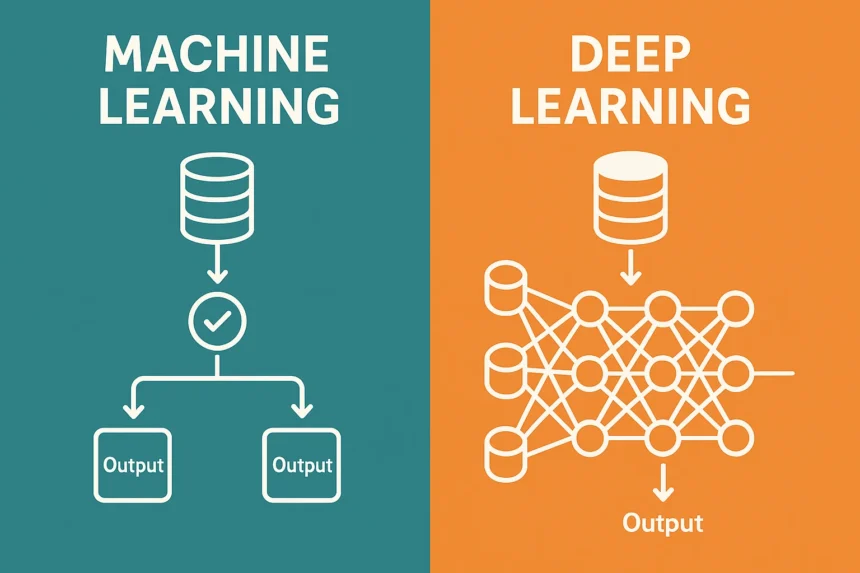
The difference between machine learning and deep learning is one of the most discussed topics in artificial intelligence today. While deep learning vs machine learning debates continue, both are subsets of AI that work with data to make predictions and solve problems. Machine learning uses algorithms to learn from data, while deep learning uses neural networks with multiple layers. Understanding machine learning vs deep learning examples, types of machine learning and deep learning, and their applications of ML and DL is crucial for anyone entering the AI field. This article covers the key differences, practical uses, and the future of machine learning and deep learning to help you choose the right path.
What is Machine Learning?
Machine learning is a subset of artificial intelligence that enables computers to learn and make decisions from data without being explicitly programmed for every task. It uses statistical algorithms to find patterns in data and make predictions about new, unseen information. The core idea is that machines can learn from experience, just like humans do, but much faster and with larger amounts of data.
Machine learning has become essential in many industries because it can handle complex problems that traditional programming cannot solve efficiently. From predicting customer behavior to detecting fraud, ML algorithms power many of the services we use daily. The technology works by training models on historical data, then using those trained models to make predictions about future events or classify new data points.
Common applications include fraud detection in banking, where ML algorithms analyze transaction patterns to spot unusual activity. Recommendation systems like those used by Netflix and Amazon also rely heavily on machine learning to suggest products or content based on user behavior. Predictive analytics in healthcare helps doctors diagnose diseases earlier and more accurately.
Types of Machine Learning
Supervised Learning
Supervised Learning uses labeled data to train models that can make predictions. The algorithm learns from input-output pairs, making it perfect for tasks like spam email filtering, credit scoring, and medical diagnosis. Examples include linear regression for predicting house prices and classification algorithms for identifying whether an email is spam or legitimate.
Unsupervised Learning
Unsupervised Learning finds hidden patterns in data without labeled examples. This type is useful for customer segmentation, market research, and data exploration. Common techniques include clustering algorithms that group similar customers together and association rules that discover relationships between different products purchased together.
Reinforcement Learning
Reinforcement Learning teaches algorithms through trial and error, using rewards and penalties to improve performance. This approach works well for robotics, game playing, and autonomous driving systems. The algorithm learns by taking actions in an environment and receiving feedback about whether those actions were good or bad.
What Is Deep Learning?
Deep learning is a specialized subset of machine learning that uses artificial neural networks with multiple layers (hence “deep”) to process and learn from data. Unlike traditional machine learning, deep learning can automatically discover and extract features from raw data without manual feature engineering. This makes it particularly powerful for handling unstructured data like images, videos, audio, and natural language text.
The “deep” in deep learning refers to the many layers of interconnected nodes (neurons) in the network. Each layer processes information and passes it to the next layer, allowing the system to learn increasingly complex patterns. This architecture mimics how the human brain processes information, though in a simplified way.
Deep learning has revolutionized fields like computer vision, natural language processing, and speech recognition. Popular tools and frameworks include TensorFlow and PyTorch, which make it easier for developers to build and train deep learning models. Companies like Google, Facebook, and Tesla use deep learning extensively in their products and services.
The technology requires significant computational power, usually provided by Graphics Processing Units (GPUs) or specialized chips called Tensor Processing Units (TPUs). This computational intensity is both a strength and a limitation of deep learning approaches.
Types of Deep Learning Models
Convolutional Neural Networks
Convolutional Neural Networks (CNNs) are designed for computer vision tasks. They excel at recognizing patterns in images by using filters that scan across the image to detect features like edges, shapes, and textures. CNNs power applications like facial recognition, medical image analysis, and autonomous vehicle perception systems.
Recurrent Neural Networks
Recurrent Neural Networks (RNNs) and their advanced versions like LSTM handle sequential data. They’re perfect for natural language processing, speech recognition, and time series prediction. RNNs can remember previous inputs, making them ideal for tasks where context and order matter, like language translation or stock price prediction.
Generative Adversarial Networks
Generative Adversarial Networks (GANs) create new content by having two neural networks compete against each other. One network generates fake data while the other tries to detect fakes. This competition results in increasingly realistic generated content, used for creating synthetic images, videos, or even deepfakes.
Transformers
Transformers represent the latest breakthrough in deep learning, especially for natural language processing. They power modern language models like GPT and BERT, enabling applications like ChatGPT, Google Translate, and advanced search engines. Transformers can process entire sequences simultaneously, making them faster and more effective than older approaches.
Key Differences Between Machine Learning and Deep Learning
Understanding the machine learning vs deep learning distinction helps in choosing the right approach for specific problems. Here are the core differences:
| Aspect | Machine Learning | Deep Learning |
| Core Concept | Uses algorithms with manually engineered features | Automatically extracts features through neural networks |
| Data Requirements | Works well with smaller datasets (thousands to millions) | Requires massive datasets (millions to billions of data points) |
| Hardware Needs | Runs efficiently on standard CPUs | Requires powerful GPUs or specialized hardware |
| Training Time | Generally faster training and results | Longer training time, sometimes days or weeks |
| Interpretability | More transparent, easier to understand decisions | “Black box” – difficult to interpret how decisions are made |
| Accuracy | Good performance on structured data | Superior performance on complex, unstructured data |
| Feature Engineering | Requires manual feature selection and engineering | Automatic feature learning and extraction |
| Computational Cost | Lower computational requirements | High computational and energy requirements |
Core Concept
Machine learning relies on human experts to identify and select important features from data before training algorithms. For example, in predicting house prices, experts might choose features like location, size, and age. Deep learning networks automatically discover these important features during training, eliminating the need for manual feature engineering.
Data Dependency
Machine learning algorithms can work effectively with smaller datasets, making them practical for businesses with limited data. Deep learning models need enormous amounts of data to perform well – often millions or billions of examples. This data hunger is both a strength (better performance with enough data) and a weakness (poor performance with small datasets).
Hardware Needs
Traditional machine learning runs well on standard computer processors (CPUs), making it accessible and cost-effective. Deep learning demands powerful graphics cards (GPUs) or specialized chips, significantly increasing infrastructure costs but enabling much faster processing of complex calculations.
Training Time & Complexity
Machine learning models typically train in minutes to hours and produce interpretable results that humans can understand and verify. Deep learning models may require days or weeks to train and create “black box” systems where the decision-making process is difficult to interpret or explain.
Practical Examples
Machine learning examples include spam email filters that use text analysis, credit scoring systems that evaluate loan applications, customer churn prediction in telecom, and recommendation engines for e-commerce sites.
Deep learning examples include image recognition in smartphones, voice assistants like Siri and Alexa, autonomous vehicle navigation systems, and language translation services like Google Translate.
Applications of Machine Learning vs Deep Learning
Machine Learning Applications excel in structured data scenarios and business intelligence. Retail companies use ML for inventory management and demand forecasting. Financial institutions rely on ML for credit risk assessment and algorithmic trading. Healthcare organizations use ML for drug discovery and clinical trial optimization. Marketing teams use ML for customer segmentation and campaign optimization.
Netflix uses machine learning algorithms to analyze viewing history and user preferences to recommend movies and TV shows. The system processes structured data like viewing time, ratings, and user demographics to make personalized suggestions. This approach works well because the data is organized and the relationships are relatively straightforward to model.
Deep Learning Applications dominate in complex pattern recognition tasks involving unstructured data. Social media platforms use deep learning for content moderation and facial tagging. Gaming companies use DL for creating realistic computer graphics and intelligent non-player characters. Security systems use deep learning for surveillance and threat detection.
Tesla’s autonomous driving system represents a prime example of deep learning in action. The system processes real-time video feeds from multiple cameras, radar, and sensor data to navigate complex traffic situations. This requires the automatic feature extraction capabilities that only deep learning can provide, handling the complexity of real-world driving scenarios that traditional programming could never address.
Future of Machine Learning and Deep Learning
The future of machine learning and deep learning shows both technologies continuing to evolve and complement each other. Machine learning will remain the backbone for structured data applications, business analytics, and scenarios where interpretability is crucial. Industries like finance and healthcare will continue relying on ML for regulatory compliance and explainable AI requirements.
Deep learning is driving breakthroughs in Large Language Models (LLMs), Generative AI, robotics, and computer vision. The technology is becoming more efficient with techniques like model compression and edge AI deployment. AutoML tools are making deep learning more accessible to non-experts, democratizing AI development across industries.
The convergence of cloud computing, edge computing, and AI is creating new possibilities. Edge AI allows deep learning models to run on smartphones and IoT devices, while cloud platforms provide the computational power needed for training large models. This hybrid approach is opening new applications in smart cities, autonomous vehicles, and personalized medicine.
Emerging trends include multimodal AI that combines vision, language, and audio processing, quantum machine learning for solving complex optimization problems, and neuromorphic computing that mimics brain architecture more closely than current approaches.
Limitations & Challenges
Machine Learning Limitations include reduced accuracy on complex, unstructured data and the need for extensive feature engineering by domain experts. ML models may struggle with image recognition, natural language understanding, or any task requiring automatic pattern discovery. The approach also requires significant human expertise to select appropriate algorithms and tune parameters effectively.
Deep Learning Challenges center around massive data requirements and computational intensity. Training deep learning models requires expensive hardware and consumes significant energy, making it environmentally and economically challenging. The “black box” nature of deep neural networks makes it difficult to understand why certain decisions are made, creating problems in regulated industries like healthcare and finance where explainability is required.
Both approaches face challenges with data quality, bias in training data, and the need for continuous model updates as data patterns change over time.
Machine Learning vs Deep Learning vs Artificial Intelligence
Understanding the machine learning vs deep learning vs AI hierarchy helps clarify how these technologies relate to each other:
| Technology | Scope | Description |
| Artificial Intelligence | Broadest | Any technique that makes machines act intelligently |
| Machine Learning | Subset of AI | Systems that learn from data without explicit programming |
| Deep Learning | Subset of ML | Neural networks with multiple layers for complex pattern recognition |
AI is the umbrella term covering any method that makes computers exhibit intelligent behavior. This includes rule-based systems, expert systems, and search algorithms, not just learning-based approaches. Machine learning is a specific approach within AI that focuses on learning from data. Deep learning is a specialized technique within machine learning that uses neural networks.
This hierarchy shows that all deep learning is machine learning, and all machine learning is artificial intelligence, but not all AI is machine learning, and not all machine learning is deep learning.
Conclusion
The difference between machine learning and deep learning comes down to complexity, data requirements, and application areas. Machine learning works efficiently with smaller, structured datasets and provides interpretable results, making it ideal for business applications, financial analysis, and scenarios requiring explainable decisions. Deep learning excels with large amounts of complex, unstructured data and powers breakthrough applications in computer vision, natural language processing, and autonomous systems.
Both technologies are essential depending on your specific needs, budget, and data availability. Rather than choosing one over the other, successful AI projects often combine both approaches strategically. The future belongs to practitioners who understand when to apply each technique effectively.
Ready to master both machine learning and deep learning? Explore Scaler’s comprehensive AI/ML courses that provide hands-on experience with both traditional ML algorithms and cutting-edge deep learning frameworks.
FAQs
1. Which is better, ML or DL?
Neither is universally better – it depends on your data, problem complexity, and resources. Machine learning works better for structured data and smaller datasets, while deep learning excels with large amounts of unstructured data like images and text.
2. Do I need ML to learn DL?
Yes, understanding machine learning fundamentals helps you grasp deep learning concepts more easily. ML provides the foundation of data preprocessing, model evaluation, and algorithm selection that applies to deep learning as well.
3. Which has better career opportunities?
Both offer excellent career prospects. Machine learning has broader applications across industries, while deep learning specialists command higher salaries in specific domains like computer vision and natural language processing.
4. Can DL replace ML completely?
No, deep learning cannot replace machine learning entirely. Many business problems work better with traditional ML approaches due to data size limitations, interpretability requirements, or computational constraints.
5. What is the salary difference between ML engineers and DL engineers?
Deep learning engineers typically earn 10-20% more than traditional ML engineers due to specialized skills and higher demand, but both roles offer competitive compensation in the AI industry.
