




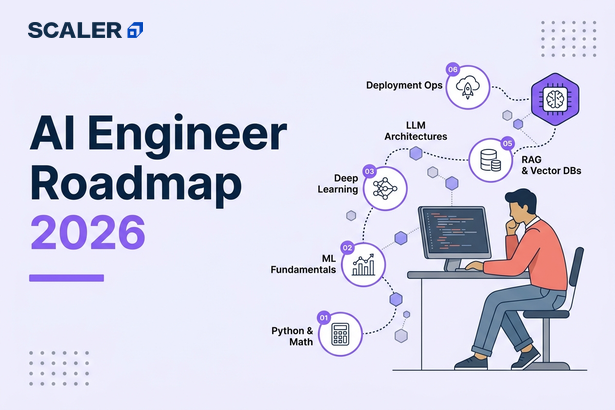
The world of Artificial Intelligence is no longer the stuff of the future; it’s very much here and hiring. In India alone, demand for AI engineers is growing rapidly. According to the Indian Express, for every 10 open GenAI roles, there’s only 1 qualified engineer available.
The Indian AI market is projected to grow at a compound annual growth rate (CAGR) of 25-35%, reaching about US $17 billion by 2027. These numbers signify a good sign for upcoming opportunities for anyone willing to learn, build, and deploy.
Artificial Intelligence is no longer just a concept people discuss; it is now a part of day-to-day life, and businesses are increasingly requiring various models to make their work more efficient than before.
Let’s understand its significance and the scope it will carry in the coming years.
Why 2026 Is THE Year for AI Engineers
In 2026, AI Engineers are becoming the “full-stack developers” of AI: people who can build models, deploy them, integrate APIs, and maintain systems at scale.
Companies are now hunting for hybrid experts who understand machine learning fundamentals, can use GenAI frameworks like LangChain, and deploy systems using MLOps tools such as MLflow or Docker.
Transform Your Career
Choose from our industry-leading programs designed for career success
Modern Software and AI Engineering Program
Master full-stack development with AI integration


 +1000 more
Modern Data Science and ML with specialisation in AI
Advanced data science techniques with AI specialization
+1000 more
Advanced AIML with Specialisation in Agentic AI
Deep dive into AIML with focus on Agentic systems
+1000 more
DevOps, Cloud & AI Platform Engineering
Build and manage AI-powered cloud infrastructure
+1000 more
AI Engineering Advanced Certification by IIT-Roorkee
Premier AI engineering certification from IIT-Roorkee

The AI Skills Explosion
Many reports suggest how fast companies have been demanding specialization in AI, and just how much the demand is speculated to increase in the future.
- In the U.S., about 50% of tech job postings now require AI-related skills, up nearly 98% compared to the same time last year.
- In India, the demand for AI professionals is projected to touch 1 million by 2026.
- One report notes that for every 10 open GenAI-roles in India, there’s only one qualified engineer available.
- Job growth for specific AI roles is off the charts. For example, listings for AI Engineer roles grew by +143%, and Prompt Engineer roles by +135% year-on-year.
So, what does this mean for you, the learner, developer, or career-changer?
- AI is increasingly becoming a must-have skill rather than a specialization. Whether you’re doing software engineering, data science, product management, or anything tech-adjacent, having at least one strong AI/LLM angle is fast becoming the norm.
- The shortage of talent means there is plenty of opportunity for you. When demand so vastly outpaces supply, it is best to see it as an advantage and grab your chosen role, as you see fit.
- Skills are shifting – it’s less about “just writing code” and more about building intelligence: prompt design, LLMs, embeddings, GenAI workflows, deployment, production monitoring. The future engineer writes the pipeline, not just the algorithm.
- Hybrid is the new “specialist” – the high-demand folks are those who can straddle layers: ML + Deep Learning + GenAI + MLOps + API integration. That is what is needed in the current scenario.
This means that if you step into 2026 with a toolkit of modern AI skills, know how to apply them, and ship something practical, you’ll be stepping into the most demanding roles. Companies want professionals who can both train and deploy models efficiently.
The following roadmap will give you an exact blueprint of what ways you should be able to learn the essential AI skills that are so required in the job market currently.
6-Month AI Engineer Roadmap – Learn, Build & Deploy
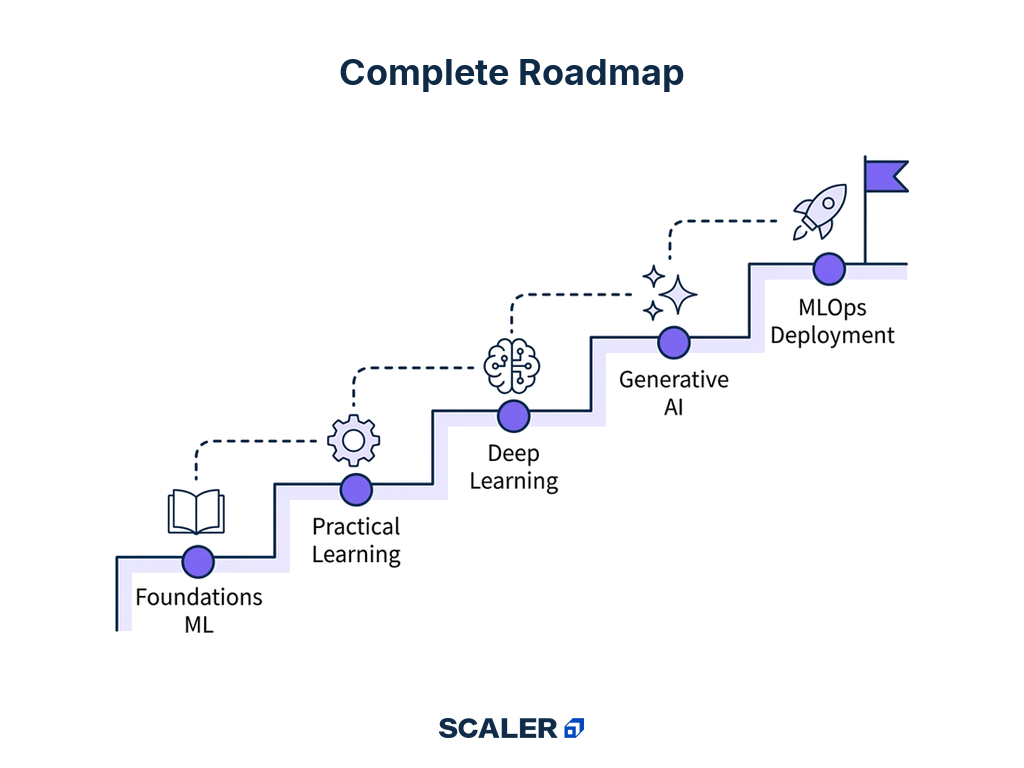
Becoming an AI Engineer may seem tough at first, but when you break it down into clear monthly goals, the journey becomes surprisingly achievable. This 6-month roadmap is designed exactly that way, step-by-step, practical, and focused on building real projects that showcase your skills. Each phase helps you learn the right tools, apply them immediately, and move closer to building production-ready GenAI and ML systems.
Here’s a summary of the AI Engineer roadmap for you:
| Phase | Timeline | What You Learn |
| Phase 1: Foundations | Month 1 | Python basics, NumPy/Pandas, ML math, evaluation metrics |
| Phase 2: Practical ML | Month 2 | Classification, clustering, pipelines, tuning, SHAP |
| Phase 3: Deep Learning | Month 3 | ANNs, CNNs, RNNs, attention, optimizers |
| Phase 4: GenAI & LLMs | Month 4 | Transformers, embeddings, prompt engineering, RAG |
| Phase 5: MLOps & Deployment | Month 5 | Model versioning, CI/CD, FastAPI, Docker, cloud deploy |
| Phase 6: Capstone Project | Month 6 | End-to-end app combining ML + LLM + deployment |
Look through each step and accordingly plan your next six months!
Phase 1 – Foundations: Python, Math, ML Basics (Month 1)
What to learn:
- Python essentials: variables, loops, functions
- Libraries: NumPy, Pandas, Matplotlib
- Math for ML: linear algebra (vectors, matrices), basic calculus, statistics
- ML fundamentals: datasets, training vs testing, evaluation metrics, overfitting
How to learn:
- Practice coding daily using Jupyter Notebook or Google Colab
- Solve small exercises: data cleaning, simple visualisations
- Study ML workflows using scikit-learn documentation
Tools: Jupyter Notebook, Pandas, NumPy, scikit-learn
Try to build: House price prediction using linear regression. Focus on data cleaning, feature selection, and error metrics (MAE, RMSE)
You will understand how ML models learn from data and can build simple supervised models.
If you want a structured path to build this exact “hybrid” skill set end-to-end, you can explore the IIT Roorkee AI Engineering Course by Scaler. It’s designed around the same stack companies are hiring for ML foundations, GenAI workflows, and deployment/MLOps so you’re not just learning concepts, but actually shipping projects.



Phase 2 Practical Machine Learning (Month 2)
What to learn:
- Classification, clustering, feature engineering
- Cross-validation, model pipelines
- Hyperparameter tuning (GridSearchCV, RandomizedSearchCV)
- Model explainability (SHAP)
How to learn:
- Take raw datasets, clean them, and build complete ML workflows
- Practice with Kaggle datasets
- Compare multiple algorithms and justify model choices
Tools: scikit-learn, XGBoost, SHAP
Try to build:
- Customer churn prediction
OR - Image classification using scikit-learn or XGBoost
By this time, you can build, evaluate, and interpret ML pipelines end-to-end.
Phase 3 – Deep Learning & Neural Networks (Month 3)
What to learn:
- Neural networks (ANNs), CNNs, RNNs, attention mechanisms
- Activation functions, loss functions, optimizers
- Training concepts: backpropagation, gradient descent
- GPU-based model training
How to learn:
- Build basic neural networks from scratch, then use frameworks
- Experiment with hyperparameters: batch size, learning rate, epochs
- Monitor training curves for underfitting/overfitting
Tools: TensorFlow, Keras, PyTorch, Google Colab (GPU)
Try to build:
- Image classifier
OR - Sentiment analysis on text data
At this stage, you can design, train, and optimize deep learning models using modern frameworks.
Phase 4 – Generative AI & Large Language Models (Month 4)
What to learn:
- LLM fundamentals: transformers, embeddings, tokenization
- Prompt engineering basics
- Working with LLM APIs
- Intro to fine-tuning & retrieval-augmented generation (RAG)
How to learn:
- Build small GenAI scripts using APIs
- Experiment with prompts and compare outputs
- Explore Hugging Face models and documentation
Tools: OpenAI API, Hugging Face Transformers, LangChain
Try to build: a writing assistant or Q&A chatbot using an LLM API
Now, you can integrate LLMs into applications and understand how modern generative systems work.
Phase 5 – MLOps, Deployment & Production Skills (Month 5)
What to learn:
- Model versioning and experiment tracking
- CI/CD for ML systems
- API development basics
- Containerization and cloud deployment
How to learn:
- Package any ML/LLM model as an API using FastAPI
- Use MLflow for model tracking
- Deploy on cloud platforms (Render, AWS, GCP, Hugging Face Spaces)
- Containerize apps with Docker
Tools: MLflow, Docker, FastAPI, Vertex AI / AWS / Render
Try to build: Deploy an ML or LLM model as a REST API or Streamlit app
At this point, you can turn ML models into production-ready services.
Phase 6 – Capstone Project: Build and Deploy a Full GenAI Application (Month 6)
What to build: A complete project that combines:
- ML or Deep Learning model
- LLM integration (API or fine-tuned model)
- Deployment (Docker + Cloud)
- Basic monitoring or versioning
Project ideas:
- AI PDF Research Assistant
- AI Resume Screening Tool
- Chatbot with memory and retrieval
- Document summarization app
Tools: LangChain, Pinecone/FAISS, OpenAI API, Streamlit, Docker
How to execute:
- Design the workflow
- Build modular code
- Containerize the app
- Deploy publicly
- Publish on GitHub + LinkedIn
After completing all the above phases, you’ll be as ready as ever to become an AI Engineer.
You might have noticed how many tools and concepts one has to learn and practice to get a hand of this skill, so naturally you would expect a rewarding career, Hence, we have covered the next segment with what all roles will you be able to manage after learning AI essentials and what can be your salary expectations.

Free Courses by top Scaler instructors
The Modern AI Engineer Tech Stack
AI Engineering is as much about tools as it is about concepts. Here’s what your stack should look like after completing the roadmap:
| Category | Tools / Frameworks |
| Languages | Python, SQL |
| Libraries | NumPy, Pandas, Scikit-learn, TensorFlow, PyTorch |
| GenAI Tools | LangChain, Hugging Face, OpenAI API |
| MLOps Tools | MLflow, Docker, FastAPI, Vertex AI, Weights & Biases |
| Data Handling | Pandas, Polars, DVC, Airflow |
| Deployment | Streamlit, Gradio, Flask, Render |
Learn more: [Data Science Courses]
These tools help you cover every phase – from data collection to app deployment.
Scaler Placement Report and Statistics
Scaler learners achieved 2.5x salary growth with average post-Scaler CTC reaching ₹23L.
 Google
 Amazon
 Microsoft
 Flipkart
 Adobe
1200+ more
Adobe
1200+ more
Skills You’ll Gain After 6 Months
After following this roadmap, you’ll have both the technical foundation and the project experience needed to step confidently into an AI engineering career.
Core Machine Learning Skills
- Supervised and unsupervised learning (regression, classification, clustering)
- Feature engineering, data cleaning and preprocessing for structured and unstructured data
- Model evaluation using metrics like accuracy, F1-score, ROC-AUC, MAE, RMSE
- Building reusable ML pipelines and performing cross-validation
- Hyperparameter tuning using GridSearch, RandomizedSearch and Bayesian Optimization
Deep Learning Skills
- Designing and training neural networks from scratch
- Building CNNs for image tasks, RNNs/LSTMs for sequences and Transformers for modern architectures
- Understanding gradient descent, backpropagation, activation functions and loss functions
- Applying regularization techniques (dropout, batch normalization, early stopping)
- Training models on GPUs using TensorFlow or PyTorch
- Debugging training issues like exploding gradients, vanishing gradients and overfitting
Generative AI & LLM Skills
- Prompt engineering for reasoning, summarization, extraction, and conversation tasks
- Working with embeddings for retrieval-based systems (RAG)
- Using LangChain to build agent-based, tool-using and memory-enabled AI applications
- Fine-tuning or parameter-efficient tuning (LoRA, QLoRA) on small and medium-scale models
- Integrating LLM APIs (OpenAI, Hugging Face) into end-to-end applications
- Evaluating LLM outputs for hallucination, consistency and reliability
MLOps & Production Engineering Skills
- Experiment tracking and model versioning using MLflow
- Creating APIs with FastAPI and packaging them into production-ready services
- Using Docker for containerization and environment reproducibility
- Building CI/CD pipelines for automated testing, deployment and updates
- Deploying ML/LLM apps on cloud platforms (AWS, GCP, Azure, Render, Hugging Face Spaces)
- Monitoring model performance and detecting drift or failures after deployment
Data Engineering & Supporting Skills
- Working with SQL for data extraction and basic transformations
- Managing data pipelines for ingestion, cleaning and batching
- Using tools like Pandas for analytical workflows and preprocessing
- Understanding ETL basics and data storage formats (Parquet, CSV, JSON)
Portfolio, Code Quality & Collaboration Skills
- Using Git and GitHub for version control, branching and pull requests
- Writing clean, modular, production-friendly Python code
- Creating documentation and detailed READMEs for public projects
- Structuring an AI portfolio that highlights end-to-end project capability
Career Path & Salaries for AI Engineers
AI engineering roles are growing quickly across industries, with strong opportunities at every experience level. The table below summarises the key roles and salary ranges you can expect when entering or progressing in this field.
| Level | Roles | Salary Range |
| Entry-Level | AI Developer, Junior ML Engineer | ₹5-12 LPA |
| Mid-Level | AI Engineer, Deep Learning Engineer | ₹11-20 LPA |
| Senior-Level | GenAI Engineer, MLOps Architect | ₹21-44 LPA |
| Global Average | AI/ML Engineer (US) | $120,000+ |
AI engineering roles are among the fastest-growing and most well-paid tech jobs globally, with new opportunities emerging in GenAI product teams, LLM infrastructure, and AI-driven startups.
The future of AI Engineering is quite promising, and if you are interested in going ahead, then worry not and do your level best for your desired role!
Scaler Alumni and Their Success Stories
Read These Important Roadmaps: More Paths to Career Success
FAQs - Common Questions
Can I become an AI Engineer in 6 months?
Yes, if you follow a well-rounded roadmap and build projects consistently. Many beginners are able to crack AI-focused roles within half a year through disciplined daily learning.
What programming skills do I need first?
You should start with Python. It’s beginner-friendly, widely used in ML and AI, and has a massive support community.
How is an AI Engineer different from a Data Scientist?
Data Scientists focus on data analysis and insights. AI Engineers focus on building and deploying models, especially GenAI and production-ready AI systems.
Which tools should I learn for GenAI in 2026?
Focus on LangChain, Hugging Face, OpenAI API, and MLflow. These tools are essential to know for modern AI development stack.
Do I need a GPU ora high-end laptop?
Not at all! You can use Google Colab, Kaggle Notebooks, or cloud platforms that provide free GPU/TPU access.
