




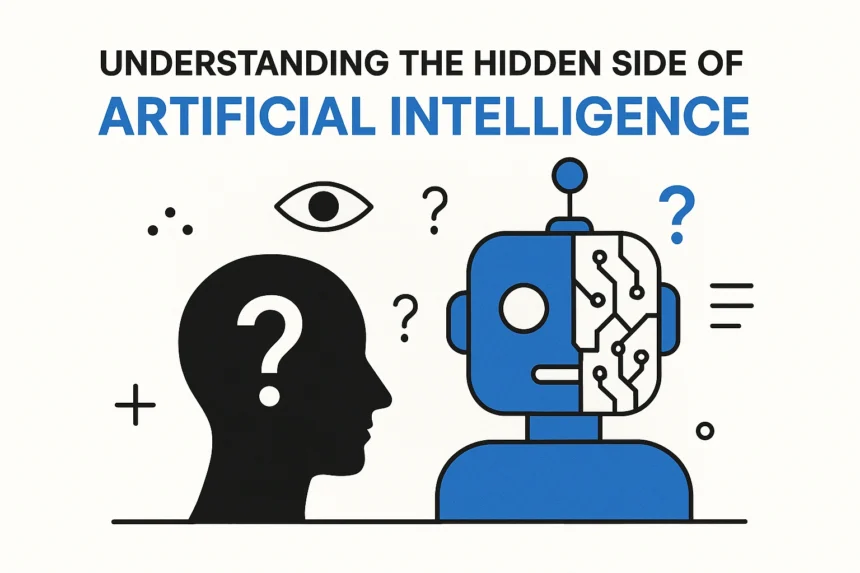
Imagine visiting a doctor, getting your test results, and being told you’ve tested positive for a condition, but no one can explain how the conclusion was reached. Not the doctor, not the lab technician, not even the system that processed the data.
This is the exact risk Black Box AI creates. You might use an AI tool to analyse medical reports, approve loans, or screen job applications, but you have no way of knowing how the system arrived at its decision.
It sounds worrying, and in many cases, it is. The good news is that professionals today can identify Black Box AI models, check their risks, and stop or regulate them when needed. But how do you recognise a Black Box AI system? And why did these models become so hard to interpret?
We’ll answer everything here!
What Does “Black Box AI” Really Mean?
Black Box AI basically refers to models whose internal logic, reasoning steps, and features used for decision-making are not directly understood by the people using them, and even by the developers who built them.
How the Term Originated
The term “black box” was introduced to describe algorithms whose internal steps are hidden or too complex to understand. In these systems, you only see the input and the output, but the logic in between remains unknown. You know what the AI received and what it produced, but you cannot see the reasoning or steps it used to reach that conclusion.
Black Box vs White Box AI
Now Block Box AI is definitely risky to use, especially for important matters. And this is exactly why White Box AI development is necessary. Here’s the difference between the two:
| Type of AI | Transparency Level | When It’s Used |
| Black Box AI | Low interpretability | Complex predictions, computer vision, NLP models, generative AI, and large-scale decision-making |
| White Box AI | Fully traceable logic | Finance, healthcare, legal decisions, safety-critical systems, compliance-heavy industries |
What Makes White Box AI Different?
White Box models are those where you can clearly see:
- How the model processes data
- What rules does it apply
- Why does it give a particular output
Functions like decision trees, linear regression, logistic regression, or rule-based systems are basically White Box. These models are simpler, but they allow complete transparency. Anyone can check the logic and verify whether the model is fair or correct.
Industries like finance, healthcare, insurance, and public-sector systems often prefer White Box AI because they need to justify every decision.
How Black Box AI Works
So now that you are familiar with a few aspects of Black Box AI, let’s get into how ot really works.
Black Box AI models work by learning patterns from large datasets. Instead of following a particular format, they adjust millions of internal connections based on training data. As these networks grow deeper, it becomes impossible to map which part of the model influenced a specific prediction.
Where These Models Are Commonly Used
- Image detection (tumours, traffic signs)
- Natural language tasks (chatbots, translation)
- Recommendations (ads, content feeds)
- Security systems (fraud alerts, anomaly detection)
Why They’re Difficult to Explain
- High-dimensional data
- Hidden layers that cannot be viewed in a proper format
- No clear separation between important and unimportant signals
- Continuous training that changes behaviour over time
This is why companies rely on external explainability tools instead of trying to inspect the model directly.
Real-World Examples of Black Box AI
Black Box AI concerns were brought up when systems started to act up in some distinctive industries. Here are some notable examples:
1) The Apple Card Controversy
When Apple Card launched in the U.S., several users reported that women were receiving much lower credit limits than men, even when they shared finances and had identical credit histories.
The issue drew major attention because neither Apple nor Goldman Sachs could explain how the AI behind the credit scoring model made these decisions.
The problem was that,
- The bank could not describe the internal logic behind the credit limit decisions.
- Users with the same financial data received different limits.
- Regulators asked for transparency, but the decision-making patterns remained unclear.
This case highlighted how financial AIs can unintentionally discriminate, and how a lack of explainability can put consumers at risk.
2) Facial Recognition Misidentification in Police Use
Several police departments in the U.S. temporarily stopped using facial recognition systems after reports of wrongful arrests and misidentification, especially involving people of colour.
Here,
- The system identified individuals using hidden internal patterns that were not visible to officers.
- When the tool made a mistake, the vendors could not explain why a specific face matched incorrectly.
- Some models were found to be trained on biased datasets.
This led to public backlash, legal challenges, and temporary bans on facial recognition use in multiple regions.
3) Healthcare Diagnostics: AI Models in Medical Imaging
Hospitals use AI tools to detect diseases from MRI scans, X-rays, and CT images. These models are often better than human radiologists in accuracy.
However, doctors frequently cannot determine which features or image patterns led to the prediction.
This is considered a problem because,
- Clinicians could not identify the reasoning behind positive or negative predictions.
- In some studies, the model reacted to irrelevant image artefacts like markings on scans, not medical features.
- No clear way existed to verify whether the model’s reasoning was medically reliable.
So now, healthcare regulators worldwide require explainability before approving medical AI systems.
4) Amazon’s Recruitment AI Failure
Amazon built an AI tool to review resumes and shortlist candidates. Over time, the model learned patterns from historical hiring data, which reflected a male-dominated tech workforce.
As a result, the system began downgrading resumes that contained the word “women’s” or came from women-focused colleges.
Now this was clearly a problem because,
- The tool made biased decisions without showing which features influenced rejections.
- Recruiters had no visibility into why certain profiles were filtered out.
- The bias only became obvious after unusual patterns were noticed.
Because of this, Amazon ended the project and admitted that the model’s internal logic couldn’t be fixed with simple rules or patches.
5) Generative AI: Large Language Models (LLMs)
Tools like ChatGPT, Claude, and Gemini generate text based on patterns learned from massive datasets. But while the answers often sound correct, the model cannot provide a traceable reasoning path.
Yes, they are considered Black Box AI because,
- There is no step-by-step explanation behind any response.
- The same prompt can produce different answers with no clear reason.
- The model’s internal patterns are based on billions of parameters that can’t be interpreted manually.
This raises concerns in journalism, academic writing, legal decisions, and any scenario where accuracy and accountability matter.
All the above examples tell us how AI systems are useful on lot many ways, but it is always better to create a systematic model for proper control instead of learning models that can lose control easily.
Why Black Box AI Is a Problem
Here are some major reasons why working with Black Box AI systems might not be the best idea:
1. No Clear Explanation for Decisions
Black Box models cannot show why they approved, rejected, or flagged something. This becomes a major issue in areas like loans, hiring, healthcare, and fraud detection, where explanations are necessary.
2. Hidden Bias in Predictions
If the training data contains bias, the model may repeat the same patterns, often without anyone noticing. Without interpretability, identifying unfair outcomes becomes difficult.
3. Security Weaknesses Are Harder to Detect
Opaque systems can hide vulnerabilities such as adversarial threats, unsafe outputs, or data exposure. Since the logic isn’t visible, spotting and fixing issues takes longer.
4. Increasing Regulatory Requirements
Laws like the EU AI Act and frameworks such as NIST AI RMF now require explanation for high-risk AI. Companies must prove how their models work, and not just present the results.
Explainable AI (XAI): The Solution to Black Box Systems
Every individual, company, or organization wishes to integrate AI in every decision possible, such as loans, hiring, medical results, and recommendations. Companies need systems that can not only predict accurately but also explain why they reached a specific conclusion.
And this is why Explainable AI (XAI) has come into use.
So, What Is Explainable AI (XAI)?
Explainable AI includes methods and tools that make an AI model’s output easier to understand. Instead of showing only the final answer, XAI helps reveal what factors influenced the prediction and how the model processed the input.
How XAI Helps Explain Complex Models
Here are some commonly used XAI methods:
- LIME: It highlights the most important features behind a single prediction. For example: “Your loan was rejected because your credit score and debt ratio had the highest impact.”
- SHAP: Breaks down the exact contribution of each feature using a consistent, game-theory approach. This helps compare how strongly each feature affects the outcome.
- Feature Importance Visuals: These graphs show which inputs the model relies on the most overall. It is useful for detecting bias or unnecessary features.
- Counterfactual Explanations: Shows what would change the prediction. Example: “If your income were slightly higher, the model would approve the loan.”
These methods surely don’t reveal every internal detail of a Black Box model, but they provide enough clarity to understand and evaluate the model’s behaviour.
Modern Applications & Systems for Transparency
Many companies now try to build AI systems that are accurate but still provide some level of clarity. They use explainability tools, monitoring platforms, and transparency reports to help users understand how models behave.
Here are a few well-known examples:
1. IBM Watson OpenScale
IBM OpenScale helps companies monitor their AI systems as they work. It checks for issues such as bias, unexpected behaviour, or drops in model accuracy. The tool also provides explanations for each prediction, helping teams understand why the model acted a certain way. This is commonly used in finance, health, and enterprise environments.
2. Google Cloud AI Explainability Tools
Google Cloud provides built-in tools that show which inputs influence a model’s prediction. Teams can visualise feature importance, analyse how a model behaves with different data points, and verify whether the system is making fair decisions. These tools are often used when companies deploy ML models in large applications.
3. OpenAI Transparency Initiatives
OpenAI publishes model cards, system behaviour reports, and safety documentation to help users understand how their models work and where they may have limitations. They openly describe potential risks, biases, safety filters, and scenarios where outputs may not be reliable. This approach supports responsible use of large language models.
These tools and initiatives don’t fully solve the Black Box problem, but they make AI systems more traceable and easier to evaluate. Companies now rely on a mix of accuracy, monitoring, and partial explanations to build safer AI applications.
Future of AI: Can We Open the Black Box?
The future of AI is moving toward systems that are not only powerful but also more transparent. Researchers are exploring hybrid models that combine interpretable techniques with deep learning, which helps users achieve both accuracy and clarity.
Governments and regulators are also introducing stricter rules around AI audits, documentation, and accountability, especially for high-risk use cases like healthcare, finance, and public services.
Many organisations are adopting human-in-the-loop workflows, where experts review or validate AI decisions before they are applied. Together, these efforts aim to reduce opacity and make AI systems safer, more predictable, and easier to trust in the years ahead.
FAQs
Why is AI called a “black box”?
Because its internal reasoning isn’t visible or understandable to people using it. You see the inputs and outputs, but not the logic that the model has used to come to a particular conclusion.
Is ChatGPT a black box AI?
Somewhat yes. Large Language Models like ChatGPT use billions of parameters, making their internal logic too complex to interpret directly. For example, if there are 5 users, and each type the same questions, ChatGPT would still respond differently based on how that person has been using it before. And this is how this model trains itself to adjust to the user’s requirements.
How do we make AI more transparent?
We can make AI more transparent through XAI methods such as LIME, SHAP, feature attribution tools, and model auditing frameworks.
Is Black Box AI dangerous?
It’s not inherently dangerous, but it becomes risky when deployed in sensitive domains without proper monitoring or explainability.
What’s the difference between Black Box and White Box AI?
White Box AI provides clear, traceable logic. Black Box AI hides its reasoning due to complexity or proprietary design.
