




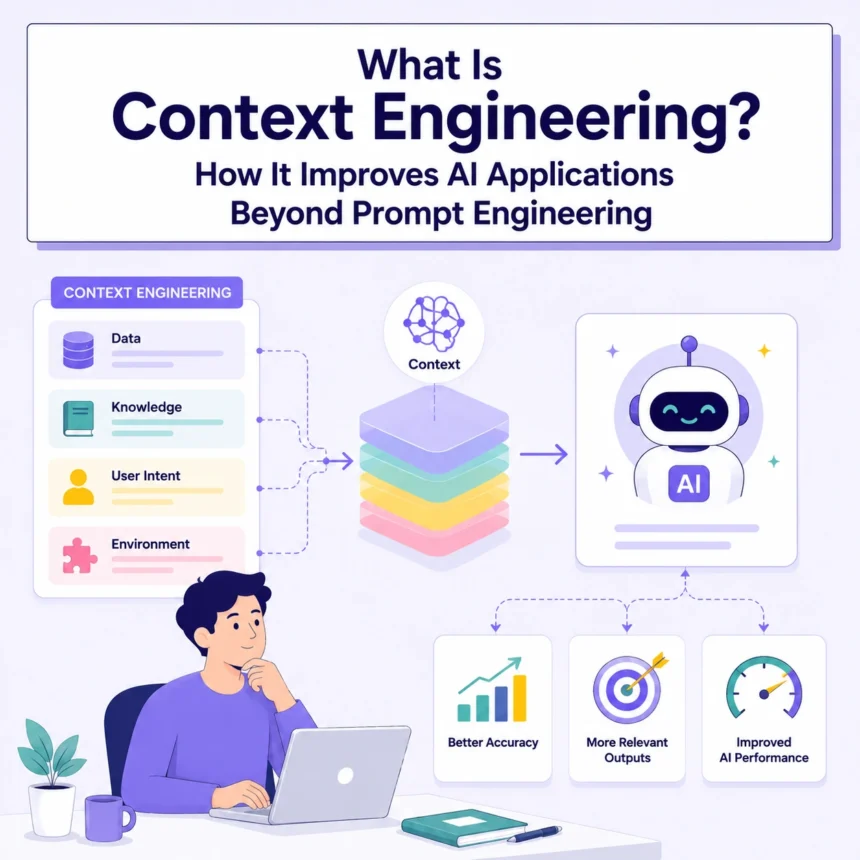
Context engineering is the discipline of deliberately designing everything a large language model sees before it generates a response, not just the instruction you type, but the retrieved documents, conversation history, tool definitions, and memory that surround it. Where a prompt is a single instruction, context is the entire informational environment the model uses to act on that instruction.
The term crystallised in mid-2025 and has since become the dominant way serious AI builders describe the actual work of making LLM applications reliable. Context engineering treats the context window, the model’s limited working memory, as something to be architected with the same rigor engineers apply to database schema design or API contracts, rather than something you fill in ad hoc with whatever seems relevant.
Where the Term Came From
Context engineering was popularised in June 2025 by Andrej Karpathy, the AI researcher and former OpenAI founding member, who argued that ‘prompt engineering’ understated the real work involved in building serious LLM applications.
Shopify CEO Tobi Lütke independently echoed the same framing around the same time, describing context engineering as the art of providing all the context needed for a task to be plausibly solvable by the model. Karpathy’s own explanation uses a computer-architecture analogy that’s become widely cited: the LLM is the CPU, the context window is RAM, and context engineering is the operating system deciding what actually gets loaded into that limited working memory.
Context Engineering vs Prompt Engineering: The Real Difference
The distinction between context engineering and being a prompt engineer is not just semantic, the two disciplines answer fundamentally different questions.
Transform Your Career
Choose from our industry-leading programs designed for career success
Modern Software and AI Engineering Program
Master full-stack development with AI integration


 +1000 more
AI Forward Deployed Engineer with Specialisation in AI applications
Build and deploy AI solutions for real-world business problems
+1000 more
Modern Data Science and ML with specialisation in AI
Advanced data science techniques with AI specialization
+1000 more
Advanced AIML with Specialisation in Agentic AI
Deep dive into AIML with focus on Agentic systems
+1000 more
DevOps, Cloud & AI Platform Engineering
Build and manage AI-powered cloud infrastructure
+1000 more
AI Engineering Advanced Certification by IIT-Roorkee
Premier AI engineering certification from IIT-Roorkee

| Dimension | Prompt Engineer | Context Engineering |
| Core question | What should I tell the model to do? | What does the model need to see to do it well? |
| Scope | A single instruction or message | Retrieved documents, memory, tool outputs, history, and the instruction itself |
| Primary skill | Clear, well-structured instruction writing | Information architecture, retrieval, ordering, compression, filtering |
| Failure mode | Vague or ambiguous instructions | Irrelevant, missing, or poorly ordered context, even with a perfect instruction |
| Where it lives | The message sent to the model | The entire pipeline feeding the model, RAG, memory stores, tool definitions |
A useful way to see the difference: a prompt engineer can write a flawless instruction, but if the retrieved documents behind it are outdated, irrelevant, or missing entirely, the model still fails, not because the prompt was bad, but because the context around it was. Context engineering treats that surrounding information environment as the actual unit of engineering work, not an afterthought to the prompt.
What Does Context Window Refer To, Exactly?
In prompt engineering, what does context window refer to? It’s the total amount of text, measured in tokens, that a language model can ‘see’ and reason over at any one time, encompassing the system prompt, conversation history, retrieved documents, tool outputs, and the current user message combined.
Modern context windows have grown dramatically, some 2026-era models support context windows large enough to hold entire codebases or lengthy document sets. But a larger context window doesn’t automatically translate into better answers; it simply means there’s more room to fill, and filling it carelessly with irrelevant or poorly structured information can hurt performance rather than help it. Understanding what does context window refer to in practical terms, a finite, costly resource, is the starting point for effective context engineering.
The Four Pillars of Context Engineering
LangChain’s Lance Martin formalised a widely cited taxonomy for context engineering, breaking the discipline into four concrete strategies:
| Strategy | What It Means | Example |
| Write | Author clear instructions and system prompts | A well-structured system prompt defining the model’s role and constraints |
| Select | Choose only the relevant context for the current step | Retrieving the 3 most relevant documents from a vector database, not all 300 |
| Compress | Reduce token waste without losing meaning | Summarising a long conversation history instead of including it verbatim |
| Isolate | Keep unrelated context separate so it doesn’t interfere | Giving each sub-agent only the context relevant to its specific task |
These four pillars give context engineering practical shape, rather than a vague mandate to ‘give the model more context,’ each strategy addresses a specific failure mode: missing information (write, select), wasted tokens (compress), and cross-contamination between tasks (isolate).
Turn Context Engineering into Production AI Skills
Understanding the principles of context engineering is only the beginning. The real value comes from applying retrieval, memory management, and context orchestration to build AI applications that are reliable, scalable, and production-ready. Learn the practical skills used by AI engineers to design high-performing LLM systems. Explore Now
How Context Engineering Improves AI Applications
Context engineering improves AI applications in ways that prompt refinement alone cannot reach, because it addresses the information the model is reasoning over, not just how the task is phrased.
- Reduces hallucination: grounding the model in retrieved, verified documents (via RAG) gives it real information to reason from, instead of relying on parametric memory that may be outdated or wrong
- Improves consistency across sessions: well-designed memory systems let an AI application recall relevant prior context, rather than starting from zero on every interaction
- Enables complex, multi-step agents: agentic workflows require context engineering to manage what each step of a task needs to see, without it, agents lose track of state and produce incoherent multi-step outputs
- Lowers cost and latency: compressing and selecting context carefully (rather than stuffing the window with everything available) reduces token usage, which directly lowers API cost and response time
- Prevents cross-task interference: isolating context between sub-agents or tasks avoids the model conflating unrelated information, a common source of confused or contradictory outputs
A team that has done rigorous context engineering, clean retrieval, relevant memory, well-isolated task boundaries, will consistently outperform a team relying on prompt tweaks alone, even if the second team’s prompts are individually more polished. The prompt is only as good as the information it has to work with.
The Lost-in-the-Middle Problem: Why Bigger Isn’t Always Better
A well-documented limitation makes context engineering necessary rather than optional: models process information at the beginning and end of a context window more reliably than content buried in the middle, a pattern researchers call the ‘lost-in-the-middle’ problem.
This means simply expanding the context window and dumping in every potentially relevant document is not a substitute for context engineering, it can actively hurt performance by burying the information that matters most in the least reliable part of the window. Effective context engineering deliberately orders and prioritises what goes where, placing the most critical information at the start or end, rather than treating the context window as an undifferentiated bucket.
AI Engineer Skills for Context Engineering
The AI engineer skills that matter most for context engineering extend well beyond the writing-focused skill set of a traditional prompt engineer:
- Retrieval system design: building and tuning RAG pipelines, including chunking strategy, embedding model choice, and retrieval ranking
- Memory architecture: designing short-term (session) and long-term (persistent) memory systems that surface the right prior context without overwhelming the window
- Token budgeting: understanding cost and latency trade-offs well enough to make deliberate compression and selection decisions
- Tool and function design: writing clear tool definitions and outputs that an agent can reliably parse and act on as part of its context
- Evaluation instincts: testing not just whether a prompt sounds right, but whether the assembled context actually produces reliable, grounded outputs across varied inputs
- System-level thinking: treating context as an engineered pipeline, with the same rigor applied to schema design or query optimisation, rather than a one-off writing exercise
These ai engineer skills reflect a broader shift in the field: prompt engineering as a narrow, standalone skill has been reclassified as one component nested inside the larger discipline of context engineering, rather than eliminated.

Free Courses by top Scaler instructors
How to Become an AI Engineer Focused on Context
For anyone wondering how to become an AI engineer with strong context engineering skills specifically, the path builds on solid ML and backend engineering foundations, then layers in the practices unique to LLM application design.
- Build a foundation in Python, APIs, and basic ML concepts, context engineering is an engineering discipline, not a prompting trick
- Learn how embeddings and vector databases work, since retrieval is central to most real-world context engineering
- Build a RAG application end to end, this single project teaches chunking, retrieval, and context assembly better than any tutorial alone
- Study memory patterns used in production agent frameworks (like LangChain or LlamaIndex) to understand how short- and long-term memory get structured
- Practise evaluating context quality, not just prompt quality, build small evals that test whether your retrieval and context assembly actually produce grounded, accurate outputs
Learning how to become an AI engineer in 2026 increasingly means learning context engineering as a core competency from the start, rather than treating it as an advanced specialisation to pick up later, the discipline has moved from niche practice to baseline expectation for anyone building production LLM applications.
Ready to Build Production-Grade AI Applications?
Scaler’s Data Science & ML Program covers RAG, vector databases, memory systems, and context engineering hands-on, with real projects and 1:1 mentorship from engineers building GenAI systems in production. Explore the Program
Scaler Alumni and Their Success Stories
FAQs
Q1. What is context engineering in AI?
Context engineering is the discipline of deliberately assembling everything an LLM sees before responding, retrieved documents, memory, tool outputs, and instructions, rather than just crafting a single prompt.
Q2. How is context engineering different from being a prompt engineer?
A prompt engineer focuses on the instruction itself, while context engineering covers the entire information environment, retrieval, memory, and history, that the model uses to act on that instruction.
Q3. In prompt engineering, what does context window refer to?
In prompt engineering, context window refers to the total amount of text a model can process at once, including instructions, retrieved data, and conversation history, measured in tokens.
Q4. What ai engineer skills are needed for context engineering specifically?
Key ai engineer skills for context engineering include retrieval system design, memory architecture, token budgeting, and evaluating context quality, not just writing clear instructions.
Q5. Is a context manager the same thing as context engineering?
No, a context manager typically refers to a system or code construct (like Python’s context manager pattern) that handles resource setup and teardown, distinct from the AI discipline of context engineering.
Q6. How to become an AI engineer skilled in context engineering?
To become an AI engineer skilled in context engineering, build a foundation in Python and ML, learn embeddings and vector databases, then build a full RAG application to practise retrieval and context assembly hands-on.
