Robotics, AI, automation and other related technologies are emerging fields, and because of this, there is growing interest among students in engineering courses across India. However, students interested in robotics often search for robotics engineering colleges India, but that is not the only thing that matters. More important is the kind of engineering programme that can prepare them for future careers in this field.
What Makes an Engineering Programme Relevant for Robotics and AI?
Robotics, AI, automation, and other emerging technologies are broad, interdisciplinary fields. Hence, a strong engineering programme in this area should not only introduce students to popular technology terms but also help them build fundamentals and practical skills.
A relevant programme for an engineering student interested in robotics and AI should include topics such as programming, AI, embedded systems, sensors, automation and control systems. It should also give students enough exposure to industry lab work and project-based learning.
How Robotics, AI, and Emerging Tech Are Connected
Work in robotics and AI is interdisciplinary. The mentioned subjects are not confined only to one field, and most courses involve a combination of various subjects, such as:
Programming and algorithms
Electronics and sensors
Mechanics and motion
Control systems
Data and machine learning
Embedded systems
Computer vision
Systems integration
Although the programme sounds futuristic, its true value lies in how much depth it covers in areas of software, hardware, and practical problems.
Dedicated Robotics Degree vs Interdisciplinary Engineering Programme
A dedicated robotics degree can be valuable for students who have already decided that they want to specialise in robotics, automation and hardware-software systems as part of their academic experience and future careers.
But there are other study tracks too that can lead to robotics and other emerging-tech careers. Software-heavy applications like robotics software, AI systems, computer vision, autonomous systems and intelligent automation can be supported by a strong computer science and AI-focused study. Here is a guide on CSE vs AI engineering for students who are comparing both paths.
For hardware-heavy applications like industrial robots, mechatronic arms, grippers, sensors and other robotics components, an in-depth understanding of electronics, mechanics, and control theory may be advantageous.
What a Strong Programme Should Actually Offer
Instead of incorporating trendy subjects into the programme in AI and robotics, it should be a balanced curriculum that provides a solid grounding in technical skills. This can help students become skilled professionals.
Some clear indicators are:
Programming skills and problem-solving
Computational mathematics
Data structures and algorithms
Knowledge of electronics and embedded systems
Control systems or automation concepts
Introduction to machine learning
Laboratory work
Project development
The Curriculum Should Show Clear Technical Direction
It is way more important to look into the learning structure of the programme and how the basics of engineering are applied step by step through core subjects and lab work, as well as through electives, major projects, research, and internships.
When students compare programmes, they should check:
Whether the curriculum progresses from basic engineering fundamentals to real-world application
Whether labs and projects are actually part of the learning experience
Whether the programme actually covers topics of robotics, AI and intelligent systems
Whether students can pursue internships, research or more in-depth technical work to further increase their knowledge
Hands-on Learning Matters as Much as Coursework
As students learn robotics, artificial intelligence, and other technologies in the current era, it is essential that the programme's practical relevance be emphasised. Students should be able to apply what they learn by building, experimenting, troubleshooting and improving systems over time.
That usually becomes visible through:
Laboratory-based coursework
Project presentations
Robotics competitions
Team-based projects across disciplines
Internships and research exposure
Peer groups that build beyond the classroom
These projects can involve robots, drones, intelligent traffic systems, health monitoring systems, logistics automation or computer vision applications.
It’s also interesting to note how some new-age programmes can support this kind of learning. Scaler School of Technology presents its CS & AI programme as “Computer Science Engineering Built for the AI Era,” with AI integrated in the curriculum from the very beginning, and a learn-by-building approach.
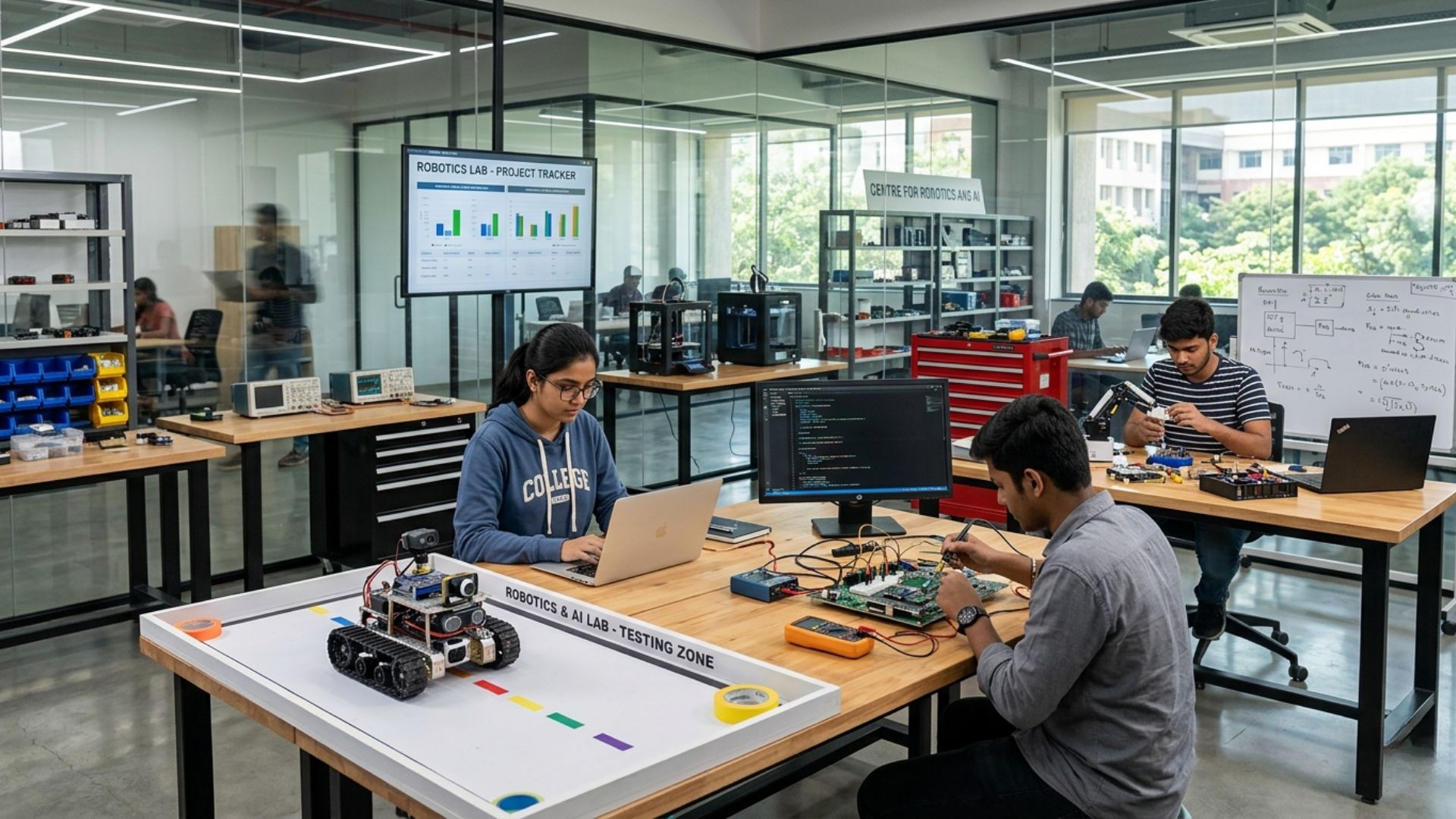
So, even if a programme is not specifically titled “Robotics,” it can still be suitable for students interested in AI-led or software-heavy emerging technology roles. Scaler Innovation Lab, is India’s only deep-tech lab with 5 state of the art labs - Robotics, AI/ML, AR/VR, Drone Technology and IoT which helps students explore interdisciplinary technology areas.
A Times of India report covers Scaler School of Technology’s Deep-Tech Innovation Lab, which highlights how the lab aims to support robotics, AI and autonomous-startup ideas through hands-on innovation and interdisciplinary problem-solving.
Fundamentals Still Matter More Than Buzzwords
What matters in the long run is the extent to which a programme covers the fundamentals.
Programming
Mathematics
Algorithms
Systems thinking
Electronics or computational foundations
Practical engineering problem-solving
A strong foundation in engineering fundamentals will help students learn the latest technologies within a few months and build upon them. Without strong engineering fundamentals, students may learn about emerging technologies and even talk about them, but they may not be able to put them to practical use.
Career Paths in AI, Robotics, and Emerging Tech
AI and robotics can lead to many different careers, if a student learns the appropriate skills from their specific programme and gains practical experience in that area. Here are a few examples:
Robotics developer
AI engineer
Automation engineer
Machine learning engineer
Embedded systems engineer
Computer vision engineer
Data or intelligent systems roles
Research or product development roles
There are many industries where people use Artificial Intelligence and Robotics. These are some of them: Healthcare, Manufacturing, Finance, Transport, Smart Systems and Automated businesses. There are many jobs that involve AI and robotics, such as working with Autonomous cars, smart factory systems, medical robotics, and AI Chatbots for customer service.
Students interested in learning about how AI and robotics are shaping future technology careers can also watch this discussion on the future of AI in robotics.
The Future of AI in Robotics & Content - @VarunMayya
However, students should not look at these careers as automatic outcomes. They need the right mix of programming, systems thinking, hardware understanding, project work and applied learning.
Conclusion
When looking for the right programme to study robotics, AI, and other emerging technologies, students should seek a strong engineering programme that offers a solid foundation and practical experience in software, systems, and intelligent technologies.
While a dedicated robotics degree could be the best option for some students, others may be better served by a high-quality interdisciplinary engineering degree or one that focuses on Artificial Intelligence. The key is to choose a programme that helps students build, adapt, and grow in emerging technological fields.
FAQs
Are robotics engineering colleges in India the only route into robotics careers?
A dedicated robotics programme is not the only way to enter robotics careers. Many students and professionals enter this field through Computer Science, Mechatronics, Electronics, Automation or other Interdisciplinary Engineering programmes. The key is to get enough exposure to projects and systems, rather than choosing a programme only because it is specifically called Robotics Engineering.
What should students look for while comparing robotics and artificial intelligence engineering colleges in India?
A good undergraduate course in AI and robotics should first provide a strong technical base to understand the different components that form a robot. Interdisciplinary coursework in areas such as computer vision, machine learning and human-robot interaction can also be useful. Above all, a good course should provide applied labs, project work, internships and industry exposure. Students should also get exposure to programming, control systems, embedded systems, machine learning and intelligent systems.
Is a computer science programme enough for AI and emerging tech careers?
Whether an undergraduate programme in Computer Science is sufficient for jobs in AI and other emerging technologies depends on the programme. If the program focuses on AI through projects and practical work, a Computer Science undergraduate program can be sufficient for many software-oriented AI roles. For robotics-related roles, however, exposure to electronics, control systems and hardware-software interfaces, along with AI, can be very helpful.
What skills are important for robotics engineering students?
A robotics engineering major requires students to build many different skills. The main skills include programming, electronics, sensors, control systems, embedded systems, machine learning and problem-solving. Since robotics connects software, hardware and intelligent systems, the programme should also include enough lab work and project-based learning.