




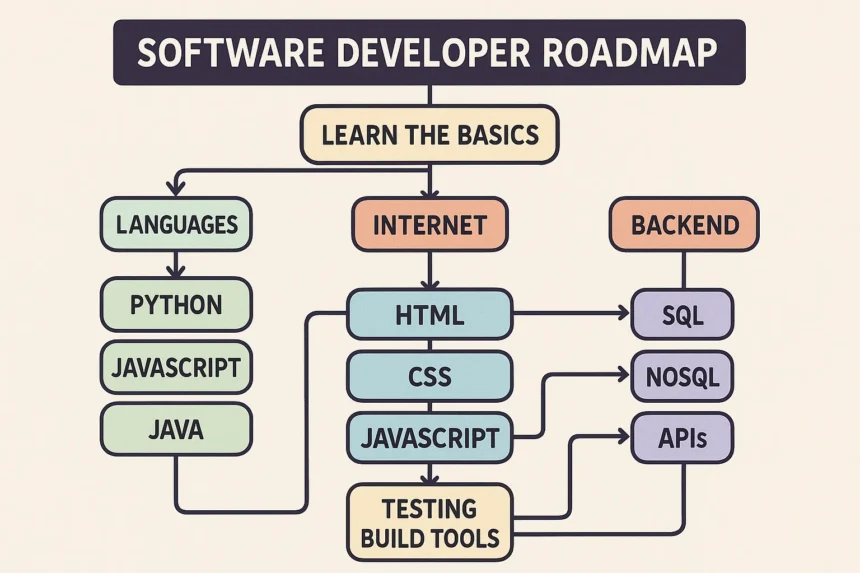
In 2025, software development stands as one of the most in-demand and dynamic career arenas. The software developer roadmap serves as a structured guide, helping aspiring professionals approach this field with clarity and confidence. No matter whether someone is a student, a professional seeking a career change, or a tech enthusiast exploring new horizons, following a roadmap to become software engineer will ensure a strategic advancement. This comprehensive article explains how to become a software developer, breaking down stages, must-have skills, certifications, possible roles, and future industry shifts.
Who is a Software Developer and What Do They Do?
The core of the software developer roadmap is understanding a developer’s multifaceted role. Software developers design, build, test, deploy, and maintain applications that power businesses and lives. These professionals are essential for turning novel ideas into robust digital products. They can specialize as frontend developers, crafting visually appealing user interfaces; backend developers, managing server logic and databases; full-stack developers, integrating both frontend and backend; mobile developers, building apps for Android and iOS; DevOps engineers, automating processes for development and deployment; or game developers, designing interactive gaming worlds. To excel at each role, developers use a mix of tools and environments such as integrated development environments (IDEs), version control systems like Git, collaborative platforms like GitHub, cloud services (AWS, Azure), and CI/CD pipelines. Understanding these tools and environments is crucial for mapping a successful software development career path and building a strong foundation as a software engineer.
Here is a detailed and actionable software developer roadmap for 2025, making how to become a software developer a reality for all.
Transform Your Career
Choose from our industry-leading programs designed for career success
Modern Software and AI Engineering Program
Master full-stack development with AI integration


 +1000 more
Modern Data Science and ML with specialisation in AI
Advanced data science techniques with AI specialization
+1000 more
Advanced AIML with Specialisation in Agentic AI
Deep dive into AIML with focus on Agentic systems
+1000 more
DevOps, Cloud & AI Platform Engineering
Build and manage AI-powered cloud infrastructure
+1000 more
AI Engineering Advanced Certification by IIT-Roorkee
Premier AI engineering certification from IIT-Roorkee

Step 1: Learn Programming Fundamentals
- Select one foundational language: Python, JavaScript, Java, or C++.
- Develop core concepts by working with variables, loops, arrays/lists, conditional statements, functions, and object-oriented programming (OOP).
- Primary keyword usage: By following the software developer roadmap, every beginner gains a crucial base for all later stages.
- Lean on free resources like W3Schools, freeCodeCamp, and Scaler Topics as a starting point for the beginner software developer roadmap.
- Practice building tiny programs to cement understanding early in a software development career path.
Step 2: Master Core Computer Science Concepts
- Dive into crucial areas: Data Structures and Algorithms (DSA), Database Management Systems (DBMS), Operating Systems (OS), and Computer Networks.
- Focus on concepts like linked lists, trees, sorting, searching, SQL, normalization, OS scheduling, process management, and TCP/IP protocols.
- Leetcode and GeeksforGeeks are invaluable for self-paced practice, while structured bootcamps at Scaler Academy ensure personalized mentorship.
- The roadmap to become software engineer emphasizes DSA, as it directly improves problem-solving and placement chances.
Step 3: Learn Version Control
- Master Git basics including repository initialization, commits, branches, pull/push, and resolving conflicts.
- Host code publicly on GitHub; learn collaborative workflows involving forks, pull requests, and code reviews.
- This is a critical skill for working in teams and contributing to large codebases along the software development career path.
Step 4: Pick a Specialization
- Frontend: HTML, CSS, JavaScript, React for creating user interfaces.
- Backend: Node.js, Python (Django/Flask), Java (Spring Boot) for building server-side logic, APIs, and database integration.
- Mobile: Flutter, React Native, or Kotlin to launch apps for iOS and Android.
- DevOps/Cloud: Gain proficiency in Docker, AWS, CI/CD, and deployment strategies.
- Data/ML: For aspiring AI engineers, Python, TensorFlow, Pandas are key.
- Use roadmap visuals to mark out these specializations for easy reference.
Step 5: Build Real-World Projects
- Create hands-on projects such as a to-do app, e-commerce platform, personal portfolio, or blog CMS.
- Deploy projects to public platforms like GitHub, Netlify, Vercel, or Heroku to build a digital portfolio.
- The software developer roadmap insists on showcasing projects, as they prove capabilities to recruiters.
Step 6: Collaborate, Contribute & Practice
- Join the global open source community, contributing to real projects.
- Apply for internships, participate in coding contests, and attend mock interviews for confidence.
- Key platforms include GitHub (for code), HackerRank (for challenges), Internshala (for internships), and Scaler Forum (for networking).
- These collaborative experiences are vital components in a modern software development career path.
Transform Your Career
Choose from our industry-leading programs designed for career success
Modern Software and AI Engineering Program
Master full-stack development with AI integration
+1000 more
Modern Data Science and ML with specialisation in AI
Advanced data science techniques with AI specialization
+1000 more
Advanced AIML with Specialisation in Agentic AI
Deep dive into AIML with focus on Agentic systems
+1000 more
DevOps, Cloud & AI Platform Engineering
Build and manage AI-powered cloud infrastructure
+1000 more
AI Engineering Advanced Certification by IIT-Roorkee
Premier AI engineering certification from IIT-Roorkee
Step 7: Master System Design (for mid-level+ roles)
- Deepen knowledge of designing scalable systems and enterprise architecture.
- Explore APIs, databases, microservices, caching, scalability, and distributed systems.
- Leverage courses on platforms like Grokking System Design or Scaler Academy’s advanced modules.
Step 8: Prepare for Interviews
- Sharpen skills in DSA, low-level design (LLD), high-level design (HLD), and HR interviews.
- Consistent behavioral question practice yields success in major hiring rounds.
- Mock interviews on Scaler, InterviewBit, or mentor-led sessions allow realistic preparation and feedback.
- The entire roadmap to become software engineer culminates here, combining technical mastery with confidence.
Skills Needed to Become a Software Developer
Becoming a software developer means mastering a blend of technical and soft skills.
| Category | Skills |
| Programming | Python, Java, JavaScript, C++ |
| Tools & DevOps | Git, Docker, Jenkins, AWS |
| CS Concepts | DSA, Operating Systems, Computer Networks, DBMS |
| Problem Solving | Competitive programming, Leetcode challenges |
| Communication | Agile methods, teamwork, feedback, technical articulation |
Following the software developer roadmap helps learners target each of these skill zones, ensuring a robust start on any software development career path.
Recommended Courses to Become a Software Developer
Gaining the right certifications and knowledge accelerates progress on the software developer roadmap. Here are popular choices for every specialization:
| Track | Courses to Consider |
| Full-Stack Dev | Scaler Academy, freeCodeCamp, Udemy |
| Frontend Dev | Meta Frontend Developer Certificate (Coursera), Codecademy |
| Backend Dev | Scaler Academy, Springboard, EdX Java Specialization |
| DSA/CS Core | Scaler DSA Masterclass, CS50, Coding Ninjas |
| DevOps/Cloud | AWS Cloud Practitioner, KodeKloud, Scaler Academy |
Every beginner software developer’s roadmap benefits from enrolling in these courses, which are taught by industry experts and offer strong placement support.
Roles in Software Development
Following the roadmap to become a software engineer unlocks multiple dynamic roles in tech.
| Role | Description |
| Frontend Developer | Crafts UI and UX with HTML, CSS, JavaScript, React |
| Backend Developer | Develops logic, APIs, and database with Node, Python, Java |
| Full-Stack Developer | Integrates frontend and backend skills |
| Mobile App Developer | Designs cross-platform apps using Flutter, React Native, Kotlin |
| DevOps Engineer | Manages CI/CD, automation, monitoring, and infrastructure |
The software developer roadmap encourages exploring several roles to discover personal strengths and align with market needs.
Salary & Career Growth Path
India’s booming tech market makes software development a lucrative career option. Typical salaries along the software development career path include:
| Experience Level | Avg Salary (India) |
| Fresher (0–2 yrs) | ₹5–10 LPA |
| Mid (3–5 yrs) | ₹12–20 LPA |
| Senior (6+ yrs) | ₹25–40+ LPA |
| Specialized Lead | ₹40L – ₹1Cr+ |
The software developer roadmap is designed to drive long-term growth, open doors to roles like Tech Lead, Architect, or even Engineering Manager, and ensure steady professional advancement.
Scaler Placement Report and Statistics
Scaler learners achieved 2.5x salary growth with average post-Scaler CTC reaching ₹23L.
 Google
 Amazon
 Microsoft
 Flipkart
 Adobe
1200+ more
Adobe
1200+ more
Future Trends in Software Development
Staying ahead calls for adapting to ever-changing trends along the software developer roadmap:
- Cloud-native and serverless architectures will dominate enterprise solutions.
- AI-assisted development tools, like GitHub Copilot and large language models (LLMs), are empowering rapid coding.
- Edge computing and Internet of Things (IoT) expand opportunities for specialized engineers.
- Low-code platforms are enabling faster prototyping and development.
- Agile, DevSecOps practices, and microservices architecture are mainstream approaches.
Monitoring these trends will make anyone’s roadmap to become software engineer future-proof.
Conclusion
In 2025, the journey on the software developer roadmap is achievable with the right mindset, consistency, and strategic learning. Anyone passionate about how to become a software developer can reach their goal by steadily building skills, completing real projects, and leaning on collaborative communities. Stay updated, embrace continuous learning, and let mentor-driven platforms drive your growth. Explore Scaler’s developer programs to start the next step and launch a successful software development career path.
Read These Important Roadmaps: More Paths to Career Success
FAQs
1. What is the best roadmap for a beginner to become a software developer?
The best beginner software developer roadmap starts with learning one core programming language, mastering DSA through practice, grasping version control, and gradually building real projects. This solidifies the basics for a long and fruitful software development career path.
2. How long does it take to become a software developer?
Most learners become job-ready within 6–12 months with dedicated, structured effort, guided by a comprehensive software developer roadmap. Advanced and specialized roles may take another couple of years for mastery.
3. Can I become a developer without a CS degree?
Absolutely. Many top employers value the right skills for software developer, demonstrated through projects and certifications. Structured online learning and active participation in coding communities are strong substitutes for formal academic backgrounds.
4. What skills are most important in 2025?
Mastery of programming fundamentals, DSA, Git, system design, problem solving, and strong teamwork abilities are essential skills for software developer success in 2025.
5. Is system design necessary for beginners?
For true beginners, system design is not essential in the earliest stages. However, as professionals progress, mastering system design becomes a key differentiator for interviews and long-term roles in the software development career path.
