




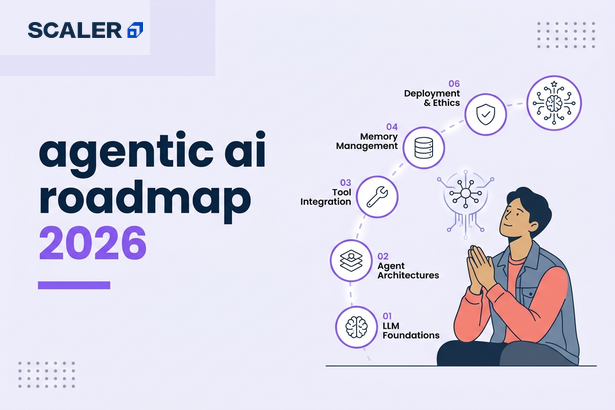
Agentic AI refers to AI systems that can plan tasks, use tools, and operate across multiple steps. By 2026, many AI applications will follow this approach to handle complex workflows in areas such as research, analytics, and internal automation, as it has already started to see effects now.
For engineers and builders, agentic AI introduces a different way of designing AI-driven systems. Instead of focusing on single interactions, development involves coordinating models, tools, memory, and execution logic within a single system.
From Chatbots to Agentic AI Systems
Early AI applications focused on conversational interfaces like our very widely used ChatGPT. These systems worked well for question answering, summarisation, and text generation. As the usage expanded, teams began building AI systems that could manage longer tasks and interact with external tools.
Agentic AI systems support this shift by enabling AI agents to execute tasks across multiple steps. An AI agent can process inputs, select tools, track intermediate results, and continue execution until the task completes. This approach now appears in many time-consuming tasks such as document analysis, workflow orchestration, and research support.
Many organisations have started adopting agent-based architectures to support these workflows, especially where tasks involve reasoning, tool usage, and iteration.
Transform Your Career
Choose from our industry-leading programs designed for career success
Modern Software and AI Engineering Program
Master full-stack development with AI integration


 +1000 more
Modern Data Science and ML with specialisation in AI
Advanced data science techniques with AI specialization
+1000 more
Advanced AIML with Specialisation in Agentic AI
Deep dive into AIML with focus on Agentic systems
+1000 more
DevOps, Cloud & AI Platform Engineering
Build and manage AI-powered cloud infrastructure
+1000 more
AI Engineering Advanced Certification by IIT-Roorkee
Premier AI engineering certification from IIT-Roorkee

Why Traditional Automation No Longer Scales
Rule-based automation follows fixed instructions. You define each step in advance, and the system follows them exactly. This works when tasks stay simple and rarely change. As workflows grow larger, these instructions become harder to manage and update.
AI agents work differently. They can handle tasks that happen in several steps and involve changing information. Instead of following fixed rules, an AI agent decides what to do next based on the situation. Engineers use this approach for everyday work like handling reports, analysing data, or managing internal processes.
As systems grow, this reduces the need to write and maintain long sets of rules for every possible situation.
Why Learning Agentic AI Needs a Structured Roadmap
The agentic AI ecosystem includes a wide range of models, frameworks, and supporting tools. Learning these components without a clear structure often leads to a fragmented understanding.
Developing AI agents typically involves:
- Large language models
- Retrieval and memory systems
- Tool integration and orchestration
- Agent coordination and evaluation
- Deployment and monitoring
Industry hiring patterns increasingly reflect these requirements. Roles related to AI agents and LLM-based systems expect candidates to understand complete agent pipelines.
If you are interested in this field, then a structured Agentic AI roadmap can provide a clear path from foundational concepts to production-level systems.
If you’d prefer to follow this roadmap through a single guided program (instead of stitching tools and frameworks together on your own), you can explore the AI Engineering course by Scaler. It’s built around the same building blocks—LLMs, RAG, tool use, evaluation, and deployment—so you can learn them in sequence with mentorship and hands-on projects.
Here, we have mapped out 10 essential phases that carry the whole agentic AI roadmap, so you can start preparing accordingly.
Here’s a quick table to give you a summary of the agentic ai roadmap’s outline at a glance.
Agentic AI Roadmap 2026: Phase-wise Outline
| Phase | Duration | What You Will Focus On | Key Outcome |
| Phase 1: Foundations | Month 0-1 | Python basics, APIs, data handling, ML concepts | You can write simple programs and automate small tasks |
| Phase 2: LLM Fundamentals | Month 1-2 | Large language models and prompt design | You can work with LLM APIs and control model output |
| Phase 3: RAG Systems | Month 2-3 | Connecting models with documents and data | You can build document-based Q&A systems |
| Phase 4: Agent Architecture | Month 3-4 | Reasoning, planning, memory, and tools | You can build single AI agents that handle multi-step tasks |
| Phase 5: Multi-Agent Systems | Month 4-5 | Agent collaboration and coordination | You can design systems where multiple agents work together |
| Phase 6: Tool Use & Integrations | Month 5-6 | APIs, external tools, and workflows | You can build agents that perform real-world actions |
| Phase 7: Memory & Autonomy | Month 6-7 | Long-term memory and planning | You can build agents that operate across longer workflows |
| Phase 8: Evaluation & Safety | Month 7-8 | Reliability, feedback, and guardrails | You can evaluate and improve agent behaviour |
| Phase 9: Deployment & MLOps | Month 8-9 | Deployment, monitoring, and scaling | You can run AI agents reliably in production |
| Phase 10: Portfolio Projects | Final Phase | Practically applicable and capstone projects | You can present a complete, job-ready Agentic AI portfolio |
Now in the next section, we’ll expand each phase with further details.
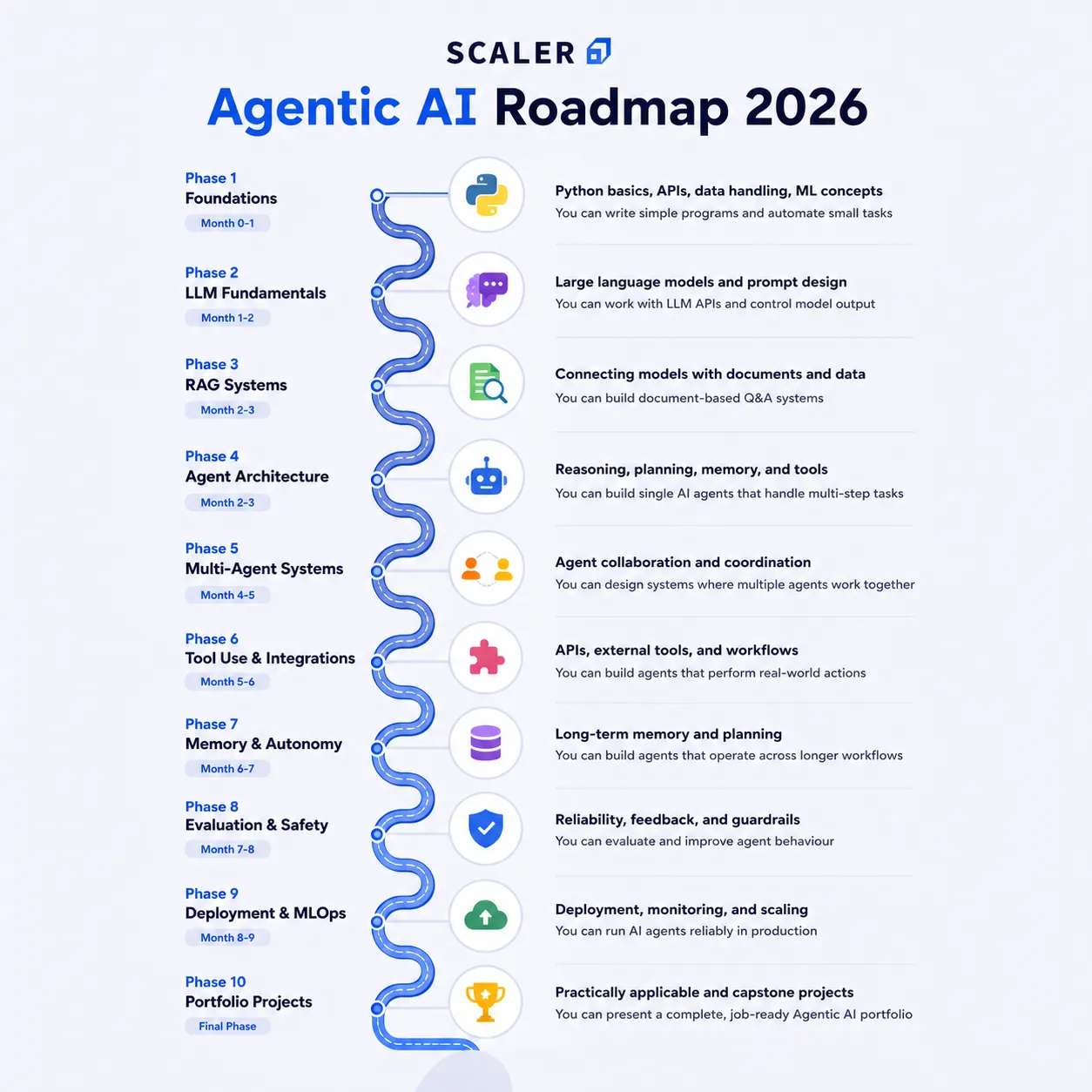
Complete Agentic AI Roadmap 2026 (Beginner to Advanced)
This section presents a step-by-step Agentic AI roadmap, perfect for beginners as well as experienced learners. You will see how agentic AI skills build over time, starting from core programming basics and moving toward capstone projects of AI agent development and deployment.
So, let’s begin!
Phase 1: Foundations for Agentic AI (Month 0-1)
In this phase, you will focus on building the basic skills required to start learning Agentic AI. The main aim here is to get familiar with programming, working with data, and understanding how AI systems connect with external services. These fundamentals will support everything you build in later phases.
Skills You Will Work On
- Python fundamentals for AI, including variables, functions, loops, and basic libraries
- APIs, JSON, and data handling, so you understand how AI systems send and receive information
- Basic machine learning and deep learning concepts, to understand how AI models work at a high level
You do not need advanced mathematics at this stage. You only need enough understanding to follow how models are used in real applications.
Tools You Will Use
- Python is the primary programming language for AI agent development
- Jupyter Notebook or Google Colab, to write, test, and run your code interactively
Mini Projects You Can Build
- An API-based chatbot that sends a request to a model and displays the response
- A data extraction or automation script that collects information and processes it using Python
By the end of this phase, you can write simple Python programs, work with APIs, and automate small tasks, which prepares you for learning large language models and AI agents in the next phase.



Phase 2: LLM Fundamentals and Prompt Engineering (Month 1-2)
Once you are done with foundational concepts, you can start working directly with large language models (LLMs). The focus here is to understand how these models process text and how you can guide their output using clear prompts. This phase will help form the base for building AI agents that rely on language models to reason and generate responses.
Key Concepts You Will Learn
- Tokenization and embeddings, which explain how text is broken down and represented inside a language model
- Prompt engineering fundamentals, so you can give clear instructions and control model output
- Working with large language models, including how they respond to inputs and generate results
You do not need to train models at this stage. You can focus on using existing models effectively.
Tools You Will Use
- OpenAI API, to interact with language models through simple API calls
- Hugging Face Transformers, to explore open-source models and understand their behaviour
These tools help you experiment with different models and prompts in a practical way.
Projects You Can Build
- A custom Q&A assistant that answers questions using a language model
- A prompt-driven task generator that creates structured outputs based on your instructions
By the end of this phase, you will be able to design effective prompts, work with LLM APIs, and build simple applications powered by language models, which will prepare you for retrieval systems and AI agents in the next phase.

Free Courses by top Scaler instructors
Phase 3: Retrieval Augmented Generation (RAG) Systems (Month 2-3)
In this phase, you will learn how to connect large language models with external information. Retrieval Augmented Generation, or RAG, allows AI systems to answer questions using your own documents and data instead of relying only on what the model already knows.
This phase is important for building AI agents that need accurate, up-to-date, or domain-specific information.
Core Concepts You Will Learn
- Vector embeddings and vector stores, which help convert text into searchable representations
- Chunking, indexing, and retrieval, so that large documents can be searched efficiently
- Building RAG pipelines, where retrieved information is passed to a language model
You will focus on understanding how information flows from documents to the model.
Tools You Will Use
- ChromaDB, to store and search document embeddings locally
- Pinecone, for managed vector storage at scale
- LlamaIndex, to connect data sources with language models
These tools help you build RAG systems without handling low-level details.
Projects You Can Build
- A PDF-based question answering system that answers questions from documents
- A domain-specific knowledge assistant trained on a focused set of data
By the end of this phase, you can build RAG-based applications that retrieve information from documents and use it to generate accurate responses, which prepares you for agent architecture and tool-based systems in the next phase.
Phase 4: Core Agent Architecture and Reasoning Systems (Month 3-4)
Once you are familiar with RAG, you will learn how AI agents are structured and how they make decisions. The focus will move from using language models to designing systems that can plan actions, use tools, and handle tasks across multiple steps.
This phase will help you understand how individual AI agents work internally before you move on to multi-agent systems.
Concepts You Will Learn
- Reasoning loops and decision-making, so an agent can decide what to do at each step
- Tool usage and action planning, which allows an agent to call tools and process results
- Reactive and planning-based agents, to understand different ways agents respond to tasks
- Short-term and long-term memory, so agents can store and reuse information during execution
These concepts explain how agents move from simple responses to structured workflows.
Frameworks You Will Use
- LangChain Agents, for building agents that can reason and use tools
- CrewAI, for designing agents with defined roles
- AutoGen, for building agents that communicate and coordinate
These frameworks help you implement agent logic without writing everything from scratch.
Projects You Can Build
- A research agent that gathers and organises information across steps
- A multi-step automation agent that completes tasks using tools and planning
By the end of this phase, you can design and build single AI agents that reason, plan actions, and complete structured tasks, which prepares you for working with multiple agents in the next phase.
Scaler Placement Report and Statistics
Scaler learners achieved 2.5x salary growth with average post-Scaler CTC reaching ₹23L.
 Google
 Amazon
 Microsoft
 Flipkart
 Adobe
1200+ more
Adobe
1200+ more
Phase 5: Multi-Agent Systems and Collaboration (Month 4-5)
In this phase, you will learn how multiple AI agents work together to complete larger tasks. Instead of building a single agent, you will design systems where agents take on different roles and collaborate toward a shared goal.
This approach is useful for tasks that involve research, decision-making, or parallel tasks.
Concepts You Will Learn
- Role-based agent design, where each agent focuses on a specific responsibility
- Agent communication, so agents can share information and coordinate actions
- Hierarchical and collaborative agent structures, to manage complex tasks efficiently
These concepts help you understand how agent teams operate as a system.
Tools You Will Use
- AutoGen multi-agent framework, to create and manage agent communication
- LangChain multi-agent modules, for coordinating multiple agents within workflows
These tools allow you to focus on system design rather than low-level communication logic.
Projects You Can Build
- A multi-agent research team where agents gather, review, and organise information
- Business process automation agents that divide tasks across multiple agents
By the end of this phase, you can build multi-agent systems where agents communicate and collaborate to solve complex problems, preparing you for advanced tool use and practical implementations in the next phase.
Phase 6: Tool Use, APIs, and Real-World Integrations (Month 5-6)
In this phase, you will have to focus on connecting AI agents with applicable tools and services. The goal is to help agents perform useful actions, such as searching information, executing code, or triggering workflows outside the AI system.
This phase shows how AI agents move from isolated systems to practical applications.
Concepts You Will Learn
- API chaining and orchestration, so an agent can call multiple tools in the correct order
- External tool usage, which allows an agent to interact with services beyond the language model
- Search, code execution, and browsing tools, to support tasks that require real-time information
These concepts help agents complete tasks that go beyond text generation.
Tools You Will Use
- LangChain toolkits, to define and manage tools used by agents
- OpenAI tool calling, to let models decide when to use specific tools
- Zapier integrations, to connect agents with everyday applications and workflows
These tools simplify how agents interact with external systems.
Projects You Can Build
- An AI-powered auto-notetaker that collects and organises information
- A task scheduling and workflow agent that manages actions across tools
By the end of this phase, you can build AI agents that use tools and APIs to complete real-world tasks, which prepares you for working with memory, planning, and long-running agents in the next phase.
Phase 7: Memory, Planning, and Autonomous AI Agents (Month 6–7)
At phase 7, you will learn how AI agents remember information and plan actions over time. The focus now must shift to building agents that can handle longer tasks, keep track of past interactions, and continue working without constant input.
This phase is important for creating agents that operate more independently.
Concepts You Will Learn
- Vector memory systems, which allow agents to store and retrieve information when needed
- Episodic and semantic memory, so agents can remember past actions and general knowledge
- Planning strategies, such as ReAct, MRKL, and Tree of Thought, to guide step-by-step reasoning
- State management, to track what an agent has done and what it should do next
These concepts help agents maintain context and make informed decisions.
Projects You Can Build
- A long-term memory AI agent that remembers and uses past information
- A self-improving research agent that refines its outputs over time
By the end of this phase, you can build AI agents that plan tasks, retain information, and operate across longer workflows, which prepares you for evaluating and improving agent performance in the next phase.
Scaler Alumni and Their Success Stories
Phase 8: Evaluating and Improving AI Agents (Month 7-8)
Now, you will focus on checking how well your AI agents perform and improving their behaviour. The goal is to understand whether an agent is giving reliable outputs and how to make it safer and more consistent over time.
This phase is important when AI agents start handling real tasks and decisions.
Concepts You Will Learn
- Agent evaluation metrics, to measure how accurately and reliably an agent completes tasks
- Hallucination control, to reduce incorrect or made-up responses
- Feedback loops and guardrails, so agents can learn from past results and follow defined limits
- Safety and constraint handling, to keep agent behaviour within acceptable boundaries
These concepts help improve trust and stability in AI systems.
Projects You Can Build
- A safety-evaluated AI agent that follows defined rules and checks its outputs
- A multi-stage agent evaluation workflow that tests agent performance at different steps
By the end of this phase, you can evaluate AI agents, improve their reliability, and apply basic safety measures, which prepares you for deploying and scaling agent systems in the next phase.
Phase 9: Deployment, Scaling, and MLOps for Agentic AI (Month 8-9)
In this phase, you will learn how to deploy AI agents and run them reliably in real environments. The focus shifts from building agents to making sure they work well at scale, stay stable over time, and remain cost-effective.
This phase prepares you for production-level agent systems.
Concepts You Will Learn
- Deployment pipelines, to move your AI agents from development to production
- Monitoring and logging, so you can track performance and detect issues
- Containerization and scalability, to run agents efficiently as usage grows
- Cost optimisation, to manage compute and API usage responsibly
These concepts help ensure your AI agents remain reliable after deployment.
Tools You Will Use
- FastAPI, to expose AI agents through APIs
- Docker, to package agents into reusable containers
- Kubernetes, to manage and scale deployments
- MLflow, to track experiments and system behaviour
These tools support long-term maintenance and scaling.
Projects You Can Build
- A production-ready AI agent API that serves various requests
- A scalable AI assistant microservice designed for higher usage
By the end of this phase, you can deploy, monitor, and scale AI agents in production environments, which prepares you for building a strong portfolio and real-world projects in the final phase.
Phase 10: Portfolio and Real-World Agentic AI Projects
In this final phase, you will focus on bringing everything together into a clear, job-ready portfolio. The goal is to show that you can design, build, and deploy agentic AI systems that solve real problems from start to finish.
This phase helps translate your learning into practical outcomes.
What Your Portfolio Should Include
- A RAG-based AI system that retrieves information from documents
- A tool-using AI agent that interacts with external services
- A multi-agent workflow where agents collaborate on tasks
- A memory-enabled agent that retains and uses past information
- A deployed production system that runs outside a local environment
Together, these projects demonstrate your ability to build complete agent-based systems.
Capstone Project Ideas You Can Build
- An AI executive assistant that supports daily work tasks
- An automated research lab that collects and organises information
- An AI business operations manager for workflow coordination
- A personal productivity AI agent that manages schedules and tasks
By the end of this phase, you can present a strong Agentic AI portfolio that reflects your development skills, making it easier for others to understand the scope and depth of your work.
Agentic AI Tech Stack: Tools and Frameworks Explained
This table summarises the core tools and frameworks used in agentic AI development. You will encounter these tools at different stages of the roadmap, depending on what you are building.
| Category | Tools | What You Will Use Them For |
| LLM & NLP Tools | OpenAI API, Hugging Face, LangChain, LlamaIndex | Working with language models and connecting them to data and tasks |
| Agent Frameworks | CrewAI, AutoGen, LangChain Agents | Building AI agents that reason, act, and collaborate |
| Memory & Vector Databases | Pinecone, ChromaDB, Weaviate | Storing and retrieving information for RAG and memory-based agents |
| Deployment Tools | FastAPI, Docker, Serverless platforms | Deploying, running, and scaling AI agents |
You do not need to learn every tool at once. As you follow the roadmap, you will naturally start using these tools when they become relevant to your projects.
Datasets for Agentic AI Knowledge and Evaluation
These datasets help you test, evaluate, and improve agentic AI systems, especially when working with document retrieval and question answering tasks.
| Dataset Type | Examples | What You Will Use Them For |
| Knowledge & Retrieval Datasets | Wikipedia dumps, ArXiv papers, OpenWebText | Building and testing RAG systems using large text collections |
| RAG & Evaluation Datasets | MS MARCO, question answering benchmarks | Evaluating retrieval quality and answer accuracy |
You can start with small datasets during development and use larger datasets only when you need deeper evaluation or broader coverage.
Career Outcomes After Learning Agentic AI
You do not have to worry about Agentic AI replacing your role, as it a skill that simply enhances your skill level.
You can apply these skills to work on more complex systems, automate workflows, and build AI-driven solutions within your existing or future roles.
Career Roles You Can Move Into
| Experience Level | Roles |
| Entry-Level Roles | AI Agent Developer, Generative AI Application Engineer |
| Mid-Level Roles | AI Automation Engineer, LLM Engineer |
| Senior Roles | Agentic AI ArchitectAI Systems DesignerApplied Scientist (AI Agents) |
As you gain experience, agentic AI skills help you move from building individual components to designing complete AI-driven systems used in real environments.
Explore these Roadmaps Also
Read These Important Roadmaps: More Paths to Career Success
FAQs: Agentic AI Self-Study Roadmap 2026
Do I need machine learning before learning Agentic AI?
You do not need deep machine learning knowledge to start. A basic understanding of how models work is enough in the beginning. As you progress, you will gradually learn the concepts needed to build and improve AI agents.
How long does it take to learn AI agents?
The timeline depends on your background and time commitment. Following a structured roadmap, most learners can build practical AI agents within six to nine months.
Which tools are required for AI agent development?
You will mainly use Python, large language model APIs, agent frameworks, and deployment tools. You do not need all tools at once, as each becomes relevant at a specific stage of the roadmap.
Can I get a job by learning Agentic AI independently?
Yes, it is possible if you focus on building real projects and a strong portfolio. Employers often look for practical experience with agent systems rather than only certifications.
