




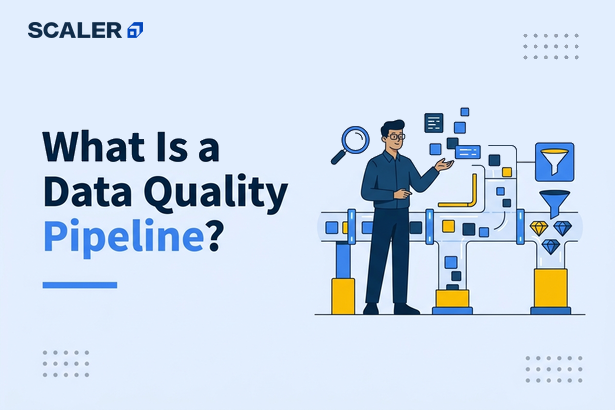
A data quality pipeline adds automated validation to a data pipeline so that incorrect, incomplete, stale, or unexpected data is detected before it reaches downstream systems. While a standard data pipeline focuses on moving and transforming data from sources to destinations, a data quality pipeline verifies that the data meets defined expectations at each important stage.
A reliable pipeline can include data quality checks for schema changes, null values, row counts, referential integrity, and data freshness. These checks help catch silent failures such as partial loads, unexpected source changes, or stale datasets before they affect dashboards, analytics, or machine learning models.
Data contracts provide another layer of reliability by defining enforceable expectations between data producers and consumers. They can specify schemas, quality rules, and freshness requirements, with violations triggering alerts or stopping a pipeline before bad data is published.
A practical data pipeline architecture typically places validation at ingestion, transformation, and publication boundaries. Tools such as dbt tests, Great Expectations, and Soda Core can automate these checks. Together, data quality pipelines and data contracts help teams build trustworthy data systems that are easier to monitor, maintain, and scale.
What Is a Data Quality Pipeline? Data Contracts for Reliable Data Pipelines
What is a data pipeline? It’s an automated system that moves data from one or more sources, transforms it into a usable shape, and loads it into a destination, a data warehouse, a dashboard, or a machine learning model. A typical data pipeline follows an Extract, Transform, Load (or increasingly, Extract, Load, Transform) sequence, running on a schedule or triggered by new data arriving.
A basic data pipeline moves data reliably from point A to point B. It says nothing, on its own, about whether that data is actually correct. That distinction, moving data versus moving trustworthy data, is exactly the gap a data quality pipeline exists to close.
Transform Your Career
Choose from our industry-leading programs designed for career success
Modern Software and AI Engineering Program
Master full-stack development with AI integration


 +1000 more
AI Forward Deployed Engineer with Specialisation in AI applications
Build and deploy AI solutions for real-world business problems
+1000 more
Modern Data Science and ML with specialisation in AI
Advanced data science techniques with AI specialization
+1000 more
Advanced AIML with Specialisation in Agentic AI
Deep dive into AIML with focus on Agentic systems
+1000 more
DevOps, Cloud & AI Platform Engineering
Build and manage AI-powered cloud infrastructure
+1000 more
AI Engineering Advanced Certification by IIT-Roorkee
Premier AI engineering certification from IIT-Roorkee

What Is a Data Quality Pipeline?
A data quality pipeline is a data pipeline with explicit validation logic built directly into it, checks that run at defined points, verifying the data meets expected standards before it’s allowed to proceed downstream. Instead of discovering a broken metric three weeks later because an executive dashboard looked wrong, a data quality pipeline catches the broken row at the moment it enters the system.
The failure mode a data quality pipeline prevents:
A NULL value slips into a column during ingestion. Nothing errors. The transformation layer processes it. The dashboard aggregates it. Three weeks later, a stakeholder asks ‘why is the metric off by 12%?’, and the answer traces back to that single NULL row that slipped through, undetected, at every stage.
This scenario, described consistently across 2026 data engineering guides, is exactly why ‘should we test our pipelines?’ is no longer a real debate among senior data engineers; the only live question is which data quality framework to use, not whether to use one at all.
Why Pipelines Fail Silently Without Quality Checks
Data pipelines fail silently when the failure happens upstream of the consumer who eventually notices something’s wrong. A schema change in a source system, a partial batch load, a broken upstream job, none of these necessarily throw a visible error. The pipeline runs, the job shows green, and bad data ships anyway.
- Schema drift: an upstream source silently adds, removes, or renames a column, and downstream transformations either break quietly or misinterpret the new shape
- Partial loads: a batch job completes ‘successfully’ but only processed half the expected rows due to an upstream timeout
- Referential breaks: a foreign key in one table no longer matches any row in its related table, silently corrupting downstream joins
- Freshness gaps: source data hasn’t actually updated in days, but the pipeline keeps running on stale data without any explicit staleness check
Data quality checks at every pipeline stage boundary are the primary defence against exactly these failure modes, catching them at the point of ingestion or transformation, rather than letting them silently propagate all the way to a business dashboard.
Data Pipeline Architecture: Where Checks Belong
A well-designed data pipeline architecture treats quality checks as a first-class part of the pipeline, not an afterthought bolted on at the end. The dominant pattern in 2026 places checks at every meaningful boundary a piece of data crosses:
| Pipeline Stage | What Gets Checked | Typical Tool |
| Ingestion (source boundary) | Schema shape, row counts, freshness of incoming data | Great Expectations, Soda Core |
| Transformation layer | Business logic assertions, referential integrity, not-null constraints | dbt tests, dbt native contracts |
| Publication (consumer boundary) | Final schema contract, SLA compliance before data reaches consumers | dbt contracts, data catalogs (e.g. DataHub) |
A common convention in this data pipeline architecture: dbt tests handle transformation-layer assertions since they live directly alongside the SQL models they validate, while Great Expectations is more commonly used for source boundary validation, where data arrives in less predictable shapes from external systems.
CTA: Build Smarter Data Pipelines for Modern Applications
Take your data engineering skills further with Scaler’s Data Science & ML Program. Learn data pipelines, data quality, and scalable data workflows through hands-on projects and industry-focused learning.
What Are Data Contracts?
A data contract is a formal, enforceable agreement between a data producer and its consumers, specifying schema, freshness expectations, and quality rules as testable commitments, not just documentation someone might read once and forget.
The distinction between data contracts and broader data governance is worth being precise about: governance sets broad standards for quality, access, and compliance across an organisation; a data contract translates those standards into a testable, enforceable commitment on one specific data asset. Governance is policy; a contract is code that actually runs and can fail a build.
The core design principle behind every serious data contract implementation:
Consumers should never be the first to discover a contract violation. Validation runs on the producer side, and the producer is notified, or the build simply fails, before or at the moment data would otherwise reach consumers.
The Data Contract Lifecycle
Implementing data contracts well follows a consistent, documented lifecycle across 2026 practitioner guides:
- Define the contract: schema, SLAs, and quality rules for a specific data asset
- Automate enforcement: incorporate schema validation, freshness tests, and data quality rules directly into the pipeline
- Publish and communicate: make the contract discoverable via a data catalog, so consumers know it exists and what it guarantees
- Monitor adherence: track schema changes, SLA violations, and downstream failures over time, not just at the moment of definition
- Govern versioning: apply version control to contracts, maintain backward compatibility, and notify consumers before breaking changes ship
A data contract that’s defined once and never monitored or versioned is, in practice, no better than a comment in a README, the enforcement and monitoring steps are what make it a genuine contract rather than aspirational documentation.
Data Quality Checks: What to Actually Test
Beyond the general principle of ‘test your data,’ a concrete, widely cited pattern for data quality checks covers four categories at every pipeline boundary:
| Check Type | What It Catches | Example |
| Row count assertions | Partial or failed loads | Today’s row count should fall within ±20% of yesterday’s |
| Null rate checks | Missing or corrupted required fields | A ‘customer_id’ column should never contain NULLs |
| Referential integrity | Broken relationships between tables | Every order’s customer_id should exist in the customers table |
| Freshness assertions | Stale or stopped upstream data | Fail the pipeline if source data is older than 24 hours |
A production data quality pipeline treats a failed check the same way it treats any other pipeline failure: halt the pipeline and alert the on-call engineer, rather than letting the job complete ‘successfully’ with quietly bad data behind it.

Free Courses by top Scaler instructors
Data Quality Framework Tools in 2026
2026 saw real movement in this tooling space, Great Expectations and Soda both changed hands or licensing, and dbt Labs merged into Fivetran, but the core data quality framework landscape remains anchored around three tools most teams evaluate.
| Tool | Model | Best For |
| dbt tests / native contracts | Warehouse-native, YAML config alongside SQL models | Transformation-layer assertions, teams already using dbt |
| Great Expectations (GX Core) | Python-native, declarative ‘Expectations’ + suites | Source boundary validation, deep profiling, ExpectAI auto-generated tests |
| Soda Core | YAML-first, SodaCL checks, optional Soda Cloud dashboard | Fast setup, CI/CD-embedded checks, business-user-friendly reporting |
dbt’s native data contract feature, available since dbt version 1.5, enforces schema and column-level constraints directly at model build time, a violation fails the build before the data is ever published, which is precisely the producer-side enforcement principle every serious data quality pipeline is built around.
Building a Data Quality Pipeline: A Practical Example
Here’s a simplified dbt-style contract and test, illustrating how schema enforcement and a data quality check work together in practice:
# models/schema.yml


models:

  - name: orders

config:

   contract:

     enforced: true

columns:

   - name: order_id

     data_type: int

     constraints:

       - type: not_null

       - type: unique

   - name: customer_id

     data_type: int

     tests:

       - not_null

       - relationships:

           to: ref('customers')

           field: customer_id
This single YAML block does two things at once: contract.enforced: true makes the schema itself a hard build-time contract, while the relationships test is a referential integrity check ensuring every order’s customer_id genuinely exists in the customers table. Running dbt test (manually, or scheduled in CI/CD) executes both, and a failure here halts the pipeline before bad data ever reaches a dashboard.
Ready to Build Production-Grade Data Pipelines?
Scaler’s Data Science & ML Program covers data engineering, pipeline architecture, and data quality practices hands-on, with real projects and 1:1 mentorship from engineers building production data platforms.
Scaler Placement Report and Statistics
Scaler learners achieved 2.5x salary growth with average post-Scaler CTC reaching ₹23L.
 Google
 Amazon
 Microsoft
 Flipkart
 Adobe
1200+ more
Adobe
1200+ more
FAQs: Data Quality Pipeline
Q1. What is a data quality pipeline?
A data quality pipeline is a data pipeline with explicit validation checks built in, catching schema, freshness, and integrity problems before bad data reaches dashboards or downstream models.
Q2. What is a data pipeline in simple terms?
What is a data pipeline: an automated system that moves data from a source, transforms it, and loads it into a destination like a warehouse or dashboard.
Q3. What is a data quality framework?
A data quality framework is a tool or methodology (like dbt tests, Great Expectations, or Soda Core) used to define, run, and enforce validation checks on data within a pipeline.
Q4. What are common data quality checks?
Common data quality checks include row count assertions, null rate checks on required fields, referential integrity checks between tables, and freshness assertions on source data.
Q5. What is a data contract, and how is it different from documentation?
A data contract is a testable, enforceable commitment on schema and quality that fails a build on violation, unlike documentation, which describes expectations without actually enforcing them.
Q6. Where should data quality checks live in a data pipeline architecture?
Data quality checks should live at every meaningful boundary in a data pipeline architecture, at ingestion, within transformation logic, and before final publication to consumers.
