





Contemplating whether Java is still relevant today?
Let’s review some recent industry statistics that highlight its massive, continuous footprint in modern software engineering.
As of May 2026, Java remains firmly among the top 4 most popular programming languages globally, according to the official TIOBE Index. In our modern tech ecosystem, Java’s extreme stability, security, and high performance make it the undisputed king of enterprise software, banking infrastructure, and high-scale cloud platforms.According to the latest global software engineering surveys, approximately 40% of technical recruiters globally actively list Java as a required skill, cementing it as one of the most consistently demanded languages for backend and full-stack engineering roles. In India’s rapid-growth digital economy, the demand for cross-functional software professionals specifically Full-Stack Java developers—has surged by 30-35% year-over-year
| Experience Level | Years of Experience | Skill Profile | Compensation Range (INR) |
| Junior / Entry-Level Developer | 0–2 Years | Core Java, basic backend understanding, foundational frontend exposure | ₹4,00,000 – ₹6,00,000 LPA |
| Mid-Level Developer | 3–6 Years | Strong backend (Spring Boot), frontend frameworks (React/Angular), cloud | ₹5,00,000 – ₹10,00,000 LPA |
| Senior Developer / Architect | 8+ Years | System design, distributed systems, cloud architecture, DevOps, leadership | ₹10,00,000 – ₹21,00,000+ LPA |
Given this robust job market and consistent salary growth, 2026 is an exceptional year to build a career as a Java Full Stack Developer, especially if you combine modern backend frameworks, microservice architectures, responsive frontend frameworks, and cloud-native deployment practices.If you are looking for a structured, hands-on path to master this extensive stack under the guidance of industry veterans, consider enrolling in the Scaler Full-Stack Developer Course. It is meticulously designed to take you from core programming concepts to advanced real-world applications.
Transform Your Career
Choose from our industry-leading programs designed for career success
Modern Software and AI Engineering Program
Master full-stack development with AI integration


 +1000 more
Modern Data Science and ML with specialisation in AI
Advanced data science techniques with AI specialization
+1000 more
Advanced AIML with Specialisation in Agentic AI
Deep dive into AIML with focus on Agentic systems
+1000 more
DevOps, Cloud & AI Platform Engineering
Build and manage AI-powered cloud infrastructure
+1000 more
AI Engineering Advanced Certification by IIT-Roorkee
Premier AI engineering certification from IIT-Roorkee

What is a Java Full Stack Developer & Why It Matters in 2026?
A Java Full Stack Developer is a highly versatile engineer capable of designing, building, and deploying a web application from end to end. They construct the backend business logic and databases using Java, Spring Boot 3, and Hibernate 6; design dynamic and responsive browser interfaces utilizing modern frontend libraries like React 19 or Angular 19; and orchestrate production deployments using cloud infrastructure, Docker, Kubernetes, and GitOps automation.
In 2026, the definition of "full stack" has evolved. Organizations no longer search for coders who simply write simple Java classes and generic HTML pages. Modern enterprises expect developers who are comfortable with:
- Microservice Architectures: Breaking monolithic codebases into decoupled, highly scalable services.
- Cloud-Native Environments: Utilizing containerization and cloud-managed databases (AWS, Azure, GCP).
- API-First Design: Architecting secure, efficient, and well-documented REST and GraphQL APIs.
- Continuous Operations: Managing Git, pull requests, automated test pipelines, and live app monitoring.
Because almost every major industry—from fintech and healthcare to global e-commerce platforms—runs on Java, becoming a Java Full Stack Developer gives you massive market leverage. The more layers of the software stack you can confidently manage, the more invaluable you become to prospective technical recruiters.
If you are interested in learning Java for your full stack journey, then do not worry! Almost all sectors and industries demand full-stack developers, and the more functions you can operate with their system, the more chances you have of being recruited.If you wish to have guided support, you can always check out Scaler’s Full Stack Developer Program for a more structured path of learning.
Who Should Follow This Roadmap? (Prerequisites)
This roadmap is specifically engineered for individuals determined to transition from basic scripting to building scalable, enterprise-grade software. It is ideal for:
- Complete Beginners: Aspiring coders who want a rock-solid, high-demand entry point into software engineering.
- Computer Science Students: Grads looking to bridge the gap between academic theory and actual production-ready stack implementation.
- Frontend Developers: UI specialists wanting to double their market leverage by mastering enterprise Java backends.
- Backend Engineers: Java developers needing to adopt React/Angular, containerization, and modern GitOps deployment pipelines.
Prerequisite Checklist:
- Basic Computer Literacy: Familiarity with command line environments, file systems, and general digital tools.
- Logical Reasoning: An affinity for step-by-step problem-solving and systemic thinking.
Note: Prior programming exposure (Python, JS, C++) is helpful, but the roadmap is structured to guide you from absolute scratch. This guide will not cover machine learning models, mobile app development, or advanced system design.
Core Skills & Technologies for Java Full Stack Developers
To establish yourself as a professional Java Full Stack Developer, you must build competency across both frontend and backend development, while understanding how applications are deployed and scaled in workspace environments.
Modern enterprise systems rely heavily on Java 17, Java 21, or Java 25 (LTS), Spring Boot 3, and Hibernate 6 on the backend. On the frontend, teams expect you to work with modern component-based libraries like React 19 or Angular 19, all of which help build dynamic and responsive interfaces styled with Tailwind CSS v4.0. Alongside this, cloud platforms, containerization, and CI/CD pipelines have become essential, since applications today must be scalable, reliable, and easy to deploy.
| Skill Area | Core Technologies Mastered | Practical Importance in 2026 |
| Java Backend | Java 17/21/25 (LTS), Spring Boot 3, Hibernate 6 | Enterprise readiness, asynchronous processing, strong type safety, scalable backend systems |
| Front-End Frameworks | React 19, Angular 19, Tailwind CSS v4.0, TypeScript | Building responsive, component-based, modern UI/UX interfaces |
| Database & APIs | PostgreSQL / MySQL, MongoDB, REST, GraphQL, Redis | High-performance data handling, caching strategies, API-first architecture |
| Cloud & DevOps | AWS, Azure, GCP, Docker, Kubernetes, CI/CD pipelines | Scalable deployments, automation, system reliability, cloud-native infrastructure |
| Full Stack Integration | Spring Cloud, Reactive Streams, Microservices architecture | Designing distributed systems, decoupled services, secure and resilient applications |
Java Full Stack vs MERN Stack — Which Should You Choose?
When deciding on a full-stack direction, developers frequently compare the Java Full Stack with the MERN (MongoDB, Express, React, Node) stack. Both are highly popular, but they serve very different business environments:
| Criteria | Java Full Stack | MERN Stack |
| Backend Language | Java (strongly typed, multithreaded runtime) | JavaScript / TypeScript (single-threaded async via Node.js) |
| Primary Frameworks | Spring Boot 3, Hibernate 6, Spring Security | Express.js, NestJS, Mongoose |
| Learning Curve | Steeper — requires OOP mastery, strict typing, and deeper system understanding | Gentler — single language (JS/TS) across frontend + backend |
| Job Market in India | Extremely high demand in enterprise, fintech, banking, and GCCs | High demand in startups, SaaS companies, and product agencies |
| Typical Salaries | ₹5.5L – ₹25L+ LPA | ₹3L – ₹22L+ LPA |
| Best For | Scalable enterprise systems, high security, heavy transaction platforms | Rapid development, MVPs, SaaS products, API-driven apps |
The Verdict: Choose Java Full Stack if you want to build a highly stable, exceptionally compensated career in banking, fintech, and multinational enterprise firms. Choose MERN Stack if you prefer working in early-stage, fast-paced startups on consumer-facing web applications.

Step-by-Step Roadmap to Becoming a Java Full Stack Developer
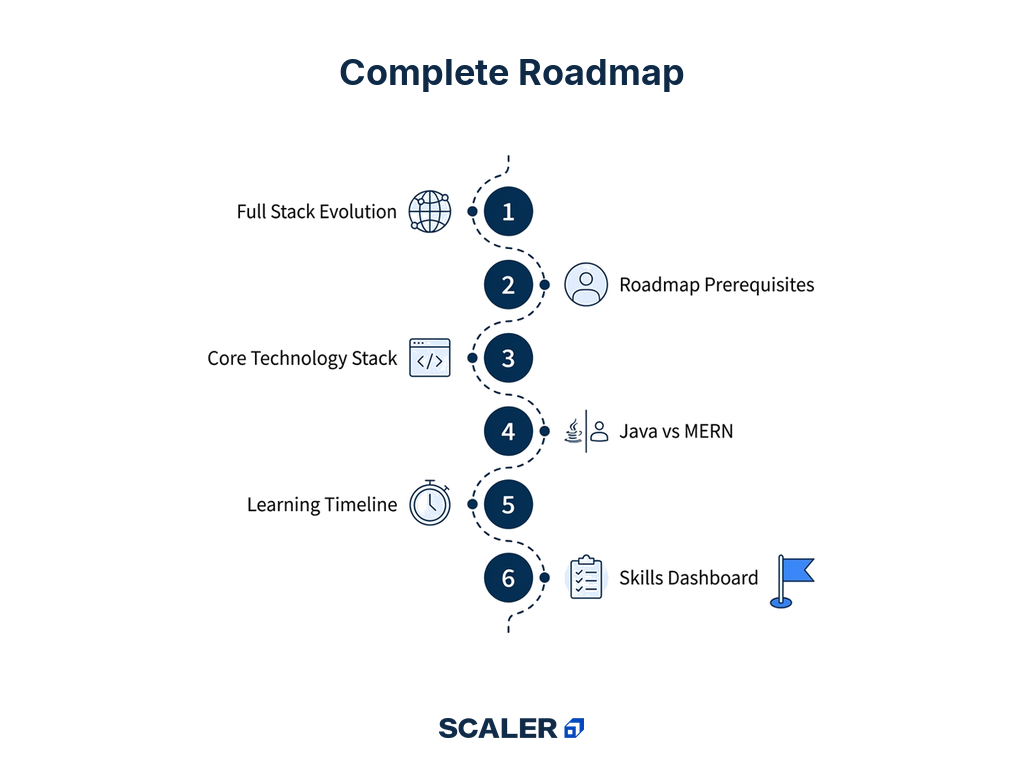
We recommend tackling this learning journey in six chronological phases, ensuring you master core programmatic concepts before introducing complex cloud orchestration.
| Phase | Duration | What You’ll Learn | Tools | Milestone Project |
| 1: Java Foundations | 4–6 Weeks | OOP Principles, Java 17/21/25 LTS, Collections Framework, Multi-threading | IntelliJ IDEA, Maven | Console-based Library / Bank CRUD Application |
| 2: Frontend Basics | 6–8 Weeks | HTML5 semantic markup, CSS3, ES6+ JavaScript, TypeScript basics, responsive design | VS Code, Git, GitHub | Static, fully responsive product landing page |
| 3: React / Angular | 4–6 Weeks | Components, Hooks, State management, Routing, consuming REST APIs | React DevTools, Axios, Vite | Single Page Application (SPA) consuming a public API |
| 4: Spring Boot Backend | 6–8 Weeks | Spring Boot 3 controllers, JPA/Hibernate, SQL schemas, Spring Security, JWT | Postman, PostgreSQL | Production-ready CRUD REST API with User Authentication |
| 5: Full Stack Integration | 4–6 Weeks | Connecting React to Spring Boot, handling CORS, JWT token storage, error handling | Docker, Postman | Multi-user Task Manager or Dynamic Job Portal App |
| 6: Cloud & DevOps | 4–6 Weeks | Docker containerization, AWS EC2/S3/RDS, GitHub Actions, Kubernetes basics | Docker Desktop, AWS CLI | Live deployment of full integrated application |
How Long Does It Take to Become a Java Full Stack Developer?
Becoming a job-ready full-stack developer depends heavily on your existing technical baseline and your weekly study commitment. In 2026, expect the following realistic timelines based on your background:
Scenario A: Absolute Beginner (No prior coding experience): Expect 10 to 12 months of consistent, daily commitment (15-20 hours/week). This allows you to comfortably digest programming logic, frontend visually interactive design, and backend relational database structures.
Scenario B: CS Graduate or Tech Professional: Expect 6 to 8 months of structured study. Since you already understand basic variables, loops, and databases, you can focus directly on framework syntax (Spring Boot, React) and cloud orchestration.
Scenario C: Experienced Backend Developer adding Frontend/DevOps: Expect 3 to 4 months of targeted upskilling. Your primary focus will be learning TypeScript, React state management, and configuring automated CI/CD pipelines.

Free Courses by top Scaler instructors
Java Full Stack Developer Skills Checklist
Use this checklist as a personal self-assessment dashboard. Identify your technical gaps as you advance through your roadmap:
Frontend Skills Checklist:
- HTML5 Semantic Layouts, SEO Metadata, and open-graph tags
- CSS3 Grid, Flexbox, Custom Properties, and responsive styling with Tailwind CSS v4.0
- Modern JavaScript (ES6+ array mapping, asynchronous promises, closures)
- TypeScript syntax, interface definitions, and static type configurations
- React 19 (Hooks, props, Context API) or Angular standalone components
- State Management (Redux Toolkit, Zustand, or RxJS)
- API Consumption (Axios, native Fetch API, handling CORS errors)
- Git version control, branching, committing, and pushing to GitHub
Backend & DevOps Checklist:
- Modern Java (Java 17/21/25 OOP, Streams API, multi-threading basics)
- Build & Package automation (Maven or Gradle configurations)
- Spring Boot 3 core concepts (Dependency Injection, Controllers, Configuration Beans)
- Spring Security & secure token-based JWT Authentication
- JPA / Hibernate 6 Object-Relational Database Mapping (ORM)
- Relational Schema Design (PostgreSQL / MySQL query indexing and joins)
- NoSQL Database basics (MongoDB document storage)
- Microservices Architecture principles (Spring Cloud Config, Gateway, and Eureka)
- Docker containerization (Dockerfiles, Docker Compose, local testing)
- Cloud deployment (AWS S3 static hosting, RDS managed DBs, and EC2 computing)
- CI/CD pipeline writing (GitHub Actions or GitLab pipelines)
Front-End Development with Java Full Stack
Frontend development focuses on building fast, accessible browser interfaces that communicate asynchronously with backend microservices via REST or GraphQL API protocols.
HTML, CSS & JavaScript Fundamentals
These three languages represent the visual foundation of the web:
HTML5 & CSS3: Design semantic layouts, fluid grid systems, responsive media queries, and utility-first styling with Tailwind CSS v4.0. Ensure your interfaces are accessible using ARIA attributes and WCAG guidelines.
Modern JavaScript (ES6+): Master Arrow Functions, Destructuring, Promises, and async/await syntax for seamless asynchronous operations.
Modern Front-End Frameworks
Once you understand vanilla JavaScript, transition into a major component-based framework:
React 19: The dominant frontend library globally. React 19 introduces major performance improvements, including asset loading, document metadata handling, and the React Compiler to automatically optimize component rendering.
Angular 19: Developed by Google, Angular is a comprehensive, highly structured framework favored by enterprises due to its strict architectural patterns. (Angular 19 utilizes modern standalone components and reactive Signals to minimize change detection overhead).
Scaler Placement Report and Statistics
Scaler learners achieved 2.5x salary growth with average post-Scaler CTC reaching ₹23L.
 Google
 Amazon
 Microsoft
 Flipkart
 Adobe
1200+ more
Adobe
1200+ more
TypeScript — Why It's Now Expected
In 2026, writing plain JavaScript in large-scale enterprise projects is a major liability. Companies almost universally require TypeScript—a typed superset of JavaScript that catches visual and variable bugs during compilation before code ever hits production servers.
TypeScript provides auto-completion, static analysis, interface contracts, and robust type safety. When building React or Angular apps, using TypeScript ensures your frontend components map precisely to your backend Java models, eliminating runtime parsing errors.
Back-End Development with Java
The backend manages your application's data layer, security credentials, and business logic. Modern backend engineering expects clean, asynchronous, and secure database interactions.
Java & Spring Boot Fundamentals
- Modern Java (Java 17/21/25): Master Object-Oriented Design, Collection Frameworks, Functional Streams, Concurrency, and Multi-Threading. Java 21 and 25 introduce Virtual Threads (Project Loom), enabling developers to write high-throughput, concurrent server applications with low resource footprints.
- Spring Boot 3: The undisputed standard framework for enterprise Java development. Master Dependency Injection, REST Controllers, Request Validation, and Spring Security configurations.
APIs, Databases & Microservices
- API Design: Build robust RESTful endpoints and explore GraphQL schemas for flexible data querying.
- Databases: Design relational database schemas using PostgreSQL or MySQL, and handle unstructured data using MongoDB.
- Object-Relational Mapping (ORM): Use Hibernate 6 and JPA to map Java classes directly to your relational database tables, optimizing queries with database indexing and caching.
- Redis Caching: Implement fast, memory-based Redis caches to store high-frequency, static data, reducing database lookup latency by over 90%.
Spring Security & JWT Authentication
Security is a non-negotiable backend responsibility. Modern full-stack applications use Spring Securit-y combined with JSON Web Tokens (JWT) to enforce secure, stateless user access.
When a user logs in, the backend validates their credentials, compiles a signed JWT token containing their user roles, and sends it to the frontend. The frontend stores this token (safely in HttpOnly cookies) and appends it to the header of every subsequent API request, allowing the Spring Security context to authenticate and authorize the action dynamically.
Microservices Architecture with Spring Cloud
As enterprise applications scale, managing a single massive "monolith" becomes highly restrictive. In 2026, leading organizations decouple applications into modular, independent Microservices.
To orchestrate these microservices, Java developers utilize Spring Cloud:
- Eureka Service Registry: Allows services to discover and communicate with each other dynamically.
- Spring Cloud API Gateway: Acts as a single entry point for all frontend requests, managing load balancing, routing, and security.
- Spring Cloud Config Server: Centralizes application configurations across all microservice instances.
- Event-Driven Communication: Integrate messaging tools like Apache Kafka or RabbitMQ to enable asynchronous, non-blocking communication between services.
Cloud, DevOps & Deployment for Full Stack Developers
To guarantee application reliability and scale server capacity dynamically, full-stack developers must understand containerization and cloud operations.
While you do not need to be a dedicated DevOps Engineer, mastering the basic deployment cycle ensures your software can run in production reliably.
| Operational Domain | Tools & Platforms | Core Purpose & Utility |
| Containerization | Docker | Packages Java runtime, frontend assets, and environment configs into portable containers that run consistently across any OS |
| Orchestration | Kubernetes | Automates scheduling, load balancing, auto-scaling, and self-healing of containerized applications at scale |
| Cloud Platforms | AWS, Azure, GCP | Provides infrastructure for virtual machines (EC2), managed databases (RDS), storage (S3), and scalable cloud services |
| Serverless | AWS Lambda, Azure Functions | Executes code on-demand without managing servers, ideal for event-driven and lightweight backend tasks |
| CI/CD Pipelines | GitHub Actions, Jenkins, GitLab CI | Automates build, testing, containerization, and deployment pipelines triggered by code commits |
| Monitoring & Logs | Prometheus, Grafana, ELK Stack | Tracks system health, logs errors, and visualizes real-time performance metrics like CPU, memory, and latency |
Recommended Tools & IDE Setup for Java Full Stack Developers
Before you begin coding, set up a professional, local development environment. Install and configure these tools in the following order:
- Java Development Kit (JDK 21 or 25 LTS): Install JDK 21 or 25 (Temurin or Amazon Corretto distribution) and configure your system path variables.
- IntelliJ IDEA (Community or Ultimate): The preferred, exceptionally powerful IDE for writing Java and Spring Boot.
- Visual Studio Code (VS Code): The lightweight, standard editor for frontend visual design, HTML, CSS, React, and TypeScript.
- Apache Maven: The dependency manager and package builder used to compile and build your Java backends.
- Postman: The standard API testing tool used to test and validate your RESTful controllers before connecting them to the frontend.
- Docker Desktop: Used to launch and run local databases (PostgreSQL, MongoDB, Redis) inside lightweight containers, eliminating local installation conflicts.
- Git & GitHub Desktop: Enforce version control, configure ssh keys, and connect local directories to your public GitHub profile.
Project Portfolio & Real-World Practice
Technical recruiters prioritize candidates who can demonstrate actual building capabilities. To stand out, construct 3 to 4 flagship, end-to-end full-stack projects and host them publicly on GitHub with clear documentation and live cloud demo links.
Flagship Project Specifications for Your Portfolio
| Project | Full Stack Tech Specs | Difficulty | Demonstrates to Interviewers | Build Time |
| Dynamic Job Portal App | React 19 + Spring Boot 3 + PostgreSQL + Spring Security + DockeSkipping JavaScript Fundamentals for React:r | Intermediate | Full-stack JWT authentication, secure file uploads (resumes), role-based access control (Employer vs Jobseeker), RESTful API design | 3–4 Weeks |
| Microservices Wallet System | Spring Boot Microservices + Spring Cloud + Apache Kafka + Docker + Kubernetes | Advanced | Distributed system design, service registry, API gateway, database isolation, asynchronous event-driven architecture | 4–6 Weeks |
| Resume Builder with PDF Export | React 19 + Spring Boot 3 + MySQL + iText PDF | Beginner–Intermediate | State management, backend PDF generation, structured data handling, REST API integration | 2–3 Weeks |
| Team Task Tracker | React 19 + Spring Boot 3 + PostgreSQL + JWT + GitHub Actions CI/CD | Intermediate | Full-stack authentication, real-time updates (WebSockets), automated CI/CD pipelines, secure deployment workflow | 3–4 Weeks |
Common Mistakes to Avoid When Learning Java Full Stack
To prevent frustration, avoid these common learning traps:
- React is a JavaScript library. If you do not understand closures, map filters, array destructurings, and promises, you will struggle with React.
- Neglecting Git and Version Control: Start committing your code from Day 1. Every project, even simple tutorial exercises, should be pushed to GitHub to build your activity history.
- Copying Spring Boot Code Blindly: Copying tutorials without understanding Dependency Injection or how beans are managed makes debugging architectural errors nearly impossible.
- Ignoring Database Optimization: Learn basic indexing and SQL query profiling. In interviews, you will frequently be asked to optimize slow queries and avoid N+1 query problems.
- Building Locally But Never Deploying: A project running locally has zero visibility. A live deployed application with an active URL on your portfolio carries immense weight in recruiter screens.
- Learning Too Many Frameworks Simultaneously: Do not jump between Spring, Micronaut, and Quarkus. Pick Spring Boot 3, go deep, and master it.
Scaler Alumni and Their Success Stories
Java Full Stack Developer Interview Preparation
Securing a Java Full Stack role in 2026 requires passing technical screens, coding tests, and systemic design interviews. Here are the core questions you must prepare for:
Frontend Interview Questions:
- What is the difference between Virtual DOM and Real DOM in React? How does React 19 handle DOM mutations?
- How does state management differ between the React Context API and Redux?
- What are the advantages of TypeScript over vanilla JavaScript in enterprise projects?
- How do you handle cross-origin resource sharing (CORS) errors on the frontend?
Backend & Database Questions:
- Explain the Dependency Injection (DI) and Inversion of Control (IoC) patterns in Spring Boot.
- What is the N+1 query problem in Hibernate, and how do you resolve it?
- Explain the differences between optimistic and pessimistic locking in database transactions.
- How do you configure Spring Security to enforce stateless JWT authentication?
- What is the difference between a monolithic and a microservices architecture?
System Design & DevOps Questions:
- How do Eureka and Zuul/API Gateway function inside a Spring Cloud microservice environment?
- What is the difference between a Docker Image and a Docker Container?
- How do you write a GitHub Actions YAML script to automate deployment to an AWS EC2 instance?
- Beyond theoretical questions, expect live coding rounds where you will be tested on data structures and algorithms (DSA). Use platforms like LeetCode or Scaler Problems to refine your analytical logic daily.
Career Paths, Roles & Salary Outlook for 2026
Acquiring a deep, multi-layered skill set in Java, databases, and cloud operations prepares you for several high-paying, high-influence roles across the global technology sector:
- Java Full Stack Developer
- Senior Backend Engineer / Spring Boot Architect
- Cloud Infrastructure / SRE Specialist
- Platform / Systems Software Engineer
| Experience / Role | Typical India Salary (INR) | Primary Tech Hubs (Bengaluru, NCR, Pune, Mumbai) |
| Entry-Level Java SDE (0–2 Years) | ₹4,00,000 – ₹6,00,000 | Can exceed ₹10,00,000 at top product companies |
| Mid-Level Java SDE (3–6 Years) | ₹5,00,000 – ₹10,00,000 | Commands premium packages with cloud, DevOps, and SRE skills |
| Senior Java Engineer (15+ Years) | ₹3,00,000 – ₹30,00,000+ | Elite architects often exceed ₹40,00,000+ in top firms |
| DevOps Cloud Architect / Lead / Specialist | ₹26,00,000 – ₹31,00,000+ | More, depending on company/stack |
Global and Remote Work Opportunities
For developers working with global companies, especially in remote international roles or developed markets like the US, compensation scales are exceptionally high. According to official salary data, Java Full Stack Developers working globally command annual base salaries ranging from $86,000 to $148,000+, depending on technical experience.
Conclusion
A successful career as a Java Full Stack Developer requires a deliberate balance of modern backend logic, responsive frontend libraries, databases, and automated cloud deployments. By mastering these core disciplines and building end-to-end project portfolios, you will develop the technical confidence and capabilities needed to solve the scaling challenges faced by modern enterprises.
If you are ready to bypass frustrating self-study and fast-track your progression under the direct mentorship of veteran tech leaders, Explore Scaler’s Full Stack Program to begin your journey today.
Career Advancement and Certifications
Scaler Academy’s Full-stack developer course is specifically engineered to prepare you to become a highly sought-after Java Full Stack Developer by providing:
An Industry-Vetted Curriculum: Master Java fundamentals, advanced data structures, microservice architectures, system design, and frontend libraries.
Live Interactive Classes: Learn directly from seasoned software engineers who have built high-scale systems at leading product companies.
Hands-On Case Studies: Build flagship, production-grade applications that replicate corporate engineering challenges to populate your portfolio.
1-on-1 Mentorship: Get direct support, code reviews, and career counseling from dedicated industry experts.
Elite Placement Assistance: Receive professional resume editing, mock interviews, and direct recruitment access with top-tier global tech giants.
Read These Important Roadmaps: More Paths to Career Success
Read These Important Roadmaps: More Paths to Career Success
Frequently Asked Questions
How do I become a full-stack developer in Java?
To become a Java Full Stack Developer, follow this progressive path:
- Master modern Java programming (Java 17/21/25) and core computer science data structures.
- Learn frontend fundamentals (HTML5, CSS3, ES6+ JavaScript) and master a framework like React 19 or Angular 19.
- Learn backend database modeling (SQL/PostgreSQL) and master Spring Boot 3 and Hibernate 6.
- Understand cloud and containerization basics (AWS, Docker, Kubernetes, and Git workflows).
- Build 2 to 3 end-to-end portfolio projects and host them publicly on GitHub.
- Java good for full-stack developers?
Yes! Java is an outstanding choice for full-stack engineering. It is highly secure, exceptionally fast, and scales seamlessly. Java's Spring Boot framework is the global standard for enterprise-level backend development, ensuring that skilled Java full-stack developers remain in continuous high demand with premium compensation packages.
- Is a career as a Java Developer a wise choice in 2026 and beyond in the era of AI?
Absolutely. While AI systems can write boilerplate code, they cannot design robust systems, manage complex database schemas, maintain secure APIs, or troubleshoot distributed cloud microservice outages. Java’s massive presence in enterprise infrastructure guarantees its longevity, and combining Java backend strength with AI-assisted workflows (like Copilot) simply increases your engineering leverage and productivity.
- Are there specific frameworks within Java that I should focus on for full-stack development?
On the backend, focus on Spring Boot 3, Spring Security, and Hibernate 6 (JPA). On the frontend, focus on React 19 or Angular 19, utilizing modern state management (like Redux, Zustand, or RxJS) to connect seamlessly to your Java APIs.
4.How important is knowledge of data structures and algorithms for a Full Stack Developer?
Data structures are the very first step in hiring interviews. Apart from interviews, they are crucial for understanding core programming concepts, problem-solving, and optimizing code efficiency. Strong DS&A skills enable you to design effective solutions and write better Java code. Platforms like InterviewBit, LeetCode, etc. can be used to enhance skills.
5.Is it necessary to specialize in a frontend framework like React or Angular as a Java Full Stack Developer?
While not mandatory, specializing in a framework like React 19 or Angular 19 is highly beneficial, as modern enterprise web interfaces are built as responsive Single Page Applications (SPAs) that interact with backend microservices asynchronously.
6.What is the average salary of a full-stack developer in India?
Varies based on experience, skills, location, and company. As of 2026, it ranges from ₹5.5 to ₹18 lakhs per year for early-to-mid-career professionals, with senior developers and microservice/cloud architects earning substantially more (regularly exceeding ₹25L–₹40L+).
7.How long does it take to get a job as a Java full stack developer?
Typically, once you complete the roadmap, expect 3 to 6 months of active, targeted job applications and interviews to secure a high-quality role, depending heavily on your portfolio strength and interview preparation.
8.Which companies in India hire Java full stack developers?
Top global recruiters include multinational financial institutions and service companies (TCS, Infosys, Wipro, Cognizant, Capgemini) as well as premium product-based tech companies and startups (Flipkart, PhonePe, Razorpay, Zepto, Amazon).
9.Java full stack vs MERN , which is better for freshers?
MERN has a gentler learning curve since you use JavaScript end-to-end; however, Java Full Stack has more stable, enterprise-level demand and higher compensation potential in long-term enterprise careers.
10.What certifications help a Java full stack developer?
Highly respected certifications include AWS Certified Developer – Associate, Oracle Certified Professional: Java SE Developer, and official Spring Professional Certifications.
11.Can I learn Java full stack without a CS degree?
Yes. Many successful developers are entirely self-taught or come from non-tech degrees. Having a proven portfolio of deployed projects and strong DSA problem-solving capabilities carries far more weight in recruitment than a physical degree.
12.How long does it take to get a job as a Java full stack developer?
Typically, once you complete the roadmap, expect 3 to 6 months of active, targeted job applications and interviews to secure a high-quality role, depending heavily on your portfolio strength and interview preparation.
13.Which companies in India hire Java full stack developers?
Top global recruiters include multinational financial institutions and service companies (TCS, Infosys, Wipro, Cognizant, Capgemini) as well as premium product-based tech companies and startups (Flipkart, PhonePe, Razorpay, Zepto, Amazon).
14.Java full stack vs MERN — which is better for freshers?
MERN has a gentler learning curve since you use JavaScript end-to-end; however, Java Full Stack has more stable, enterprise-level demand and higher compensation potential in long-term enterprise careers.
15.What certifications help a Java full stack developer?
Highly respected certifications include AWS Certified Developer – Associate, Oracle Certified Professional: Java SE Developer, and official Spring Professional Certifications.
16.Can I learn Java full stack without a CS degree?
Yes. Many successful developers are entirely self-taught or come from non-tech degrees. Having a proven portfolio of deployed projects and strong DSA problem-solving capabilities carries far more weight in recruitment than a physical degree.

