



According to the McKinsey & Company State of AI report, more than 70% of organizations are already using AI in at least one business function.
Large language models are driving much of this adoption. Tools like ChatGPT, Gemini, and LLaMA are being used for various activities such as coding, search, content generation, and internal workflows, while companies like OpenAI, Google, and Meta continue to expand their capabilities.
But the truth of the matter is that once you move beyond using these tools, the learning path seems to be scattered. You will come across prompting, embeddings, vector databases, RAG, fine-tuning, APIs, but they’re often explained separately, without showing how they fit into a system.
And this is exactly where most learners get stuck. And the reason is simple, that concepts being challenging isn’t the problem, but finding the connection between them ends up being confusing.
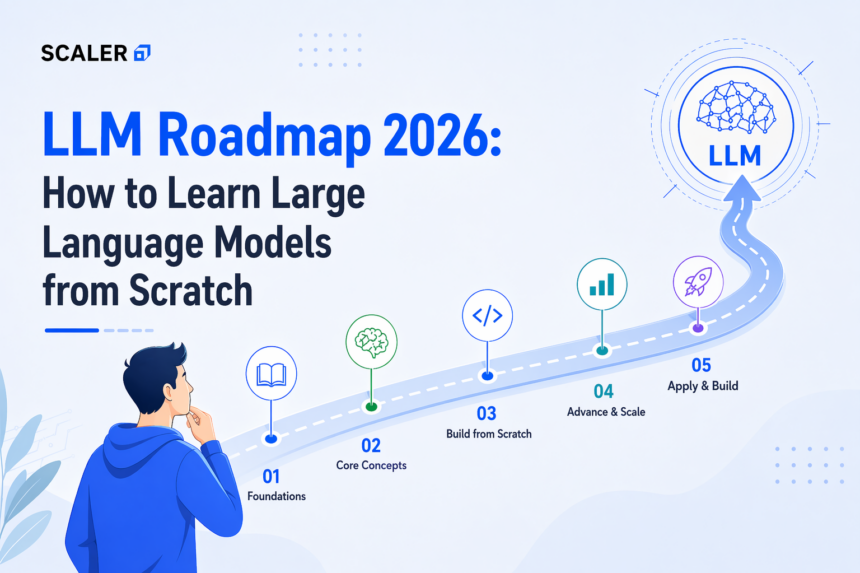
Hence, we have prepared this LLM Model roadmap, trying to solve this very issue in learning.
We’ll take this step by step over 16 weeks and focus on building along the way. By the end, you should be able to create your own LLM apps, deploy them, and actually use them in real-world projects.
If you want a broader roadmap, follow this:
How to Learn AI in 2026: Step-by-Step Roadmap from Beginner to Expert
How to Become an AI Engineer in 2025: Skills, Roadmap & Career Guide
Transform Your Career
Choose from our industry-leading programs designed for career success
Modern Software and AI Engineering Program
Master full-stack development with AI integration


 +1000 more
AI Forward Deployed Engineer with Specialisation in AI applications
Build and deploy AI solutions for real-world business problems
+1000 more
Modern Data Science and ML with specialisation in AI
Advanced data science techniques with AI specialization
+1000 more
Advanced AIML with Specialisation in Agentic AI
Deep dive into AIML with focus on Agentic systems
+1000 more
DevOps, Cloud & AI Platform Engineering
Build and manage AI-powered cloud infrastructure
+1000 more
AI Engineering Advanced Certification by IIT-Roorkee
Premier AI engineering certification from IIT-Roorkee

Why Learn LLMs in 2026?
A lot of developers already use LLMs while working. These models help with writing code, fixing bugs, answering questions, and handling data. Tools like GitHub Copilot have especially made it easier for coders than before.
Now, surely companies have noticed this too, and hence it has increasingly become an expectation to have familiarity with such models. It’s not just about knowing machine learning anymore. If you can build things like chatbots or simple AI tools using LLMs, that’s already useful in real projects. Following a proper llm roadmap helps you get there faster.
This is also why many developers are now trying to figure out how to learn llm in a way that can help them efficiently. The good part is that getting started is much easier now. You don’t need to train big models or have a research background. With APIs, open models, and simple tools, you can start building your own projects early and learn as you go.
Prerequisites for the LLM Roadmap
Alright! Just as it is important to understand basic math before starting complex equations, it is essential to have familiarity with some concepts to start off with LLMs as well.
A lot of people make the mistake of jumping straight into high-level tools like LangChain or ChatGPT wrappers without understanding the mechanics underneath. When the model starts hallucinating or your pipeline breaks, you’ll be left staring at an error message with no idea how to debug it.
Before getting into LLMs, you’ll need Python for working with text data, handling API calls, and managing dependencies. Basic async handling also comes up once model calls start slowing things down.
A basic understanding of how machine learning models work is enough here; models predict outputs based on patterns, training adjusts those predictions, and outputs are not always reliable.
From NLP, the focus is on how text is processed: tokenization, embeddings, and sequence prediction.
Before getting into the phases, you can look into a quick overview of the phases.
| Phase | Focus | What You Should Cover |
| Phase 1 (Weeks 1-4) | Foundations & Constraints | Transformer, Attention, Tokenization, Embeddings, VRAM, Quantization |
| Phase 2 (Weeks 5-10) | Working with LLMs | Prompting (Zero/Few/CoT), Fine-tuning (LoRA, QLoRA), RAG, Vector DBs, LangChain, LlamaIndex |
| Phase 3 (Weeks 11-16) | Production & Optimization | RLHF, Quantization, Inference (vLLM, TGI), Deployment, AI Agents |
| Projects | Hands-on | Prompt-based apps, RAG system, Fine-tuned model, Agent workflow |
| Goal | Outcome | Move from using APIs > building scalable LLM systems |
With that overview, we can go phase by phase in detail.
LLM Roadmap: Phase 1 Foundations (Weeks 1-4)
The first month is about understanding constraints. We start with the Transformer and Self-Attention because they are the literal reasons apps hit memory limits.
Once you understand why models weight specific tokens, we move to the plumbing: tokenization and embeddings. If you mess this up, your RAG retrieval will be garbage. We wrap up with the hardware, specifically VRAM and quantization. Knowing how to squeeze a 70B model onto a single GPU is a baseline requirement for moving past simple API calls and actually deploying products.
Transformer Architecture: Attention Is All You Need
We can’t map out an llm engineer roadmap without looking at why we stopped using RNNs. The old models were a total bottleneck because they processed text sequentially. They were slow, impossible to scale across GPUs, and constantly lost the plot in long sentences. The Transformer fixed this by ditching the left-to-right approach for Self-Attention. Now, the model just dumps the whole sequence into memory and weights every token against every other token simultaneously.
This is why we can parallelize training, but it’s also why our llm course roadmap is always hitting VRAM walls. Your compute cost scales quadratically with the context window, so the longer the prompt, the more your hardware struggles. It’s the first big reality check in any llm learning path: the architecture is powerful, but it’s a memory hog.



Tokenization & Embeddings Deep Dive
Once the architecture makes sense, the next step is understanding how text turns into data. Most of the strange model behavior starts here.
Tokenization: Computers don’t see words; they see tokens. It’s not just splitting by spaces; it’s sub-word chunks. If we don’t understand this, it’s hard to explain why models mess up spelling or why a single emoji can take up way more tokens than expected.
Embeddings: This is how text gets represented inside the model. We’re turning text into vectors in a high-dimensional space. If we don’t get how these vectors represent meaning, building things like search or RAG will mostly be guesswork. We should at least understand why “king - man + woman = queen” works.
Pre-Training vs Fine-Tuning vs Inference
Knowing where your work actually starts prevents you from burning your budget on the wrong tasks.
Pre-Training: Training from scratch is a million-dollar grind. Unless you have a massive GPU cluster, you are not doing it. You are just picking a base model that already knows how to speak.
Fine-Tuning: This is your day-to-day. You’re taking a base model and giving it a personality or specialized expertise (like legal jargon). You aren’t teaching the language; you're teaching it how to behave for your use case.
Inference: It is the production phase. This is where you face real-world headaches like latency, throughput, and GPU costs.
Don't waste weeks trying to train a model when you actually just need a better prompt or a smaller, quantized version for faster inference.
LLM Roadmap: Phase 2 - Working with LLMs (Weeks 5 -10)
This is the implementation phase, so you will be able to put your understanding to use. We will move beyond basic chat into Prompt Engineering techniques like Few-Shot and Chain-of-Thought to extract reliable logic, followed by Fine-Tuning via LoRA and QLoRA to specialize model behavior on a budget. A significant portion of this phase is dedicated to RAG (Retrieval-Augmented Generation), the industry standard for connecting LLMs to private data via Vector Databases. Finally, we use LangChain and LlamaIndex as the glue to handle boilerplate and transform simple scripts into production-ready applications.
Prompt Engineering: Zero-Shot, Few-Shot, Chain-of-Thought
In 2026, we’ve moved past treating prompts like magic spells. In a real llm engineer roadmap, your prompt is essentially a contract. If your contract is vague, your application breaks in production.
Zero-Shot: This is fine for low-stakes tasks like summarizing a Slack thread. But in a professional generative ai roadmap, zero-shot is a liability for anything structural. Without a reference, the model will guess your intended JSON schema or tone, and it will often guess wrong. If you’re getting inconsistent results after three tries, stop tweaking the adjectives and graduate to examples.
Few-Shot: It's the Production Standard. This is where you provide 3–5 gold standard input-output pairs. At Scaler, we teach this as the primary way to handle edge cases. If your model keeps failing on empty inputs or slang, you don't need a bigger model; you need a few-shot example that shows exactly how to handle that specific messy data.
Chain-of-Thought (CoT): Buying the Model Time to Think. For complex logic or multi-step math, asking for a direct answer is a recipe for hallucinations. By forcing the model to output its reasoning steps first, you’re essentially expanding its working memory. In an llm learning path, mastering CoT is the difference between a bot that looks smart and a system that actually produces reliable, verifiable logic.
The goal isn't just to get a good response; it's to get the same response every time. Small changes in structure or delimiters (like using XML tags to separate instructions from data) often do more for your large language model roadmap than switching models ever could.
Fine-Tuning LLMs: LoRA, QLoRA, PEFT
When prompting fails to deliver consistency, you need fine-tuning. Full-parameter tuning is usually a non-starter due to high memory costs and the risk of breaking the model’s reasoning. Instead, we use PEFT (Parameter-Efficient Fine-Tuning) to surgically update specific tasks:
LoRA (Low-Rank Adaptation): Instead of touching trillions of weights, you freeze the base model and train tiny adapter layers. This allows you to swap specialized behaviors in and out without massive compute overhead.
QLoRA: The practical choice for individual developers. It uses 4-bit quantization to shrink the memory footprint, allowing you to run training sessions on a single consumer GPU rather than a massive cluster.
These methods are usually used to lock in format and style. If your model won't stick to a rigid JSON schema or a specific technical dialect, you don't need a better prompt; you need an adapter.
RAG: Retrieval-Augmented Generation with Vector DBs
RAG is the standard for production because it stops models from hallucinating or using old info. Instead of the model guessing from its memory, you give it a search engine to look up your actual data.
You’ll use Vector Databases like Pinecone or Weaviate to store data as embeddings, which lets the AI search for meaning rather than just matching keywords. But the real challenge isn't the storage, it's the retrieval. Simple setups usually fail in the real world, so you’ll need things like hybrid search and re-ranking to make sure the model actually gets the right context.
In practice, RAG failures almost always come from poor data pipelines, not the model itself.
LangChain & LlamaIndex: The Glue Code
No one wants to write hundreds of lines of code just to handle chat history or fix a failed API call. That’s why we use these libraries. In 2026, LangChain and LlamaIndex are the glue that keeps your app together so it doesn't break the second a user asks a weird question.
LlamaIndex: If your project is all about searching through messy PDFs or company docs, you can start here. It’s built to help the model find the right info without you having to build a search engine from scratch. It’s the fastest way on this llm learning path to get a RAG system working with real data.
LangChain & LangGraph: The Control Freak LangChain is huge and can feel a bit messy, but it's the standard for a reason. In 2026, everyone is moving toward LangGraph. It lets you build agents that can actually think in loops, check their own work, and use other tools. It’s the core of any llm engineer roadmap where you need the AI to actually do stuff, not just chat.
The pro move isn't picking one; it's using both. Most people use LlamaIndex to find the data and LangGraph to manage the logic. These tools can be annoying to learn, but they save you from rewriting the same basic code for every single project in your large language model roadmap.
LLM Roadmap: Phase 3 - Advanced & Production (Weeks 11-16)
After practicing all the given oncpets, you can now move to advanced topics. It’s one thing to get a model to answer a question on your laptop; it’s another thing entirely to make it fast enough and cheap enough to actually ship to users. In this part of the llm engineer roadmap, we’re moving past simple chat windows and focusing on two things: making the model smarter (autonomy) and making it cheaper (optimization).
By the end of these six weeks, you’ll stop asking What can this model do? and start asking How do I keep this thing from breaking the bank? It’s the least flashy part of the llm learning path, but it’s the most important if you actually want to build a product that lasts.
RLHF & Alignment Techniques
In 2026, we don't just leave a model's personality to chance. Alignment is how we shift a model from smart but unpredictable to actually being useful for our specific use case. It’s essentially the ethics and vibe check.
We use RLHF (Reinforcement Learning from Human Feedback) or the simpler DPO (Direct Preference Optimization) to lock this in. Instead of just guessing with prompts, we show the model pairs of Good vs Bad responses. This is how we force it to follow strict safety rules or stick to a very specific brand voice. If we need our AI to stay professional and avoid certain topics, this is where we bake those rules directly into its brain.

Free Courses by top Scaler instructors
Model Quantization & Inference Optimization
Running a large model at full precision is too expensive for most hardware. Quantization fixes this by shrinking the model so it can actually run. It is like compressing a high-quality photo. You lose a tiny bit of detail, but the file becomes small enough to use.
If you want to run models locally on a laptop, you will use GGUF. This format is popular in tools like Ollama because it can split the work between your CPU and GPU. If you have an NVIDIA GPU and need speed, you should look at AWQ or EXL2. These formats keep the quality high while making the model much faster. Mastering these formats is how you run powerful AI without spending a fortune on hardware.
Deploying LLMs: APIs, vLLM, TGI
Fitting a model on your hardware is only half the battle. If you use a basic Python script, your first user might be fine, but the second one will be stuck waiting for a minute while the model finishes its first task. To handle multiple users at once, you need a proper inference engine.
The API Route (OpenAI, Anthropic, Gemini): This is the move for 90% of our projects. We don’t worry about VRAM or CUDA versions; we just pay per token. It’s perfect for prototyping, but once we scale, the lack of control and the monthly bills can become a bottleneck.
The Self-Hosted Route (vLLM, TGI, SGLang): If we need data privacy or want to optimize costs at high volumes, we host the model. But a basic Python script won't work in production; it'll freeze after one user. We need a serving engine to handle concurrent traffic:
vLLM: This is the industry standard. It uses PagedAttention to stop memory fragmentation, letting us fit way more users onto a single GPU. If we're building a standard chat app, we start here.
TGI (Text Generation Inference): The Hugging Face standard. It’s rock-solid and has the best integration with the HF ecosystem. If we need something easy to monitor and just works with minimal tuning, this is the one.
SGLang: It's the speed demon for agents. In 2026, it’s outperforming vLLM by about 30% in throughput. It uses RadixAttention for automatic prefix caching, meaning if our agent has a massive system prompt or a long chat history, it doesn't have to re-read it every time. It’s nearly instant for multi-turn conversations.
The important point is that without these engines, your app is a demo, not a service. We use these tools so the second user isn't stuck waiting for a minute while the first user's request finishes.
Scaler Placement Report and Statistics
Scaler learners achieved 2.5x salary growth with average post-Scaler CTC reaching ₹23L.
 Google
 Amazon
 Microsoft
 Flipkart
 Adobe
1200+ more
Adobe
1200+ more
Building AI Agents & Multi-Agent Systems
When you give a model the ability to use tools, the complexity shifts from writing a good prompt to managing a process. Instead of just asking for a summary, an agent can find a document, check your database for context, and then trigger an email with the results.
Multi-Agent Systems: In a production environment, one giant model often gets overwhelmed by complex instructions. We now use frameworks like LangGraph or CrewAI to break tasks into specialized roles. You might have one Researcher agent, one Coder, and a Reviewer who looks for bugs. They work together to catch mistakes before they ever reach the user.
The Practical Side: The real challenge here isn't the AI, it's the engineering. You have to build guardrails to prevent infinite loops, where an agent gets stuck calling the same tool over and over. Mastering observability (tracking every step the agent takes) is what separates an experimental script from a reliable system that can be trusted with real-world tasks.
This is the peak of the llm engineer roadmap. It’s the point where you stop building cool demos and start building autonomous software that can handle a task from start to finish.
Top LLM Models to Know: GPT, Llama, Mistral, Claude, Gemini
- GPT-5.4 (OpenAI): The smartest brain available. It’s the go-to for high-end reasoning and complex agents that need to stay on track. The catch is that it's expensive. Use it when you need a Senior Architect level of thought and can afford the API bill.
- Claude 4.7 (Anthropic): The favorite for coding. It’s famous for being honest; it's less likely to hallucinate or be overly chatty than GPT. If you’re building a dev tool or need a model that follows strict rules, this is the gold standard.
- Llama 4 (Meta): The king of open-source. It uses a Mixture-of-Experts (MoE) architecture, making it incredibly fast. Use this if you want to host the model on your own hardware to keep your data private or avoid API rate limits.
- Gemini 3.1 (Google): The memory king. While others talk about thousands of words, Gemini handles millions. Use this for Long Context tasks like uploading a 10-hour video or a 2,000-page PDF and asking questions about a single detail inside it.
- Mistral Large 3 (Mistral AI): The lean and mean choice. It’s a European favorite that focuses on efficiency. It’s perfect for high-speed, reliable production apps where you need high intelligence without the lag of a massive model.
Scaler Alumni and Their Success Stories
Read These Important Roadmaps: More Paths to Career Success
FAQs
1. How long does it take to learn LLMs?
You can hack a basic wrapper in a weekend, but becoming an actual engineer takes about six months. You’ll spend the first half dealing with the unglamorous stuff, fixing data shapes, mastering Python async, and figuring out why models act weird. By month four, you’re usually ready to handle fine-tuning and agentic loops. The goal is just to get to the point where you can see a new tech update on Friday and know exactly how to implement it by Monday.
2. Do I need a PhD to work with LLMs?
Unless you’re trying to invent the next Transformer at OpenAI, a PhD isn't a requirement. The industry is split between researchers and the engineers who actually build stuff. Most companies are hiring for the latter. Companies care less about your degree and more about whether you can actually ship a RAG pipeline and keep the GPU bill from exploding. Being a builder with a portfolio of working projects wins every time.
3. What is the difference between GPT and Llama?
It’s the difference between renting a brain and owning one. GPT is the easy route; you just hit an API and get a smart result without worrying about the hardware. It's great for testing ideas fast. Llama is for when you want to own the process, keep your data private, and stop paying massive API bills. The move is usually to start with GPT to see if the idea even has legs, then jump over to Llama once the API bills get scary or you need to lock the data down.
4. What is RAG and why is it important?
Think of RAG as giving the AI an open-book exam. Standard models have a knowledge cutoff; they don't know what happened yesterday or what's in your private folders. RAG fixes this by letting the model search your PDFs or databases for the answer before it speaks.
In 2026, this is the industry standard because it's the best way to kill hallucinations. Instead of guessing, the AI is forced to use your specific facts. It’s also cheaper and faster than retraining; when your data changes, you just update the file. Most companies don't need a custom model; they just need one that can talk to their data without making stuff up.
5. How much math do I need for LLMs?
You can skip the whiteboard equations, but you can’t be totally math-blind. It’s all about intuition now. You need enough Linear Algebra to understand how words turn into vectors for RAG, and enough Probability to get why a model picks one word over another. Don’t waste time on Calculus proofs; libraries like PyTorch do that for you. You just need to understand the vibe of how models learn so you can actually troubleshoot when a fine-tuning session starts crashing.
