MBA for Tech
Career Options After BCA: Jobs, Higher Study, Salaries and How to Choose
A BCA is more than a pathway into entry-level IT jobs. Whether you want to become a software developer, work in data or cybersecurity, pursue an MCA or MBA, explore non-coding tech roles, or prepare for government exams, this guide covers the career options, salary expectations, and key factors to help you choose the path that best fits your skills and goals.
Team SSB
5 min. read

Two doubts follow a lot of BCA graduates. The first is a nagging sense that a three-year BCA is somehow a lesser technology degree than a four-year BTech, and that software companies will always prefer the engineer. The second is the assumption that you must do an MCA before anyone will take you seriously. Both deserve an honest answer, because they shape how you read every option below.
Here it is: for most software, web and IT roles, a BCA graduate who can genuinely build things competes directly with a BTech graduate, because technology hiring rewards what you can demonstrate far more than the label on your degree. And an MCA is one strong option among several, not a gate you must pass through. Seen that way, the career options after BCA are wide and, unusually, quite job-ready from day one. This guide maps the five routes, shows what each looks like for a computer-applications graduate, answers the MCA question honestly, and helps you narrow the field, whether or not you want to spend your career writing code.
At a glance. A BCA opens five routes: a job now, higher studies, professional certifications, government and competitive exams, and entrepreneurship. Three honest points run through them: a BCA competes with a BTech on demonstrable skill for most software roles, an MCA is optional rather than mandatory, and there are genuine non-coding paths for graduates who would rather not spend their days programming. |
The Five Routes After BCA
A computer-applications graduate's options land more clearly as five directions than as a scattered list of job titles. Nearly everything worth considering fits one of them, with a single honest difference from an engineering degree worth naming up front.
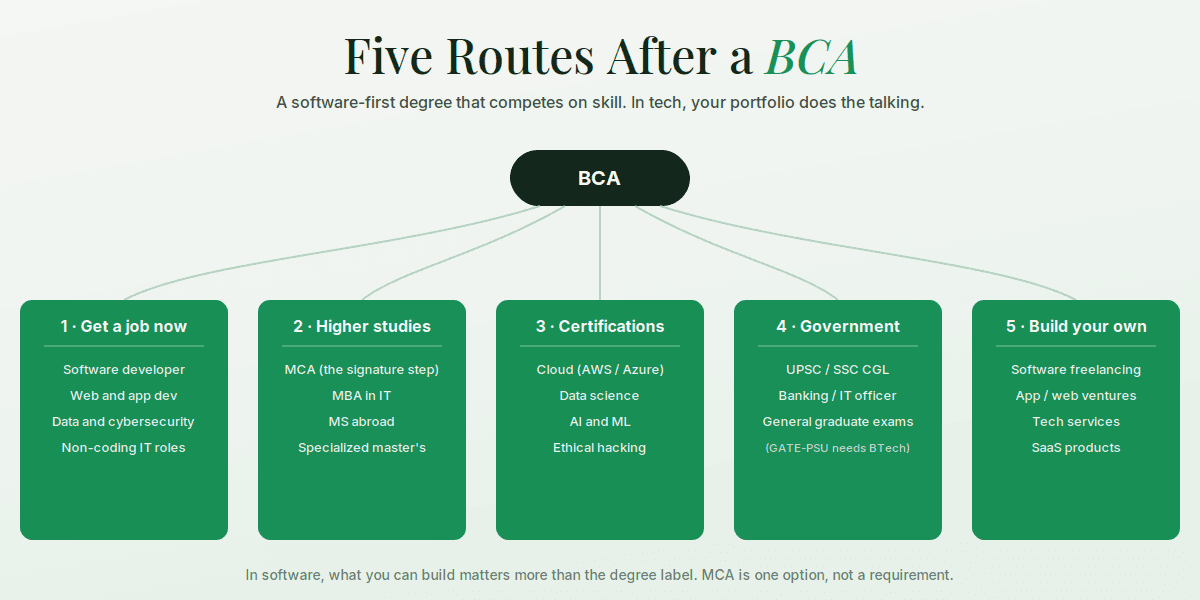
Those five directions are: taking a job now, going on to higher study, adding a professional certification, sitting for government and competitive exams, or building something of your own. The honest difference: the government route is thinner for a BCA than for an engineer, since the GATE-based PSU and engineering-services track is reserved for engineering graduates. More on that in its section.
Route by Route, What Each Looks Like After BCA
Route 1: Get a job now, coding and non-coding
A BCA is directly job-ready in the IT sector, and companies like TCS, Infosys, Wipro, Accenture and Cognizant hire computer-applications graduates into entry-level roles every year. The first real fork is between coding-heavy roles and the genuine non-coding paths the usual guides overlook.
Software, web and app development. Building and maintaining applications and websites with languages and frameworks like Java, Python, JavaScript and React. This is the core BCA job, and a strong portfolio here competes directly with an engineering graduate. A software focus pairs well with an MBA, later if you want to move toward the business side.
Data and cybersecurity. Data analyst roles (SQL, Excel, Python, a visualization tool) and cybersecurity roles (ethical hacking, network security) are strong, well-paid entry points for a BCA graduate with the right skill.
Non-coding IT roles. If you enjoy technology but not programming, there are real paths: business analysis, software testing and QA, UX design, technical writing, IT support and project coordination, and digital roles. A BCA’s technical literacy is an asset in all of them, without a line of production code.
The honest note. In software, the portfolio is the qualification. A BCA graduate with real projects, a GitHub, a working app, a live dashboard, is judged on that work, not on whether the degree said BCA or BTech. The degree gets you the interview; what you can build gets you the job. |
Route 2: Higher studies, with MCA as the signature step
If you want to deepen your expertise or pivot, further study is a strong route, and for a BCA the MCA is the natural, degree-specific progression, though it is a choice rather than a requirement.
MCA. The classic next step after a BCA, deepening software development, systems and emerging technologies, and helpful for senior technical, architect and some product-company roles. It is genuinely useful, but not mandatory, plenty of BCA graduates build strong careers without it.
MBA in IT or management. The business pivot, into IT project management, product management or business analysis, for the graduate who wants to move from building software to leading the teams and products around it. Our guide to an MBA after BCA covers this.
MS abroad. An MS in computer science or a related field abroad offers global exposure and advanced technical depth for those aiming at international roles.

Route 3: Professional courses and certifications
For a BCA graduate, a targeted certification is one of the highest-return moves available, and can meaningfully raise a fresher package. Cloud (AWS, Azure), data science, AI and machine learning, ethical hacking and full-stack development each take months rather than years and prove a specific, in-demand skill. Because software hiring is skill-first, a certification plus real projects often does more for your prospects than another degree.
Route 4: Government and competitive exams (lighter for a BCA)
Here is the honest, degree-specific difference. A BCA is a recognized bachelor’s degree, so you are eligible for the general-graduate government exams, but not for the engineering-only track that BTech graduates get.
Open to you. UPSC Civil Services, SSC CGL, and banking exams like IBPS and SBI PO, including specialist IT-officer roles in public-sector banks, are all open to a BCA graduate.
Not open to you. The GATE-based PSU technical recruitment (ONGC, BHEL, NTPC and the like) and the UPSC Engineering Services Examination generally require an engineering degree, so they are not a BCA route. It is better to know this honestly than to chase an ineligible path.
Route 5: Entrepreneurship and independent paths
Software is one of the most accessible fields in which to work independently or build something. Freelance development, app and web projects for clients, a small tech-services business, or a SaaS product are all reachable with a BCA and a real skill, and many start while still building their portfolio. The low capital cost of software makes this one of the more realistic entrepreneurial routes of any degree in this series.
Job Now, or Study More? Do You Actually Need an MCA?
Everything above circles back to this one question, so it deserves a straight answer instead of the reflexive "obviously, do MCA."
You can build a strong IT career without MCA. Because a BCA is job-ready and software hiring is skill-first, you can start now, prove yourself on real work, add targeted certifications, and rise through experience. Many capable developers and IT professionals never did an MCA; they built a portfolio and a track record instead.
MCA helps in specific situations. It deepens technical expertise and can matter for senior technical and architect roles, for teaching, and to clear the filters some product companies apply. It is worth doing when depth is genuinely your goal, and an expensive detour when taken only because it is the expected default.
Put plainly: an MCA is a useful option, not a turnstile you have to pass through. A BCA with a demonstrable skill attached holds its own, which is exactly why the "you must do MCA" assumption is worth questioning before you sign up for two more years of it.
How to Choose Your Path: A Filter
Five routes is more than anyone can hold at once, so let a few blunt questions do the narrowing.
Coding, or non-coding? If you enjoy programming, development, data and cybersecurity roles fit. If you like technology but not coding, business analysis, testing, UX, technical writing and IT project roles are genuine paths, do not force yourself into development if it is not for you.
Technical depth, or a business pivot? Depth points to MCA, an MS and specialist technical roles; a business pivot points to an MBA, product management and consulting.
Earn now, or study more? If you want income and experience, a job plus certifications starts you sooner. If depth is genuinely your goal, an MCA or MS is worth the time.
Stability, or growth? The general-graduate government and banking route offers stability; private tech, startups and freelancing offer faster growth and more variance.
Stay technical, or move toward product and management? Staying favors development and MCA; moving favors product, business analysis and the data-analyst or management routes.
Work through those and the five usually come down to one or two that actually fit, which beats scanning the full list of every job a BCA can lead to.
Salaries at a Glance
Pay after a BCA varies by role, skill and city, so treat these as indicative starting points, and read the higher figures as skill- and experience-dependent rather than automatic.
Route / role | Indicative entry range (India) | Notes |
|---|---|---|
Software / web developer | ~₹3–6 LPA | Rises fast with a strong portfolio |
Data analyst | ~₹4–7 LPA | Higher with SQL and Python depth |
Cybersecurity | ~₹5–8 LPA | Certifications lift this notably |
Non-coding IT (BA, QA, support) | ~₹3–6 LPA | Business analysis pays at the top |
Post MCA / MBA | ~₹5 LPA and up | Depends on skill and institute |
On the common question of whether a BCA graduate can earn a lakh a month: yes, it is reachable, but usually through a specialized, in-demand skill (cloud, data, cybersecurity) with a few years of experience, or a strong role at a product company, not at entry. The skill, not the degree alone, gets you there.
The Skills That Actually Get You Hired
For a BCA graduate this idea is sharper than for almost any other degree, because in software the portfolio genuinely is the qualification. India's employability research, the annual India Skills Report among it, has for years put the share of graduates rated job-ready at only around half, and in technology the gap is almost always a matter of demonstrable skill, not the degree. A BCA graduate who can show real work competes with anyone.
In practice that means concrete, showable things: a language and framework stack with projects behind it; a cloud or data or cybersecurity certification with something you built; a GitHub or a live application; and, for the non-coding paths, a portfolio of analysis, testing or design work. A focused certification plus real projects moves a BCA graduate past most of the field, and often past the degree-label question entirely.
For the BCA graduate whose interest is drifting from writing code towards product management or running a business, it is worth knowing a newer kind of program exists: one that selects on your profile rather than an entrance exam and lets students build and run real ventures instead of only studying them.
Scaler School of Business is one of these. To be honest upfront, it grants a PGP certificate rather than a UGC degree, and it belongs beside the routes above as one option, not a replacement for them.
Frequently Asked Questions
Q1. Is a BCA as good as a BTech?
A: For most software, web and IT roles, yes, provided you can demonstrate real skill. Technology hiring rewards what you can build over the degree label, so a BCA graduate with a strong portfolio competes directly with a BTech graduate. The main difference is that a BTech opens the engineering-only GATE-PSU and engineering-services government track, which a BCA does not.
Q2. Do I need to do MCA after BCA?
A: No. An MCA deepens technical expertise and helps for senior technical, architect and teaching roles, but it is not mandatory. Many BCA graduates build strong IT careers through a job plus certifications and a portfolio. Do MCA if depth is genuinely your goal, not because it is the assumed next step.
Q3. Can I get a job after BCA without coding?
A: Yes. Business analysis, software testing and QA, UX design, technical writing, IT support and project coordination, and digital roles all value a BCA's technical literacy without requiring you to write production code. If you like technology but not programming, these are genuine, well-paid paths.
Q4. Can I earn 1 lakh a month after BCA?
A: Yes, it is reachable, though usually not at entry level. It typically comes from a specialized, in-demand skill such as cloud, data or cybersecurity with a few years of experience, or a strong role at a product company. A demonstrable skill, not the degree alone, is what gets you there.
Q5. What government jobs can I get after BCA?
A: A BCA qualifies you for general-graduate exams: UPSC Civil Services, SSC CGL, and banking exams like IBPS and SBI PO, including specialist IT-officer roles. Note that the GATE-based PSU technical track and the Engineering Services Examination generally require an engineering degree, so they are not open to BCA graduates.
Q6. Which is better after BCA, MCA or MBA?
A: They serve different goals. An MCA deepens technical and software expertise; an MBA moves you toward management, product and business roles. Choose MCA for technical depth and an MBA for a business pivot, based on whether you want to keep building software or lead the teams and products around it.
Q7. What is the best specialization after BCA?
A: Data science, artificial intelligence, cloud computing and cybersecurity are among the most in-demand and fastest-growing specializations for a BCA graduate, whether through a certification or an MCA specialization. The best one is where your interest meets a growing, skill-hungry field.
Q8. Does a BCA have a good future?
A: Yes. Demand for software, data, cloud and cybersecurity skills continues to grow, and a BCA is a recognized, job-ready route into all of them. As with any technology career, the future is strongest for graduates who keep building demonstrable skills rather than relying on the degree alone.
The Bottom Line
A BCA is not a lesser technology degree. It is a job-ready route into software, data, cloud and cybersecurity, and for most of those roles a BCA graduate who can demonstrably build competes with anyone, because technology hiring rewards skill over the label on the certificate. An MCA is one strong option, not an obligation, and there are real paths for graduates who would rather not spend their days coding. Narrow the five routes by whether you want to code, how deep you want to go, and what you actually enjoy, then build the portfolio that proves it. In software more than anywhere, what you can build is what turns a BCA into a career.

Non-IIM MBA
Top Non-IIM MBA Colleges in Bangalore (2026): Fees, Placements & How to Choose
5 min. read
MBA for Professionals
Is an MBA Worth It for Working Professionals? An Honest 2026 Guide
5 min. read

MBA for Engineers
MBA After B.Tech (2026): Eligibility, Specializations, Salary & Is It Worth It?
5 min. read
MBA for Engineers
MBA After Engineering (2026): Eligibility, Specializations, Salary & Is It Worth It?
5 min. read