
MBA for Engineers
MBA After Engineering (2026): Eligibility, Specializations, Salary & Is It Worth It?
Considering an MBA after engineering? This guide explains eligibility, entrance exams, specialization options, career paths, salary potential, ROI, and the key differences between an MBA and a technical master’s. It also covers full-time, one-year, executive, online, and no-CAT routes to help engineers choose the right path based on their experience and career goals.
Team SSB
5 min. read
Engineering teaches you how things work. At some point, many engineers want a say in what gets built, why, and for whom, and that means stepping out of execution and into the decisions, budgets and teams behind it. An MBA is one of the most established ways to make that move, and it applies whether you came through a B.Tech, a B.E. or a diploma-to-degree route.
Whether it is the right step depends on what you want from it. This guide covers an MBA after engineering for 2026 in full: who is eligible, how an MBA compares with a technical master’s, which specialization suits your goal, the salary and roles it opens, the routes that skip the CAT, and a clear way to decide. It is also honest about when an MBA is the wrong call.
That leap from building things to leading the decisions behind them is exactly what some programs are now designed around. Scaler School of Business is built around doing rather than studying - and it is one of the options this guide covers.
Can You Do an MBA After Engineering?
Yes, and the path is open to engineers of every kind. B.E. and B.Tech graduates across all branches qualify, and so do those who reached their degree through a diploma route, as long as the final qualification is from a recognised institution. The usual bar is a bachelor’s degree with about 50 per cent or more, plus either a valid entrance score or, at some programs, a profile-based evaluation. Final-year students can normally apply, subject to completing their degree. Eligibility is seldom the real hurdle. The harder questions are why you want the degree, and whether an MBA or a technical master’s serves your goal better, which the next sections tackle.
Why Engineers Make Strong MBA Candidates
Business schools actively want engineers, and engineers often do well once they arrive. The reasons are worth understanding before you apply.
A quantitative edge. The analytical and problem-solving habits engineering builds map directly onto finance, analytics, operations and strategy.
Structured thinking. Breaking a messy problem into parts is exactly what consulting and management roles reward.
A technology lens. As almost every industry becomes software-shaped, leaders who understand the technology hold an advantage.
The missing half. Engineering rarely teaches finance, marketing, people management or strategy, and an MBA fills precisely that gap.
The result is a profile that moves comfortably between the technical and the commercial, which is both rare and well paid.
Is an MBA After Engineering Worth It?
For the engineer with a clear destination, yes. If you want to move into management, product, consulting or your own venture, and you choose a program whose outcomes justify its cost, an MBA is one of the most efficient ways to get there. GMAC’s 2025 Corporate Recruiters Survey found the MBA remained the highest-paid graduate credential, with employers projecting MBA hires to out-earn both other master’s graduates and experienced hires brought straight from industry.
It is a weaker bet when the motivation is vague, or when you are running from a job rather than toward a goal. Judge it as an investment: the median salary its graduates earn, the share of the cohort placed, and how fast a realistic package repays the fees and the time away. A common benchmark is recovering the total program cost within three to five years through the post-MBA salary uplift.
Who Earns More? MBA Manager VS Non-MBA Manager
Who Should Think Twice About an MBA After Engineering
An MBA is not the right next step for every engineer. Pause if any of these sound like you.
You want to deepen your technical craft. If your aim is to become a stronger engineer or researcher, a technical master’s or a focused certification will take you further than a management degree. The next section unpacks this choice.
You cannot yet name your destination. An MBA taken to escape a job you dislike, with no clear role in mind, rarely repays the cost.
The numbers do not add up yet. If the best program open to you carries fees a realistic package would struggle to justify, waiting and reapplying from a stronger position is fair.
You would gain more from experience first. A few years of real responsibility often compound faster than a degree taken too early, and they make you a stronger candidate later.
MBA or M.Tech / M.S.? The Engineering-Specific Choice
This is the fork most engineers actually face, and it matters more than which MBA college you eventually pick. The short version is that a technical master’s takes you deeper, while an MBA takes you broader.
Choose a technical master’s (M.Tech / M.S.) if you want to | Choose an MBA if you want to |
|---|---|
Specialise further in your engineering domain | Move out of pure execution into management |
Work in research or advanced technical roles | Own products, strategy or client problems |
Go deep in fields like AI, data or systems | Build or lead a team, function or company |
Example career growth: Move into ML research at a deep-tech firm. | Example career growth: Move from software engineer to product manager at a fintech. |
There is no universally better option. The honest test is whether you are trying to get better at what you already do, or to change what you do. The first points to a master’s, the second to an MBA. Some engineers do both over a career, but rarely at the same time.
Which MBA Specialization Fits Your Goal
Rather than picking by your branch, it is usually wiser to pick by where you want to go. Use this as a starting map.
If your goal is to… | Specializations that fit | Typical roles |
|---|---|---|
Lead teams and business units | General Management, Strategy | Manager, business head |
Run operations and supply chains | Operations, Supply Chain | Operations / SCM manager |
Build and own products | Product Management, Technology Management | Product manager |
Work with money and markets | Finance | Finance, investment roles |
Shape brand and growth | Marketing | Marketing / growth manager |
Solve problems for clients | Consulting, Strategy | Management consultant |
Start your own venture | General Management, Entrepreneurship | Founder |
Your engineering background is an asset across all of these. Let the specialization follow your destination, not your branch.
Note: these are roles typically reached three to five years post-MBA, not on graduating. The first post-MBA role is usually a rung below an associate before a manager, a senior analyst before a lead with the titles above arriving as you build a track record.
Career Paths & Roles After an MBA
An engineering foundation paired with an MBA opens roles that span the technical and the commercial.
Management consulting, where structured problem-solving is prized.
Product management, where understanding the build is a genuine edge.
Operations and supply chain leadership, a natural fit for many engineering branches.
Strategy and general management, running functions, units and eventually whole businesses.
Finance and analytics, where the quantitative habit pays off.
Entrepreneurship, building a company on a technical-plus-business foundation.
Recruiters across consulting, technology, manufacturing and finance actively seek this dual profile.
Salary After an MBA for Engineers
Salaries vary widely by institute, role and city, so read any figure as a guide, not a promise. Broadly, early-career engineers in India often earn around ₹3.5 to ₹7 lakh a year before an MBA. (AmbitionBox, 2026) While graduates from strong Indian MBA programs commonly move into roles paying ₹15 to ₹30 lakh or more (institute placement reports, 2025–26; IIM Bangalore’s 2026 cohort averaged ~₹32.6 lakh and ISB’s ~₹37.3 lakh), with top-ranked institutes and premium consulting, finance, product and general-management roles going higher.
Role | Indicative Range |
|---|---|
Management Consultant | ~₹18–30 LPA |
Product Manager | ~₹18–30 LPA |
General Manager / Business Head | ~₹15–30 LPA |
Finance Manager | ~₹10–22 LPA |
Marketing Manager | ~₹8–20 LPA |
Operations / Supply Chain Manager | ~₹8–18 LPA |
Indicative 2026 ranges, compiled from AmbitionBox and institute placement reports; top IIM, ISB and global-school outcomes can exceed these.
Two honest adjustments before trusting any average. Look at the median rather than the mean, since a few large offers inflate the headline, and ask for the placement rate, because a high average means little if only part of the cohort was placed.
Choosing the Right Program: Full-Time, 1-Year, Executive or Online
There are four broad formats, and the right one depends mostly on your stage.
Format | Best suited to | Note |
|---|---|---|
Full-time, 2-year | Freshers and early-career (0–3 yrs) | Full internship-to-placement cycle |
Full-time, 1-year | Experienced professionals (4–8 yrs) | Accelerated, lower opportunity cost |
Executive | Working professionals (5+ yrs) | Keep your job, weekend classes |
Online | Upskillers staying in role | Maximum flexibility |
Build-led (e.g. SSB) | Fresh grads and career switchers who want to build and learn side by side | Hands-on, profile-based, no CAT |
Early in your career, a full-time two-year program or a build-led program usually fits best. With several years behind you, a one-year or executive format is more efficient. For the accelerated route specifically, see our guide to the best one-year MBA programs in India.
Eligibility & Entrance Exams, Including the No-CAT Routes
The common bar is a recognised bachelor’s degree, typically with around 50 per cent or more, with relaxations for reserved categories at many colleges. Final-year students can usually apply. On exams, you have more options than CAT alone.
CAT is the most widely accepted, and the route for the IIMs and many top schools.
XAT, NMAT, SNAP, CMAT, MAT and ATMA are accepted across a wide range of private and state institutes.
The GMAT is useful for one-year, executive and globally oriented programs.
Skipping CAT entirely? You still have real options. Many colleges admit through XAT, NMAT, SNAP or CMAT, and some programs admit entirely on profile. Scaler School of Business, covered next, weighs your academics, projects, initiative and potential rather than a single exam. For an engineer who has deliberately stepped off the CAT route, it is a considered path, not a fallback. |
Beyond the Traditional MBA: Scaler School of Business
If you want a program that treats management as something you do rather than only study, Scaler School of Business is worth a close look. It runs a full-time, 18-month program in Management and Technology in Bengaluru, admits on the strength of your profile rather than an entrance exam, and is built so that engineers spend their time building real products and businesses rather than working only through theory and cases.
Why Choose Scaler School of Business? HONEST Review & Benefits
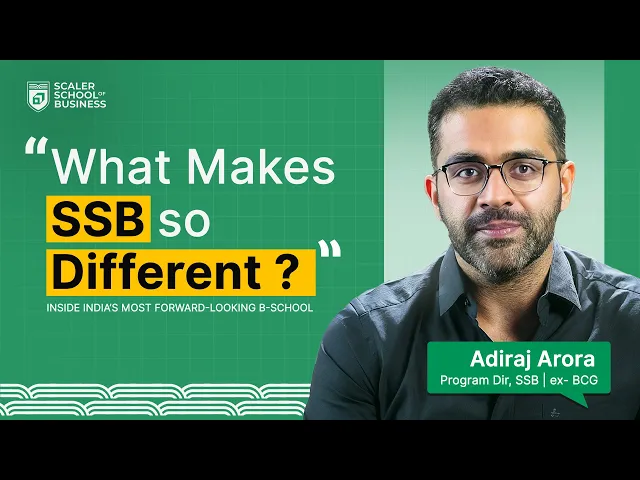
A few of the things that set it apart:
You build and ship, not just study. Students launch three real AI products and spend more than 150 hours working hands-on with over 25 tools across more than ten workshops.
You run two live businesses. A Direct-to-Consumer challenge, where teams build a real brand and chase revenue within weeks on real startup capital, and a six-month venture program that takes an idea from prototype to revenue, and sometimes to raising money from investors.
You work on real company problems. More than ten company-sourced projects guided by over a hundred industry leaders, alongside a full-time internship.
You learn from operators. Much of the faculty are working leaders rather than career academics, including names such as Dr. Narahari Hansoge(IIM Bangalore), Vidit Jain (Ex-McKinsey), Dr, Akash Krishnan (Gartner), Sucheta Mahapatra (Airtel), Manish Pansari (Myntra)
You build inside a startup ecosystem. The Scaler Innovation Lab sits steps from class, so you prototype and ship alongside real founders.
It is built for exactly the engineers a traditional route can overlook. The engineer who wants to move beyond a purely technical role into product, strategy or management. The fresh graduate or early-career professional who wants a fast, practical start. The career switcher changing function or industry. And the aspiring founder who wants the frameworks, network and practice before building a company of their own.
How to Get In: Application, Profile & Prep
Whichever route you choose, the application tends to ask for similar things. Plan for a statement of purpose that connects your engineering background to where you want to go, two recommendation letters from managers or professors, and a resume that highlights impact rather than duties. Many programs add a group discussion, a written ability test and a personal interview, so practise articulating your goals clearly.
On timing, most programs admit in rounds, and applying in the first round usually improves both your chances and your scholarship odds. If a test is involved, give yourself three to six months to prepare, and start your essays early. As a rule, begin a full cycle ahead of the intake you want.
How to Decide: An Engineer’s Framework
Before you commit, run your situation through a few questions.
Direction. Is your goal to go deeper technically, or broader into business? That settles MBA versus master’s.
Goal clarity. Can you name the role you want afterwards? If not, it is usually better to wait.
Format fit. Does your stage suit a two-year, one-year, executive or build-led program?
Return. Set the fees against a median package and your current salary.
Learning model. Do you learn best through lectures and cases, or by building and shipping?
Common Mistakes Engineers Make When Choosing an MBA
Even engineers who decide an MBA is right often stumble on the same execution errors. Watch for these.
Confusing an MBA with a master’s, and picking the one that does not match the goal. An engineer set on going deeper in machine learning enrols in a general MBA, then spends two years on marketing and accounting modules when a focused M.S. would have built the depth they actually wanted.
Applying with no clear destination, and hoping the degree will supply one. Someone leaves a backend role out of boredom, finishes the MBA, and graduates still unsure whether they want product, consulting or finance now two years and several lakh worse off, with the same open question.
Choosing on brand alone, without checking whether the program fits how you want to work. A hands-on builder picks the biggest name on the list, then finds it teaches almost entirely through lectures and case discussion, and spends the program wishing they were shipping something instead.
Underestimating the true cost, which includes the income you give up, not only the fees. A candidate budgets ₹15 lakh in fees but forgets the ₹12–16 lakh in salary given up over two years out of work, so the real cost sits closer to ₹30 lakh than to the sticker price.
Treating the entrance exam as the only door, and missing the profile-based and alternative-exam routes. An engineer with strong projects and a side venture writes off the MBA after a middling CAT percentile, never learning that profile-based programs would have weighed exactly the strengths the exam ignored.
Frequently Asked Questions
Q1. MBA or M.Tech after engineering, which is better?
A: Neither is universally better. Choose an M.Tech or M.S. to go deeper technically or into research, and an MBA to move into management, product, consulting or entrepreneurship. The test is whether you want to get better at what you do or change what you do.
Q2. Can a diploma engineer do an MBA?
A: Yes, provided your final qualification is a recognised degree. Many MBA programs accept engineers from diploma-to-degree routes on the same terms as B.Tech and B.E. graduates.
Q3. Which MBA specialization is best after engineering?
A: Pick by goal rather than branch: operations and supply chain for process-heavy roles, product and technology management for building, finance or marketing for a pivot, and general management or consulting for leadership. See the specialization map above.
Q4. What salary can I expect after an MBA following engineering?
A: Broadly ₹8 to 30 lakh a year from strong programs, depending on role — marketing and operations roles toward the lower end, and consulting, product and general-management roles at roughly ₹18 to 30 lakh (see the salary table above). Top IIM, ISB and global-school graduates go beyond ₹35 to 40 lakh. Figures vary by institute and cohort, so check current placement reports.
Q5. Can a fresher do an MBA right after engineering?
A: Yes. Two-year and build-led programs such as Scaler School of Business accept freshers, while one-year and executive programs generally expect a few years of work experience.
Q6. Can I do an MBA after engineering without CAT?
A: Yes. Many colleges accept XAT, NMAT, SNAP, CMAT or MAT, and some programs, including Scaler School of Business, admit entirely on a profile-based evaluation with no entrance exam.
Q7. Is an MBA good for engineers who want to start a company?
A: Often, yes. The finance, strategy and people skills an MBA builds complement an engineering foundation well, and build-led programs add hands-on venture experience.
Your Next Steps
If you have decided to take this seriously, work through it in this order.
Settle the MBA-versus-master’s question first: deeper or broader?
Write down the role you want to be in three to five years from now.
Map that goal to a specialization using the table above.
Shortlist programs by format and realistic return, not by brand alone.
Decide your admission route: an entrance exam, or a profile-based program.
Prepare your profile, essays and timeline, and start a full cycle ahead.
The Bottom Line
An MBA after engineering is a powerful move for the engineer with a clear goal and the numbers to back it. It turns deep technical knowledge into the broader judgement that leadership, product and consulting roles reward. It is the wrong move if you want to go deeper rather than broader, choose on brand alone, or expect it to supply a direction you have not chosen.
If your aim is to come out able to lead, build and ship rather than only to describe theory, a hands-on option such as Scaler School of Business, with its real products, live businesses and operator faculty, is built for engineers making the move into product, strategy and founding roles. Whichever route you pick, let the decision rest on your goals and the stage of your career.
Non-IIM MBA
Top Non-IIM MBA Colleges in Bangalore (2026): Fees, Placements & How to Choose
5 min. read
MBA for Professionals
Is an MBA Worth It for Working Professionals? An Honest 2026 Guide
5 min. read

MBA for Engineers
MBA After B.Tech (2026): Eligibility, Specializations, Salary & Is It Worth It?
5 min. read
MBA for Engineers
MBA After Engineering (2026): Eligibility, Specializations, Salary & Is It Worth It?
5 min. read