MBA for Tech
Career Options After BSc: Jobs, Study & How to Choose
Explore the best career options after BSc, including jobs, higher studies, certifications, government exams and entrepreneurship, with guidance on choosing the right path based on your specialization, timeline and skills.
Team SSB
5 min. read

Finishing a BSc rarely brings the clarity you expect. The problem is almost never a shortage of options; it is the opposite. A science degree fans out into direct jobs, further study, government service, professional certifications and even starting something of your own, and standing at the middle of all of it, the honest question is not “what can I do?” but “which of these actually fits me?”
Two things shape the answer more than anything else, and this guide is built around both. The first is your specialization: career options after BSc look very different for a computer science graduate than for one in physics, biotechnology or nutrition. The second is your timeline: whether you want to earn now or invest in more study first. What follows maps the five broad routes open to you, shows what each looks like for a science graduate specifically, and then helps you narrow them down rather than leaving you with a longer list than you started with.
At a glance. A BSc opens five routes: a job now, higher studies, professional certifications, government and competitive exams, and entrepreneurship. Which fits depends on your specialization and whether you want to earn or study next. One honest truth runs through all of them: for a science graduate, the degree opens the door, but the specific skills you add, coding, data tools, lab certifications, are what actually get you hired. |
The Five Routes After BSc
Instead of a flat list of jobs, it helps to see your options as five distinct directions. Almost every path after a BSc falls into one of them, and naming them makes the choice far less overwhelming.
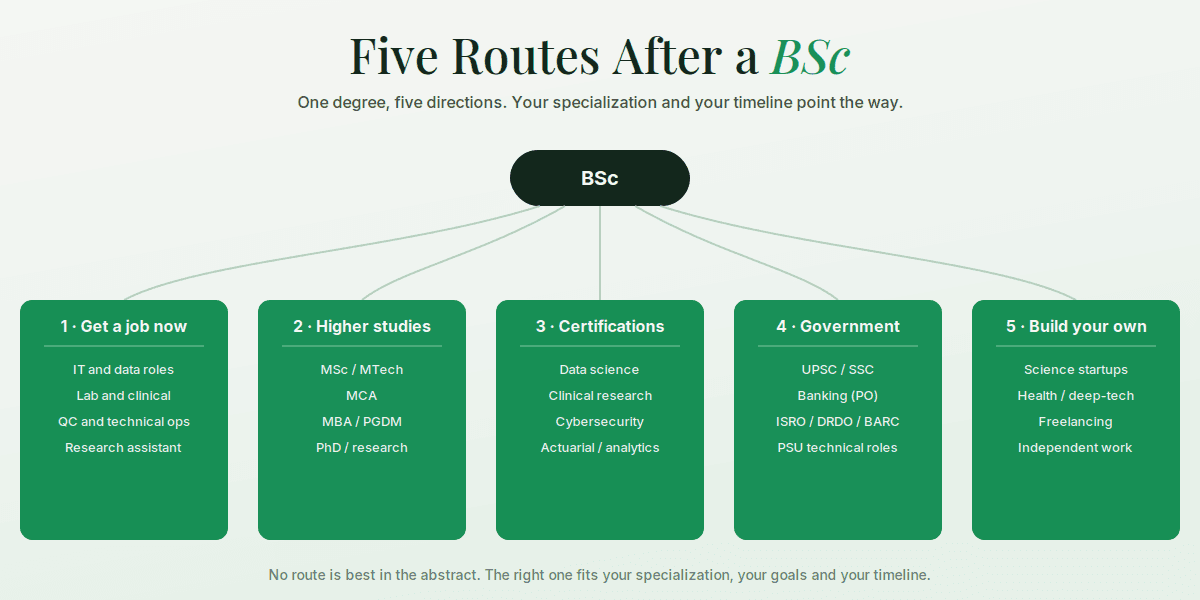
The five are: getting a job now, pursuing higher studies, taking professional courses and certifications, preparing for government and competitive exams, and building something of your own. The rest of this guide walks through each in turn, with the roles and requirements that apply to a science graduate, before helping you work out which route is yours.
Route by Route, What Each Looks Like After BSc
Route 1: Get a job now
This is the route the usual guides skip, because they assume a science graduate should always study more. Many do not need to. A BSc qualifies you for real entry-level work today, and the honest picture depends on your stream.
IT and data roles. If you studied computer science, mathematics or statistics, roles like software developer, data analyst, business intelligence analyst and junior data scientist are open with the right practical skills in Python, SQL and Excel. A graduate from a non-computing stream can reach the same roles by adding a focused coding or analytics course, this is one of the most common and effective moves a general BSc graduate makes.
Lab, clinical and research roles. Physics, chemistry, biology and biotechnology graduates move into lab technician, research associate, clinical research associate and quality-control roles across pharma, biotech, manufacturing and diagnostics. These are the core science jobs a BSc was built for.
Quality control and technical operations. Manufacturing, food, chemical and pharmaceutical companies hire science graduates for QC analysis, technical writing, regulatory support and technical operations, steady roles that value scientific rigor over a specific specialization.
The honest catch. A bare, general BSc with no added skill is harder to place than the brochures admit. The graduates who land the better jobs now are almost always the ones who paired the degree with a demonstrable skill, a programming language, a data tool, a lab certification. More on that below, because it is the single most useful thing to know. |
Route 2: Higher studies
If your specialization rewards depth, or you want to change direction, further study is a strong route. The main options each serve a different goal.
MSc or MTech. An MSc deepens your science toward research, R&D and academia; an MTech (via GATE, for eligible science graduates) moves you toward engineering specializations. Choose these if you want to go further into the subject you already love.
MCA. A clean transition into software and IT for graduates who want to move firmly into tech rather than add a certificate to a non-computing BSc.
MBA or PGDM. For science graduates who want to pivot toward management, business or product roles rather than stay in a lab or pure-tech track. If this is you, it is worth understanding both the traditional route and how a PGDM differs from an MBA, and there is a fuller guide to an MBA after BSc that covers eligibility and specialization choices for a science background. Computer science graduates weighing the same move can look at the MBA after computer science guide specifically.
PhD and research fellowships. The path into serious research and academia, for those certain they want a research career.

Route 3: Professional courses and certifications
Often the fastest way to convert a BSc into employability, a focused certification can take months rather than years and targets exactly what employers test for. The strongest options for a science graduate include data science and analytics certifications (which pair naturally with a math, stats or computing background and lead toward roles like business analyst), clinical research and regulatory-affairs certifications for life-science graduates, cybersecurity credentials, and actuarial qualifications for the strongly mathematical. These add a practical, job-ready layer on top of the degree you already hold.
Route 4: Government and competitive exams
A BSc makes you fully eligible for some of the most sought-after government roles, and one category here is a genuine science-graduate advantage that the usual lists underplay.
Civil services and administration. UPSC Civil Services for IAS, IPS and IFS roles, and State PSC exams for state administrative posts, all open to any graduate.
Staff selection and banking. SSC CGL for inspector and assistant-section-officer roles across central ministries, and IBPS or SBI exams to join public-sector banks as a probationary officer.
Scientific government organizations. This is the science-specific prize: technical assistant and scientist positions at ISRO, DRDO, BARC and CSIR, often through GATE or specialized entrance exams. Few other degrees open these doors as directly as a relevant BSc does.
Route 5: Entrepreneurship and independent paths
A science background is a real asset in the right kind of venture. Biotech, health-tech and deep-tech startups are built on exactly the domain knowledge a BSc provides, and the newer independent paths, freelancing in data or technical content, building a product, joining an early-stage team, reward capability over credentials. For science graduates drawn to building rather than joining, an MBA for entrepreneurs is one way to add the business and network layer, though it is far from the only one; many start with a skill and an idea.
Job Now, or Study More?
This is the fork most people skip, and for a science graduate it is the one that matters most, because the field’s unspoken default, always study more, is not right for everyone. Here is the honest version.
A job now makes sense when your specialization is already employable (computer science, data, IT), when you want income and real experience sooner, or when you are not yet sure which direction to commit to and would rather find out by working. Starting work does not close the study door; many people do a master’s or an MBA later, with a clearer goal and often an employer’s support.
More study makes sense when your specialization genuinely rewards depth (many core-science research careers effectively require an MSc or PhD), when you want to switch fields cleanly (MCA into software, MBA into management), or when the roles you want simply will not open to a bachelor’s alone.
Underneath the choice sits a truth worth stating plainly: a BSc paired with demonstrated skills often beats a BSc followed by another degree with no practical skills attached. Studying more is valuable when it builds capability you can show, and expensive when it is just a way to postpone the harder question of what you can actually do.
How to Choose Your Path: A Filter
With five routes on the table, the way to narrow them is to answer a few honest questions about yourself. Each one pushes you toward some routes and away from others.
Is your specialization job-ready now, or does it reward more study? Computer science, data and IT can go straight to work; physics, chemistry and core biology often reward an MSc or PhD for the better roles. Let your stream point you.
Do you want to stay in science, or pivot? Staying in science favors MSc, research and scientific-government routes. Pivoting favors MCA, an MBA, analytics certifications or a startup.
Stability, or growth and risk? If security matters most, the government and PSU route is built for it. If you want faster growth and can accept more risk, private-sector roles and entrepreneurship fit better.
Earn now, or build credentials first? This is the timeline question from the previous section, and it cleanly separates “job now” from “higher studies.” Be honest about which you actually want.
People, numbers, building, or discovery? Numbers point to data and analytics; building points to product, tech and startups; discovery points to research and academia. Follow the kind of work you would not tire of.
Answer these and the five routes usually collapse to one or two that genuinely fit, which is a far better place to start than a list of everything a science graduate could theoretically do.
Salaries at a Glance
Pay after a BSc varies enormously by specialization, skill and city, so treat the ranges below as indicative starting points rather than promises, and weigh the median for a role over the flattering top-end figure.
Route / role | Indicative entry range (India) | Notes |
|---|---|---|
IT and data roles | ~₹4–10 LPA | Highest for CS/data with real skills |
Lab, clinical and research | ~₹3–6 LPA | Rises with an MSc or specialization |
Higher study (post MSc/MCA) | ~₹4–12 LPA | Depends on field and institute |
MBA / management pivot | ~₹6 LPA and up | Wide range; tier-dependent |
Government and PSU | ~₹4–10 LPA | Plus security and allowances |
The pattern across the data is consistent: technology, analytics, healthcare and research show the strongest long-term growth, and within every route, the graduates who added a demonstrable skill out-earn those who relied on the degree alone.
The Skills That Actually Get You Hired
If you take one thing from this guide, take this. For a science graduate, the degree gets you considered; the skill gets you hired. Surveys of Indian graduate employability have repeatedly found that only around half of graduates are considered job-ready, and the gap is rarely the degree itself, it is the absence of the specific, demonstrable skills employers need.
For a BSc that means concrete things: programming and data tools (Python, SQL, a visualization tool) for anyone near data or tech; laboratory and instrumentation certifications for life-science and chemistry roles; domain software and analysis skills for research and QC; and, for the data-oriented, the analytics stack that turns a science background into a data-science or analyst career. A focused three-to-six-month certification, plus a small portfolio of real work, moves you past most of the field faster than another year of untargeted study.
A note for the science graduate who wants to pivot into business, product or management rather than stay in a lab or pure-tech role: some newer programs are built around doing rather than only studying, admitting on profile and having students build real products and ventures instead of sitting through theory. Scaler School of Business is one such option to be aware of, though it is worth being clear that it awards a PGP certificate rather than a degree, so it suits people who value demonstrated capability over a formal qualification, and it is only one of several routes covered above. For most BSc graduates, the more immediate lever is simply the skill layer, whichever route you choose.
Frequently Asked Questions
Q1. Is a BSc enough to get a job?
A: Yes, a BSc qualifies you for real entry-level roles in IT and data, labs and clinical settings, quality control and technical operations. The honest caveat is that a bare degree with no added skill is harder to place; graduates who pair the BSc with a demonstrable skill, such as programming or a lab certification, land the better jobs far more easily.
Q2. What can I do after BSc without further study?
A: Plenty. You can take a job in data or IT (with the right practical skills), lab and research roles, quality control and technical operations, or prepare for government and banking exams, all open to a fresh BSc graduate. A short certification rather than a full degree is often enough to become job-ready quickly.
Q3. Which BSc has the best scope and salary?
A: Computer science, data science and IT lead on immediate hiring and pay, followed by biotechnology and the allied health sciences for their healthcare demand. Mathematics and statistics graduates do well in analytics and actuarial roles. The strongest scope is wherever your specialization meets a growing, skill-hungry industry.
Q4. Should I do an MSc, MCA or MBA after BSc?
A: It depends on your goal. Choose an MSc to go deeper into your science toward research or academia, an MCA to move firmly into software and IT, and an MBA or PGDM to pivot into management or business. Match the course to the direction you want, not to which sounds most impressive.
Q5. What government jobs can I get after BSc?
A: A BSc makes you eligible for UPSC Civil Services, SSC CGL, and banking exams like IBPS and SBI PO, all open to any graduate. The science-specific advantage is scientific-organization roles at ISRO, DRDO, BARC and CSIR, often through GATE or specialized exams, which few other degrees open as directly.
Q6. Can I switch to a non-science career after BSc?
A: Yes, and many do. An MBA or PGDM opens management, marketing and product roles; analytics and digital certifications open data and marketing careers; and profile-based, build-first programs let you demonstrate capability rather than prove it on paper. A science background is a foundation to build on, not a boundary.
Q7. Which is the best job after BSc?
A: There is no single best; it depends on your specialization and what you want from work. For computer-science and data graduates, developer and analyst roles pay and grow fastest. For life-science graduates, clinical research and healthcare roles fit best. For those wanting stability, scientific-government roles are hard to beat. Use the filter above to find yours.
The Bottom Line
Career options after a BSc are not scarce; they are abundant, and that abundance is exactly what makes the choice feel hard. The way through is not to chase the longest list but to narrow it: let your specialization and your timeline point you toward one or two of the five routes, decide honestly whether you want to earn now or study more, and then commit to building the specific skills that make your chosen path real. A BSc is a strong foundation. What you build on it is what turns it into a career.

Non-IIM MBA
Top Non-IIM MBA Colleges in Bangalore (2026): Fees, Placements & How to Choose
5 min. read
MBA for Professionals
Is an MBA Worth It for Working Professionals? An Honest 2026 Guide
5 min. read

MBA for Engineers
MBA After B.Tech (2026): Eligibility, Specializations, Salary & Is It Worth It?
5 min. read
MBA for Engineers
MBA After Engineering (2026): Eligibility, Specializations, Salary & Is It Worth It?
5 min. read