MBA for Tech
Career Options After BTech: Jobs, Higher Study, Salaries and How to Choose
A BTech offers far more opportunities than the default campus IT job. Whether you want to pursue software development, data and AI, core engineering, government careers, higher studies, or move beyond coding altogether, this guide explains the paths available, realistic salary expectations, and the factors that matter most when choosing the right career after BTech.
Team SSB
5 min. read

For a large share of BTech graduates, the path after the degree feels pre-decided: a campus placement into a mass-hiring IT service company, a generic developer or support role, and a starting package that does not quite match the four years of effort. Many finish feeling either funneled into that default or quietly certain it is not what they wanted. If that is you, the honest starting point is this: the default IT job is one option, not the ceiling.
A BTech is a strong, flexible degree, and the same qualification that leads to a generic IT role also opens higher-value software and product-company work, data and AI, core engineering, government service, research and building your own thing, including paths that go beyond writing code entirely. And for the common worry about college tier, the honest version is that your tier tends to shape your first job, not your ceiling; a demonstrable skill closes the gap faster than most people expect. This guide maps the five career routes after BTech, with a clear eye on how to get past the default, and help you choose the one that actually fits you.
At a glance. A BTech opens five routes: a job now, higher studies, professional certifications, government and competitive exams, and entrepreneurship. Two honest points shape them: the default mass-hiring IT job is one option rather than the best or only one, and there are strong paths past it, including beyond coding entirely, with a demonstrable skill mattering more than your college tier for where you end up. |
The Five Routes After BTech
A BTech graduate's options come into focus faster as five directions than as a long roster of job titles. Nearly everything worth considering fits one of them, and the first route especially is worth reading with the default IT job in mind.
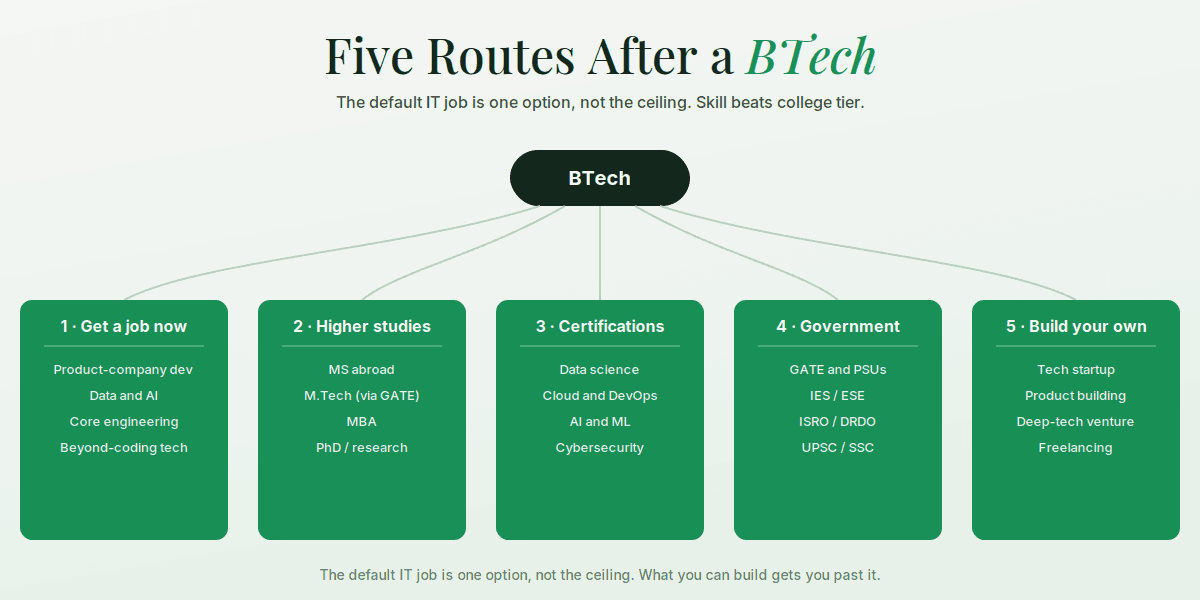
Those five directions are: taking a job now, going on to higher study, adding a professional certification, sitting for government and competitive exams, or building something of your own. Each is covered below around the question a BTech graduate actually carries: how do I aim past the default and toward something that fits me.
Route by Route, What Each Looks Like After BTech
Route 1: Get a job now, beyond the default
The job market for a BTech graduate has a quiet hierarchy the placement brochure rarely spells out. Understanding it is the difference between accepting the default and aiming past it.
Product-company software, not just IT services. The common default is a mass-hiring IT service role at modest pay. The roles worth aiming for are software engineering positions at product companies, which pay substantially more and offer better work. The gap between the two is bridged mostly by demonstrable skill, a strong coding portfolio and data-structures preparation. A software focus also pairs well with an MBA later.
Data, AI and high-value tech. Data science, machine-learning and AI-engineering roles, along with cloud, DevOps and cybersecurity, are among the highest-value entry points and are open across branches with the right skill, not just to computer-science graduates. The data-science route in particular rewards a BTech’s quantitative training.
Core engineering, by branch. If your interest is genuinely in your discipline, core roles in design, production, site and systems work at major industrial and infrastructure firms are a real path, honestly branch-dependent in pay and volume.
Beyond coding, still in tech. If you like technology but not programming, product management, business analysis-style problem solving, UX design and technical writing are genuine tech-adjacent roles that value a BTech without a career of coding.
The honest note. The single biggest lever on your first job, and on how far past the default you land, is demonstrable skill, not the name of your college. A strong portfolio, real projects and solid interview preparation routinely let graduates from lesser-known colleges outcompete better-pedigreed peers who coasted. Tier shapes the start; skill shapes the trajectory. |
Route 2: Higher studies
Further study is a strong route, and for a BTech graduate it often works best as a deliberate lever to reposition rather than a default next step.
MS abroad. Through GRE, IELTS or TOEFL, an MS in the US, Europe or Germany offers global exposure, advanced research and international roles, a popular way to reset onto a higher trajectory.
M.Tech, via GATE. A two-year deep dive into a technology specialization within India, opening research and senior technical roles, and admission to the IITs, NITs and IIITs.
MBA. The management pivot, for the graduate who wants to move from building to leading, into product, strategy or consulting. Our guide on MBA after engineering covers this in detail.

Route 3: Professional courses and certifications
The fastest way to move from a default role to a higher-value one is a targeted certification. Data science, cloud (AWS, Azure), AI and machine learning, and cybersecurity each take months rather than years and prove a specific, in-demand skill. For a BTech graduate stuck in or headed toward a generic role, a certification plus real projects is often the most efficient route to something better.
Route 4: Government and competitive exams
A BTech carries the full engineering eligibility for government routes, so these are genuinely open to you if stability and public service appeal.
GATE and PSUs. A strong GATE score opens stable, well-paid technical roles at public-sector undertakings like ONGC, BHEL, NTPC and IOCL.
Engineering Services and research. The UPSC Engineering Services Examination leads to senior government technical roles, and ISRO and DRDO recruit BTech graduates as scientists and technical officers.
Civil services and others. UPSC Civil Services (IAS, IPS, IFS) and banking and SSC exams are open to BTech graduates who want to move fully into administration or the public sector.
Route 5: Entrepreneurship and independent paths
A BTech is a natural foundation for building. Tech and deep-tech startups draw directly on technical skill, supported by incubators and startup initiatives, product building lets you turn an idea into something real, and freelance development is a flexible way to work independently while building a track record. The low capital cost of software makes this one of the more realistic entrepreneurial routes available.
Job Now, or Study More? And How to Get Past the Default
There are really two decisions bundled into this section, and the second is the one BTech graduates most want a straight answer on.
Job now, or study more. If you can aim past the default now, target product companies or a high-value skill like data or cloud, a job first is often the faster, lower-risk move, and you can add an MS or MBA later with a clearer goal. Study first when it is the genuine lever you need: an MS to reset your trajectory, an M.Tech for research depth, or an MBA to pivot into management.
How to get past the default IT job. Wanting more than a generic IT service role is not entitlement; it is a reasonable goal with a concrete method. The lever is almost always a demonstrable skill, a strong coding portfolio and interview preparation for product roles, a data or cloud certification with real projects, or a higher degree used deliberately to reposition. “I do not want a default IT job” is a legitimate driver, and the path past it is built, not wished.
On college tier: it genuinely influences your first placement, but it is not a life sentence. Graduates from lesser-known colleges move into strong roles all the time by building skill and proof. The tier opens or narrows the first door; what you can demonstrably do decides every door after it.
How to Choose Your Path: A Filter
Five routes is more than anyone can weigh at once, so let a handful of blunt questions do the narrowing.
Accept the default, or aim higher within tech? If a stable IT role suits you, that is a valid choice. If you want more, target product companies, data, cloud or AI, and build the skill that gets you there.
Coding, or beyond coding? If you enjoy building software, development and high-value tech fit. If you like technology but not programming, product, business analysis, UX and technical roles are genuine paths.
Stay technical, or pivot to management? Staying favors software, data and M.Tech; pivoting favors an MBA, product and consulting.
Stability, or growth and risk? The government and PSU route offers stability; product companies, startups and entrepreneurship offer faster growth and more variance.
Skill-build now, or study to reposition? If you can level up with a certification and a portfolio, do it now. If you need a reset, use an MS or MBA deliberately for that purpose.
Work through those and the five usually come down to one or two that actually fit, which beats accepting whichever job the default funnel happens to offer.
Salaries at a Glance
Pay after a BTech varies sharply by role, skill and company type, and the gap between a default IT service role and a high-value one is large, so treat these as indicative starting points.
Route / role | Indicative entry range (India) | Notes |
|---|---|---|
Default IT service role | ~₹3.5–5 LPA | The common starting point |
Product-company software | ~₹8 LPA and up | Skill- and interview-gated |
Data / AI / high-value tech | ~₹6 LPA and up | Strong with a real portfolio |
Core engineering (by branch) | ~₹3–6 LPA | Varies by branch and cycle |
PSU / government (via GATE) | ~₹6–12 LPA | Plus security and benefits |
On the common question of earning a lakh a month after a BTech: it is reachable, but through a high-value role, product-company software, specialized data or cloud work, with skill and a couple of years of experience, not through the default IT role. The skill, not the degree alone, gets you there.
The Skills That Actually Get You Hired
For a BTech graduate this idea answers both anxieties at once, the default job and the college tier. India's employability research, the annual India Skills Report among it, has for years put the share of graduates rated job-ready at only around half, and the difference between a default IT role and a high-value one is almost entirely demonstrable skill. Skill is also what closes the college-tier gap, which is why it is the single most important thing to build.
In practice that means concrete, showable things: a strong coding portfolio and data-structures preparation for product-company interviews; a data, machine-learning or cloud certification with real projects behind it; a security credential; or, if you are pivoting toward product management, the analytical and communication skills those roles reward. A focused certification plus a body of real work moves a BTech graduate past the default, and past the tier question, faster than almost anything else.
For the BTech graduate whose pull is shifting from the technical track toward product management or building a business, it is worth knowing that a newer kind of program exists: one that selects on your profile rather than an entrance exam and puts students to work by letting them run real ventures instead of only studying them. Scaler School of Business is one of these. To be honest upfront it grants a PGP certificate rather than a UGC degree, and it stands beside the routes above as one option, not a replacement for them.

Frequently Asked Questions
Q1. What are the career options after BTech apart from an IT job?
A: Plenty. Beyond the default IT service role you can aim for product-company software, data science, AI and cloud roles, core engineering in your branch, government and PSU jobs via GATE, higher studies (MS, M.Tech or MBA), non-coding tech roles like product management and business analysis, and entrepreneurship. The generic IT job is one option, not the only one.
Q2. Which job is best after BTech?
A: There is no single best; it depends on what you want. For pay and growth, product-company software and high-value tech roles in data and AI lead; for stability, PSU and government routes via GATE are strong; for those leaving pure coding, product and management roles fit. Aim for the route that matches your strengths, and build the skill it needs.
Q3. Can I go beyond coding after BTech?
A: Yes. Product management, business analysis, UX design and technical writing are genuine tech roles that value a BTech's technical understanding without requiring a career in programming. Many BTech graduates move into these deliberately, often with a relevant skill or, for some, an MBA.
Q4. Can I get 1 lakh a month after BTech?
A: Yes, it is reachable, though usually not at entry level or in a default IT role. It typically comes from a high-value position, product-company software, specialized data or cloud work, with a demonstrable skill and a couple of years of experience. The skill, not the degree alone, is what gets you there.
Q5. Does my college tier limit my career after BTech?
A: It influences your first placement, but it does not set your ceiling. Graduates from lesser-known colleges routinely move into strong roles by building demonstrable skill, a real portfolio and solid interview preparation. Tier shapes the first door; what you can actually do decides the rest.
Q6. What government jobs can I get after BTech?
A: A BTech carries full engineering eligibility: PSU technical roles at ONGC, BHEL, NTPC and others via GATE, the UPSC Engineering Services Examination, scientist roles at ISRO and DRDO, and the general UPSC Civil Services and banking exams open to all graduates.
Q7. Should I do an M.Tech, MS or an MBA after BTech?
A: It depends on your goal. Choose an MS abroad to reset your trajectory and gain global exposure, an M.Tech (via GATE) for research or deep technical depth, and an MBA to pivot into management, product or consulting. Use higher study as a deliberate lever, not a default.
Q8. What are the best options after BTech CSE?
A: For a CSE graduate, product-company software engineering, data science and machine learning, cloud and cybersecurity are the highest-value technical routes, while product management and business analysis suit those who want to go beyond coding. In every case, a strong portfolio matters more than the college name.
The Bottom Line
A BTech is a strong, flexible degree, and the default IT service job is one option, not the ceiling. The same qualification opens higher-value software and product work, data and AI, core engineering, government service, research and building your own thing, including paths well beyond coding. Your college tier may shape the first door, but a demonstrable skill shapes every door after it. Narrow the five routes by what you actually want, decide honestly whether to aim past the default now or use higher study to reposition, and then build the skill that gets you there. What you can demonstrably do, far more than the college on your certificate, is what turns a BTech into the career you want.

Non-IIM MBA
Top Non-IIM MBA Colleges in Bangalore (2026): Fees, Placements & How to Choose
5 min. read

MBA for Professionals
Is an MBA Worth It for Working Professionals? An Honest 2026 Guide
5 min. read

MBA for Engineers
MBA After B.Tech (2026): Eligibility, Specializations, Salary & Is It Worth It?
5 min. read
MBA for Engineers
MBA After Engineering (2026): Eligibility, Specializations, Salary & Is It Worth It?
5 min. read