MBA for Tech
Career Options After Engineering: Jobs and How to Choose
Engineering opens far more career paths than most graduates realize. Whether you want to work in your core branch, switch to IT, prepare for government exams, pursue higher studies, or leave engineering altogether, this guide breaks down the opportunities, expected salaries, and key decision factors to help you choose a career path that matches your strengths and long-term goals.
Team SSB
5 min. read

Two things make the question of what to do after engineering different from most other degrees. The first is that your options depend heavily on your branch, a civil engineer, an ECE engineer and a computer-science engineer face genuinely different starting points. The second is quieter but very common: a large number of engineering graduates finish the degree and realize they do not actually want to work as engineers, and quietly worry that four years were wasted.
It is worth settling that worry at the start. An engineering degree is valued precisely because it travels. The analytical thinking, problem-solving and structured reasoning it builds are exactly what open doors well beyond core engineering, into technology, product, management, data and more. So both the graduate who loves their branch and the one who wants to leave engineering behind have strong paths ahead. This guide maps the five broad routes for career options after engineering, shows what each looks like across branches and both on and off the engineering path, and helps you narrow them to what fits you.
At a glance. Engineering opens five routes: a job now (core or IT), higher studies, professional certifications, government and competitive exams, and entrepreneurship. Two honest points shape them: your branch strongly influences your core options, and the degree travels well beyond engineering, so deciding you do not want core engineering is a common, legitimate pivot rather than a dead end. |
The Five Routes After Engineering
An engineer's options come into focus faster as five directions than as a long list of job titles. Nearly everything worth considering fits one of them, and one of the five, government and competitive exams, is unusually strong for engineers, stronger than it is for almost any other graduate.
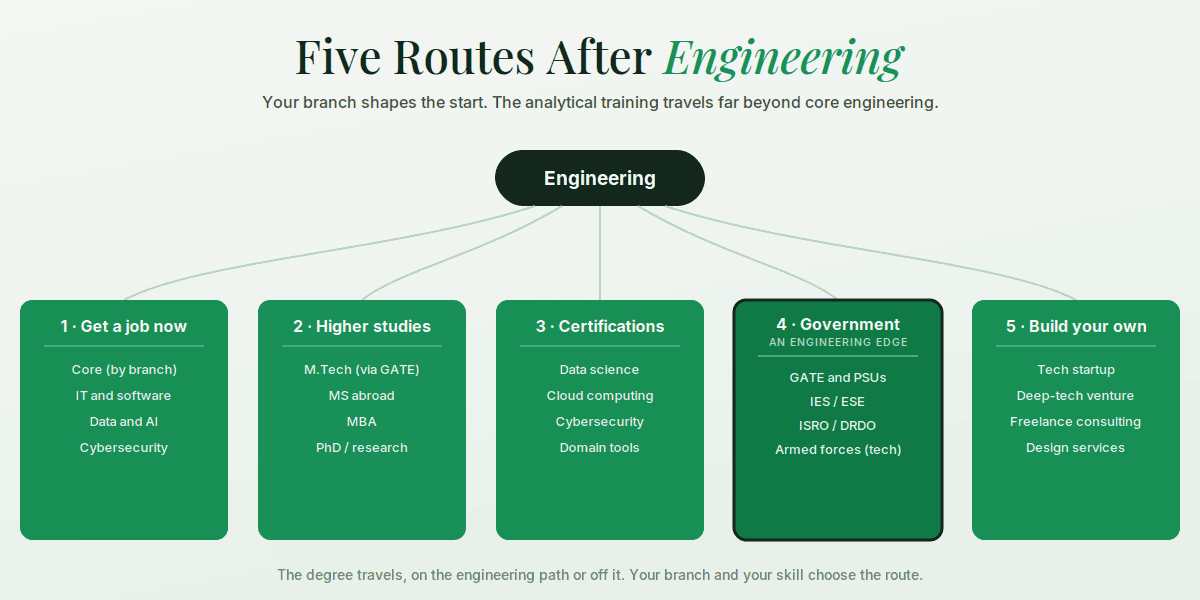
Those five directions are: taking a job now (core or IT), going on to higher study, adding a professional certification, sitting for government and competitive exams, or building something of your own. The government route is flagged here because engineering opens doors that few other degrees can, GATE-based PSU roles, the Engineering Services, and the defense research bodies.
Route by Route, What Each Looks Like After Engineering
Route 1: Get a job now, core or IT
The first real fork for an engineering graduate is between core engineering work in your branch and the broader technology sector, which now hires engineers of every branch.
Core engineering, by branch. Working directly in your discipline: site and structural roles in civil, design and production roles in mechanical, power-systems roles in electrical, VLSI and embedded roles in ECE. These are honestly branch-dependent, and the pay and volume of openings vary by branch and industry cycle.
IT and software. Software development, testing and web roles at service and product companies are open to engineers of any branch, not just computer science, which is why so many mechanical and civil graduates end up in tech.
Emerging tech. Data science, AI and machine learning, cloud computing and cybersecurity are high-growth and, importantly, open across branches with the right added skill, not restricted to computer-science graduates.
The honest note. Whether you go core or IT, the degree gets you considered but a demonstrable skill gets you hired, a software stack, a data portfolio, a design tool, a domain certification. This is doubly true if you are entering a field outside your branch, where you are competing partly on proof rather than pedigree. |
Route 2: Higher studies
If you want to deepen your expertise or change direction, further study is a strong route, with three main options serving different goals.
M.Tech, via GATE. A two-year deep dive into a branch niche, through the GATE exam, opening corporate R&D and academic paths and admission to the IITs, NITs and IIITs. The natural choice if you want to go further into engineering itself.
MS abroad. Through GRE, IELTS or TOEFL, an MS in countries like the USA, Germany or Canada offers global exposure, advanced research and international job prospects.
MBA. The management pivot, and a common one for engineers who want to move from building things to leading the teams and businesses that build them. Our guide to an MBA after engineering covers this in depth.

Route 3: Professional courses and certifications
For a fast, targeted move, especially into the high-growth tech fields, a focused certification takes months rather than years. Data science, cloud (AWS, Azure, GCP), cybersecurity and domain-specific tools each let an engineer of any branch enter a growing field on the strength of a demonstrable skill. For a graduate unsure whether to stay in their branch, a certification is also a low-cost way to test a new direction before committing.
Route 4: Government and competitive exams, an engineering edge
This is where engineering opens doors that most other degrees cannot, which is why it deserves real attention rather than a passing mention.
GATE and PSUs. A strong GATE score is the gateway to stable, well-paid technical roles at major public-sector undertakings like ONGC, BHEL, NTPC, GAIL, IOCL and HPCL, a route essentially reserved for engineers.
Engineering Services (IES/ESE). The UPSC Engineering Services Examination leads directly into senior government technical positions managing large-scale infrastructure, an engineering-only civil service with real authority and prestige.
Defense and research. ISRO and DRDO recruit engineers as scientists and technical officers, and the Armed Forces offer technical entry schemes for engineering graduates who want to serve in a technical capacity.
Civil services. Engineers also do well in the UPSC Civil Services (IAS, IPS, IFS), where analytical training is an asset, and in banking and SSC roles open to all graduates.
Route 5: Entrepreneurship and independent paths
An engineering foundation is a genuine asset in building things. Tech and deep-tech startups draw directly on technical capability, supported by incubators and venture funding, and freelance engineering, design and software consulting lets you work independently for global clients. For those who want to add business and network depth to a technical idea, an MBA for entrepreneurs is one route, though many engineers simply start building with the skills they already have.
Job Now, or Study More? And What If You Do Not Want to Be an Engineer?
Two honest forks sit here, and the second is the one the usual guides ignore.
Job now, or study more. If your branch is employable and you want income and experience, a job plus a skill starts you sooner, and you can add an M.Tech or an MBA later with a clearer goal. Study first when your target genuinely needs it: research and academia need an M.Tech or PhD, a clean management pivot is smoother with an MBA, and some specializations need a master's.
What if you do not want to be an engineer? This is far more common than graduates realize, and it is not a waste. The analytical training an engineering degree gives you is exactly what lets you move into product management, business analysis, management consulting, finance and data roles, fields that actively value engineers for how they think. “I do not want to do core engineering” is a legitimate, well-trodden pivot, not a confession of failure. Product management in particular is a natural landing spot, which is why an MBA for product management is a popular route for engineers leaving the technical track.
The honest thread running under both forks: an engineering degree is rarely wasted, because it travels. Stay technical or leave core engineering behind, and it is still the degree carried by a skill you can show that moves you forward, not the degree on its own.
How to Choose Your Path: A Filter
Five routes is more than anyone can weigh at once, so let a handful of blunt questions do the narrowing.
Stay technical, or pivot? If you enjoy the technical work, core engineering, IT, emerging tech and M.Tech fit. If you want to leave it, product, management, consulting and finance are open and value your training.
Which branch are you? Your branch strongly shapes your core options and your best government routes. Be realistic about the openings and pay in your specific discipline before committing to core work.
Depth, or breadth? Technical depth points to M.Tech, MS and specialist roles; business breadth points to an MBA, product and consulting.
Stability, or growth and risk? The government and PSU route, uniquely strong for engineers, is built for stability. Private tech, startups and entrepreneurship offer faster growth and more variance.
Build things, or lead the people who do? If you love building, stay close to the technical work. If you are drawn to leading teams and products, the management routes fit better.
Work through those and the five usually come down to one or two that actually fit, which beats staring at the full spread of everything an engineer could theoretically do.
Salaries at a Glance
Pay after engineering varies widely by branch, route and city, and the core-versus-IT gap is real, so treat these as indicative starting points rather than promises.
Route / role | Indicative entry range (India) | Notes |
|---|---|---|
Core engineering (by branch) | ~₹3–6 LPA | Varies sharply by branch and cycle |
IT and software | ~₹4–12 LPA | Product firms pay most |
Data / AI / emerging tech | ~₹6 LPA and up | Strong with a real portfolio |
PSU / government (via GATE) | ~₹6–12 LPA | Plus security and benefits |
Post MBA / management pivot | ~₹6 LPA and up | Strongly tier-dependent |
The consistent pattern: IT and emerging-tech roles tend to start higher than core engineering, the PSU route pairs solid pay with security, and across every route a demonstrable skill lifts the figure above the base.
The Skills That Actually Get You Hired
Here is the idea that matters most, and it applies whether you stay in engineering or leave it.India's employability research, the annual India Skills Report among it, has for years put the share of graduates rated job-ready at only around half. For engineers the gap is rarely the degree, it is the absence of a specific, demonstrable skill. The degree gets you considered; the skill gets you hired.
For an engineer that means concrete, showable things: a software stack and real projects for IT roles; a data or machine-learning portfolio for emerging tech; a cloud or cybersecurity certification; a strong GATE score for the PSU and higher-study routes. If you are pivoting off the technical track, the analytical and communication skills that land product, consulting and business roles, our guide to becoming a management consultant traces one such path. A focused certification plus a body of real work moves you past most of the field.
For the engineer specifically pivoting toward product, management or business rather than staying on the technical track, it is worth knowing that some newer, build-first programs admit on the strength of your profile and have students run real ventures rather than only study cases; Scaler School of Business is one such option. To be honest upfront, Scaler School of business offers a PGP certificate rather than a UGC degree, and it is one route among the several above rather than a substitute for them.

Frequently Asked Questions
Q1. What if I don't want to be an engineer anymore?
A: This is common and not a waste of your degree. Engineering training in analysis and problem-solving is exactly what employers value in product management, business analysis, consulting, finance and data roles. Leaving core engineering is a legitimate, well-trodden pivot, usually made smoother by adding a relevant skill or, for some, an MBA.
Q2. Which job is best after engineering?
A: There is no single best; it depends on your branch and what you want. For growth and pay, IT, software and emerging-tech roles lead; for stability, PSU and government roles via GATE are hard to beat; for those leaving the technical track, product and management roles fit well. Match the route to your strengths, not to a salary headline.
Q3. What are the career options after engineering besides IT and software?
A: Plenty: core engineering in your branch, PSU and government roles via GATE, the Engineering Services (IES/ESE), ISRO, DRDO and Armed Forces technical entry, higher studies (M.Tech or MS), an MBA and management, and entrepreneurship. IT is popular but far from the only path.
Q4. What government jobs can I get after engineering?
A: Engineering opens some of the best government routes available: PSU technical roles at ONGC, BHEL, NTPC and others via GATE, the UPSC Engineering Services Examination, scientist roles at ISRO and DRDO, Armed Forces technical entry, and the general UPSC Civil Services and banking exams open to all graduates.
Q5. Should I do M.Tech, MS or an MBA after engineering?
A: It depends on your goal. Choose an M.Tech (via GATE) to deepen your branch toward R&D or academia, an MS abroad for global exposure and research, and an MBA to pivot into management, product or business. Match the qualification to the direction you actually want.
Q6. Can I move into a non-technical career after engineering?
A: Yes, and many do. Product management, consulting, business analysis, finance and marketing all actively recruit engineers for their analytical thinking. A relevant skill or certification, and for some an MBA, makes the transition smoother, but the core strength employers want, structured problem-solving, which you already have.
Q7. What is the highest-paying option after engineering?
A: Software and product roles at top product companies, emerging-tech roles in data and AI, and post-MBA management and consulting sit at the high end, though the largest figures come with experience and a strong track record, not at entry. The PSU route pairs good pay with unusual security.
Q8. Does my engineering branch limit my options?
A: It shapes your core-engineering options and your best government routes, but it does not limit you overall. IT, emerging tech, higher studies, management and entrepreneurship are open across branches with the right added skill, which is why engineers of every discipline end up in a wide range of fields.
The Bottom Line
An engineering degree is not a narrow ticket to one kind of job. It opens core engineering, the whole of technology, some of the strongest government and PSU routes available, and, crucially, a wide set of non-technical paths for those who decide engineering is not for them. Your branch shapes the start, but the analytical training travels far beyond it, so wanting to leave core engineering is a genuine option rather than a wasted degree. Narrow the five routes by your branch and your aptitude, decide honestly whether you want to stay technical or pivot, and then build the demonstrable skill that carries your chosen path forward. What you build on an engineering degree matters more than the branch printed on it.

Non-IIM MBA
Top Non-IIM MBA Colleges in Bangalore (2026): Fees, Placements & How to Choose
5 min. read

MBA for Professionals
Is an MBA Worth It for Working Professionals? An Honest 2026 Guide
5 min. read

MBA for Engineers
MBA After B.Tech (2026): Eligibility, Specializations, Salary & Is It Worth It?
5 min. read
MBA for Engineers
MBA After Engineering (2026): Eligibility, Specializations, Salary & Is It Worth It?
5 min. read