Business Management Glossary
Functions of Management: The Five Core Functions Explained
Understand the five core functions of management: planning, organizing, staffing, directing and controlling, how they work as a continuous cycle, and how their importance changes across different levels of management.
Team SSB
5 min. read

Management is the process of getting work done through other people by organizing an enterprise’s resources toward a defined goal. The functions of management are the categories that work divides into: the distinct activities a manager performs, whatever the industry, the department or the seniority of the role.
This entry covers the five functions in turn, where the framework originated, how each one feeds the next, and what all five look like applied to a single decision. It also sets out how the balance between them changes as a manager rises, and where managerial work ends and departmental work begins.
Short answer. The five functions of management are planning, which sets goals and decides how to reach them; organizing, which structures the work and the resources; staffing, which puts capable people into the roles; directing, which guides and motivates them; and controlling, which measures results and corrects course. Together they form a continuous cycle rather than a one-time sequence. |
The Five Functions of Management
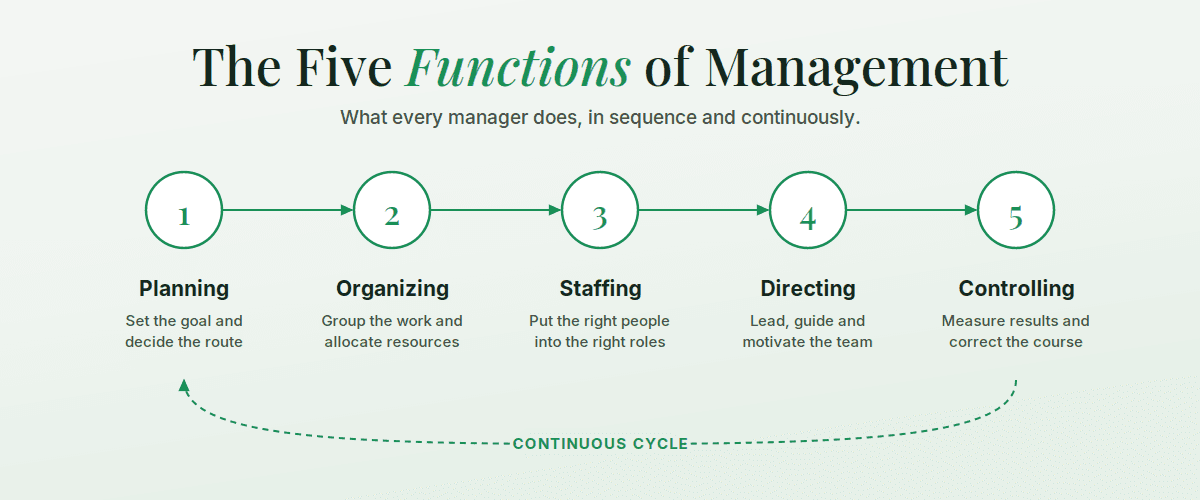
Each function answers a different question about running an enterprise: what are we trying to do, how is the work arranged, who does it, how are they led, and is it working.
Planning
Planning is deciding in advance what has to be achieved, by when, and by what route. It produces the objectives the enterprise works toward and the standards every later function is measured against, which is why it comes first.
The work involves setting objectives, forecasting the conditions the enterprise will operate in, generating and weighing alternative courses of action, allocating the money and people each option would need, and fixing timelines. Plans are made at more than one horizon, from multi-year direction down to the coming week, and each horizon has its own methods, covered in our entry on the types of planning.
Organizing
Organizing arranges work and resources so that the plan can actually be carried out. It converts an intention into a structure.
A manager organizing a function identifies the activities the plan requires, groups related activities together, assigns each group to a role, delegates the authority needed to act, and establishes who reports to whom. Four ideas do most of the work here: division of labor, which splits a large task into specialized jobs; departmentalization, which groups those jobs by function, product, geography or customer; span of control, the number of people one manager can supervise effectively; and chain of command, the unbroken line of authority from the top of the enterprise to the bottom.
Staffing
Staffing fills the structure with capable people and keeps it filled. It treats people as the resource that has to be found, developed and retained rather than simply deployed.
It runs from workforce planning, estimating how many people are needed and with what skills, through recruitment, selection and placement, into training, performance appraisal, compensation, promotion and transfer. Staffing is continuous rather than periodic, because roles change as the enterprise grows and people leave for reasons outside the manager’s control.
Directing
Directing sets the structure in motion. Planning, organizing and staffing prepare an enterprise to act; directing is what makes it act.
It rests on four elements. Supervision is overseeing work as it happens. Motivation is giving people reason to put in effort, through incentives, recognition or the nature of the work itself. Leadership is influencing the direction of that effort. Communication carries instruction downward, information upward and coordination sideways. Directing is the function that deals with people rather than systems, which is why it is the least mechanical of the five and the hardest to standardize.
Controlling
Controlling measures what actually happened against what was supposed to happen, and corrects the difference.
It proceeds in four steps: establish standards of performance, measure actual performance, compare the two and identify any deviation, and take corrective action. Control also operates at three different moments. Feedforward control acts before the work, screening inputs so problems never enter the process. Concurrent control acts during the work, catching drift while it can still be corrected cheaply. Feedback control acts after the work, using results to improve the next cycle. An enterprise that relies only on the third kind learns about every problem too late to prevent it.
Where the Five Functions Come From
The framework has a traceable origin. Henri Fayol, a French mining engineer who ran a large coal and steel company, set out the first systematic account in his 1916 book Administration Industrielle et Générale. He identified five elements of management: planning, organizing, commanding, coordinating and controlling (American Journal of Business Education). Fayol argued that these applied universally, to businesses, armies, governments and charities alike, because they describe what managers do rather than what any particular enterprise produces.
Luther Gulick and Lyndall Urwick built on that in 1937 with the acronym POSDCORB, breaking executive work into planning, organizing, staffing, directing, coordinating, reporting and budgeting. Staffing appears as a separate item here for the first time.
The version most widely taught today, particularly across Indian commerce and management curricula, comes from Harold Koontz and Cyril O’Donnell: planning, organizing, staffing, directing and controlling. Other groupings exist alongside it. George R. Terry proposed four: planning, organizing, actuating and controlling, and several later writers fold staffing back into organizing to arrive at four functions rather than five.
The differences come down to two editorial choices. The first is whether staffing is substantial enough to stand alone; as enterprises grew and hiring, training and appraisal became specialized work, most frameworks concluded that it was. The second is what to do with coordinating, which Fayol listed separately and which later writers handled differently, as the next section covers.
How the Functions Connect to Each Other
The five are usually drawn in sequence, and there is a real logic to the order: you cannot organize work until you know what the work is for, cannot staff a structure that does not exist, cannot direct people who have not been hired, and cannot control against standards that were never set.
What makes it a cycle rather than a line is the last link. Controlling measures performance against the standards that planning produced, so the two functions are joined at both ends. When controlling finds a deviation, the correction usually returns to an earlier function: a missed target might mean the plan was wrong, the structure was inefficient, the wrong person was in the role, or the direction given was unclear. Each diagnosis sends the manager back to a different function, and the cycle begins again with better information than it had the first time.
In daily practice the functions also overlap rather than taking turns. A manager plans next quarter while controlling this one, and directs a team through work that was organized months earlier. The sequence describes the logical dependency between the functions, not the order of a manager’s working day.
Where coordination fits
Fayol treated coordinating as a function in its own right, sitting alongside the other four. Most later writers did not keep it as a separate item, treating it instead as a necessary component of all the other functions. The reasoning is that coordination has no distinct moment of its own: work is coordinated when a plan aligns departmental objectives, when a structure clarifies who owns what, when communication keeps two teams from duplicating effort, and when control catches them drifting apart. It runs through the five functions rather than following them, which is why it rarely appears as a sixth item on the list.
The Five Functions Applied to One Product Launch
The functions are easier to hold onto when a single decision is carried through all five. Take a small team given a fixed amount of capital and six weeks to launch a direct-to-consumer product and turn a profit.
Planning. The team decides what to sell and to whom, prices it, works out how much of the budget goes to inventory and how much to acquiring customers, and fixes what success means by the deadline. That last decision matters more than it looks, because the revenue target set here becomes the standard the team is judged against in week six.
Organizing. The work splits into sourcing, storefront and creative, paid acquisition, and fulfillment. Each area gets an owner, and the team settles which decisions that owner can take alone and which need the group, so that a pricing change does not need four conversations.
Staffing. People are matched to the areas by capability rather than preference. The person who can actually run a paid campaign takes acquisition, whoever can negotiate with suppliers takes sourcing, and anyone short of a skill the plan depends on has to learn it quickly or the role is reassigned.
Directing. A short daily check-in keeps the four areas synchronized. When the first week produces almost no orders, the work of directing is keeping the team focused instead of dispirited, settling the argument between spending more on ads and cutting the price, and making sure the person handling fulfillment knows why the delivery promise cannot slip.
Controlling. Revenue, customer acquisition cost and margin are tracked daily against the plan. Halfway through, acquisition cost on one channel turns out to be higher than the margin per order, which means every sale through it loses money. The team stops that channel, moves the budget to the one that is working, and revises the revenue target to something the remaining weeks can support.
That last step is the cycle closing. The correction did not stay inside controlling; it sent the team back into planning with a changed budget and a changed target, and the four functions after it adjusted accordingly. Six weeks is short enough that all five functions happen in view of each other, which is what makes a compressed venture a useful way to learn them.
How the Emphasis Shifts Across Management Levels
Every manager performs all five functions. What changes with seniority is the proportion of time each one takes.
Level | Functions that dominate | Typical focus |
|---|---|---|
Top management | Planning and organizing | Direction of the whole enterprise, structure, major resource allocation |
Middle management | Staffing and directing | Translating strategy into departmental plans, building and leading teams |
Supervisory management | Directing and controlling | Day-to-day execution, output quality, immediate correction |
The pattern reflects time horizon more than importance. Senior managers work on decisions whose consequences appear in years, so their effort concentrates where the enterprise is being pointed. Supervisors work on decisions whose consequences appear the same afternoon, so their effort concentrates on execution and immediate correction. The hierarchy itself is covered in our entry on the levels of management.
Managerial Functions and Operative Functions
The five functions are sometimes called managerial functions to distinguish them from operative functions, which are the specialized activities a business performs: production, marketing, finance, purchasing and human resources.
The distinction matters because the two are often listed together as though they were the same kind of thing. They are not. Operative functions vary by department, and a person working in one may never touch another. Managerial functions apply to every department at once. A finance manager plans the budget cycle, organizes the reporting structure, staffs the team, directs the analysts and controls against forecast, and so does a marketing manager within marketing. This is what makes the five functions universal: they describe the work of managing, which is the same activity wherever it is performed, while operative functions describe what is being managed.
Terms People Often Mix Up
Management and administration
Administration is generally used for the function that sets objectives and major policy, while management is used for the function that executes them. In practice the two overlap heavily and many enterprises use the words interchangeably, with senior managers doing both.
Directing and leading
Directing is the broader function, containing supervision, motivation, leadership and communication. Leadership is one element within it, the ability to influence people toward a goal. A manager directs by virtue of position; a manager leads by virtue of influence, and the two do not always coincide.
Functions and principles of management
Functions describe what managers do. Principles are general guidelines on how to do it well, such as unity of command or division of work. Fayol wrote about both, which is why they are frequently confused, but a function is an activity and a principle is a rule of thumb.
Organizing and organization
Organizing is the function, an ongoing activity of arranging work and authority. An organization is the entity that results, or more broadly the enterprise itself. One is a verb, the other a noun.
Where the Functions Are Learned by Performing Them
The five functions are simple to list and considerably harder to feel. Reading that controlling means correcting deviation is not the same experience as watching a target slip and having to decide, with the money already committed, whether the problem is the plan, the structure, the team or the direction being given. That judgment is built by running something rather than by studying it.
Scaler School of Business is built around that idea. It runs an 18-month, full-time PGP in Management and Technology in Bengaluru, with admission decided on the strength of your profile rather than a CAT or GMAT score. Student teams operate real ventures on real capital, run go-to-market projects with established brands, and work with and inside funded startups based on the same campus, which means performing all five functions inside a single compressed cycle rather than examining them one at a time.
It awards a PGP certificate rather than a UGC degree, and it is full-time and on campus, so it suits people able to study without working alongside it.
Frequently Asked Questions
Q1. Are the five functions performed in order or at the same time?
A: Both. The order describes a logical dependency, since each function needs the output of the one before it. In practice a manager performs several simultaneously, planning one period while controlling another.
Q2. Which function of management is the most important?
A: None is dispensable, but planning has the widest consequences, because the objectives and standards it produces determine what the other four functions organize around, staff for, direct toward and measure against.
Q3. How much of a manager's time goes to each function?
A: It varies by level rather than following a fixed split. Senior managers spend most of their time planning and organizing; supervisors spend most of theirs directing and controlling.
Q4. Do the functions apply to a small business or a startup?
A: Yes, though they are performed less formally and often by the same person. A founder plans the month, organizes the work, hires, leads the team and checks the numbers, sometimes within a single day.
Q5. Can any of the functions be skipped?
A: Not without cost. Skipping planning leaves nothing to measure against, skipping organizing produces duplicated or dropped work, skipping staffing leaves roles unfilled, skipping directing stalls execution, and skipping controlling means problems surface only once they are expensive.
Q6. Which function do first-time managers find hardest?
A: Usually directing, because the first four can be prepared in advance while directing has to be done live, with people whose motivation and disagreements are not fully predictable.
Q7. Do the functions change when teams work remotely or use AI tools?
A: The functions stay the same; the methods change. Directing relies more on deliberate communication when a team is distributed, and controlling gets faster when performance data is continuous rather than reported monthly.
Q8. Do the functions of management apply outside business?
A: Yes. They were framed as universal from the outset, and hospitals, schools, government departments and non-profits all plan, organize, staff, direct and control, though their objectives and standards are not financial.

Non-IIM MBA
Top Non-IIM MBA Colleges in Bangalore (2026): Fees, Placements & How to Choose
5 min. read

MBA for Professionals
Is an MBA Worth It for Working Professionals? An Honest 2026 Guide
5 min. read

MBA for Engineers
MBA After B.Tech (2026): Eligibility, Specializations, Salary & Is It Worth It?
5 min. read

MBA for Engineers
MBA After Engineering (2026): Eligibility, Specializations, Salary & Is It Worth It?
5 min. read