MBA for Non-Tech
MBA After B.Com: Is It Worth It, and Which Path Fits You?
Explore whether an MBA after B.Com is worth it, how it compares with CA, CS, CMA and CFA, which specializations fit commerce graduates best, and how to choose between studying further, gaining work experience, or taking a build-first business route.
Team SSB
5 min. read

A B.Com gives you a real foundation, accounting, taxation, economics, the mechanics of how business is recorded and reported. What it does not give you, on its own, is a clear way past the execution-level roles it qualifies you for. An accounts executive can see the ceiling from the desk, t and the MBA after B.Com is the most common way commerce graduates try to break through it.
It is not the only way, though, and that is the most important part. Before you commit two years and a large fee, the real question is not whether an MBA helps a commerce graduate, it usually does, but whether it is the right next move for you, against a professional course like CA or CFA, and against simply working for a couple of years first. This guide answers that decision head-on, then covers the specializations that actually fit a commerce base, the fresher-versus-experience call, realistic salaries, and a build-first alternative for people who would rather apply business than only study it.
Short answer. An MBA after B.Com is worth it when you want to move from execution into strategy and management, and want the network and recruiting access a good program provides. If your goal is deep technical mastery of finance or accounting instead, a professional course such as CA, CMA or CFA may serve you better, and many commerce graduates do one of those and then an MBA. Choose on the outcome you want, not on which is the default.
MBA After B.Com vs CA, CS, CMA and CFA: Which Route Fits?
This is the fork almost every commerce graduate stands at, and the one most articles walk straight past. The honest way to think about it is not which qualification is better in the abstract, but what kind of professional each one makes you.
A professional course makes you a deep technical specialist. A Chartered Accountant masters audit, taxation and financial reporting; a Company Secretary masters corporate law and governance; a Cost and Management Accountant masters costing and financial control; a CFA charterholder masters investment analysis and portfolio management. These are depth qualifications, and they are the stronger choice if you want to be the expert in the room on a specific technical subject.
An MBA makes you a generalist manager. It trades some of that technical depth for breadth across functions, the leadership and strategy skills to run teams and business units, a professional network, and the flexibility to move between finance, marketing, product or operations rather than being tied to one. It is the stronger choice if you want to manage and lead rather than specialize, or if you want the option to pivot away from pure finance.
Route | What it makes you | Time | Best for | Main trade-off |
|---|---|---|---|---|
MBA | A generalist manager with breadth and a network | 1–2 years | Moving into strategy, leadership or a new function | Less technical depth in any one area |
CA | An expert in audit, tax and reporting | ~3–5 years | Deep finance and accounting careers | Long, exam-heavy, narrow at first |
CS | An expert in corporate law and governance | ~3–5 years | Compliance and secretarial roles | Specialized; narrower demand |
CMA | An expert in costing and financial control | ~3–4 years | Cost, control and manufacturing finance | Specialized; less general mobility |
CFA | An expert in investment analysis | ~2–4 years | Investment management and research | Narrow to finance; global exam |
The two are not mutually exclusive, and a common, powerful sequence is to finish a professional course and then add an MBA, pairing deep technical credibility with managerial breadth. But standing at the fork today, the question to answer honestly is this: do you want to be a specialist or a manager? That single answer settles most of the decision, and the rest of this guide assumes you have leaned toward the MBA.
Why an MBA After B.Com Actually Pays Off
For a commerce graduate specifically, an MBA does three things that a B.Com alone cannot, and it is worth being precise about them rather than repeating the usual promises.
It converts a foundation into breadth. Your B.Com taught you how business is recorded; an MBA teaches you how it is run, adding strategy, marketing, operations and organizational skills to the finance base you already have. That breadth is what managerial roles actually require.
It breaks the execution ceiling. The roles a B.Com qualifies you for, accounts executive, junior analyst, are execution roles with a visible limit. An MBA is the most direct route from doing the work to deciding what work gets done, which is the move from executive to manager to strategy.
Your commerce base is a genuine head start. This one is specific to you. The finance, accounting and economics core that trips up engineers and arts graduates in the first year of an MBA is familiar ground for a B.Com graduate, so you spend less effort on the fundamentals and more on the parts that are new. It is a real, if quiet, advantage.
One honest caveat. None of this is automatic. An MBA from a weak program with poor placements does not break any ceiling; it just adds cost and two years. The payoff comes from a good program used deliberately, not from the three letters themselves.
Best MBA Specializations for B.Com Graduates
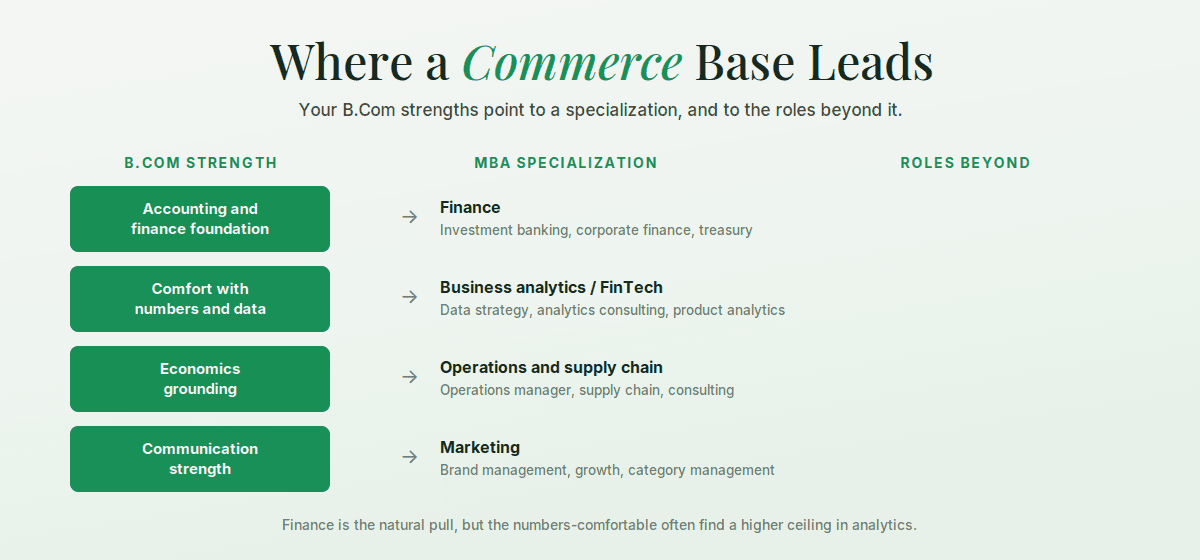
You can choose any specialization, but a few build naturally on a commerce base, and one is a sharper play than the obvious default. The map below traces your B.Com strengths to the specializations they support and the roles beyond them.
Finance: the natural progression
The most logical step, and the one that leans hardest on your existing knowledge. A finance MBA opens investment banking, corporate finance, treasury, financial analysis and wealth management. If you already enjoyed the accounting and finance parts of your B.Com and want to go deeper into how money is raised, invested and managed, this is the path of least resistance and often the highest early ceiling.
Business analytics and FinTech: the sharper play
Here is the recommendation: the usual list buries. A B.Com graduate who is comfortable with numbers is well placed for business analytics, and the ceiling in analytics and financial technology has been rising faster than in traditional finance. If you like working with data as much as with ledgers, an analytics or FinTech specialization takes the quantitative comfort a commerce degree builds and points it at some of the fastest-growing, best-paid roles in the market. For many numbers-strong commerce graduates, this beats defaulting to finance.
Marketing, and operations
If your strengths lean toward communication and persuasion rather than pure numbers, marketing opens brand management, growth and category roles, and a commerce grounding in how businesses make money is a real asset there. Operations and supply chain, meanwhile, suits the process-minded, and your economics grounding transfers cleanly into thinking about efficiency and cost.
MBA After B.Com as a Fresher, or After Work Experience?
This is a real decision with real trade-offs, not the throwaway question it is usually treated as. Both routes work; they suit different people.
Straight through, as a fresher
You attempt CAT or another entrance in your final year and go directly into an MBA. The advantages are that you keep your academic momentum, you finish younger, and you avoid the opportunity cost of delaying. The cost is that you enter with little to talk about in interviews and internships beyond academics, and you may pick a specialization before you have seen enough of the working world to know what suits you.
A few years of work first
You take a finance, analyst or operations role for two to three years, then apply. The advantages are a stronger application, a clearer sense of which specialization fits, better internship and placement outcomes because you bring real context, and often a better return because you know what you are buying. The cost is the delay and the discipline it takes to leave a paying job to study again.
As a rough guide: if you have a strong academic record and a clear reason for the MBA now, going straight through is defensible. If you are unsure which direction you want, a couple of years of work will sharpen the decision and strengthen the application more than another attempt at the entrance exam will.
Eligibility and Entrance Exams
The baseline for most MBA programs is straightforward for a commerce graduate.
Undergraduate score. Usually a minimum of 50 percent aggregate in your B.Com, with top-tier schools expecting 55 to 60 percent or higher.
Entrance exams. CAT for the IIMs and most top Indian schools, with XAT, NMAT, SNAP and CMAT accepted widely across private institutes, and the GMAT for study abroad or executive programs.
Selection rounds. Shortlisted candidates typically face a group discussion, a written ability test and a personal interview.
No CAT score? You still have real options. Beyond the XAT, NMAT, SNAP and CMAT routes, some newer programs admit entirely on profile rather than a single exam, weighing your academics, work and initiative. Scaler School of Business, covered below, is one such route, no CAT or GMAT required.
Salaries and ROI After an MBA Following B.Com
An MBA does shift a commerce graduate’s earning trajectory, but treat every headline package as a range that depends heavily on the school, the role and your own starting point, not as a promise. The roles a B.Com to MBA path most naturally leads to look roughly like this.
Role | Indicative entry range (India) | Where it sits |
|---|---|---|
Finance manager / analyst | ~₹6–15 LPA | The natural finance progression |
Business / data analyst | ~₹8–16 LPA | The analytics and FinTech track |
Product manager | ~₹10–18 LPA | For those who add tech or product depth |
Marketing / brand manager | ~₹7–14 LPA | For the communication-strong |
Before you trust any of these numbers, read them the way a commerce graduate should. A median says more than an average, because a few large offers inflate the mean. A placement rate says more than a top salary, because it captures how many graduates actually landed a role. And only fees set against a realistic median reveal the true payback period. Read that way, a mid-tier program that places well can out-return a bigger name that does not.
A Build-First Alternative: Scaler School of Business
There is one more route worth putting on the table, and it suits a particular kind of commerce graduate: the one who enjoyed business in practice more than in theory, and who would rather show what they can do than describe it in an exam. That is the idea behind Scaler School of Business, an 18-month, full-time, on-campus PGP in Management and Technology in Bengaluru, admitted on the strength of your profile with no CAT or GMAT.
Where a traditional MBA would teach a B.Com graduate the theory of running a business, SSB has students run one. For someone already comfortable with the numbers, that means applying them live, on a real budget with real consequences, rather than in a case study.
What that looks like for a commerce graduate:
You apply numbers to a real business, not a case. Students run a live Direct-to-Consumer challenge on real startup capital, turning a real brand's sales, margins and cash position into the kind of P&L a B.Com trains you to read, rather than a textbook one.
Can These B-School Students Build a ₹50 Lakh Dropshipping Business
You build and ship. Students build three AI products, work hands-on with more than 25 AI tools, and spend over 150 hours on AI across the program, so a commerce base is extended with the technical fluency the modern finance and analytics roles increasingly ask for.
You work on real company problems. More than ten company-sourced projects with over 100 industry leaders, plus go-to-market work with brands including Mokobara, Quenzy, Nuvie and Practo, and a full internship.
You build inside a live ecosystem. The Scaler Innovation Lab shares the campus, where more than ten funded startups operate, and students work with and inside them rather than studying them from a distance.
You learn from operators and backers who have built. SSB was co-founded by Anshuman Singh (formerly Meta) and Abhimanyu Saxena, both IIIT-Hyderabad alumni, and is backed by founders including Deepinder Goyal of Zomato and Kunal Shah of CRED, with faculty drawn from working operators.
It tends to fit the commerce graduate who wants to move into product, strategy or a startup rather than a conventional accounts track; the numbers-comfortable candidate whose real work outshines their entrance score; the switcher who wants proof they can operate; and the aspiring founder who wants the network and the practice before building something of their own.
What SSB says upfront. It awards a PGP certificate, not a UGC degree, and sits outside the AICTE and UGC frameworks by design, which is what lets it rewrite the curriculum every year and staff it with operators. If you specifically need a recognized degree, or if your goal is deep technical finance where a CA or CFA is the stronger tool, SSB will tell you plainly it is not the right fit. For a commerce graduate who wants to build and lead rather than specialize, that trade is often worth making. |
How to Decide: A B.Com Graduate’s Framework
Run your own situation through these, in order. They resolve most of the decision faster than another comparison table will.
Specialist or manager? If you want to be the technical expert, a professional course may beat an MBA. If you want to manage, lead and keep your options open, the MBA is built for that.
Is deep technical finance the goal? If your heart is set on investment analysis or audit specifically, weigh CFA or CA first, and consider adding an MBA later rather than instead.
Fresher or experience-first? Clear reason and strong record now, going straight through is fine. Unsure of direction, a couple of years of work will sharpen it.
Which specialization matches your strengths? Numbers and finance lean toward finance or analytics; communication leans toward marketing; process-thinking toward operations.
Do you learn better by studying or by building? If it is the latter, a build-first program may fit you better than a lecture-and-case MBA.
Do you need a recognized degree? If a government role or further academic study requires one, that rules some options in and others out. Decide it early.
Common Mistakes B.Com Graduates Make
Defaulting to finance because it is familiar. Comfort is not the same as best fit; the numbers-strong often do better in analytics.
Doing an MBA to escape, not to reach. An MBA taken to get away from a dull job rarely lands well. Aim it at a specific destination.
Ignoring the professional-course option. For a deep-finance goal, a CA or CFA can be the better and cheaper tool.
Choosing on brand alone. A recognizable name with a weak placement record is worse than a mid-tier school with strong outcomes.
Overpaying for the outcome. Fees a realistic package cannot recover in a few years are a poor trade, whatever the brochure says.
Frequently Asked Questions
Q1. Is an MBA better than CA after B.Com?
A: Neither is better in the abstract; they make different professionals. CA makes you a deep specialist in audit, tax and reporting, while an MBA makes you a generalist manager with breadth and a network. Choose CA for deep finance expertise and an MBA to move into management and strategy. Many commerce graduates do CA first and then an MBA.
Q2. Can I do an MBA right after B.Com without work experience?
A: Yes. Most Indian MBA programs admit freshers, and you can attempt CAT or another entrance in your final year. Going straight through keeps your momentum, but a couple of years of work first usually produces a stronger application and a clearer sense of which specialization fits you.
Q3. Which MBA specialization is best after B.Com?
A: Finance is the natural progression and leans on what you already know, but a numbers-comfortable commerce graduate often finds a higher ceiling in business analytics or FinTech. Marketing suits the communication-strong, and operations the process-minded. Match the specialization to your strengths rather than to the default.
Q4. Can I do an MBA after B.Com without CAT?
A: Yes. Many schools accept XAT, NMAT, SNAP or CMAT instead of CAT, and some newer programs, including Scaler School of Business, admit entirely on a profile-based evaluation with no entrance exam at all.
Q5. Does an MBA after B.Com actually increase salary?
A: From a good program used well, yes, it shifts you from execution-level pay toward management-level pay. From a weak program, it mostly adds cost. Weigh the median package and placement rate of the specific program, not the headline average, before assuming a raise.
Q6. Is a Finance MBA the only good option for commerce graduates?
A: No. Finance is the most natural fit, but it is not the only strong one. Analytics, FinTech, marketing and operations all suit different commerce profiles, and defaulting to finance simply because it is familiar can mean missing a specialization that fits you better.
Q7. Can I do an MBA after B.Com if my aggregate is below 50 percent?
A: It is harder, since most reputed programs set a 50 percent minimum, but not impossible. Some private institutes and profile-based programs weigh your overall profile, work and entrance performance rather than the undergraduate percentage alone, so a strong application elsewhere can offset a lower aggregate.
The Bottom Line
An MBA after B.Com is a strong move when it is chosen on purpose: to trade a commerce foundation for managerial breadth, to break past execution-level roles, and to open a specialization that fits your actual strengths rather than the familiar default. It is a weaker move when it is a reflex, taken because it is what commerce graduates are supposed to do next, without weighing the professional-course fork or the fresher-versus-experience call.
So answer the specialist-or-manager question first, match the specialization to your strengths second, and be honest about whether you learn better by studying or by building. And if it is the latter, a build-first option such as Scaler School of Business, where a commerce base gets applied to real ventures rather than case studies, is worth weighing on its own terms, as an alternative to a traditional MBA rather than a version of one.

Non-IIM MBA
Top Non-IIM MBA Colleges in Bangalore (2026): Fees, Placements & How to Choose
5 min. read
MBA for Professionals
Is an MBA Worth It for Working Professionals? An Honest 2026 Guide
5 min. read

MBA for Engineers
MBA After B.Tech (2026): Eligibility, Specializations, Salary & Is It Worth It?
5 min. read
MBA for Engineers
MBA After Engineering (2026): Eligibility, Specializations, Salary & Is It Worth It?
5 min. read