
Non-IIM MBA
MBA for Tech Professionals (2026): Is It the Right Move, and Which Kind?
Explore whether an MBA is worth it for tech professionals in 2026, including when it helps you move from building to leading, how it compares with staying technical, and what to look for in a tech-focused business program.
Team SSB
5 min. read
Most tech careers hit the same wall. You get very good at building, and then the next rung up is not more technical, it is leadership, strategy, and business decisions, and your engineering skill stops being the thing that moves you forward. That is the moment people start weighing an MBA for tech professionals. Whether it is the right move, and which kind, depends a lot on what you build today: an engineer, a data scientist, a data analyst, and an aspiring product manager each face a different version of this question.
This guide sorts that out. It covers who an MBA actually helps, the honest AI-era case for the degree, the fork between an MBA and staying technical, the difference between a general MBA and a technology-management one, the format that fits a working professional, and where a build-first program like Scaler School of Business fits.
Short answer. Is an MBA worth it for tech professionals? It is, if your goal is to move from building to leading: product, strategy, consulting, or the executive track. It is not, if you want to go deeper technically. The strongest case in 2026 is that AI is automating routine work and raising the premium on judgment and leadership. |
Which Tech Professional Are You?
“Tech professional” covers very different careers, and the MBA answer shifts with each. Find yourself here first.
Software developer or engineer. The real question is whether you want to leave the technical track at all. See our guide to the MBA for software developers.
Data scientist. Your fork is an MBA versus a deeper technical master’s, once you already have the technical spike. See our guide to the MBA for data scientists.
Data analyst. The move is usually from the analyst seat into analytics management. See our guide to the MBA for data analysts.
Aspiring product manager. The decision is an MBA versus other routes into product. See our guide to the MBA for product management.
IT and infrastructure. The pull is toward IT leadership and business-facing roles, where the leadership case below applies directly.
Wherever you sit, the shared decision is the same: does moving from technical work to leadership need an MBA, and if so, which kind? That is what the rest of this covers.
What an MBA for Tech Professionals Actually Does
For someone already strong technically, an MBA is not about adding technical depth. It changes three things.
Business fluency. Finance, strategy, marketing and operations give you the frame to connect a technical decision to revenue, cost and company direction. An MBA helps you gain business knowledge outside your tech specialty.
Leadership and influence. You learn to lead cross-functional teams and communicate with people who are not engineers, which is the daily work of any senior role.
Network and access. Business school connects you to peers, recruiters and paths outside your current company, and it opens the door if you aspire to a management role.
What it does not do is make you a better engineer, and it is not a shortcut to a promotion you can earn on the job. It is a tool for changing what you do, not for climbing the ladder you are already on.
Is an MBA Worth It for Tech Professionals?
Two-sided. It is worth it if you want to move off the technical track into product, strategy, consulting or leadership, and you value the network and the credential. It is not worth it if you love the technical craft and want to keep doing it, where the pay and the growth stay strong without a business degree. Most MBA graduates end up in consulting, finance or tech roles, so the degree fits a shift toward those, not a deepening of engineering.
Is an MBA Still Worth It in the Age of AI?
This is the sharpest version of the question in 2026, and the honest answer is encouraging. AI is automating routine analysis and the entry rung of most career ladders. In a recent recruiter survey, one in three employers said they had already replaced some entry-level roles with AI, while more of them plan to hire MBA graduates this year than last, and more than half said the degree has grown more important as AI takes hold. The logic is simple: AI has made competent output cheap, so value moves to what the machine cannot supply, judgment, strategy and leading people. Those are the muscles an MBA builds, which is why managerial roles are considered more protected than the tasks below them.
There is a real caveat for tech readers, though. Classic MBA content can lag the speed of tech, and many programs still carry close to no depth on AI. So the question is not only “MBA or not,” it is “will this program keep pace.” The programs worth your money treat AI and technology as core rather than a bolted-on elective, and teach you to apply AI to real decisions rather than describe it.
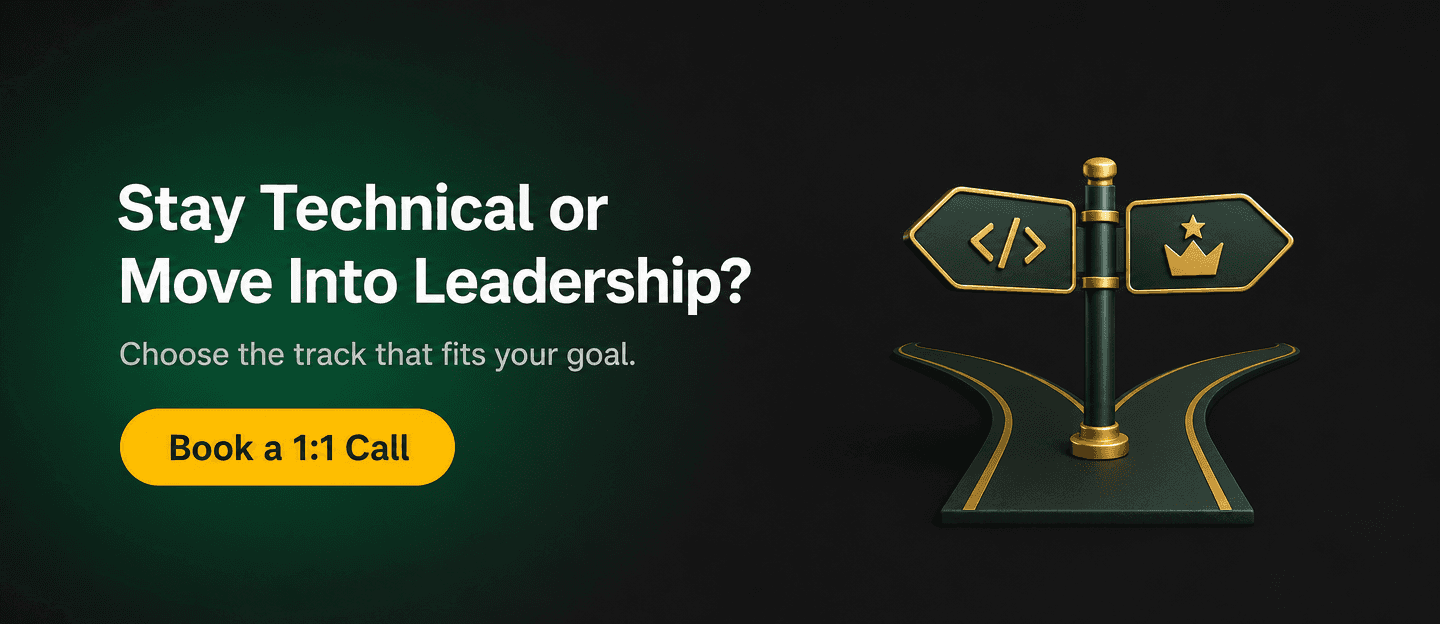
MBA vs Staying Technical vs an Internal Move
Before you commit, weigh the three real alternatives.
Route | What it gives you | Best for |
|---|---|---|
MBA | Business breadth, leadership, network, a credential outside tech | Moving off the technical track into product, strategy or leadership |
Stay technical (senior IC) | Staff, principal, distinguished engineer depth | Building at the deepest level, with strong pay and no degree needed |
Internal move to management | A management title, earned on the job | Leading a team without paying for a degree |
Two honest notes. First, the senior individual-contributor track does not need an MBA and can reach pay comparable to management, so staying technical is not the poorer choice. Second, tech people often ask why not just take online certifications or courses instead. A course builds one specific skill; what the MBA adds that a course does not is the network, the recruiting access, and the leadership signal that a career switch runs on. If you only need a skill, a course is cheaper. If you need a change of track, that is the MBA’s job.
General MBA vs Technology Management MBA
If you decide on an MBA, there is a second choice most tech people face: a general MBA or a technology-focused one. A general MBA teaches broad business, finance, marketing and operations, and it is enough if you are heading into a conventional business role. A technology-management MBA keeps that core but adds the intersection of technology and business, emerging tech, analytics, and managing technical teams and products, which suits someone who wants to lead in a tech-driven company rather than leave tech behind.
The rule of thumb: if your future is running a business function, a general MBA works. If your future is leading technology, a product, an engineering org, or a tech company, the technology-focused path keeps your hard-won context useful instead of setting it aside. In an AI-shaped market, that technical context plus business judgment is exactly the rare combination employers pay for.
Which MBA Format Fits You: Full-Time, Part-Time, Executive, or Online?
The format decides whether the MBA fits your life, and it is often the real blocker for a working professional.
Format | Who it suits |
|---|---|
Full-time | A clean reset with campus recruiting, if you can step away from work |
Online / part-time | Early-to-mid-career professionals who cannot quit and want to switch or upskill while earning |
Executive | Senior professionals, roughly 8 to 15 years in, moving toward the C-suite |
Match the format to where you are, not to prestige. A full-time program gives the sharpest reset and the strongest recruiting access, but it costs you a salary and asks you to step away; an online or executive route keeps you earning but leans on you to drive the switch yourself.
Roles Tech Professionals Move Into
The destinations an MBA genuinely opens, most of them a step away from pure engineering:
Product management, the most common landing spot, where your technical background is a real edge.
Technology consulting and strategy, where structured thinking plus technical fluency is a strong pairing.
The technology leadership track, up to CIO and CTO.
Venture capital and investing, where technical judgment is valued.
Founder or early-stage operator, building on the network and the business skills.
AI is also creating leadership roles that sit between technology and the business, from AI product management to data-driven strategy, which reward exactly the tech-plus-business profile this path builds.
Salary and ROI
Be clear-eyed about the money. If you stay technical, the pay is already strong: senior and staff engineers at product companies in India earn roughly ₹35 to 60 lakh, and the technical-leadership track can match management pay without an MBA (Instahyre). So the MBA is not a raise on your current track. Its return comes from the track it opens: business-side leadership roles, up to CTO or COO, where a CTO at a funded startup can earn from around ₹50 lakh to ₹1.5 crore plus equity (Instahyre). Weigh the tuition and the foregone salary against the roles the degree unlocks, not against your current pay. For the full cost-versus-return method, see our guide on whether an MBA is worth it.
What to Look for in a Program
Judge a program on what it builds, not its brand. For a tech professional in 2026, weigh four things: real technology and AI depth in the core rather than a single elective, projects with real stakes over case studies alone, faculty who have operated and led rather than only taught, and a network you will still use in ten years. Format follows your life, full-time for a reset, executive or online to keep earning.
Where Technology Meets Leadership: Scaler School of Business
If the move you want is from building technology to leading it, it is worth looking at a program built for exactly that crossing. Scaler School of Business runs an 18-month, full-time PGP in Management and Technology in Bengaluru, where students you're admitted on the strength of your profile, not a test score - there's no CAT or GMAT.
The fit for a tech professional is the AI-native, build-first model. Students ship three AI products, work hands-on with more than 25 AI tools, and run go-to-market projects with real brands, a direct answer to the common criticism that classic MBAs lag on technology and AI. You keep using your technical instincts while adding the business, leadership and decision-making reps that leadership demands.
Can these MBA students Build AI Products with 0 Coding knowledge?
To be clear on the bounds. It will not deepen your engineering; a technical master’s does that. It is full-time and on-campus, so it is not the route if you must keep your job. And it awards a PGP certificate, not a UGC degree, sitting outside the AICTE and UGC frameworks by design; if you need a UGC-recognised degree, it is not your fit. If you want the technology, AI and business foundation that leadership in a tech-driven company rewards, that is what it is built for.

How to Decide
Five questions settle it:
Do you want to keep building, or lead the people and the business around what gets built?
Is your goal a track change (the MBA’s job) or a promotion (earn it on the job)?
Do you want to lead technology specifically, which points to a tech-focused program, or a general business function?
Can you afford a full-time reset, or do you need an executive or online format?
Does the program treat AI and technology as core, or as an afterthought?
Frequently Asked Questions
Q1. Is an MBA worth it for tech professionals?
A: Yes if you want to move into product, strategy, consulting or leadership; no if you want to stay deeply technical. In an AI-shaped market, the leadership skills it builds are gaining value.
Q2. General MBA or technology management MBA?
A: A general MBA suits a conventional business role; a technology-management MBA suits leading technology, products or tech teams, and keeps your technical context useful.
Q3. Will an MBA help me become a manager?
A: It helps you move into business-side leadership. A same-track engineering-management promotion is usually earned on the job, not bought with a degree.
Q4. Do tech professionals need an MBA to get promoted?
A: No. The senior technical track pays well without one. The MBA is for changing tracks toward the business side.
Q5. Is an MBA still relevant with AI?
A: Yes. AI automates routine work and raises the premium on judgment and leadership, and recruiters increasingly value the degree as AI spreads.
Q6. What roles do tech professionals move into after an MBA?
A: Most commonly product management, then consulting and strategy, technology leadership up to CTO, venture capital, and founding a company.
Q7. Should I do a full-time or online MBA?
A: Full-time for a clean reset with recruiting access; online or executive if you cannot leave your job. Match it to your stage.
Q8. Do I need to crack CAT or GMAT?
A: For many programs yes, but a growing number, including profile-based ones, admit without a national entrance exam.
The Bottom Line
For a tech professional, an MBA is not a way to get better at technology or to speed up a promotion you can already earn. It is a way to change what you do: from building the system to leading the product, the team, or the company. In a market where AI is making routine output cheap and paying a premium for judgment, that shift is worth more, not less. So the real questions are whether you want to lead rather than build, and whether the program you pick treats technology and AI as core.
If both answers point the same way, a build-first program like Scaler School of Business is set up for exactly that crossing.

Non-IIM MBA
Top Non-IIM MBA Colleges in Bangalore (2026): Fees, Placements & How to Choose
5 min. read
MBA for Professionals
Is an MBA Worth It for Working Professionals? An Honest 2026 Guide
5 min. read

MBA for Engineers
MBA After B.Tech (2026): Eligibility, Specializations, Salary & Is It Worth It?
5 min. read
MBA for Engineers
MBA After Engineering (2026): Eligibility, Specializations, Salary & Is It Worth It?
5 min. read