
Non-IIM MBA
MBA Without CAT in 2026: Every Route, Honestly Tiered
Explore every credible MBA route without CAT in 2026, from XAT, GMAT and executive MBA options to profile-based programs. This guide honestly compares each pathway by credibility, fit, risks and career outcomes so you can choose the route that makes the most sense for your profile.
Team SSB
5 min. read
MBA Without CAT: Is It Settling, or Smart?
Missed the CAT cutoff? Wondering if no-CAT means settling for less? Looking for a route that was actually built for someone with your profile?
Start with the second question, because it is the one quietly driving the other two. No-CAT is not settling. But to really answer that, you have to ask a bigger question first: what if the smarter move was never the exam in the first place?
Here is why that is not just a reframe to make you feel better. CAT ranks test-takers under time pressure across three specific skill sets. That is all it does. It says nothing about your ability to lead a product team, build a business, or make a strategic call under real conditions, the things an MBA is actually supposed to prepare you for.
That is exactly why credible MBA pathways have always existed outside the CAT system. XAT opens XLRI, one of India’s strongest non-IIM brands, built on its own exam and its own seven-decade reputation. GMAT opens ISB Hyderabad, work-experience-friendly and globally recognised. The Executive MBA route exists for professionals who do not need to step away from work for two years. These are not workarounds. They are established, high-credibility routes that plenty of strong candidates have used for decades.
A newer generation of programs has gone further still, asking not “what did you score?” but “what have you actually built?”
This guide gives you a tiered and honest map of every route: what each one is genuinely worth, who it is right for, and which ones carry risks most articles will not mention.
Already know your profile? Skip straight to the route that fits you: the profile guide below.
Why People Skip CAT and Why You Are Right to Question It
Whether you are an engineer who never wanted to spend a year on exam prep, a professional mid-career who wants to switch direction, or a fresher whose profile says more than any percentile would, the calculation you are running is the same: is this the right path for where I actually want to go?
For engineers especially, the question has a sharp edge.
You spent four years studying calculus, algorithms, and systems design. Now you are being told that to prove you can do business, you have to sit for an exam where 40% of the questions are on quantitative aptitude.
Does that feel right to you?
CAT does not test whether you can build a product, lead a team, or make a call under pressure. It tests whether you are prepared for the CAT. Those are not the same thing. If you have two years of engineering behind you, you already know which one matters in a room.
Most engineers who land here fall into one of three situations.
You gave it a genuine shot. You prepared alongside a full-time job, hit 78 or 85 percentile, and watched the cutoff sit fifteen points above you. That is not your capability. That is the gap between your prep time and someone who spent a year doing nothing else.
You chose not to appear. Not out of fear. You ran a quiet calculation: twelve months of prep is twelve months not shipping, not building, not moving in the direction you actually want. You chose momentum. That is a strategy.
You looked at the output and decided it did not fit. Two years. Rs. 25 to 35 lakhs. Is the ROI math actually there for you? Placements skewed toward consulting and banking. If you want a PM role at a growth-stage startup or a strategy position at a D2C brand, that pipeline was never quite built for you.
None of these is a failure. The only version that hurts you is picking a weak program to avoid the exam. That is what this guide is here to prevent.
Every Route to an MBA Without CAT, Honestly Tiered
Not all no-CAT pathways are equal. Some are genuinely strong. Some work for specific situations. And some, though heavily marketed, carry real career risk. Here is the honest breakdown.
Tier 1: Strong, Credible Routes
These are pathways where the absence of CAT does not imply any compromise in quality.
Alternative National Entrance Exams: XAT, NMAT, SNAP, CMAT, MAT
Several of India’s most respected B-schools run their own exams, entirely independent of CAT. If you are building your list of CAT alternatives, these are the ones that carry real weight.
XAT, conducted by XLRI Jamshedpur, is the most demanding of the lot. Gateway to one of India’s consistently top-ranked non-IIM B-schools, with average placements well above Rs. 25 LPA and recruiters like Deloitte, ITC, and HUL hiring consistently from the program. Treat it with the same preparation weight as CAT.
NMAT is accepted by NMIMS Mumbai alongside 30+ institutions. You can attempt it up to three times per cycle. If NMIMS is the goal, this is your lever.
SNAP opens the Symbiosis group, including SIBM Pune, where the 2023-25 batch saw average placements cross Rs. 18 LPA with recruiters including Deloitte and Accenture on campus.
CMAT, MAT, and ATMA cast a wide net across hundreds of institutions. Use them to expand options, not as a primary strategy.
International Tests: GMAT and GRE
The global standard, and the route into ISB Hyderabad, Great Lakes, and SP Jain without CAT. GMAT rewards analytical reasoning over test-taking speed. If you have two or more years of work experience, your application becomes more than a score. Prep time is typically shorter than a full CAT cycle, and the credential works internationally.
Profile-Based Admission with No Standardised Test
The category most guides ignore, and arguably the most significant shift in Indian management education in recent years.
These programs evaluate who you are: your work history, what you have built, your video essay, and how you perform in a business-case interview. No percentile required. If you are an engineer who has shipped a product, a professional who has led a team, or a fresher with a real project, this route can assess your potential more accurately than any exam. We will return to this category. It is where the most outcome-focused programs in India now sit.
Tier 2: Situational Routes
Legitimate pathways for specific profiles. They are not for everyone, but for the right person, they are entirely credible.
Executive MBA: For Experienced Professionals
Built for mid-career professionals with seven or more years of experience. CAT not required. Most take the GMAT or a profile-based evaluation. Right tool, wrong time if you are two years out of college.
IIM Entry Without CAT: Executive MBA and IPM
Two IIM routes exist outside the standard CAT process. The IIM IPM (Integrated Program in Management), offered by IIM Indore, IIM Rohtak, IIM Ranchi, and others, is a five-year program open to Class 12 students via an aptitude test, with no CAT required. The IIM Executive MBA and PGPX, offered by IIM Ahmedabad, IIM Bangalore, and IIM Calcutta, is built for professionals with five or more years of experience and admits primarily on GMAT and work profile. If an IIM name is non-negotiable and CAT is off the table, these are the two honest routes.
Genuinely Accredited Online and Distance MBA
Programs from IGNOU, Amity Online, Manipal Online, and BITS Pilani WILP offer real flexibility with UGC or AICTE recognition. No entrance exam. Study alongside a full-time job. The non-negotiable word: accredited. Always check the UGC-DEB list before committing. An unaccredited online MBA is a different and riskier product.
Tier 3: Approach with Caution
Management Quota Seats
Entry without a score, in exchange for higher fees. Rarely come with scholarships. Often carry weak placement records and a reputational cost that follows you into interviews. If a merit route exists at the same institution, take it.
Unaccredited or Unknown Programs
Check three things before committing: AICTE approval or UGC recognition, independently verified placement data with company names and salaries, and alumni visibly doing the work you want to do. If any of these are unclear, that is the answer.
Route | Exam Required? | Typical Profile Fit | Credibility | Best For |
XAT / NMAT / SNAP | Yes, own exam | Any motivated candidate | High | Strong CAT alternatives, top non-IIM B-schools |
GMAT / GRE | Yes, international | Work-experience candidates | High | ISB, global programs, executive track |
Profile-based, no test | No | Builders, engineers, switchers, strong freshers | High — outcomes-dependent | Those with strong profiles over exam scores |
Executive MBA | GMAT or profile | 7+ years of experience | High | Mid-career acceleration |
Accredited online MBA | No | Cannot step away from job | Medium to High (verify accreditation) | Working professionals |
Management quota | No | Anyone with budget | Low to Medium | Approach with significant caution |
Unaccredited programs | No | Anyone | Low | Avoid |
Which Route Fits You?
Three questions per profile. If most of them land, the route below is built for you.
B.Tech Engineer Looking to Pivot
Want to own the roadmap, not just build the feature?
Targeting PM, strategy, or the founder’s office over consulting and banking?
Confidence in your projects and work say more about you than a percentile ever could?
Your B.Tech gives you the analytical foundation that most MBA programs spend the first semester building from scratch. What you need is the business and strategy layer on top. Profile-based programs are built for your exact profile: they evaluate your technical depth alongside your business thinking, and the cohorts are full of people making the same move. If you are specifically researching the MBA after the B.Tech direct admission route, look for programs where engineers make up a significant share of the intake, AI and product are core, and admissions care about what you have built.
Career Switcher
Spending years in the wrong function?
Know where you want to go but lack the proof to make the jump?
Worried a credential alone will not make the switch credible?
Take someone three years into a finance analyst role who wants to move into product. A traditional MBA gives them a credential and a career services office. It does not give them a product to point to.
The programs that work for a switch like this build proof-of-work during the program, not just at the end. An actual PM internship, not a finance internship with a new title, is worth more than the brand name on the certificate.
Strong Fresher
Stronger profile than your exam score would ever suggest?
Built something real in college that no percentile would capture?
Looking for a room of builders, not just toppers?
Profile-based admission measures initiative and what you have actually done, not test performance under pressure. The project, the team, the problem you solved outside a classroom: these carry real weight here. If your profile is strong, this route gives you a fairer assessment than CAT ever would.
Builder or Aspiring Founder
Have an idea and need structure, peers, and investor access more than a certificate?
Want to pitch at a Demo Day more than go through campus placements?
Is the ecosystem around you more important than the name on the certificate?
Look for mandatory incubation, a founder simulation, working capital tied to your idea, and a campus inside a startup ecosystem. The program you want is one where graduation looks like having built something, not just having studied it.
Brand Name Is the Primary Goal
Is a specific brand name the non-negotiable outcome?
Would anything short of IIM or ISB feel like settling?
Are you willing to retake to get that name?
Be honest: a profile-based no-CAT route will not give you that. The path is CAT, GMAT for ISB, or XAT for XLRI. That is a legitimate goal. This guide is for those who have made peace with a different set of priorities.

What a No-CAT MBA Should Actually Deliver in 2026
Here is the question that matters more than the route: what does the program actually produce?
In 2026, employers are becoming less reliant on degree titles alone and more focused on demonstrable skills, practical expertise and the ability to apply knowledge in real business contexts. LinkedIn’s 2026 Skills on the Rise report says employers are “looking less at job titles or degrees, and more at what people can actually do,” while Reuters reports that in India’s GCC and tech hiring market, 40% of employers prefer demonstrable AI skills or certifications over degrees, and another 32% give equal weight to skills, certifications and degrees.
A candidate who shipped a real AI product, worked directly with a founder on a live GTM problem, and built a business from scratch in the first semester shows up differently in an interview than one who studied the same scenarios through a case. The proof-of-work is the differentiator, and it is widening.
The right question for a no-CAT MBA is not “is this respected?” It is: does it produce people who can do the work, and does it have the record to prove it?
This is where Scaler School of Business sits.
Scaler School of Business: The Profile-Based, Execution-First Standard
No CAT. No GMAT. No entrance exam of any kind.
SSB was built by people who have built exactly what you are trying to build. Anshuman Singh, co-founder of Scaler and formerly at Meta, and Abhimanyu Saxena, IIT Roorkee alumnus and Scaler co-founder, designed the program from scratch around one question: what does it actually take to build and lead in 2026? The program is backed by Deepinder Goyal of Zomato, Kunal Shah of CRED, and Binny Bansal of Flipkart, which tells you something about the kind of talent they are trying to build.
Getting in does not depend on a percentile. It depends on who you are. Your work history, your projects, how you think through a business problem in an interview.
SSB Admissions: scaler.com/school-of-business/admission
Here is what that profile-based entry actually buys you.
Outcomes and placements: 76% of SSB’s founding cohort pivoted into the roles they actually wanted, switching functions, industries, or career tracks entirely during the program. 100% of the founding cohort secured internships from campus, at companies including Razorpay, BharatPe, The Whole Truth, Apna, and others. Full-time placements from the cohort span Blinkit, Urban Company, Razorpay, BharatPe, Ninjacart, Scapia, Toddle, and Even Health, among others, with an average salary hike of 3.4x after the program.
Curious whether your profile fits this kind of pivot? Book a 1:1 session with the SSB team.
Cohort caliber: The no-CAT admission route does not produce a weaker cohort. It produces a different one. SSB’s intake is approximately 47% engineers, 27% business and management graduates, and 26% from arts and science backgrounds, with an average of 2.8 years of work experience. The room includes IIT alumni, former Amazon, McKinsey, and Uber professionals, and strong freshers, all selected on profile depth, not percentile.
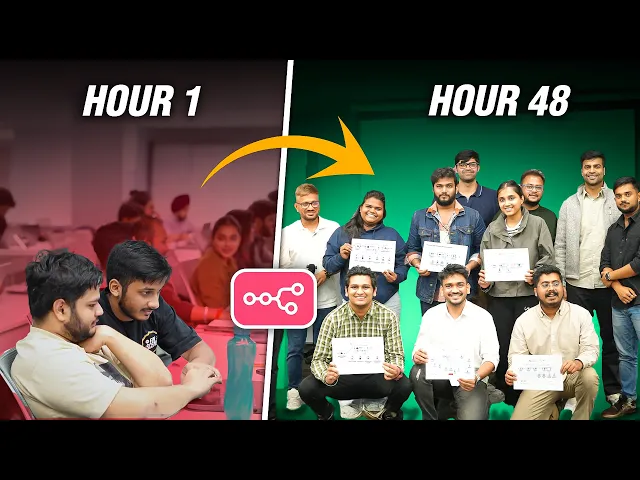
Proof-of-work, built during the program: In the first six weeks, your future classmates are not studying marketing theory. They are sourcing products, building brands, running ads, and selling directly to consumers at a live retail location. In a 48-hour AI sprint, students with no coding background ship working AI products: voice agents, automation workflows, content tools, and medical triage systems. The curriculum covers 150+ hours of AI across all four semesters, 25+ tools, and three AI products built during the program. In the Hustle founder simulation, every student takes an idea from zero to a real business: validating demand, building a product, finding customers, and pitching to investors on Demo Day. Five-plus startups have been incubated in SSB’s Innovation Lab, which sits on the same campus as Scaler’s tech program. Students have also worked on live problems brought in by founders from Mokobara, Quenzy, and Nuvie, building GTM strategies that are actively being implemented. Faculty are not career academics. They are operators who have built and scaled at Razorpay, McKinsey, Bain, Uber, and Zomato. Not case studies. Actual output.
SSB is an 18-month, full-time, on-campus PGP-MT (Post Graduate Program in Management and Technology) based in Bengaluru. Program fee: Rs. 23 lakhs.
On cost: Program fee is Rs. 23 lakhs. SSB has built multiple access routes for candidates who need them.
On the certificate question: Here is what most guides will not tell you. An MBA degree requires over 90% of teaching hours to come from PhD-holding instructors, with the curriculum controlled by that framework. That means it cannot move at the pace AI is moving, and it locks out faculty who are actually building right now, operators like Kanishk Mehta at Razorpay, not just academics with the right degree. SSB awards a PGP certificate instead, a deliberate trade that lets the curriculum update in real time. If a UGC-recognised degree is a hard requirement for your goal, SSB is not the right fit, and that is worth saying clearly. Otherwise, the certificate becomes secondary to what you can actually demonstrate in an interview room.
We Gave MBA Students 48 Hours to Build AI Products Without Code
MBA Without CAT: Frequently Asked Questions
Is an MBA without CAT worth it?
Yes, if the program has verified placements and a cohort worth being in. The route in does not determine the value. The program does.
Can you do an MBA without CAT and GMAT?
Yes. Several credible programs require neither. Profile-based programs evaluate your work history, projects, and a case interview instead of any standardised test.
If you want a concrete example of what that looks like, SSB’s entire admission process runs on profile, a video essay, and a business case discussion. Nothing else. Apply here.
Which MBA programs do not require CAT?
XLRI via XAT, NMIMS via NMAT, ISB via GMAT, and SIBM Pune via SNAP are among the strongest alternatives. If you want to skip standardised tests entirely, profile-based programs evaluate you on who you are and what you have built.
SSB is one such program. No CAT, no GMAT, no external test required. New-age business schools do not believe one data point defines a student’s career, so admission is a holistic profile evaluation based on your experience, projects, and how you think. SSB Admissions
Is a no-CAT MBA respected by employers?
Depends on the program, not the admission route. Verified placements, cohort quality, and what alumni are actually doing after graduation are what employers check.
Can working professionals do an MBA without CAT?
Yes, through Executive MBA programs, UGC-accredited online MBAs, or full-time profile-based programs where work experience is weighted positively in the selection process rather than treated as a gap.
Can freshers and B.Tech graduates get in without CAT?
Yes. Profile-based programs evaluate internship quality, academic performance, and real projects rather than a percentile. B.Tech graduates are particularly well-suited to programs that bridge engineering and business thinking.
SSB’s current cohort is 47% engineers and 53% from business & other non-engineering backgrounds, all selected on profile rather than a score. scaler.com/school-of-business/admission
Ready to Take the Next Step?
Applications for SSB’s are closing soon. No CAT. No standardized test. Admission on profile, projects, and how you think.
If this is the room you want to be in, the application window is open now.
Apply now:
Non-IIM MBA
Top Non-IIM MBA Colleges in Bangalore (2026): Fees, Placements & How to Choose
5 min. read
MBA for Professionals
Is an MBA Worth It for Working Professionals? An Honest 2026 Guide
5 min. read

MBA for Engineers
MBA After B.Tech (2026): Eligibility, Specializations, Salary & Is It Worth It?
5 min. read
MBA for Engineers
MBA After Engineering (2026): Eligibility, Specializations, Salary & Is It Worth It?
5 min. read