Business Management Glossary
Nature of Management: Characteristics and Why it Matters?
Understand the nature of management, including its key characteristics, why it is considered both a science and an art, how it functions as a partial profession, and what that means for how management is learned and practiced
Team SSB
5 min. read

Management is the process of getting work done through other people by organizing an enterprise’s resources toward a defined goal. The nature of management asks two questions about that process: what it is like wherever it is performed, and what kind of discipline it is.
The first question is answered by its characteristics, the features that hold true in a hospital, a factory and a software company alike. The second is the long-running question of whether management is a science, an art or a profession, which turns out to have a more useful answer than any single word.
Short answer. Management is goal-oriented, all-pervasive, multidimensional, continuous, dynamic, intangible and a group activity. It is both a science and an art: a social science, because its principles establish cause and effect but predict tendencies rather than certainties, and an art, because applying them well depends on personal skill built through practice. It is only partly a profession, since no license is required to manage. |
The Characteristics of Management
Seven features describe management wherever it is found. Each one carries a practical consequence, which is what makes the list worth more than a definition.
Management is goal-oriented
Management exists to achieve something specific. It has no purpose independent of the objectives it serves, and different enterprises pursue very different ones: a retailer pursues sales, a hospital pursues patient outcomes, a charity pursues reach. The consequence is that management is judged on results rather than on effort. A manager who works hard and misses the objective has not managed well, which is an uncomfortable standard but a clear one.
Management is all-pervasive
The same activity appears in every organized enterprise, of every size, in every country and in every department. Henri Fayol argued this from the beginning, holding that the work of management applied universally, whether in business, the military, government or philanthropic undertakings (American Journal of Business Education). The consequence is that managerial skill transfers. What differs between a factory and a school is the work being managed, not the act of managing it, which is why a capable manager can move between sectors in a way a specialist often cannot.
Management is multidimensional
Management operates on three things at once. It manages work, translating an objective into tasks that can actually be performed. It manages people, who have their own motivations and cannot simply be allocated like equipment. And it manages operations, the flow of activity that turns inputs into outputs. The consequence is that a manager strong in only one dimension will struggle: technical mastery without the ability to lead people, or a talent for people without an understanding of the operation, both leave a gap that shows up quickly under pressure.
Management is a continuous process
There is no point at which management is finished. Objectives are set, work is organized and results are measured, and the measurement produces the information for the next round. The consequence is that management has no natural completion, only cycles, which distinguishes it from a project. It also means a manager is never working on one thing at a time: this quarter is being measured while the next is being planned.
Management is a group activity
Management is only necessary because more than one person is involved. A single person working alone organizes their own effort; the moment two people share an objective, someone has to divide the work, resolve disagreement and keep the parts aligned. The consequence is that authority, communication and coordination are not optional extras but structural requirements, and they become more demanding as the group grows.
Management is dynamic
The environment an enterprise operates in changes continuously: technology, competition, regulation, customer expectations and the workforce itself. Management adapts to those shifts rather than holding a fixed position. The consequence is the most practically important one on this list. Management principles have to be flexible guidelines rather than fixed formulas, because a rule that produced good results in one set of conditions can produce poor ones in another.
Management is an intangible force
Management cannot be seen. What can be seen is its effect: work that flows without friction, people who know what they are responsible for, targets that are met. Its absence is equally visible, in duplicated effort, confusion over ownership and missed deadlines. The consequence is that managerial performance can only be inferred from outcomes, never inspected directly, which makes it genuinely difficult to evaluate and easy to misattribute in either direction.
Management as a Science, an Art and a Profession
The second question about the nature of management is what category it belongs to. Each of the three candidates has its own tests, and management performs differently against each.
Is management a science?
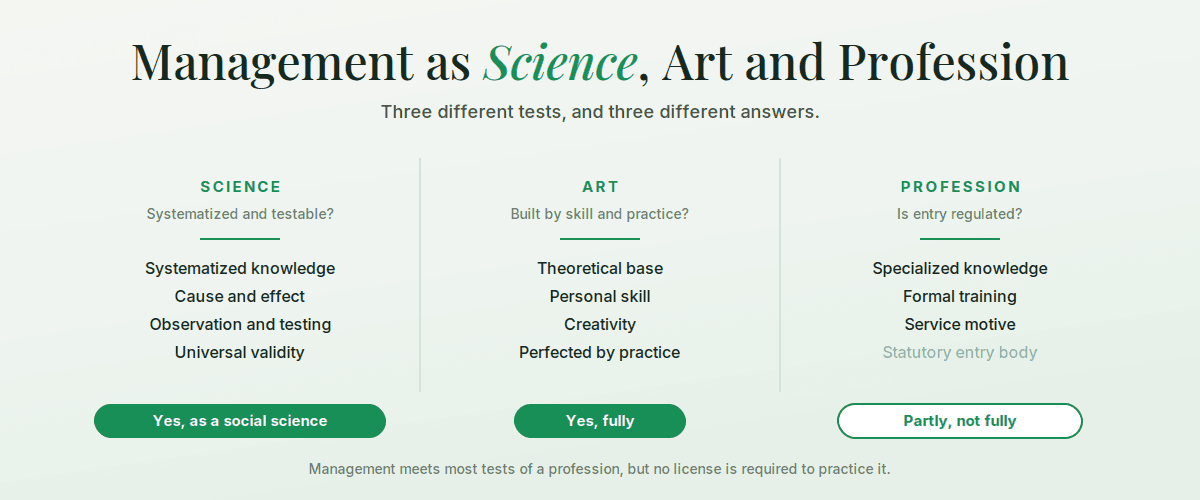
A science is a systematized body of knowledge, built through observation and experiment, that establishes relationships between causes and effects and holds valid across situations. Management meets the first three tests comfortably. It has an organized body of principles and concepts developed over more than a century, drawing on economics, sociology, psychology and mathematics. That knowledge was built by observing enterprises and testing what worked. And its principles do assert cause and effect: divided authority produces confusion, unclear objectives produce scattered effort.
The fourth test is where it separates from physics or chemistry. Management deals with human behavior, which cannot be held constant the way a laboratory variable can. The same principle applied to two teams can produce different results, because the people differ. Management is therefore a social science: its principles are genuine and testable, but they predict tendencies rather than certainties.
Is management an art?
An art rests on a body of theory, is expressed through personal skill, requires creativity, and is perfected through practice. Management satisfies all four without qualification.
The theory exists in the principles above. The personal skill is evident in the fact that two managers with identical training handle the same problem differently, and one gets a better result. Creativity is required because no situation matches the textbook case exactly, so a principle has to be adapted rather than applied. And practice is what improves it: managers become better at difficult conversations, at reading when a team is struggling and at judging when to intervene by doing those things repeatedly, not by studying them further.
Is management a profession?
The criteria for a profession, as set out by the management writer McFarland, are a specialized body of knowledge, formal methods of acquiring training, a representative association, an ethical code, and fees charged for service. Management satisfies most of these criteria, but only partially. The body of knowledge exists and is taught formally, satisfying the first two. Fees are routinely charged for management services, satisfying the fifth. Codes of conduct exist within specific industries and professional bodies, addressing the fourth, if unevenly.
The third criterion: A representative association, is where the case weakens. Associations exist, including the All India Management Association, but membership is voluntary rather than compulsory, and entry into management itself is unregulated: a person can be appointed a manager with no qualification, no examination and no membership of any body, which is not true of a doctor, a lawyer or a chartered accountant. That gap in gatekeeping, not a missing body of knowledge, is why management is best described as partly a profession rather than a full one. Management is therefore best described as partly a profession, holding the knowledge and the responsibility of one without gatekeeping.
Why This Changes How Management Is Learned
Taken together, the science and art verdicts carry a practical implication about how the subject is acquired.
The science half of management is transferable. Principles, frameworks and the accumulated record of what has worked can be written down, taught in a classroom and learned from a book by anyone willing to read carefully. The art half cannot be transferred that way. Judgment, timing, the ability to tell which principle a messy situation actually calls for, and the confidence to act on incomplete information are built by making decisions and living with the consequences. No amount of reading substitutes for the first time a plan fails and a correction has to be made with a team watching.
That explains an outcome that would otherwise be puzzling: two people can absorb the same theory and manage very differently. It also explains why management education pairs coursework with projects, simulations and internships. The two halves are acquired by different means, and a person who has only one of them is recognizable. Someone with theory alone can describe management fluently without being able to do it; someone with practice alone accumulates habits that work until conditions change, without the principles to know why.
Why the Nature of Management Matters in Practice
Beyond how it is learned, the characteristics have direct consequences for how a manager should act.
Apply principles as guidelines, not formulas. Because management is dynamic and its principles are social rather than exact, a rule that fits one situation can misfire in another. Unity of command is sound in a production line and is deliberately broken in a matrix team, where a person reports to both a function and a project. The skill is diagnosing which applies.
Expect managerial skill to transfer, and technical skill not to. Because management is all-pervasive, a manager moving into a new sector carries the managing with them even though the operative work is unfamiliar. What has to be rebuilt is domain knowledge, not the capacity to manage.
Review what is working, on a schedule. Because the environment shifts continuously, practices decay quietly rather than failing loudly. A process that fits the enterprise at one size will constrain it at another, and nothing signals the change except deteriorating results.
Diagnose backward from outcomes. Because management is intangible, a problem cannot be observed directly in the managing. It shows up as missed targets, duplicated work or confusion over ownership, and the manager has to reason back from the symptom to whichever function produced it.
The Four Senses of the Word “Management”
The word carries four distinct meanings, and much of the confusion around the term comes from moving between them without noticing.
Sense | What it refers to | Example in use |
|---|---|---|
An activity | The act of getting things done through others | “Management takes patience.” |
A group | The people who hold managerial positions | “Management announced the change.” |
A discipline | A field of study with its own body of knowledge | “She studied management.” |
A process | The sequence of functions managers perform | “The management process begins with planning.” |
All four are correct. The sense being used is usually clear from context, and the functions that make up the fourth are set out in our entry on the functions of management.
Terms People Often Mix Up
Nature and scope of management
These are two different questions that are frequently asked together. Nature asks what management is like and what kind of discipline it is, which is the subject of this entry. Scope asks how far it extends, across functional areas such as finance, marketing, operations and human resources, and across every level of an enterprise.
Characteristics and principles of management
Characteristics describe what management is: goal-oriented, continuous, intangible and so on. Principles prescribe how to do it well, such as unity of command or division of work. A characteristic is an observation about the thing; a principle is a guideline for practicing it.
Social science and exact science
Both are sciences. An exact science studies physical phenomena that behave identically under identical conditions, so its predictions are certainties. Social science studies human behavior, which varies, so its predictions are tendencies. Management being a social science does not make it less rigorous; it makes its findings probabilistic rather than absolute.
A professional manager and management as a profession
A professional manager is someone who manages as a career rather than by virtue of owning the business. That describes a person’s role. Whether management is a profession is a question about the field itself, and the two answers are independent: professional managers are common, while management remains only partly a profession.
Where the Practiced Half Is Built
If the science of management can be read and the art of it cannot, the practical question becomes where the second half comes from. It comes from managing something where the outcome matters, early enough that the lessons are still cheap.
Scaler School of Business is built around that. It runs an 18-month, full-time PGP in Management and Technology in Bengaluru, admitted on the strength of your profile with no CAT or GMAT. Student teams operate real ventures on real capital, run go-to-market projects with established brands, and work with and inside funded startups based on the same campus, so the taught half and the practiced half are built alongside each other rather than in sequence.
It awards a PGP certificate rather than a UGC degree, and it is full-time and on campus, so it suits people able to study without working alongside it.

Frequently Asked Questions
Q1. Why is management called a social science rather than an exact science?
A: Because its subject is human behavior, which does not respond identically to identical conditions. Its principles are genuine and testable but predict tendencies rather than guaranteed outcomes.
Q2. Do the principles of management work in every situation?
A: Not mechanically. They are guidelines whose usefulness depends on context, which is why judging when a principle applies is part of the skill rather than separate from it.
Q3. Do you need a formal qualification to become a manager?
A: No. There is no mandatory license or examination, which is the main reason management is only partly a profession. A qualification helps, but it is not a legal requirement.
Q4. Is management the same across different countries?
A: The activity is. What managers do is broadly consistent, while how they do it varies with culture, labor practice and regulation, so approach adapts even where the underlying work does not.
Q5. Is management different in a small business than in a large corporation?
A: The functions are identical; the formality differs. In a small business one person often performs all of them informally, while a large enterprise distributes them across levels with documented processes.
Q6. Why is management described as a factor of production?
A: Because it is the input that makes the others productive. Land, labor and capital do not combine themselves; management is what assembles and directs them, which is why it is counted alongside them.
Q7. Can someone manage well without studying management?
A: Yes, and many do, by acquiring the art through experience. Studying supplies the principles faster and explains why something works, which shortens the trial and error considerably.
Q8. Does the nature of management change as technology changes?
A: The characteristics hold. Technology changes the tools and the speed at which information arrives, but management remains goal-oriented, continuous, intangible and a group activity.

Non-IIM MBA
Top Non-IIM MBA Colleges in Bangalore (2026): Fees, Placements & How to Choose
5 min. read

MBA for Professionals
Is an MBA Worth It for Working Professionals? An Honest 2026 Guide
5 min. read

MBA for Engineers
MBA After B.Tech (2026): Eligibility, Specializations, Salary & Is It Worth It?
5 min. read

MBA for Engineers
MBA After Engineering (2026): Eligibility, Specializations, Salary & Is It Worth It?
5 min. read