Non-IIM MBA
Top PGDM Colleges in Bangalore: Fees, Placements and How to Choose
Explore the top PGDM colleges in Bangalore for 2026, including fees, placements, entrance exams, recognition checks, PGDM vs MBA differences, no-CAT routes, and how to choose the right program based on outcomes, ROI and learning style.
Team SSB
5 min. read

Bangalore is one of the deepest pools of management education in India, and a large share of its best-known business schools award a PGDM rather than an MBA. For anyone weighing one, the city offers strong options across a wide range of fees, specializations and admission routes.
This guide covers the top PGDM colleges in Bangalore for 2026, with indicative fees, average packages, the entrance exams each one accepts, and a short note on who each suits. It also does something the usual list does not: it explains what a PGDM actually is, how it differs from an MBA, and how to check that one is properly recognized, because those are the questions that send most people to search in the first place.
One note before the list. The choice in Bangalore is no longer only between traditional colleges. A build-first option has appeared for people who want to learn by doing rather than by sitting through theory, Scaler School of Business, covered in its own section below. It is neither an MBA nor a PGDM, which is exactly why it sits outside the table rather than inside it.
Short answer. A PGDM is a Post Graduate Diploma in Management, awarded by an autonomous AICTE-approved institute rather than a university. Bangalore’s strongest PGDM options include XIME, JAGSoM, SJIM, ISBR, Ramaiah and GIBS, among others. An AICTE-approved PGDM with AIU equivalence is treated as equivalent to an MBA for most purposes, so recognition, not the label, is what to check first. |
Top PGDM Colleges in Bangalore at a Glance
The table groups the city’s better-known PGDM institutes by tier, following the way the field is usually sorted. IIM Bangalore is deliberately left out of the table: its flagship is a post-graduate program in its own lineage rather than a PGDM of the kind below, and a PGDM applicant is not realistically choosing between it and these institutes. Fees and packages are indicative, drawn from publicly listed 2026 data, so confirm the current figures on each college’s official site.
College | Tier | Indicative Fees | Avg. Package | Exams | Best For |
|---|---|---|---|---|---|
XIME Bangalore | Premier | ~₹12–15 L | ~₹10–14 LPA | CAT/XAT/CMAT/MAT | Rigorous curriculum, entrepreneurial focus |
JAGSoM Bengaluru | Premier | ~₹15–17 L | ~₹13 LPA | CAT/XAT/MAT/GMAT | AACSB-accredited, finance and digital tracks |
SJIM Bangalore | Premium | ~₹9.8 L | ~₹9 LPA | CAT/XAT/MAT/CMAT | Values-led, practical, strong ROI |
ISBR Business School | Premium | ~₹12–14 L | ~₹8–12 LPA | CAT/XAT/CMAT/MAT/ATMA | Corporate networking, global PGDM paths |
Ramaiah (MSRIM) | Premium | ~₹12–14 L | ~₹8–10 LPA | CAT/XAT/CMAT/KMAT | Dual specialization, global immersion |
GIBS Business School | Premium | ~₹10–13 L | ~₹8–11 LPA | CAT/XAT/CMAT/MAT | Value-added programs, industry mentoring |
ISME Bangalore | Specialist | ~₹12–14 L | ~₹8–10 LPA | CAT/XAT/CMAT/MAT/GMAT | International outlook, small cohorts |
Nitte (NSOM) | Specialist | ~₹9–12 L | ~₹8–10 LPA | CAT/XAT/CMAT/KMAT | Finance analytics and banking tracks |
Figures are publicly listed 2026 data; verify on official sites before relying on them.
A Build-First Alternative: Scaler School of Business
The institutes above are traditional PGDM programs, and for many people one of them will be the right answer. But if part of the reason you are looking is that you want something more hands-on, there is a different option in Bengaluru worth knowing about, Scaler School of Business. It is a full-time, 18-month program in Management and Technology, that admits students on the strength of their profile through its own selection process rather than a national entrance exam. The program is built around actually building things rather than studying them.
It is worth being precise about what it is, because this page has just drawn a careful line between a degree and a diploma. SSB is neither an MBA nor a PGDM. It awards a PGP certificate, and it sits outside the AICTE and UGC systems by design, which lets it change its curriculum as fast as the industry does. If your goal specifically requires an AICTE-approved PGDM or a recognized degree, such as certain government roles, one of the institutes in the table is the better fit. What SSB offers instead is a build-first model for people who weigh demonstrated capability above the credential itself.
Top Reasons to Choose Scaler School of Business | Is This the Best Business School in India?
A few of the things that set it apart:
You build and ship, not just study. Students launch three real AI products and spend more than 150 hours working hands-on with over 25 tools across more than ten workshops.
You run live businesses. A direct-to-consumer challenge, where teams build a real brand and chase revenue within a few weeks on real startup capital, and a longer venture program that takes an idea from prototype toward revenue, and in some cases toward raising money.
You work on real company problems. A portfolio of company-sourced projects guided by industry leaders, alongside a full internship.
You learn from operators. Much of the faculty are working leaders rather than career academics, including names such as Dr. Narahari Hansoge(IIM Bangalore), Vidit Jain (Ex-McKinsey), Dr, Akash Krishnan (Gartner), Sucheta Mahapatra (Airtel), Manish Pansari (Myntra).
You build inside a startup ecosystem. The Scaler Innovation Lab sits steps from class, so you prototype and ship alongside real founders.
It tends to suit people a traditional route often overlooks: those who have consciously stepped off the CAT track and want a modern alternative; the B.Tech engineer, a common profile in Bengaluru, who wants to move beyond a purely technical role into product, strategy or management; the fresh graduate or early-career professional who wants a fast, practical start; the career switcher changing function or industry; and the aspiring founder who wants the frameworks, the network and the practice before building a company of their own.

Is a PGDM Recognized? AICTE Approval and AIU Equivalence
MBA | PGDM | |
|---|---|---|
Awarded by | A university or affiliated college | An autonomous, AICTE-approved institute |
Type | A degree | A diploma |
Curriculum | Set by the university | Set by the institute, updated faster |
Recognition to check | University and UGC status | AICTE approval and AIU equivalence |
This is the question most PGDM applicants actually worry about, and it has a clear answer. A PGDM’s standing rests on two separate things, and it is worth checking both before committing to any institute.
AICTE approval
AICTE approval means the program meets the national regulator’s standards for a management program, covering faculty, infrastructure and curriculum. For a PGDM this is not optional; an approved PGDM is a recognized qualification, while an unapproved “PGDM” from an institute without it is not. This is the first box to tick, and it can be checked on the AICTE list rather than taken from a brochure.
AIU equivalence
The Association of Indian Universities (AIU) can certify a PGDM as equivalent to an MBA degree. This equivalence is what lets a PGDM holder do the things a degree unlocks: apply for a PhD, sit certain government examinations, or take a role that specifies a master’s degree. A well-regarded PGDM institute will usually hold this equivalence, and it is worth confirming directly if any of those paths matter to you.
The practical rule is simple. An AICTE-approved PGDM with AIU equivalence is treated as equal to an MBA for almost every purpose, so a strong PGDM is not a lesser qualification, it is a differently governed one. Where a PGDM can fall short is when the institute lacks one or both, which is exactly why recognition belongs at the top of the shortlisting checklist rather than the bottom.
Entrance Exams Accepted, and the No-CAT Routes
Bangalore’s PGDM institutes accept a wide spread of exams, so a single weak CAT attempt rarely closes every door.
CAT and XAT are accepted almost everywhere, including XIME, JAGSoM, SJIM, ISBR, Ramaiah and GIBS.
CMAT, MAT, ATMA and KMAT are accepted across most private PGDM institutes, widening the routes considerably.
The GMAT is useful for globally oriented and lateral candidates, and for the international PGDM paths some institutes run.
The Karnataka PGCET feeds several aided and state-linked options.
Fees vs Salary: the Real ROI
Headline “average package” numbers flatter almost every brochure. Three honest adjustments are worth making before you trust them.
Look at the median, not just the average. A few high offers can pull the average well above what a typical graduate earns, so where an institute publishes a median figure, weigh it more heavily.
Do the ROI math. Divide total fees by a realistic median package. Lower-fee institutes with solid placements often lead on pure ROI, while premium programs cost more but can justify it through brand and recruiter access.
Check the placement rate, not just the salary. A high average means little if only a fraction of the cohort was placed, so always ask for the percentage placed.
Because outcomes depend so heavily on the institute, the specialization and your own starting point, it pays to work out your own numbers rather than trusting a single headline figure.
Eligibility Criteria
Requirements vary by institute, but the common baseline looks like this.
A bachelor’s degree in any discipline from a recognized university, usually of at least three years.
A minimum aggregate of around 50 percent, with relaxation for reserved categories at many institutes.
Final-year students can usually apply, subject to completion.
A valid entrance score such as CAT, XAT, CMAT, MAT, ATMA, KMAT or the Karnataka PGCET, or, for a profile-based program, an evaluation of your background instead.
How to Choose the Right PGDM College in Bangalore
A shortlist is a starting point, not an answer. Run any options through the six checks below before you commit, and note that for a PGDM the first one carries extra weight.
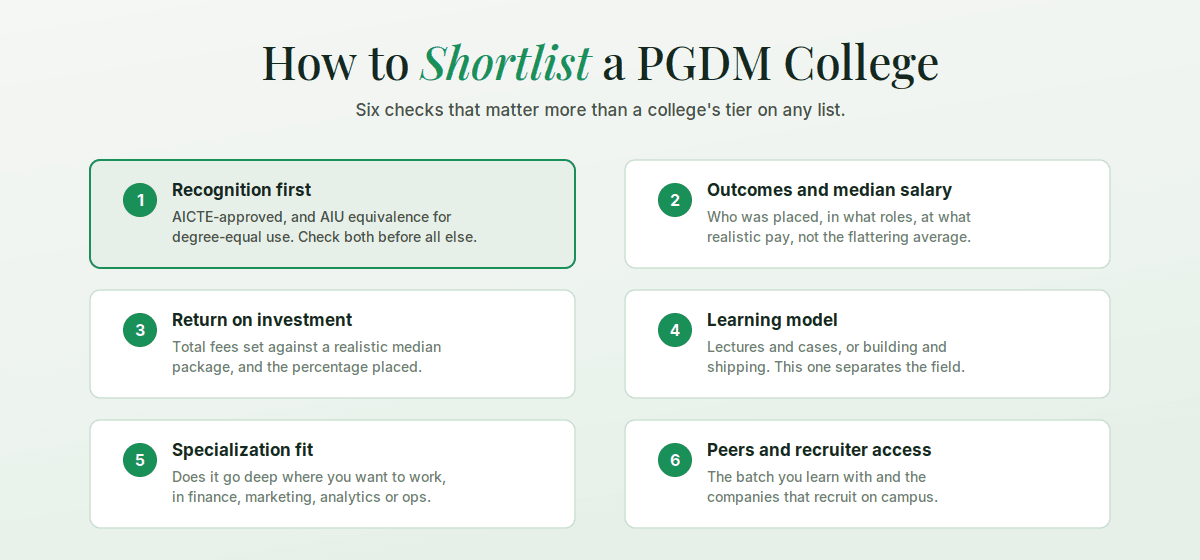
Recognition, first. For a PGDM this comes before everything else: confirm AICTE approval, and AIU equivalence if you may need degree-equal standing for a PhD or a government role.
Outcomes and median salary. Who was placed, in what roles, and at what realistic pay?
Return on investment. Fees set against a median, rather than headline, package, and the percentage of the cohort placed.
Learning model. Do you learn best through lectures and cases, or by building and shipping? This single question separates a traditional PGDM from a build-first program.
Specialization fit. Does the program go deep where you want to work, whether that is finance, marketing, analytics or operations?
Peers and recruiter access. The people you study with shape what you learn and who you know afterwards, and proximity to the companies you want puts you in front of the right recruiters.
If you are not sure where you land, being honest about how you learn and what you want afterwards usually makes the right program obvious faster than another spreadsheet does.
Common Pitfalls to Avoid
A good shortlist is only half the job. Most weak PGDM decisions in Bangalore come down to the same avoidable mistakes, and for a diploma the first one carries more weight than it would for a degree. Check your choice against each before you commit.
Skipping the recognition check. This is the costliest mistake unique to the PGDM route. Confirm AICTE approval on the official list, and AIU equivalence if you may ever need degree-equal standing for a PhD or a government role. An unapproved "PGDM" can look identical in a brochure and mean far less on paper.
Chasing the brand instead of the fit. The best-known name is not automatically the best institute for you. A program that matches your goals, your specialization and how you learn will do more for your career than a higher-ranked one that does none of those things.
Trusting the average package. Headline averages are pulled up by a few outsized offers. Ask for the median and the percentage of the cohort actually placed, because those two numbers describe a typical graduate's outcome far better than the brochure figure.
Ignoring the real ROI. A premium fee only makes sense if a realistic package can justify it. Divide total fees by a median outcome before you sign, not after, and be honest about how long the payback actually takes.
Over-indexing on CAT. CAT is one admission filter, not a measure of your potential as an operator. XAT, CMAT, MAT, ATMA, KMAT and profile-based routes all open strong institutes that one weak CAT score would otherwise close off.
Rule these out and the decision gets much simpler. More often than not, the right institute is the one still standing once each pitfall has been eliminated.
Frequently Asked Questions
Q1. Is a PGDM equal to an MBA?
A: In practice, yes, when the PGDM is AICTE-approved and holds AIU equivalence. The MBA is a university degree and the PGDM is an institute diploma, but with those two approvals a PGDM is treated as equivalent to an MBA for employment and most further study.
Q2. Is a PGDM valid for government jobs and a PhD?
A: It is, provided it carries AIU equivalence, which is what certifies the diploma as equal to a master’s degree for those purposes. Without that equivalence a PGDM may not satisfy a role or program that specifically requires a degree, so confirm it before applying.
Q3. Why do top institutes offer a PGDM instead of an MBA?
A: Because a PGDM institute is autonomous and sets its own curriculum, while an MBA follows a university’s syllabus. That freedom lets strong institutes update what they teach faster and add industry-aligned specializations sooner, which is why several of the most respected business schools choose the PGDM route deliberately.
Q4. Can I do a PGDM in Bangalore without CAT?
A: Yes. Most PGDM institutes accept XAT, CMAT, MAT, ATMA or KMAT in place of CAT, and some newer programs, including Scaler School of Business, admit entirely on a profile-based evaluation with no entrance exam required.
Q5. How do I check whether a PGDM is AICTE-approved?
A: Look the institute up on the official AICTE approved-institutions list rather than relying on the brochure, and separately confirm AIU equivalence with the Association of Indian Universities if you may need degree-equal standing. Both are quick to verify and worth doing before you pay a deposit.
Q6. Does a PGDM or an MBA have better placements?
A: Neither wins by default; placements track the specific institute, not the qualification type. A well-placed AICTE-approved PGDM can out-recruit a weak university MBA and the reverse is equally true, so compare the median package and placement rate of the actual programs rather than the labels.
Q7. Is a PGDM from a private institute worth it?
A: It can be, when it is AICTE-approved, ideally AIU-equivalent, and its outcomes justify the fees. The strongest private PGDM institutes in Bangalore place well and stay current; the weakest trade on the label without the recognition or the results, which is why the checks above matter.
Q8. Is Scaler School of Business a PGDM?
A: No. SSB is neither a PGDM nor an MBA. It awards an 18-month PGP certificate and sits outside the AICTE and UGC systems by design, with a build-first model rather than a diploma or degree curriculum. It is an alternative to these routes for people who value demonstrated capability over the credential, not a version of them.
The Bottom Line
Bangalore gives PGDM aspirants genuinely strong choices, from premier institutes like XIME and JAGSoM to well-placed premium schools such as SJIM, ISBR, Ramaiah and GIBS. The best college is not the highest on any tier list; it is the one whose recognition is solid, whose outcomes fit your goals, and whose fees a realistic package can justify. Verify AICTE approval and AIU equivalence first, then use the framework and compare real outcomes.
And if part of what drew you here was the wish for something more modern, a build-first option such as Scaler School of Business, with its focus on real products, live businesses and learning by doing, is designed for exactly that: the engineers, switchers, early-career professionals and aspiring founders who want to graduate able to build, not only to recite. It is a different route from a PGDM, not a version of one, and it is worth weighing on those terms.
Non-IIM MBA
Top Non-IIM MBA Colleges in Bangalore (2026): Fees, Placements & How to Choose
5 min. read
MBA for Professionals
Is an MBA Worth It for Working Professionals? An Honest 2026 Guide
5 min. read

MBA for Engineers
MBA After B.Tech (2026): Eligibility, Specializations, Salary & Is It Worth It?
5 min. read
MBA for Engineers
MBA After Engineering (2026): Eligibility, Specializations, Salary & Is It Worth It?
5 min. read