Business Management Glossary
Types of Entrepreneurship: The Complete Guide
Explore the main types of entrepreneurship, from small business and scalable startups to social, digital, corporate, and franchise models, with Indian examples and guidance on choosing the model that fits your goals, capital, and risk appetite.
Team SSB
5 min. read

Entrepreneurship is the process of identifying an opportunity, organizing people and capital around it, and carrying the risk of turning it into a working venture. That process takes very different shapes in practice. A neighborhood bakery and a venture-funded software company are both entrepreneurial, but almost nothing about how they are financed, how fast they grow, or how their founders spend a working day is the same.
The types of entrepreneurship set out below cover the four core models, the routes a founder can take into a business, ventures built for purposes beyond profit, technology and cross-border forms, and the separate set of labels that describe the entrepreneur rather than the enterprise. Indian examples and the official definitions that separate one category from another are included throughout.
Short answer. The four core types of entrepreneurship are small business, scalable startup, large company or corporate, and social entrepreneurship. Ventures are also grouped by how the founder enters the business, whether the goal is profit or measurable impact, and the domain they operate in, which is why the same company can be described in more than one way. |
How Entrepreneurship Is Classified
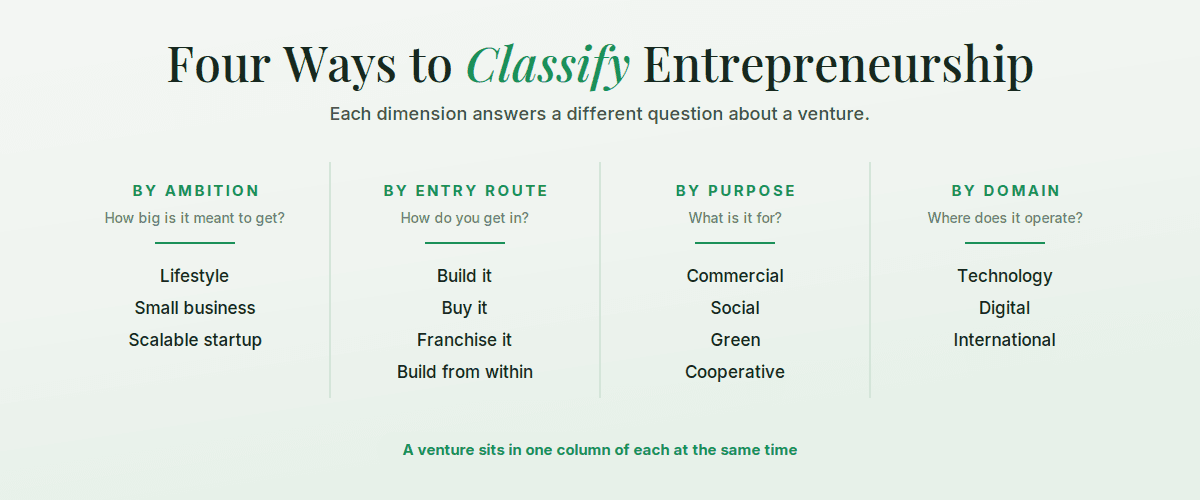
Entrepreneurship is described along four dimensions. Each answers a different question about a venture.
Ambition. How large is the business meant to become? This separates a lifestyle venture from a local enterprise from a company built to scale.
Entry route. How does the founder get into it? A business can be built from nothing, bought, licensed as a franchise, or started inside an existing employer.
Purpose. What does the business exist to achieve? Financial return, a social outcome, an environmental one, or shared benefit for its members.
Domain. Where and through what does it operate? Technology, purely digital channels, or across national borders.
A venture occupies a position on all four at once. A food delivery company is scalable by ambition, founder-built by entry route, commercial by purpose and technology-led by domain, and every one of those labels is accurate at the same time. The sections that follow work through each dimension in turn.
The Four Core Models: Small Business, Startup, Corporate and Social
The most widely used grouping, associated with entrepreneur and educator Steve Blank, sorts ventures by how large they intend to become and who owns the risk.
Small business entrepreneurship
An owner-operated business serving a local or specialized market, with growth measured in stability rather than scale. Funding usually comes from personal savings, family, or a bank loan, and the founder works in the business daily. In India these enterprises are formally recognized through the MSME framework and Udyam registration, with thresholds revised upward from April 2025 so that a micro enterprise now covers investment up to ₹2.5 crore and turnover up to ₹10 crore (Bajaj Finserv). Success looks like a durable income and a loyal customer base.
Scalable startup entrepreneurship
A venture built around a model that can be repeated at increasing scale, usually financed by external equity from angel investors or venture capital. The founder trades ownership for the capital to grow quickly, and the aim is market share and a large exit rather than steady income. India now has more than 2.25 lakh startups formally recognized by the government, making it the third largest startup ecosystem in the world.
Large company or corporate entrepreneurship
New products, business lines or internal ventures created inside an established company. The capital, brand and distribution already exist, so the risk sits with the organization rather than the individual. This is how mature businesses renew themselves when their existing products reach the end of a growth cycle.
Social entrepreneurship
Business methods applied to a social problem, where success is measured in outcomes as well as revenue. Funding is often blended, combining earned income with grants or impact investment, and surplus is typically reinvested into the mission rather than distributed.
Model | Typical funding | Who carries the risk | Measure of success |
|---|---|---|---|
Small business | Savings, loans | The owner, personally | Steady income and repeat custom |
Scalable startup | Angel and venture capital | Founders and investors | Growth, market share, exit |
Corporate | Internal budgets | The organization | New revenue streams |
Social | Blended revenue and grants | Founders and funders | Measured social outcomes |
Building, Buying, Franchising or Innovating from Within
How a founder enters a business shapes the capital required, the speed of getting started, and how much of the outcome they own.
Building from scratch
Starting with an idea and no existing structure. The cheapest version is solopreneurship or freelancing, where one person runs the whole operation and brings in contractors as needed. Nothing is inherited, which means full ownership and full uncertainty.
Acquisition entrepreneurship
Buying a business that already has customers, revenue and staff. Uncertainty is lower because the model is proven, but the capital required upfront is far higher, and the work shifts from creating demand to improving an operation. The main risk moves to valuation and undisclosed liabilities, which is why diligence matters more here than in any other route.
Franchise entrepreneurship
Licensing the right to operate an established brand using its proven system. The playbook, supply chain and brand recognition come ready made, which shortens the path to trading. In exchange, the franchisee pays fees and royalties, follows the franchisor’s rules, and holds no equity in the parent brand, so the ceiling on the reward is lower than in a business you own outright.
Intrapreneurship
Building a new venture inside an employer, a term coined by management thinker Gifford Pinchot III. The intrapreneur gets capital, colleagues and distribution without risking personal savings, and is protected if the venture fails. The trade is that the upside belongs to the company, and internal politics or a change in corporate priorities can end a project that is performing perfectly well.
Ventures Built for Impact, Not Only Profit
The purpose dimension extends past social entrepreneurship into several related forms, each with a different beneficiary.
Green and environmental entrepreneurship
Also called ecopreneurship. The environmental outcome is the product rather than a side effect: renewable energy, waste reduction, sustainable materials, or cleaner supply chains. SELCO India, which supplies solar energy systems to underserved rural households, is a long-running example of a business whose commercial model and environmental purpose are the same thing.
Community and cooperative entrepreneurship
The enterprise is owned by the people it serves, and surplus flows back to members rather than outside shareholders. Amul, owned by the dairy farmers who supply it, is the best known Indian example, and the structure explains why decisions favor supplier incomes over investor returns.
How impact ventures are funded and measured
Two operational features separate these ventures from conventional businesses. The first is blended finance: earned revenue sits alongside grants, philanthropic capital or impact investment, each with different expectations attached. The second is dual accounting, where the organization reports financial performance and measured impact side by side, because a funder is buying an outcome rather than a return. Aravind Eye Care, which cross-subsidizes free treatment with paying patients, is a working illustration of both.
Technology, Digital and Cross-Border Ventures
The domain dimension describes where a venture operates and what it is built on.
Technopreneurship
Technology is the product itself, not merely the channel used to sell it. These ventures are research heavy, often carry significant development costs before earning anything, and treat intellectual property as a core asset. Zoho, which built a global software suite from India without external funding, shows that this model does not have to depend on venture capital.
Digital and online entrepreneurship
The business exists entirely online, which keeps overheads low and gives immediate access to a wide audience. Ecommerce stores, software delivered as a service, marketplaces and content businesses all sit here. The advantage is speed and reach; the difficulty is that low barriers to entry mean competitors can appear as quickly as you did.
International entrepreneurship
Operating across national borders early rather than after saturating a home market, through exports, licensing, joint ventures or foreign subsidiaries. It opens larger markets and spreads risk across economies, at the cost of managing several regulatory systems, currencies and business cultures at once.
The Founder Behind the Venture: Types of Entrepreneurs
A separate set of labels classifies the entrepreneur rather than the enterprise, describing how a person approaches opportunity and change. The two systems sit alongside each other, so one company can be a scalable startup by model and led by an imitative entrepreneur by temperament.
The classic grouping comes from the economist Clarence Danhof, who sorted entrepreneurs by their willingness to adopt change.
Innovative. Introduces genuinely new products, processes or markets, in the sense the economist Joseph Schumpeter described as creative destruction. High risk, high potential reward, and the type most associated with breakthrough industries.
Imitative, also called adoptive. Takes a model already proven elsewhere and adapts it to a new market. This is common in developing economies, where the work of localizing a known idea creates real value. Ola built a ride-hailing business around Indian payment habits, vehicle types and road conditions rather than importing a model unchanged.
Fabian. Cautious and traditional, changing only when not changing has become the greater danger. Long-established family firms often operate this way, which protects them from fads and exposes them to slow decline.
Drone. Refuses to adopt new methods even as the market moves on, continuing with established practice at the cost of shrinking margins. This is the one category that describes a business in trouble.
Four further labels are in common use today. The hustler substitutes effort for capital and grows through persistence rather than funding. The researcher studies a market thoroughly before committing, preferring evidence to instinct. The buyer uses capital to acquire promising businesses rather than start them. The serial entrepreneur repeatedly starts, builds and exits ventures, treating company building itself as the skill.
Every Type of Entrepreneurship Compared
Set side by side, the models differ most in what they demand at the start and what they can become.
Model | Capital needed | Risk to founder | Growth ceiling | Daily involvement |
|---|---|---|---|---|
Solopreneur | Minimal | Low | Limited by your hours | Total |
Small business | Low to moderate | Moderate | Local or regional | High |
Franchise | Moderate to high | Moderate | Set by the franchisor | High |
Acquisition | High | Moderate | Depends on the asset | Medium |
Scalable startup | High, external | High | Very high | Total, for years |
Corporate venture | Company funded | Low | High | Salaried role |
Social venture | Blended | Moderate | Mission dependent | High |
What Each Model Looks Like in India
A short set of Indian reference points, one for each of the main forms.
Model | Indian example |
|---|---|
Small business | Neighborhood retail and services registered under the MSME framework |
Scalable startup | Zerodha, which reached national scale without raising outside capital |
Technopreneurship | Zoho, a global software business built from India |
Imitative entrepreneurship | Ola, which localized ride-hailing for Indian conditions |
Cooperative | Amul, owned by the dairy farmers who supply it |
Social venture | Aravind Eye Care, which cross-subsidizes free treatment |
Green venture | SELCO India, supplying solar power to rural households |
Finding the Model That Fits You
Because the dimensions are independent, the practical question is not which type is best but which position you want on each. Five questions settle most of it.
How large do you want this to become? A business that supports one household and a business built for national scale require different funding, different partners and different working lives.
What capital can you actually access? This alone rules several routes in or out. Buying a business or taking a franchise needs money upfront; building from scratch and solopreneurship need very little.
How much risk can you carry, and for how long? Personal risk tolerance is a constraint, not a character flaw, and it is worth being honest about before rather than after committing savings.
Is profit the goal, or the means? If the outcome you want is social or environmental, the funding, legal structure and success metrics all change from the outset.
Do you want to run it daily, or own it? Some models require the founder in the operation for years; others are designed to be governed rather than worked.
These are easier to answer from inside a venture than in the abstract. A few weeks of running something real reveals more about your appetite for daily operations or outside investment than any amount of planning. Which is why programs built around operating live ventures like Scaler School of Business, have students run a direct-to-consumer business on real capital, work alongside funded startups on the same campus, and in some cases raise pre-seed funding while still enrolled. Testing two or three models before committing to one is a reasonable way to find the answer.
Terms People Often Mix Up
Startup and small business
These are not the same category, and in India the distinction has a legal definition. To be formally recognized as a startup, an entity must be under ten years old, have turnover below ₹200 crore in any financial year, and be working toward innovation or operating a scalable business model, with a longer twenty-year window and a higher threshold for deep tech ventures (Startup India). A small business is defined by its size; a startup is defined by its intent and its growth model. A profitable fifteen-year-old firm is a small or medium enterprise, however modern it looks.
Entrepreneur and entrepreneurship
Entrepreneurship is the process of building a venture. An entrepreneur is the person doing it. This is why the two lists in this guide differ: one classifies businesses, the other classifies people.
Social enterprise and NGO
A social enterprise sells something to fund its mission and aims to cover its own costs. A non-governmental organization is funded primarily by donations and grants. Both pursue social outcomes; only one has customers.
Intrapreneur and entrepreneur
An intrapreneur builds a new venture using an employer’s money and takes a salary. An entrepreneur uses their own or investors’ money and takes the equity. The work can look identical from the outside; the exposure is entirely different.
Learning These Models by Running One
Definitions and distinctions of the kind set out above establish the vocabulary. Deciding which model suits you is a separate exercise, and it tends to be settled by running something rather than by weighing options on paper. The gap between a small business and a scalable startup stops being abstract the first time you have to choose between a steady margin and outside investment, and the gap between building a venture and buying one closes the moment you have done either.
Scaler School of Business is built around that distinction. It runs an 18-month, full-time PGP in Management and Technology in Bengaluru, with admission decided on the strength of your profile rather than a CAT or GMAT score. Students operate ventures rather than only study them: running a direct-to-consumer business on real capital, working with and inside funded startups based on the same campus, and building products that reach real users. Some student teams have raised pre-seed funding while still enrolled, which puts the scalable startup route directly in front of them.
It awards a PGP certificate rather than a UGC degree, a deliberate choice that lets the curriculum move faster and keeps faculty as practicing operators rather than tenured academics. It's full-time and on campus, built for people who can commit to studying without holding down a job at the same time.
Frequently Asked Questions
Q1. How many types of entrepreneurship are there?
A: There is no fixed number, because the total depends on how many dimensions are counted. Sorting ventures by ambition alone gives four. Adding entry route, purpose and domain takes it past a dozen, and folding in founder styles such as innovative, imitative, Fabian and drone raises it further, since those describe people rather than businesses.
Q2. What are the 4 pillars of entrepreneurship?
A: They are usually given as opportunity recognition, innovation, calculated risk-taking and value creation. The grouping is a teaching device rather than a fixed standard, so the exact wording varies.
Q3. What are the 7 M's of entrepreneurship?
A: Money, manpower, machinery, materials, markets, management and motivation. It is a memory aid for the resources a venture has to assemble before it can trade, not a formal framework.
Q4. Which type of entrepreneurship is most profitable?
A: Scalable startups carry the highest ceiling and the highest failure rate. Acquisition and franchise routes produce steadier returns because the operation is already trading. Expected profit follows the risk taken and the capital committed rather than the label attached to the venture.
Q5. Which type of entrepreneurship is most common in India?
A: Small business, by a wide margin. Most Indian enterprises are micro or small firms registered under the MSME framework, while formally recognized startups, although growing quickly, remain a far smaller group.
Q6. Does every type of entrepreneurship need outside funding?
A: No. Scalable startups usually do, because growth outruns earned revenue. Small businesses, solopreneurs and lifestyle ventures are commonly financed from savings and cash flow, and corporate ventures draw on internal budgets rather than investors.
Q7. Can a venture move from one type to another?
A: Yes, and many do. A small business that finds a repeatable model can raise capital and become a scalable startup, a founder-built company can pass to a buyer entrepreneur, and a commercial venture can take on a social mission. The classification describes a venture at a point in time, not permanently.
Q8. Which type suits a first-time founder with limited capital?
A: Building something small, whether freelancing or solopreneurship, because the entry cost is lowest and mistakes are cheapest to absorb. Acquisition and franchise routes reduce uncertainty but require capital upfront, and a scalable startup depends on investors willing to back an unproven track record.

Non-IIM MBA
Top Non-IIM MBA Colleges in Bangalore (2026): Fees, Placements & How to Choose
5 min. read

MBA for Professionals
Is an MBA Worth It for Working Professionals? An Honest 2026 Guide
5 min. read

MBA for Engineers
MBA After B.Tech (2026): Eligibility, Specializations, Salary & Is It Worth It?
5 min. read

MBA for Engineers
MBA After Engineering (2026): Eligibility, Specializations, Salary & Is It Worth It?
5 min. read