



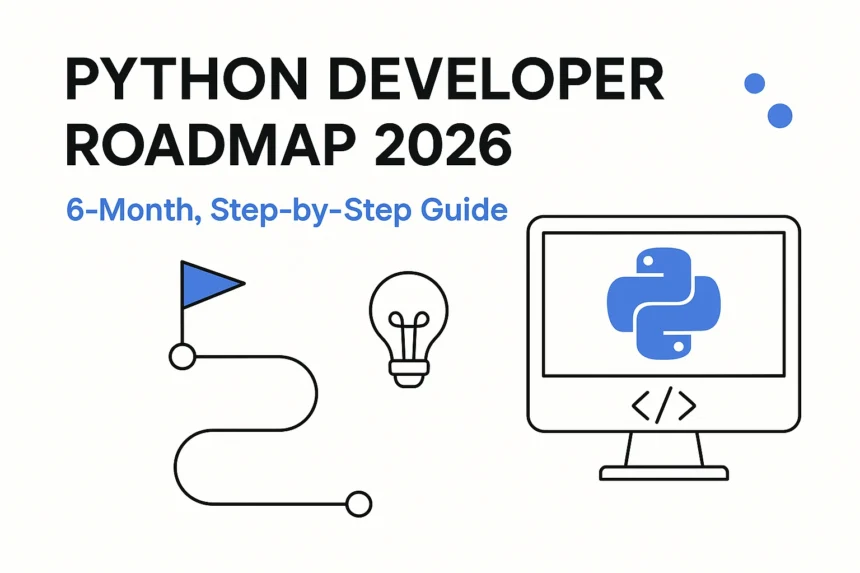
Python is an easy-to-learn programming language that is used to build almost anything: websites, apps, data analysis tools, AI models, automation scripts, and more. If you’ve been thinking about learning Python in 2026, then you will surely not regret it, given the constant demand and requirement of this tool across roles.
Python has always been known for its simplicity, but what makes it even more relevant today is how deeply it’s used with AI, automation, data-driven decision-making, and modern backend development. With Python 3.13 rolling out performance upgrades and new frameworks growing rapidly, now is genuinely the best time to start your journey.
This 6-month Python roadmap is designed for absolute beginners, students, career switchers, or working professionals looking to future-proof their skills. No complicated jargon. No overwhelming theory dumps. Just a clean, practical, month-by-month guide that teaches you modern Python the way it’s used today.
Let’s begin your Python learning journey.
Transform Your Career
Choose from our industry-leading programs designed for career success
Modern Software and AI Engineering Program
Master full-stack development with AI integration


 +1000 more
Modern Data Science and ML with specialisation in AI
Advanced data science techniques with AI specialization
+1000 more
Advanced AIML with Specialisation in Agentic AI
Deep dive into AIML with focus on Agentic systems
+1000 more
DevOps, Cloud & AI Platform Engineering
Build and manage AI-powered cloud infrastructure
+1000 more
AI Engineering Advanced Certification by IIT-Roorkee
Premier AI engineering certification from IIT-Roorkee

Why Python Remains the Most Versatile Language in 2026
6Python continues to dominate the tech world, and for good reason. According to the 2026 Stack Overflow Developer Survey, Python’s adoption rose by 7 percentage points year-over-year, making it one of the fastest-growing languages in its class. Its flexibility is what makes it easier for developers to understand and use: they use it across AI, data science, backend web services, and automation. Python remains one of the top skills employers look for across industries.
Python’s Continued Relevance in Tech
With the use and constant upgradation of AI, people started to think that Python won’t be used anymore, and that news from Google didn’t help either. But you don’t have to worry, since this language is still required even today.
The language helps with:
- AI and ML research
- Backend services for apps and websites
- Data analysis and visualization
- Automation scripts you can run with just a few lines
- Scientific computing and academia
Its versatility is the reason many people choose it as their first programming language and why senior developers continue using it for real-world projects.
Why 2026 Is the Year to Learn Python
Python 3.13 brings faster performance, cleaner error messages, and enhancements that make development smoother for beginners. New frameworks like FastAPI have also taken the backend world by storm with simple syntax and incredible speed. AI tools and libraries are expanding, and Python remains the default choice for everything machine learning.
If you’re planning to build projects that remain relevant for the next decade, 2026 is the perfect starting point.
Career Benefits of Learning Python
Python developers enjoy some of the best career pathways today. Whether your goal is automation, AI, web development, or analytics. Python is required everywhere. Salaries have consistently increased over the last three years, and companies look for candidates who can combine Python fundamentals with practical projects.
Now that we are done with a little overview of Python, let’s get into how you can learn this in-demand language in 6 months.
The 6-Month Python Developer Roadmap: Month-by-Month Breakdown
We have designed this month-by-month roadmap so that it gives you a clear, structured path to go from Python beginner to job-ready developer in just six months.
Each stage focuses on one core skill set – starting with the basics, moving into real-world projects, and finishing with advanced tools used by modern developers. Whether you’re learning data science, web development, automation, or AI, this roadmap keeps you focused, organized, and consistently improving.
Here’ a summarized table that includes all the required steps in the roadmap:
| Phase | Timeline | What You Learn |
| Phase 1: Python Fundamentals | Month 1 | Syntax, variables, data types, loops, conditionals, functions |
| Phase 2: Data Structures & File Handling | Month 2 | Lists, tuples, sets, dicts, file I/O, exceptions, structured data |
| Phase 3: OOP & Modules | Month 3 | Classes/objects, inheritance, polymorphism, modules, packages, venvs, pip |
| Phase 4: Libraries & Automation | Month 4 | NumPy, Pandas, Matplotlib, Requests, BeautifulSoup, automation basics |
| Phase 5: Web Dev or AI Intro | Month 5 | Flask/FastAPI basics, routes, APIs, DBs / scikit-learn basics, ML workflow, intro to TensorFlow, APIs |
| Phase 6: Capstone & Deployment | Month 6 | Git, Docker, CI/CD, full-project structure, deployment on Render/Railway |
Let’s see what your 6-month journey looks like.
Phase 1 (Month 1): Python Fundamentals
This is where you build your foundation. Everything else in your Python journey depends on understanding these basics.
What You’ll Learn:
- Basic syntax
- Variables
- Data types
- Loops
- Conditional statements
- Functions
Tools to Use: VS Code, Jupyter Notebook
Project Idea: Number Guessing Game (You can take anything interesting and try practicing the tools on it)
Here, you will gain a solid understanding of Python syntax and basic problem-solving.
Phase 2 (Month 2): Data Structures & File Handling
At Month 2, you will store, access, and manage real-world data, which is a must-have skill for all developers.
Topics to Cover:
- Lists, tuples, sets, and dictionaries
- File reading and writing
- Exception handling
- Understanding structured data
Tools: PyCharm, Google Colab
Project Idea: Contact Book or Expense Tracker
At this stage, focus on learning how to organize data and handle user inputs.
Phase 3 (Month 3): Object-Oriented Programming & Modules
In Month 3, you will focus on writing structured, reusable code using OOP principles. This phase helps you build programs that are easier to maintain, scale, and integrate into larger projects.
Learn:
- Classes and objects
- Inheritance
- Polymorphism
- Modules and packages
- Virtual environments
- pip package installation
Tools: Python REPL, pip
Mini Project: Student Management System
By this time, you will have the ability to structure large applications logically.
Phase 4 (Month 4): Libraries & Automation Projects
In Month 4, you will start using Python’s major libraries to perform practical tasks. This phase focuses on data handling and automation, where you apply Python to solve everyday problems and build functional utilities.
Learn:
- NumPy (arrays and operations)
- Pandas (data manipulation)
- Matplotlib (visualization)
- Requests (API calls)
- BeautifulSoup (web scraping)
Tools: Jupyter, Selenium (optional), API platforms
Project Idea: Web Scraper or Email Automation Script
At this stage, you’ll be able to build automation workflows and process heavy datasets.
Phase 5 (Month 5): Web Development or AI Introduction
At this phase, you can start exploring web development or take your first steps into AI and machine learning, depending on the path you want to follow next.
Option 1: Web Development (Flask/FastAPI)
- Build REST APIs
- Work with templates
- Handle routes, requests, and responses
- Connect databases (basic)
Option 2: AI/ML Introduction
- Basics of scikit-learn
- Model training workflow
- Intro to TensorFlow
- Using APIs like OpenAI
Tools: FastAPI, Postman, Colab
Project Idea: Blog API or a Simple ML Model
At this stage, you can build and deploy your first functional machine learning or web application.
Phase 6 (Month 6): Capstone Project & Deployment
In the final month, you bring together everything you’ve learned by building a complete project and deploying it. This phase focuses on applying your skills end-to-end, from writing the code to putting the project online for others to use.
Learn:
- Git and version control
- Docker basics
- CI/CD pipelines
- Structuring full projects
- Deployment on Render or Railway
Capstone Ideas:
- AI Resume Analyzer
- Task Manager App
- Weather API Service
Now at last you can build a polished, hosted project you can confidently showcase in your portfolio.
You can also explore Scaler’s free Python tutorial for beginners with a certificate, which covers the basics step-by-step and helps you build the foundational skills needed.

Free Courses by top Scaler instructors
Modern Python Stack You Should Master
Throughout this roadmap, you will learn Python by working with the tools, libraries, and frameworks developers use today. You will work with core Python, data libraries, automation tools, web frameworks, and beginner-friendly AI packages, which will give you a solid foundation to build industry-level projects with confidence.
Here’s a quick look at the technologies you’ll be learning along the way. This roadmap covers the exact stack modern developers use today.
It’s a mix of core tools, automation libraries, web frameworks, and AI tools.
| Category | Tools/Libraries |
| Core | Python 3.13, VS Code, pip |
| Data & Analysis | NumPy, Pandas, Matplotlib |
| Web | Flask, FastAPI |
| Automation | Selenium, Requests, BeautifulSoup |
| AI/ML | scikit-learn, TensorFlow, OpenAI API |
| Dev Tools | Git, Docker, Streamlit |
Skills You’ll Gain in 6 Months
By following this roadmap consistently, you’ll build a strong, practical skill set that is necessary to have along with Python code. In just six months, you’ll understand how to solve problems, work with data, build simple web or AI applications, and deploy real projects, all using tools and techniques that developers rely on every day. This section breaks down the exact skills you’ll develop as you progress through each phase of the journey.
Core Programming
You’ll understand how to write clean, structured code using loops, conditions, functions, and error handling. You’ll also understand how to break problems into smaller parts, write reusable modules, and debug issues efficiently.
Data Manipulation
With NumPy, Pandas, and Matplotlib, you learn how to load datasets, clean them, analyse patterns, and create visualisations. You’ll also get natural at transforming data, handling missing values, and preparing datasets for further processing or modelling.
Web/AI Skills
Depending on your chosen track, you either build REST APIs using frameworks like Flask or FastAPI, or create basic machine learning models using scikit-learn. You’ll learn how to accept inputs, process them, and return outputs, which is similar to real production systems.
Development Workflow
You’ll learn how developers use Git for version control, organise project files, document their work, and deploy applications. This includes pushing code to GitHub, managing updates, and ensuring your project runs consistently across different environments.
Scaler Placement Report and Statistics
Scaler learners achieved 2.5x salary growth with average post-Scaler CTC reaching ₹23L.
 Google
 Amazon
 Microsoft
 Flipkart
 Adobe
1200+ more
Adobe
1200+ more
Projects You Can Build with Python
Here’s a quick overview of the practical projects in your journey:
| Phase | Project Example | Outcome |
| Month 1 | Number Guessing Game | Core syntax skills |
| Month 2 | Expense Tracker | File handling & data storage |
| Month 3 | Student Management System | Understanding of OOP |
| Month 4 | Web Scraper | Automation & API handling |
| Month 5 | Blog API / ML Model | Web or AI foundations |
| Month 6 | Capstone Project | Fully deployable project |
Every mini project builds towards your final month. So, always remember to keep building projects as you go!
Career Path & Salary Trends for Python Developers (2026)
Python continues to offer strong career potential in 2026, both in terms of job diversity and long-term growth. If you’re exploring your next move, starting out, switching fields, or planning to advance into more technical roles, Python gives you several paths to consider.
Its use across web development, data analytics, automation, and AI means you can build a career that aligns with your interests and strengths. In the next section, you’ll see the key career options, salary expectations in India and abroad, and how you can plan your growth as a Python developer.
Python Career Roles & Salary Outlook 2026
Here’s a quick overview of the key Python career paths and the salary ranges you can expect at different experience levels.
| Level | Roles | Salary Range |
| Entry-Level | Python Developer, Automation Engineer | ₹4-9 LPA |
| Mid-Level | Backend Developer, Data Analyst | ₹5-10 LPA |
| Senior-Level | AI Engineer, Full Stack Python Developer | ₹12-28 LPA |
| Global Outlook (2026) | Python Developer (US) | $77,000 - $100,000 |
Read These Important Roadmaps: More Paths to Career Success
Scaler Alumni and Their Success Stories
FAQs - Common Questions About Learning Python (2026)
Can I learn Python in 6 months?
Yes! With consistency (1-2 hours a day), six months is more than enough to reach beginner-to-intermediate level.
Do I need prior coding experience?
No. Python is one of the easiest programming languages to start with.
What’s the best Python framework to begin with?
Flask and FastAPI are both great beginner-friendly choices.
Should I learn Python for AI or web development?
Learn core Python first. Once you’re comfortable, either path becomes much easier.
What projects help me get hired?
Automation scripts, REST APIs, and basic ML models stand out the most during interviews.
