




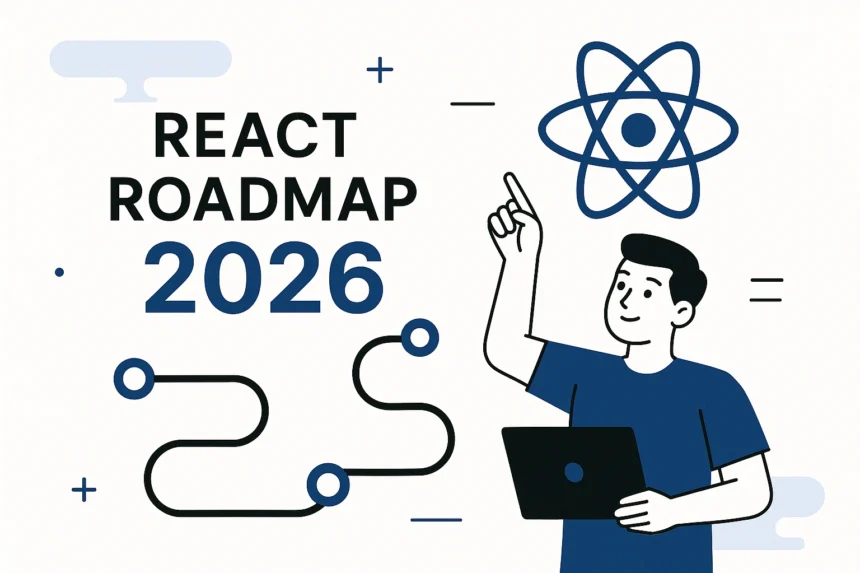
If you plan to learn React in 2026, you are choosing one of the most in-demand frontend skills. Whether you want to become a frontend developer, switch careers, or build modern web apps, this React roadmap gives a clear month-by-month plan with practical projects and modern tools. The guide is designed for beginners and self-learners and maps out a complete React developer roadmap built around hands-on practice and real-world applications.
Why React Skills Will Be Essential in 2026
React continues to dominate frontend development and remains the foundation for modern frameworks like Next.js and Remix. Companies choose React for its component-based design, broad ecosystem, and strong community. Learning React is a long-term investment because it enables you to build scalable user interfaces, reuse components across projects, and integrate easily with backend services. The React ecosystem keeps evolving, so learning React now sets you up for both current and future frontend roles.
The Frontend Evolution in 2026
React 19 introduces features like concurrent rendering and improved server components, which help apps run smoother and scale better. These updates change how developers think about rendering and data fetching, but they remain rooted in familiar React concepts. As the frontend evolves, React keeps a leading role by making advanced patterns easier to adopt while preserving developer productivity and backwards compatibility.
Transform Your Career
Choose from our industry-leading programs designed for career success
Modern Software and AI Engineering Program
Master full-stack development with AI integration


 +1000 more
Modern Data Science and ML with specialisation in AI
Advanced data science techniques with AI specialization
+1000 more
Advanced AIML with Specialisation in Agentic AI
Deep dive into AIML with focus on Agentic systems
+1000 more
DevOps, Cloud & AI Platform Engineering
Build and manage AI-powered cloud infrastructure
+1000 more
AI Engineering Advanced Certification by IIT-Roorkee
Premier AI engineering certification from IIT-Roorkee

Why Companies Still Love React
Organizations of all sizes prefer React because it accelerates development and improves code reuse. Teams can ship features faster using component libraries and shared patterns, and they can optimize performance using established tools. React’s maturity and large talent pool make it a safe choice for long-term projects and enterprise systems.
Career Outlook for React Developers
React developers can work as frontend developers, UI engineers, or full-stack engineers when paired with Node.js. Demand for React skills remains high in tech hubs around the world, and many companies list React among the top requirements for frontend roles. For anyone following a react roadmap 2025, learning React means access to varied jobs and strong salary prospects.
React Roadmap 2026 — The 6-Month Learning Journey
This six-month plan divides learning into focused monthly phases. Each month builds on the previous one, introduces specific tools, and includes a small project to help you practice. The roadmap is ideal for people who follow the Frontend Developer Courses or use the JavaScript Roadmap 2026 as a companion.
Phase 1 (Month 1): Modern JavaScript & Environment Setup
Start with modern JavaScript fundamentals because React stands on top of ES6 and later features. Learn about let and const, arrow functions, template literals, destructuring, and the spread operator. Practice promises, async and await, and JavaScript modules. Familiarity with basic DOM manipulation helps you understand how React abstracts the DOM. Set up your environment with VS Code, Node.js, npm, and Git. A small project like an interactive to-do app built with vanilla JavaScript will give you practical experience and prepare you to transition into React.
Phase 2 (Month 2): React Fundamentals
Once you are comfortable with JavaScript, start learning React basics. Practice writing functional components, using JSX to describe UI, and passing data with props. Learn how to manage local component state and handle events in the UI. Use Vite.js to bootstrap lightweight React projects and use Chrome DevTools and React Developer Tools while debugging. Build a small project such as a counter or notes app to practice props, state, and user interaction. This phase builds your confidence in creating and composing UI components.
Phase 3 (Month 3): React Hooks & Component Architecture
With the basics in place, learn React hooks and component architecture. Master useState for local state, useEffect for side effects, and useRef for DOM references and mutable values. Study how to build custom hooks to encapsulate logic that can be reused across components. Learn how to structure components and organize files so your app remains maintainable as it grows. Use ESLint and Prettier to keep code consistent. A weather app or an expense tracker is a great project for practicing hooks and modular component design.
Phase 4 (Month 4): Routing, APIs & State Management
At this stage, add routing and data fetching to your skill set. Learn React Router to build single page apps with multiple views and dynamic routes. Use Fetch or Axios to call APIs and handle responses and errors. Explore the Context API for simple global state and introduce Redux Toolkit or Zustand for more complex state management. A movie browser app that fetches data from a public API is an ideal project to combine routing, API integration, and global state. This phase teaches you how to build real-world SPAs that users expect.
Phase 5 (Month 5): Advanced React & Ecosystem Tools
Advance your skills with performance optimizations and modern tooling. Learn memoization patterns such as React.memo, useMemo, and useCallback to prevent unnecessary re-renders. Apply code splitting, lazy loading, and suspense for better initial load times. Get an introduction to Next.js to understand server-side rendering and static site generation for better SEO and performance. Explore state libraries like Redux Toolkit and Zustand to see different approaches to state. Building a blog app or an e-commerce product listing helps you apply these advanced patterns and ships you closer to production-ready applications.
Phase 6 (Month 6): Deployment, Testing & Portfolio Projects
In the final month you focus on testing and deployment so your apps are robust and discoverable. Learn unit testing with Jest and component testing with React Testing Library. Set up simple CI/CD pipelines using GitHub Actions and deploy your sites to services like Vercel or Netlify. Tie together frontend and backend by building a full-stack React app or a polished portfolio site that showcases your best projects. This capstone project demonstrates your ability to plan, implement, test, and deploy real applications.
The Modern React Stack (2025 Edition)
The modern react roadmap includes both JavaScript and optional TypeScript for type safety. React remains the core framework and Next.js is the leading choice for server-rendered or hybrid apps. State management can vary by project, with Redux Toolkit and Zustand being popular choices alongside the Context API. UI work often uses utility-first frameworks such as Tailwind CSS or component libraries like Material UI.
Build tools such as Vite improve developer experience, and testing stacks using Jest and React Testing Library ensure quality. Deployment platforms such as Netlify and Vercel make shipping apps simple and fast. The stack is flexible and you can pick tools that match the project and team.
Skills You’ll Gain from This Roadmap
Core React Fundamentals
Following this React developer roadmap, you will build strong React fundamentals such as how components work, how props help transfer data, and how state controls dynamic UI behavior. You will also learn essential hooks like useState, useEffect, and useRef, which are the backbone of every modern React application. These skills form the core foundation for anyone trying to learn React in 6 months.
Working with APIs and Routing
You will gain experience integrating external APIs into your applications using fetch or Axios. This includes handling loading states, errors, and asynchronous data. You also learn React Router, enabling you to create multi-page applications with nested routes, dashboards, and dynamic pages that reflect real-world frontend development.
Optimization and Performance Techniques
As your apps grow, you develop important optimization skills such as memoization using React.memo, useMemo, and useCallback. You also learn code splitting and lazy loading, which improve load time and overall performance. These optimization techniques are critical React developer skills that companies actively look for when hiring.

Free Courses by top Scaler instructors
Deployment and Testing Essentials
You learn how to deploy your React applications on platforms like Vercel, Netlify, and GitHub Pages. Basic testing concepts with Jest and React Testing Library help you ensure your components behave correctly before deployment. These production-focused steps help you transition from beginner to job-ready developer.
Modern Frontend Engineering Practices
Throughout this roadmap, you pick up valuable frontend engineering practices such as accessibility standards, Git-based version control, reusable component architecture, UI/UX fundamentals, and clean code strategies. These broader skills significantly improve your profile as a frontend React developer and align well with the modern React roadmap for 2025.
Projects You’ll Build During This Roadmap
Beginner-Level Projects
In the early months, you build beginner-friendly projects that focus on essential concepts. You start with a simple to-do application, which sharpens your JavaScript logic and foundational React state management. You then create a notes app to understand props, data flow, and component structure. These guided projects support your goal of learning React in 6 months.
Intermediate API and Routing Projects
You move on to building a weather application that fetches real-world data through APIs, giving you a strong understanding of hooks, async functions, and conditional UI rendering. Later, you develop a movie browser where users navigate between pages, practice routing, and handle dynamic content. These projects begin to resemble real client applications.
Advanced Application Development Projects
In advanced stages, you build feature-rich apps such as a blog system or a product listing dashboard. These projects introduce Redux or Zustand, filtering features, infinite scroll, global state management, and advanced component patterns. They mirror what mid-level developers work on in real companies.
Final Capstone Project
To complete this roadmap, you create a portfolio-ready capstone project such as an e-commerce prototype, a blog platform, or a full-stack MERN application. This final project represents your ability to design, develop, and deploy a complete production-grade application. It becomes a strong asset when applying for frontend roles or React developer positions.
Scaler Placement Report and Statistics
Scaler learners achieved 2.5x salary growth with average post-Scaler CTC reaching ₹23L.
 Google
 Amazon
 Microsoft
 Flipkart
 Adobe
1200+ more
Adobe
1200+ more
Career Roles and Salary Trends for React Developers (2026)
Entry-Level Roles
Once you complete this roadmap, you qualify for roles such as Junior React Developer, UI Developer, or Frontend Developer Intern. These positions involve basic component development, UI fixes, simple API connections, and collaborating with senior developers.
Mid-Level React Roles
With experience, you move into mid-level positions such as React Developer, Full Stack JavaScript Developer, or Frontend Engineer. These roles require ownership of features, performance improvement, API integration, and scalable architecture. Your React developer skills and project experience make you a strong fit for these roles.
Senior and Specialized Roles
As you grow further, you can specialize as a Senior Frontend Engineer, React Architect, Technical Lead, or UI Engineering Specialist. These roles focus heavily on performance optimization, design systems, code quality, and mentoring junior developers. They offer excellent career growth and leadership opportunities.
Salary Trends and Market Demand
React remains one of the most in-demand frontend technologies in 2025. According to AmbitionBox, React JS Frontend Developers in India earn between ₹1.8 lakh to ₹17.6 lakh per year, depending on experience. React Developers more broadly in India report salaries from ₹1.6 lakh to ₹9.5 lakh per year. On Glassdoor, frontend React developers with around 4–6 years of experience have reported compensation as high as ₹30 lakh per year, especially in tech hubs. Completing a structured React developer roadmap and building real-world project experience through a learn React in 6 months plan significantly increases your chances of landing interviews and negotiating strong offers.
Explore More Roadmaps
Scaler Alumni and Their Success Stories
Read These Important Roadmaps: More Paths to Career Success
FAQs — Common Questions
- Can you learn React in six months?
Yes. With steady practice, consistency, and building small-to-mid–scale projects, you can master React fundamentals and create deployable applications in six months.
- Do you need to learn JavaScript first?
Yes. A strong understanding of modern JavaScript (especially ES6+) makes learning React much easier because React relies heavily on concepts like arrow functions, array methods, spread/rest operators, and async operations.
- What backend pairs well with React?
Node.js with Express is the most common and seamless choice. However, React also works perfectly with other backends such as Python (Django/Flask/FastAPI), Go, Ruby on Rails, and Java Spring Boot.
- Is React still relevant in 2025?
Yes. React remains one of the most widely used JavaScript libraries globally, with continuous updates, strong community support, and adoption by major companies.
- Should you learn Next.js after React?
Yes. Next.js is a natural progression after React. It helps you build production-ready apps with features like server-side rendering, routing, performance optimization, and API routes built in.
Finally, Your 6-Month Path to React Mastery in 2025 is All Set
This React roadmap is designed to help you move from beginner to job-ready in six months through focused learning and project work. The plan blends modern JavaScript fundamentals, core React concepts, hooks, state management, routing, performance optimization, testing, and deployment. By following the roadmap, you will gain practical experience, build a portfolio, and be ready to apply for frontend roles. Start with JavaScript, progress month by month, and use your projects to demonstrate the skills employers want.
