




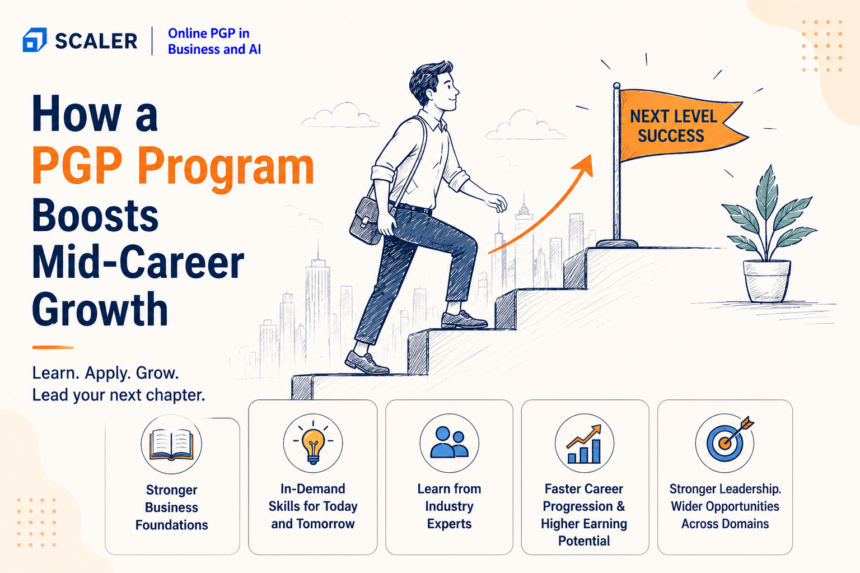
If you’ve been working for a few years now, you’ve probably felt an uncomfortable shift in the job market. Layoffs, slower salary growth, and delayed promotions have made many employees question how secure or rewarding their current roles really are. Even if you’re performing well, it can feel like growth has stalled or the next step isn’t as clear as it used to be.
What’s changed is how employers evaluate value. Today, it’s not just about how long you’ve been in the workforce; it’s also about whether your skills still match what the business needs at present. That’s why you’re seeing people with solid experience still struggling to move up, while others who have updated their skills are getting better opportunities.
If you’re at a point where you don’t want to start over but do want stronger growth, structured upskilling becomes extremely important. Hence, for upskilling and learning, many professionals, even in the midst of their careers, choose to enroll in programs like PGP.
Now, can a PGP work? Let’s find that out!
How a PGP Program Can Help You Accelerate Career Growth
PGP programs are built with one clear goal in mind: helping you grow in your career without stepping away from it. If you’re already working, you don’t need another theory-heavy course. You need learning that fits your role today and prepares you for the role you want next.
Build Role-Specific, Industry-Aligned Skills
At this stage of your career, generic knowledge is surely not what you need. What can actually help is learning practices that can help you adapt to the latest trends. PGP programs are structured around how work actually happens in organisations, whether that’s analytics, product, marketing, operations, or leadership roles. This makes it easier for you to see how your learning applies to your current job or a future role.
Strengthen Decision-Making and Leadership Capability
As you move forward, you come to a position of making decisions since you have dealt with enough executions and planning already. You’re expected to make important decisions, manage stakeholders, and think beyond your individual tasks. PGP programs focus heavily on these aspects through case discussions, problem-solving frameworks, and practical scenarios.
Use Projects to Demonstrate Impact
One of the biggest challenges mid-career professionals face is proving their value for the next role. PGP programs address this by emphasizing projects and assignments that are most likely to be faced in workplaces.
You can often use these projects to showcase impact within your current organisation, support a role change, or strengthen your case during performance discussions. Instead of saying you’re ready, you have work to show for it.
Open Doors to Better Roles and Career Progression
When you combine your existing experience with updated, role-relevant skills, you naturally become more competitive in the job market. Many professionals use a PGP to move into roles with higher responsibility, shift into growing domains, or regain momentum after a period of stagnation.
Built for Working Individuals: Flexibility That Fits Your Schedule
Since you are already working and don’t wish to risk leaving your current position. It is best to go for courses that allow flexibility, as it’s done in PGP programs.
Here’s the usual pattern:
- Online, Hybrid, and Weekend Learning Options: Most PGPs offer formats that allow you to continue working while studying, so you don’t have to risk taking a career break.
- Bite-Sized Modules and Self-Paced Content: Learning is broken into manageable modules, which makes it easier to balance work, learning, and personal commitments without burnout.
- Immediate Application of Learnings at Work: What you learn in a PGP can often be applied immediately at your workplace, which increases your value even before the program ends.
What You Learn in a PGP Program
A mid-career PGP is designed to help you grow in two directions at once: deeper expertise in your chosen domain and broader capabilities that prepare you for larger responsibilities. Instead of isolated subjects, the learning is structured to reflect how decisions are carefully made in organisations.
Core Business and Technical Competencies
Depending on the specialisation you choose, you build practical expertise in areas such as analytics, project management, business strategy, operations, or functional domains like marketing or finance. The focus stays on solving real problems you’re likely to encounter at work, not just understanding concepts in isolation.
Tools and Frameworks Used in Real Industries
PGP programs emphasise tools, frameworks, and workflows that professionals actively use in their day-to-day roles. This ensures that what you learn feels immediately relevant and easier to apply at work, rather than remaining theoretical or outdated.
Leadership and Communication Skills
As your role expands, how you communicate and make decisions matters as much as what you know. PGPs include structured training in communication, stakeholder management, and leadership, helping you prepare for people-management and cross-functional responsibilities.
Capstone Projects and Industry Assignments
Projects and assignments play a central role in tying everything together. They allow you to work on realistic business scenarios and build a portfolio that demonstrates how you approach problem-solving, strategy, and execution.
At Scaler’s PGP Program in Business, this pattern is approached closely, combining core business learning with hands-on projects and industry exposure so professionals can see how each skill connects to real career outcomes.
How a PGP Program Helps in Career Transition
Career transitions are quite common, especially now that job roles are evolving quickly. So, if you are planning to switch roles, then worry not, as many people end up planning on doing, and why not? After so many years of working and experience, it is only right that you land a rewarding job of your dreams!
Hence, many professionals decide to get enrolled in PGPs for that boost and extra support. Here’s how a PGP program works when you want to switch careers:
Structured Learning Path for Switching Domains
When you try to switch to a new domain on your own, it’s natural to get overwhelmed by uncertainty; you don’t always know what to learn first, what matters most, or what employers expect. A PGP fixes that by giving you a clear and sequenced learning path.
For example:
- If you’re moving from IT into product management, a good PGP will guide you through core business concepts, product lifecycle thinking, stakeholder communication, and user research, in the exact order you’ll use them on the job.
- If you aim to go from marketing into analytics, you start with data fundamentals, then move into tools like SQL and Python, and finally learn how to convert insights into business decisions.
So once you have a clear roadmap and pattern at hand, it becomes easier to follow through with and start your learning journey with focus.
Practical Skill Training Reduces Transition Risk
One of the biggest risks when switching careers is that you may clear an interview but still feel unprepared for the actual job requirements. This happens when learning stays theoretical.
With a PGP program, you can at least be assured, since the whole course is developed to help you upskill practically:
- You can work with live datasets, dashboards, and analytics tools if you’re moving into analytics.
- You’ll have to build product requirement documents, mock roadmaps, or go-to-market plans if you’re switching to product roles.
- You also solve real or simulated business cases that mirror what professionals do at work.
This means that when you apply for jobs, your portfolio is ready by the time you finish the program, which is what employers like to check the most.
Mentorship and Industry Exposure Help You Understand Expectations
Another reason career switches take time to come to a decision is that there is a lack of clarity about what work really looks like in your target domain. Job descriptions rarely tell you how teams operate, how success is measured, or what day-to-day challenges you’ll face.
Now, PGP programs typically include:
- Guidance from industry professionals
- Mentorship that answers real workplace questions
- Live projects or case work drawn from industry context
So, Mentors are usually available to have a proper discussion about what path suits you best and what steps can be taken to grow towards it. These discussions are necessary, especially from an industry expert, since they understand the job market the best and can help you identify your strengths and weaknesses properly.
You can also look at the Scaler PGP program to understand how a PGP program is typically structured and the kind of career outcomes learners have achieved.
Career Outcomes After Completing a PGP Program
Career outcomes from a PGP depend on prior experience, specialisation, and how well the learner applies the skills gained. That said, there are some common and observable patterns across industry-aligned PGP programs.
Roles You Can Aim For After a PGP
A PGP program prepares learners for role-specific responsibilities, which often leads to clearer career positioning. Depending on the specialisation chosen, common roles learners move into include:
- Business Analyst: working with data, processes, and stakeholder requirements
- Product Manager: handling product strategy, execution, and cross-functional coordination
- Project Lead or Program Manager: managing delivery timelines, teams, and outcomes
- Marketing Strategist: focusing on growth, performance marketing, or brand strategy
- HR Business Partner (HRBP): aligning people strategy with business goals
- Operations Manager: improving efficiency, systems, and execution processes
These roles typically require a mix of domain knowledge, decision-making ability, and communication skills.
Salary Growth and Promotion Opportunities
While salary outcomes vary across industries and roles, many professionals use a PGP program to achieve their goals faster, but it is usually advisable to first see if your company considers the certification, and then you can decide to go ahead with it. Common outcomes include:
- Movement into higher-impact roles with broader responsibility
- Faster eligibility for managerial or lead positions
- Improved earning potential due to stronger skill relevance
In several cases, professionals do not change companies immediately but use the PGP experience to secure internal promotions or expanded roles, especially when the program aligns closely with their job function, and you can do it too!
Enhanced Professional Visibility and Networking
Having a professional network brings ample opportunities. PGP cohorts usually include learners from different industries, roles, and experience levels, which helps expand professional visibility beyond one’s current organisation.
Through peer interactions, group projects, and discussions, learners:
- Gain exposure to how different industries solve similar problems
- Build long-term peer networks across functions
- Improve confidence in professional communication and collaboration
Over time, these connections often lead to referrals, collaborations, or role discovery across domains.
Does PGP Provide Guaranteed Jobs?
A PGP program surely does not guarantee a specific title or salary. What it does provide is clear role alignment, stronger professional positioning, and preparedness. Learners who actively engage with the curriculum, projects, and peer network tend to see visible outcomes and opportunities.
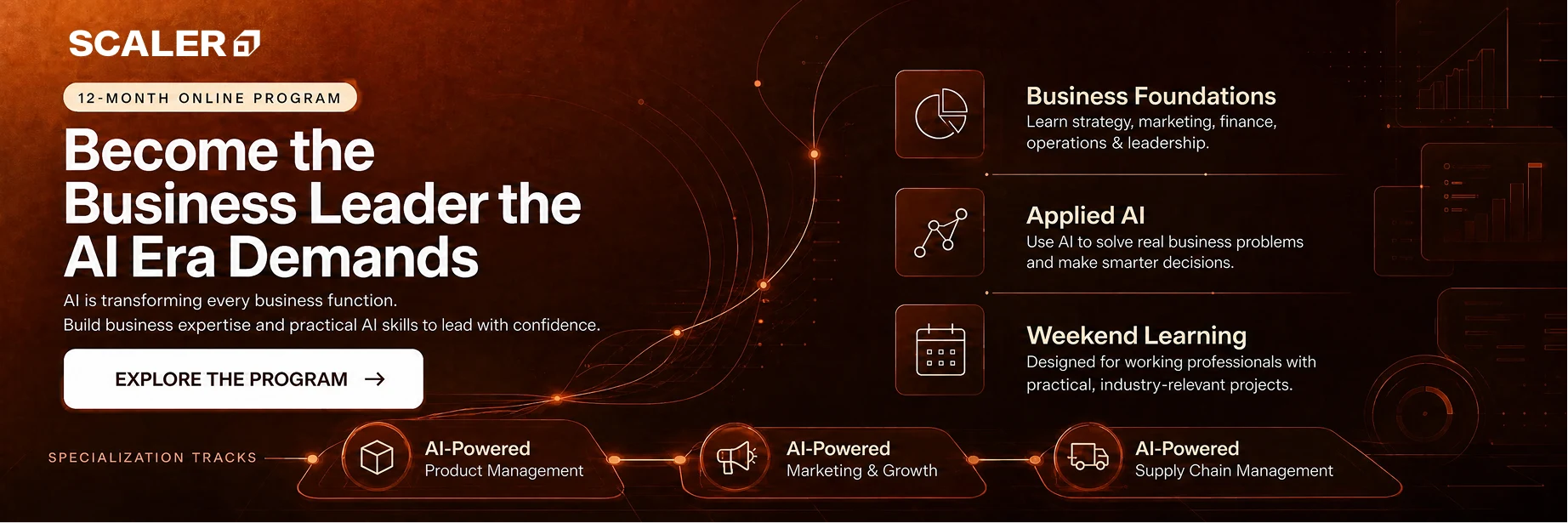
Before enrolling in any advanced program, it’s important to evaluate its placement outcomes, real-world exposure, and long-term career impact. With the Scaler’s PGP course in business and ai, learners gain access to structured career support, industry-aligned internships, and hands-on projects that bridge business strategy with applied AI. This ensures participants are not just learning concepts, but actively preparing for high-impact roles across business, analytics, and AI-driven domains.
FAQs: About PGP Programs
Is a PGP program better than an MBA for mid-career professionals?
For many mid-career professionals, a PGP program can be a viable option. PGPs usually focus on specific skills, practical application, and immediate role relevance, whereas MBA programs often follow a broader and more academic structure. The right choice depends on whether you are aiming for faster upskilling or a long-term academic credential.
How long does a PGP program take while working full-time?
Most PGP programs run between 6 and 18 months. Many are designed in online or hybrid mode, with flexible schedules that allow learners to study alongside a full-time job without taking a career break.
Do companies value PGP certifications?
Companies value PGP certifications when the program includes aspects like applied learning, practical projects, and tool-based training. Recruiters typically focus less on the certificate itself and more on what you can do as a result of the program.
Can a PGP help me switch careers?
A well-structured PGP can support a career switch by providing role-specific skills, structured learning paths, and practical exposure. While no program can remove all risk, PGPs help reduce uncertainty by preparing you for real job responsibilities before you make the transition.
