




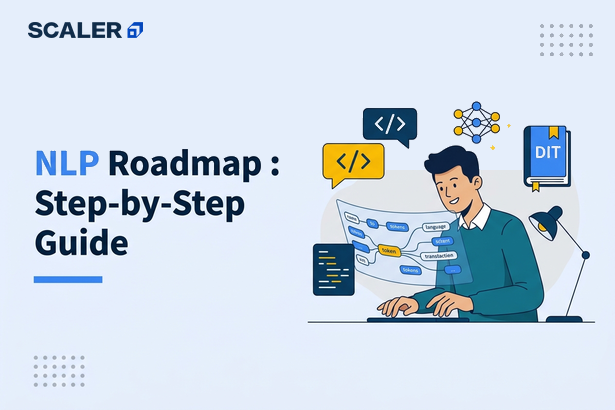
Why NLP Is One of the Most In-Demand AI Skills in 2026
Natural Language Processing, or NLP, focuses on how computers understand and work with human language. The global NLP market is expanding rapidly and is expected to be worth around USD 67.8 billion by the end of 2025, up significantly from previous years as more industries invest in text-based AI solutions.
As organisations adopt AI across products and internal workflows, the demand for NLP skills continues to grow. Engineers use NLP to build systems that can read text, understand intent, generate responses, and support decision-making at scale.
NLP Skills Power the AI Revolution
Many widely used AI applications rely on NLP at their core. These include chatbots, virtual assistants, search systems, text summarisation tools, and recommendation engines. As large language models become more common, NLP skills now extend beyond simple text processing to handling real-world language tasks.
The growth of LLM-based applications has increased the need for professionals who understand how text data is processed, represented, and used in AI systems. This makes NLP a foundational skill for anyone working with modern AI products.
Transform Your Career
Choose from our industry-leading programs designed for career success
Modern Software and AI Engineering Program
Master full-stack development with AI integration


 +1000 more
Modern Data Science and ML with specialisation in AI
Advanced data science techniques with AI specialization
+1000 more
Advanced AIML with Specialisation in Agentic AI
Deep dive into AIML with focus on Agentic systems
+1000 more
DevOps, Cloud & AI Platform Engineering
Build and manage AI-powered cloud infrastructure
+1000 more
AI Engineering Advanced Certification by IIT-Roorkee
Premier AI engineering certification from IIT-Roorkee

Why Learning NLP Requires a Structured Roadmap
NLP covers a wide range of concepts, tools, and techniques. You need to understand text processing, machine learning models, deep learning methods, and basic language concepts to build reliable NLP systems.
Without a clear learning path, it is easy to jump between tools and topics without building a strong foundation. A detailed NLP roadmap can help you progress step by step, starting with basics and moving toward advanced NLP applications used in real-world systems.
The next sections break this NLP roadmap for 2026 into clear phases, from beginner concepts to advanced skills.
Also Check out: NLP Syllabus 2026
Complete NLP Roadmap 2026: Step-by-Step From Beginner to Advanced
This section outlines a phase-by-phase NLP roadmap for 2026, we have particularly prepared this to help you move from basic programming skills to advanced natural language processing concepts. Each phase builds on the previous one, so you can develop NLP skills in a structured and practical way.
Phase 1: Foundations (Month 0-1)
In this phase, you will focus on building the basic programming skills needed for NLP. The goal is to become comfortable with Python and the tools used to work with text and data.
What You Will Learn
- Python basics for writing simple programs
- Core concepts such as data types, loops, and functions
- Working with Jupyter Notebook for interactive coding
These concepts help you understand how text data is handled before applying NLP methods.
Platforms and Tools
- Python as the primary language for NLP
- Jupyter Notebook for running and testing code
- Google Colab for working online without setup
These platforms make learning and experimentation easier.
Practice Tasks
- Cleaning raw text using Python
- Building a simple word frequency analyser
By the end of this phase, you will be able to write basic Python programs and prepare text data for NLP tasks, which sets the foundation for the next phase.
Phase 2: Core NLP Fundamentals (Month 1-2)
At phase 2, you will learn how raw text is prepared for NLP tasks. The focus will be on understanding how language data is cleaned, broken down, and transformed before it is used by NLP models.
Key Areas You Will Cover
- Text preprocessing to clean and standardise input data
- Tokenization to split text into meaningful units
- Handling stopwords to reduce noise in text
- Lemmatization and stemming to bring words to their base form
These steps form the base of most NLP pipelines.
Libraries and Frameworks
- NLTK for learning and experimenting with NLP techniques
- spaCy for efficient and production-ready text processing
These libraries help you apply NLP concepts using real code.
Practice Tasks
- Building a spam classifier using a bag-of-words approach
- Creating a rule-based system for text tagging
By the end of this phase, you can clean and prepare text data and apply basic NLP techniques, which prepares you for working with machine learning models in the next phase.
If you’re learning NLP to get hired, the strongest signal is projects—not theory. If you want a guided path to build portfolio-ready NLP/LLM work (like RAG assistants and real deployments), the IIT Roorkee AI Engineering program by Scaler is worth exploring.



You can also learn NLP in detail for free with Scaler’s NLP Tutorial!
Phase 3: Machine Learning for NLP (Month 2-3)
In this phase, you will learn how to apply machine learning models to text data. The focus will have to shift from preparing text to training models that can classify, analyse, and make predictions based on language.
Topics You Will Work On
- Text vectorization using methods like Bag-of-Words and TF-IDF
- Machine learning models such as Naive Bayes, Support Vector Machines, and Logistic Regression
- Feature engineering techniques for improving text-based models
These topics help convert text into numerical form that models can learn from.
Libraries and Tools: scikit-learn for building and evaluating machine learning models
This library provides ready-to-use tools for NLP-related machine learning tasks.
Practice Tasks
- Building a sentiment analysis model to classify text as positive or negative
- Creating a resume classifier to categorise resumes based on content
By the end of this phase, you can train and evaluate machine learning models for NLP tasks, which prepares you for deep learning approaches in the next phase.
Also check out: Scaler AIML Porgram
Phase 4: Deep Learning for NLP (Month 3-4)
At phase 4, you will learn how deep learning models handle language tasks at a deeper level. The focus moves from traditional machine learning to neural networks that can capture context and meaning in text more effectively.
Core Topics You Will Explore
- Neural networks and how they process text data
- Recurrent models such as RNN, LSTM, and GRU for sequence-based tasks
- Word embeddings like Word2Vec and GloVe to represent meaning in text
These concepts help models understand relationships between words and sentences.
Frameworks You Will Work With
- TensorFlow, for building and training deep learning models
- PyTorch, for experimenting with flexible neural network architectures
These frameworks support most modern deep learning workflows in NLP.
Practice Tasks
- Building a text generation model that produces sentences based on learned patterns
- Creating a neural sentiment classifier using deep learning techniques
By the end, you can build and train deep learning models for NLP tasks, which will prepare you for working with transformer-based models in the next phase.
Learn Deep learning for free with Scaler’s Tutorial!

Free Courses by top Scaler instructors
Phase 5: Transformers and Modern NLP (Month 4-5)
In the 5th phase, you will learn how modern NLP systems understand context and meaning at scale. The focus moves to transformer-based models, which power most real-world NLP applications used today.
Core Ideas You Will Learn
- The attention mechanism, which helps models focus on relevant parts of text
- Self-attention, used to understand relationships between words in a sentence
- Encoder-decoder models, commonly used for tasks like translation and summarisation
- Popular transformer models such as BERT, RoBERTa, and GPT, and what they are used for
These ideas explain how modern NLP models handle long and complex text.
Libraries You Will Use: Hugging Face Transformers, to load, fine-tune, and use pre-trained transformer models. This library allows you to work with state-of-the-art NLP models without training them from scratch.
Practice Tasks
- Building a text summarisation system
- Creating a question answering system based on documents
- Implementing named entity recognition to extract key information from text
After familiarizing yourself with the concepts, you can work with transformer models and build practical NLP applications, which prepares you for advanced NLP systems and real-world deployment in the next phases.
Phase 6: LLMs and Applied NLP (Month 5-6)
In this phase, you will learn how large language models are applied to NLP tasks. The focus is on using pre-trained models effectively and understanding how to guide their behaviour for practical applications.
Key Areas You Will Focus On
- Fine-tuning pre-trained language models for specific tasks
- Zero-shot and few-shot learning, where models perform tasks with little or no training data
- Prompt engineering to guide model responses clearly and consistently
- Safety and ethical considerations when working with language models
Platforms and Services
- Hugging Face, for fine-tuning and experimenting with open-source language models
- OpenAI API, for building NLP applications using hosted large language models
These tools allow you to apply LLMs without managing complex infrastructure.
Practice Tasks
- Building a chatbot for conversational tasks
- Creating a document summariser for long text inputs
- Developing an LLM-powered query system for searching and answering questions
By the end, you can apply large language models to common NLP problems and build end-user applications, which will prepare you for advanced NLP systems and deployment-focused work in the next phase.
Phase 7: Advanced NLP – RAG, LLMOps, and Deployment (Month 6-7)
At this stage, you will focus on building advanced NLP systems and preparing them for real-world use. The emphasis is on combining language models with external data, managing model workflows, and deploying NLP applications so others can use them.
Focus Areas You Will Work On
- Retrieval Augmented Generation (RAG), to connect language models with external documents and data
- Embeddings and vector databases, to store and retrieve text efficiently
- LLMOps practices, to manage experiments, updates, and reliability
- Deploying NLP models, so applications run outside local environments
These areas help you move from experimental NLP models to usable systems.
Tools and Platforms
- Pinecone or ChromaDB, for storing and searching embeddings
- LangChain, to connect language models with data sources and workflows
- FastAPI, to expose NLP systems through APIs
- Docker, to package applications for consistent deployment
These tools support building and running NLP systems at scale.
Practice Tasks
- Building a RAG-based chatbot that answers questions from documents
- Creating a domain-specific knowledge assistant using focused data
- Deploying a production-ready NLP API that serves real requests
After completing the concepts in this phase, you will be able to build, deploy, and maintain advanced NLP applications, completing the transition from learning concepts to delivering production-level NLP systems.
Scaler Placement Report and Statistics
Scaler learners achieved 2.5x salary growth with average post-Scaler CTC reaching ₹23L.
 Google
 Amazon
 Microsoft
 Flipkart
 Adobe
1200+ more
Adobe
1200+ more
Phase 8: Portfolio Building and Real-World NLP Projects
In this final phase, you will focus on consolidating everything you have learned into a strong NLP portfolio. The aim is to show that you can work across traditional NLP, deep learning, and modern LLM-based systems, and deploy them.
What Your Portfolio Should Cover
- Machine learning and deep learning–based NLP projects
- At least one transformer-based NLP project
- At least one LLM-based application
- Deployed NLP systems that run outside a local setup
Together, these projects will show your ability to handle NLP tasks end to end.
Capstone Projects You Can Build
- An AI customer support bot that handles common queries
- A text-to-insights system that extracts useful information from documents
- A RAG-based enterprise search tool for querying internal knowledge
By the end of this final phase, you can present a complete NLP portfolio that reflects real-world skills, making it easier for others to understand the depth and range of your NLP experience.
Tools You Must Master in the NLP Roadmap (2025 Edition)
This table highlights the key tools you will use across different stages of the NLP roadmap. You will encounter these tools gradually as your skills progress from beginner to advanced NLP applications.
| Category | Tools | What You Will Use Them For |
| Core Tools | Python, Jupyter Notebook, Google Colab | Writing code, experimenting with text data, and learning NLP concepts |
| NLP Libraries | NLTK, spaCy, Hugging Face | Text preprocessing, language analysis, and working with modern NLP models |
| ML & DL Tools | scikit-learn, TensorFlow, PyTorch | Training and evaluating machine learning and deep learning NLP models |
| Advanced Tools | LangChain, Vector Databases, Docker, FastAPI | Building, deploying, and scaling real-world NLP applications |
Checkout: Scaler’s Python Tutorial for free
You do not need to learn all these tools at once. As you follow the NLP roadmap, you will start using each tool when it becomes relevant to the type of NLP system you are building.
Scaler Alumni and Their Success Stories
NLP Learning Timeline: Beginner to Advanced (6-7 Months)
This timeline gives you a clear view of how NLP skills typically progress over time. You can adjust the pace based on your background and available study hours.
Month-wise NLP Learning Timeline
| Timeline | What You Will Focus On |
| Month 1 | Python basics and programming fundamentals |
| Month 2 | Core NLP techniques and machine learning for text |
| Month 3-4 | Deep learning models for NLP |
| Month 4-5 | Transformer models and modern NLP methods |
| Month 6 | Large language models and applied NLP projects |
| Month 7 | Deployment and portfolio development |
By following this timeline, you can move from beginner-level skills to building and deploying real-world NLP applications within six to seven months.
Certifications to Support Your NLP Learning
These certifications align well with practical NLP and LLM work and are commonly recognised by teams working on production AI systems.
Industry-Relevant NLP Certifications
| Level | Certification | Issued By | How it can help |
| Intermediate | NLP Specialization | DeepLearning.AI | Builds strong foundations in NLP using modern deep learning techniques |
| Advanced | NLP & LLM Certification Tracks | Hugging Face | Focuses on transformers, LLMs, and practical NLP workflows |
| Advanced | Machine Learning - Specialty | Amazon Web Services | Validates applied ML and NLP skills in production cloud environments |
These certifications work best when paired with projects. So, always remember that its best to have credible certification but can only work ater having a good portfolio.
Career Roles After Completing This NLP Roadmap
NLP skills apply across many AI and engineering roles. They do not lock you into a single job title, but instead expand the type of problems you can work on as your experience grows.
NLP Career Paths
| Experience Level | Roles |
| Entry-Level Roles | NLP AnalystML Engineer (NLP-focused) |
| Mid-Level Roles | NLP EngineerAI Engineer |
| Advanced Roles | LLM EngineerResearch EngineerApplied Scientist (NLP) |
As you progress, NLP skills allow you to move from working on individual models to designing and improving full language-based systems used in real applications.
Read These Important Roadmaps: More Paths to Career Success
FAQs: NLP Roadmap 2026
How long does it take to learn NLP in 2026?
The amount of time you take depends on your daily commitments and study time. With a planned roadmap, many learners can build practical NLP skills and projects within six to seven months.
Do I need strong math skills for NLP?
You do not need advanced mathematics to start learning NLP. Basic understanding of linear algebra and probability is helpful, but most concepts can be learned gradually as you progress through the roadmap.
Which NLP tools should beginners start with?
Beginners should start with Python and basic NLP libraries such as NLTK and spaCy. These tools help you understand how text is processed before moving on to advanced models and frameworks.
Can I get a job after completing this NLP roadmap?
Yes, if you focus on building projects and a strong portfolio. Employers often look for practical experience with NLP systems rather than only course completion or certifications.
