




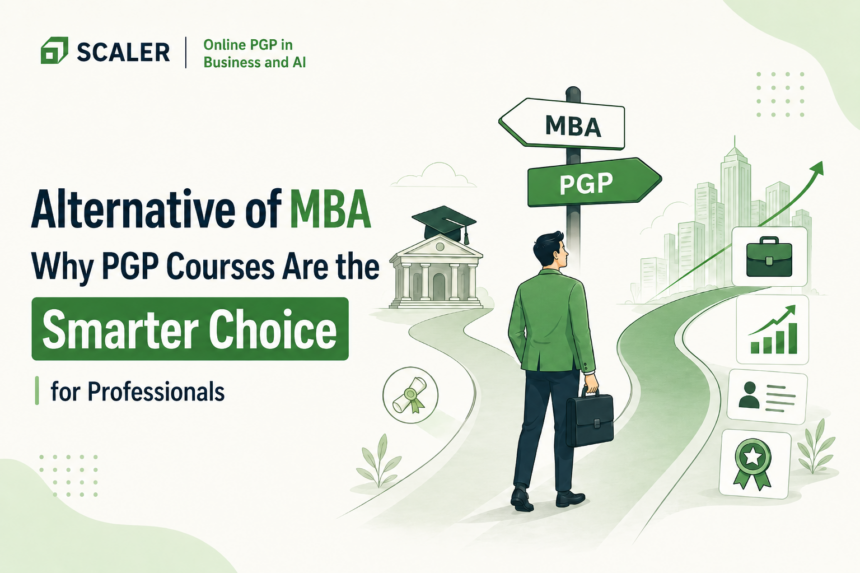
For a long time, an MBA was seen as the default step for career growth in business and management. Today, many people have understood that just a degree is not credible anymore, and having skills plays a much bigger role in getting selected for rewarding roles. Hence, they are actively looking for an alternative of MBA that fits better with their time, budget, and career stage.
The reason is simple. Professionals want programs that are faster, more affordable, and closely linked to real industry skills. This shift has made PGP courses a popular choice among people who want growth without putting their careers on hold.
So if you are also thinking of exploring options that are alternative of MBA, then do read along as we cover all you need to know about PGP courses.
Why Many Professionals Are Looking for MBA Alternatives in 2026
Many professionals today are actively searching for an alternative of MBA because the usual MBA programs do not always fit their current needs. A few reasons are:
- High cost and long duration: MBA programs often require a large financial investment and one to two years of full-time commitment. For working professionals, this can mean taking a career break and losing income during that period.
- Growing demand for skill-based roles: Companies now expect professionals to be job-ready. They look for practical skills, tool knowledge, and the ability to solve problems. In many roles, this matters more than studying broad academic subjects.
- Difficulty balancing work and education: Most professionals cannot afford a career-break to study full-time. They need learning options that fit around work schedules, family responsibilities, and daily routines.
Because of these reasons, many professionals are finding that more skill-based learning options are exploring MBA alternatives for professionals that are shorter, flexible, and more aligned with real industry needs.
What Is a PGP Course & Why It’s Considered an MBA Alternative
A PGP is a professional course that focuses on building specific skills needed for certain job roles. These programs are commonly taken by graduates and working professionals who want guided learning without enrolling in a long academic degree.
For a detailed explanation of how PGP programs are set up, you can refer to the PGP Overview.
How PGP Courses Are Structured
PGP courses are usually divided into short modules. Each module covers a specific area and includes learning, practice, and assessment components together. Learners complete one module before moving to the next.
This structure keeps the course organised and limits overlap between topics. Instead of studying multiple subjects at the same time, learners get to focus on one area at a time.
Duration and Learning Format
Most PGP courses run for 6 to 18 months. They are often offered in online or hybrid formats, with classes scheduled on weekends or outside standard working hours.
This allows learners to continue working while studying. There is no requirement to take a long break from employment, which is one reason professionals compare PGP courses with full-time MBA programs.
Nature of the Curriculum
PGP curricula focus more on skill enhancement. Learning is usually assessed through assignments, case studies, and projects. Some programs include a capstone project at the end.
The curriculum typically covers fewer subjects than an MBA, but in more depth. The intent is to focus on skills that are directly relevant to specific roles.
Why It Is Compared With an MBA
Professionals often compare PGP courses with MBAs because both are used for career development after graduation. While MBAs follow an academic, degree-based structure, PGP courses follow a shorter, skill-focused structure.
So choosing between them totally depends on what outcomes you would like to prefer after course completion.
MBA vs PGP: A Detailed Comparison for Working Professionals
Choosing between an MBA and a PGP often comes down to how you want to learn, how long you can commit, and what outcomes you expect. The table below highlights the key differences that working professionals typically consider when comparing MBA vs PGP, which is better for their careers.
| Considerable Factors | MBA | PGP |
| Program Length & Mode | 1 – 2 years full-time | 6 -12 months; online, hybrid, weekend options |
| Learning Focus | Broad management theory | Role-specific skills and tools-based curricula |
| Curriculum Structure | Classroom studies, case discussions | Practice projects, tools, and capstones |
| Assessment Style | Exams and papers | Assignments and practical evaluations |
| Fees | Typically higher over a longer period | Generally lower overall due to shorter duration |
| Return on Investment (ROI) | Long-term value | Faster application of skills; earlier ROI |
| Career Readiness | Focused on leadership and strategy | Focused on job-ready skills |
| Placement Pattern | Campus placements (for full-time) | Career support or project outcomes |
| Ideal For | Long-term leadership growth | Quick upskilling or career switching |
But why the difference in length, curriculum, and ROI? Let’s look into each aspect!
Also read: PGP Course in Business vs MBA: Which Is Right for You?
Program Length & Learning Mode
- MBA: The usual MBA programs take 1 – 2 years, with most of the learning delivered in a full-time campus environment. Part-time and executive MBAs exist, but many standard programs are long and structured around semester systems.
- PGP: PGP courses are typically designed to be shorter, for around 6 to 18 months, and offer more flexible learning modes such as online, hybrid, or weekend classes. This makes them easier to fit alongside a full-time job.
Curriculum & Skill Outcomes
- MBA: The curriculum covers a wide range of management topics, including finance, marketing, operations, strategy, and organisational behaviour. The emphasis is often on theory, case studies, and broad business frameworks.
- PGP: If we look into pgp vs mba comparison, then pgp focuses more on job-relevant skills and tools. Most include practical assignments and a capstone project that simulates real work, helping you demonstrate applied capability when you switch roles or seek promotions.
Fees & ROI
- MBA: Because of the longer duration and degree structure, MBA programs usually require higher fees. The return on investment often accumulates over a longer period, especially if the goal is senior leadership roles.
- PGP: The shorter duration and focused curriculum help keep the overall cost lower. Since the learning is more focused, many professionals begin applying new skills during or soon after the program, which can shorten the time it takes to see a return on investment.
Placement & Career Opportunities
- MBA: Full-time MBA programs often include campus placements and planned recruitment cycles. Graduates may enter roles in management, strategy, consulting, or leadership pipelines.
- PGP: PGP programs vary in placement support depending on the provider. Many offer career support, mentoring, and project-based outcomes that help professionals move into specific roles such as business analyst, product associate, marketing strategist, or operations coordinator. The emphasis is more on readiness for job interviews and applied roles than on formal campus placement alone.
When evaluating pgp vs mba, which is better, make your decision based on your priorities:
- If you want skill-based learning that you can use quickly and keep working at the same time, a PGP may fit better.
- If you are targeting broader business education and long-term leadership roles, MBA programs provide a more comprehensive foundation.
Want a guided counseling on whether a PGP would be the right path? Check out Scaler’s PGP Course in Business and feel free to contact us for any queries regarding the program!
Key Advantages of Choosing a PGP
Here are some aspects that people usually keep in mind while enrolling in a PGP course:
Quitting Your Job Isn’t Necessary
With a PGP, you can learn while continuing to work. Most programs are designed so that you apply what you learn during the course itself. This helps you improve performance at work without taking a long career break.
So if you are hesitating to take a career break and want to upskill without leaving your current job, then PGP courses can certainly help you with it.
Specialized Learning Matching Industry Needs
PGP courses focus on specific domains, not general management. You choose a track based on what you want to grow into.
Common specializations include:
- PGP in Business or Management
- PGP in Analytics or Data
- PGP in Marketing or Growth
- PGP in Product Management
- PGP in HR or People Analytics
This helps you spend time only on skills that are required for your role, instead of covering many unrelated subjects and broad concepts.
Industry-Recognized Certification With Upgraded Skills
While selecting candidates, employers at all times care about the skills that you have, the tools you can use, and the practical experience you have had. When a PGP program helps you build these, recruiters are able to understand your skill level and can make recruitment decisions accordingly.
Ideal for Career Switching or Skill Upgrading
If you are planning to switch roles or upgrade skills, a PGP gives you a clear learning path. You will follow a structured curriculum instead of trying multiple short courses without direction.
This can help reduce confusion during transitions and help you prepare for new roles with more clarity and confidence.
Who Should Choose a PGP Program Instead of an MBA?
A PGP program may suit you better than an MBA if your current situation or goals match the points below.
- You are a working professional with limited time: You need a program that fits around your job and does not require a long career break.
- You want to upskill quickly at the mid-career stage: You are looking to move faster in your role or prepare for the next step without spending years in study.
- You want high ROI and faster results: You prefer a shorter program where skills can be applied early, helping you see value sooner.
- You want domain-specific growth: You are aiming to grow in a specific area, such as marketing, data, HR, product, or operations, rather than studying broad management subjects.
If most of these points describe your situation, a PGP program is likely to align better with your goals.
Career Outcomes After a PGP Program
A PGP program does not promise a fixed job title. It helps you build skills for specific roles. The role you move into depends on your current experience, the skills you learn, and how you use them in your job or interviews.
Promotions and Role Upgrades
If you apply new skills effectively, you may see:
- Growth into analyst, strategist, or managerial roles
- Expanded responsibilities within your current team
- Greater involvement in decision-making or project ownership
Many professionals use PGP learning to strengthen their position in their existing organisation.
Career Switching Opportunities
PGP programs are often used to move into high-demand fields such as:
- Data and analytics
- Product or program roles
- Marketing and growth
- HR and people analytics
An industry-relevant curriculum and application-based learning usually help learners make a credible portfolio that essentially helps recruiters understand the skill-level of the candidate better.
Increased Salary Potential Through Skill-Based Growth
Employers tend to reward professionals who bring useful skills and can deliver results. When your work improves, salary growth often follows through:
- Role changes
- Performance-based hikes
- Access to higher-impact responsibilities
Not everyone indeed sees the same results, but stronger skills often lead to better roles and higher pay over time.
FAQs: Choosing Between MBA & PGP
1. Is a PGP a valid alternative to an MBA?
Yes, a PGP can be a valid alternative, depending on your goals. If you want practical skills and faster application at work, a PGP can help you with that. If you are looking for a formal degree and long-term leadership roles, an MBA may be more suitable.
2. Which is more affordable: an MBA or a PGP?
In most cases, a PGP is more affordable. PGP programs are shorter, so the overall cost is usually lower. MBA programs often involve higher fees and a longer time commitment.
3. Can a PGP help me change my career domain?
A PGP can help you move into a new domain if it teaches role-specific skills and includes practical projects. Your transition depends on your background and how well you apply what you learn during interviews and at work.
4. Is a PGP recognized by employers?
Employers recognize PGP programs when they help you build useful skills. Recruiters usually focus on what you can do, the tools you know, and the work you can explain, so as long as you check all their recruitment criteria boxes, then you’re all set.
5. Which gives faster results: an MBA or a PGP?
A PGP usually shows results faster because it is shorter and focused on applied skills. MBA programs tend to show results over a longer period, especially for leadership and senior roles.
