




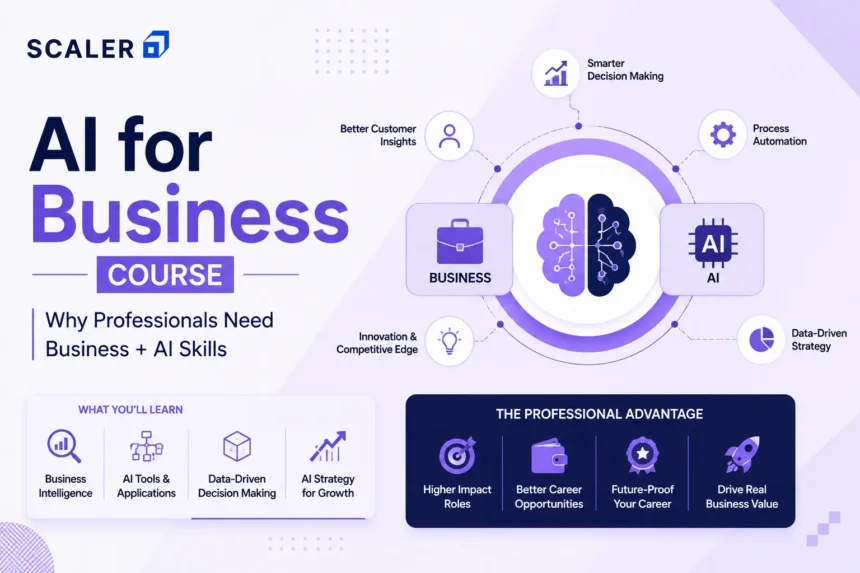
Now we are truly facing the times when businesses and industries are carefully trying and testing newer resources. For that, AI has been especially looked into and researched.
Companies want teams to “use AI more.” Managers are being asked about automation in meetings. Analysts are expected to speed up reporting with AI tools. Suddenly, everyone is experimenting with prompts, copilots, dashboards, and workflow tools, but half the time, nobody is fully sure what’s actually useful and what’s just hype.
And this is why business-focused AI learning is growing so fast. When companies demand certain skills, it’s only right to acquire them!
Here, people are mainly looking for practical ways to use AI in everyday business work.
- Which AI tools are worth learning?
- Where does AI actually save time?
- What changes for analysts, managers, and business teams?
- And what kind of AI understanding is genuinely useful at work?
That’s why it’s important to find a good ai for business course. The most valuable programs in this case should cover business applications, analytics, productivity, workflows, communication, and decision-making.
The learning path changes depending on the role, too. A generative ai for business course may focus more on workflow automation and AI-assisted productivity. An ai course for business leaders usually leans more toward strategy and organizational decision-making. Meanwhile, an ai course for business analyst roles often focuses on reporting, interpretation, forecasting, and AI-supported analytics workflows.
Should You Consider an AI for Business Course?
- Most ai for business course programs now include analytics, automation tools, reporting workflows, and AI-assisted business tasks.
- Analytics workflows, reporting tasks, automation tools, and AI-assisted productivity are now common parts of these programs.
- A generative ai for business course works well for professionals who want practical AI usage without moving into engineering-heavy roles.
- These courses are commonly taken by managers, analysts, consultants, operations professionals, marketers, and mid-career employees.
- Many programs now combine business understanding, analytics, and AI tools together instead of teaching them separately.
Key takeaway: These courses are mainly designed for professionals who want to use AI more effectively in business roles without going too deep into technical AI development.
Generative AI for Business Course
Remember when ChatGPT, Copilot, Perplexity, and more such AI tools were introduced? It just became so easy to get the work done!
Maybe you’ve used AI to summarize reports, clean up presentations, draft emails, organize research notes, or speed up repetitive documentation work. Sometimes it genuinely did save time but sometimes the output sounded polished but still missed the context completely.
And to figure out the ways to keep using these tools in the most efficient way possible, the generative ai for business courses come of use. You’ll basically understand where AI can help, where manual work is genuinely required, and most importantly, how businesses expect employees to use AI for efficiency.
What these courses usually include
- reporting and documentation workflows
- Prompt writing for workplace tasks
- AI-assisted research and summaries
- spreadsheet and analytics workflows
- workflow automation basics
You can also check out some AI tools for business workflows for a better understanding.
You should also keep in mind that your area of learning will depend on your role, for example:
| Role | Where AI tools are commonly used |
| Managers | Planning docs, presentations, summaries |
| Analysts | Reporting, spreadsheets, research |
| Consultants | Market analysis and proposal drafts |
| Operations Professionals | Documentation and workflow tracking |
If you are considering an ai course for business leaders, then it usually leans more toward planning, communication, and workflow decisions. An ai course for business analyst roles tends to cover reporting, dashboards, spreadsheets, and analytics tasks.
Check out some of the best AI courses in 2026
Before choosing any ai and business analytics course, check whether the syllabus includes review workflows too. Generating AI output is one thing. Reviewing it properly is what usually determines whether the work becomes genuinely useful.
Go through this generative AI syllabus to get an idea of what should be covered.
AI Course for Business Leaders
You might have noticed by now how work expectations have changed so drastically, especially when AI is used.
If presentations take less time to make, people expect more presentations. If reports get generated faster, reporting cycles become shorter. If AI tools can summarize meetings instantly, managers are suddenly handling more discussions, more documents, and more decisions in less time.
This may sound productive at first, but it also creates a different problem altogether, and that is, getting the word done quickly rather than properly.
A lot of leadership-focused AI learning should involve these areas:
- Which tasks genuinely save time with AI?
- Which outputs still need manual review?
- Where does faster execution reduce quality?
- And how should teams actually use AI without creating more confusion later?
And if you want to understand the answer to these questions, then an ai course for business leaders can help you with it. The learning usually stays connected to operational decisions, communication quality, reporting workflows, analytics interpretation, and implementation challenges that managers are already dealing with.
What these courses usually include:
- AI tools used during reporting and planning
- approval and review workflows
- analytics and business insights
- AI-assisted communication and documentation
- workflow automation decisions
- productivity measurement and execution tracking
One thing worth paying attention to before choosing any ai for business course is whether the syllabus talks about review systems and business-side implementation challenges. You wouldn’t want to waste time on overviews or basic prompting.
And that matters because many companies don’t see if you can just “use AI” but can genuinely operate it like:
- Verify AI-generated work properly
- communicate insights clearly
- reduce repetitive work without reducing quality
- and make better operational decisions with faster information
If your work revolves around dashboards, spreadsheets, forecasting, and reporting tasks, then an ai course for business analyst roles or an ai and business analytics course can help you understand this area of skillset.
AI Course for Business Analyst
Let’s be honest! Analytics has now become considerably more efficient than before, especially with the right AI tools.
AI tools can already clean spreadsheets, generate summaries, organize datasets, suggest visualizations, and even create first-pass reports. So the value of a business analyst comes down to:
- asking better business questions
- spotting weak assumptions
- Understanding why numbers changed
- and explaining what the data actually means for decisions
That’s where an ai course for business analyst roles can become helpful.
It goes without saying that a lot of professionals already know Excel, dashboards, SQL basics, or reporting tools. The difficult part is usually connecting analytics with business decisions properly, especially once AI starts speeding up repetitive reporting work.
Here’s what is expected currently:
- interpreting trends instead of only reporting them
- Understanding the business context behind numbers
- reviewing AI-generated summaries critically
- identifying misleading patterns in reports
- communicating insights clearly to non-technical stakeholders
Go through this business analytics process to understand how reporting and decision-making usually connect inside businesses.
One thing you should note here is that AI tools are changing analytics workflows unevenly. Repetitive reporting tasks are becoming faster, but interpretation work is becoming more important. Businesses still need analysts who can explain:
- Why conversions dropped
- Why customer behavior changed
- Which metrics actually matter
- and whether AI-generated insights are even reliable
| Area | AI can already help with | Your judgment still matters in |
| Reporting | Summaries and first-pass analysis | Business interpretation |
| Dashboards | Visualization suggestions | Deciding what matters |
| Research | Data organization | Context and prioritization |
| Forecasting | Pattern identification | Decision-making |
You should also understand the difference in learning paths here: a generative ai for business course may stay closer to AI-assisted workflows and productivity tools, while an ai course for business leaders usually leans more toward planning and operational decisions.
Compare roles through this data analyst vs business analyst breakdown.
Before choosing any ai and business analytics course, check whether the syllabus includes interpretation, communication, and decision-making alongside the tools themselves.
You can also explore this data analyst course syllabus to understand what skills are commonly covered.
How AI Is Changing Business Leadership
Have you noticed how much easier it has become to produce work, but not necessarily easier to decide what good work is anymore?
A team can now generate five presentation drafts in an hour. Strategy documents sound more polished. Reports get summarized instantly. Meeting notes are automated. Even market research that earlier took days can now be compiled within minutes using AI tools.
Microsoft’s 2024 Work Trend Index also found that nearly 75% of knowledge workers already use AI at work, so this isn’t really a future trend anymore. It’s already changing how teams operate.
And that changes leadership work, too.
Earlier, managers often spent more time pushing work forward. Now a lot of the effort goes into reviewing outputs, filtering weak ideas, deciding what actually deserves attention, and stopping teams from drowning in unnecessary information.
For example:
- If AI helps teams create more reports, somebody still needs to decide which metrics actually matter.
- If presentations become easier to generate, leaders still need to identify whether the thinking behind them is strong.
- If AI speeds up communication, managers still need to make sure teams are aligned instead of simply reacting faster.
Once businesses start using AI regularly, leadership work changes too. Managers end up handling faster execution cycles, more information, and more decisions across teams, which may lead you to feel the need to start exploring an ai course for business leaders at this stage.
What leadership-focused AI learning usually covers
- reviewing AI-generated outputs critically
- making decisions with faster information cycles
- identifying weak recommendations quickly
- reducing repetitive work without reducing quality
- coordinating teams using different AI tools
- balancing speed with clarity during execution
You can also explore how mid-career growth with a PGP is changing for professionals moving into leadership and strategy-focused roles.
And honestly, this is also why many companies are now paying more attention to judgment and communication quality. AI can already help people create work faster, but explaining the details is still crucial.
If your role consists of analytics, reporting, dashboards, and interpretation work, then an ai course for business analyst roles or an ai and business analytics course can help you.
Check out Scaler Online PGP in Business & AI if you are ready to explore ai for business course options.
Business Analytics and AI Course
Companies today collect more customer, sales, product, and operational data than ever before, but a surprising number of teams still struggle to answer very basic questions clearly.
Why are customers leaving after the first purchase?
Why do some users stay active while others disappear in a week?
Why does one city perform better than another despite similar marketing spend?
Why do certain products get attention but not conversions?
That’s where business analytics becomes far more important than simply “knowing data tools.”
AI can already organize spreadsheets, summarize datasets, detect patterns, and generate first-level analysis quickly. But businesses still need people who can separate useful signals from misleading ones and connect those findings with actual decisions.
For example, if customer retention drops, the answer is rarely sitting in one chart. It may be pricing, poor onboarding, delivery delays, wrong customer targeting, or even seasonal buying behavior. The difficult part is figuring out which factor actually matters before teams waste time solving the wrong problem.
That’s why an ai and business analytics course usually works best when the learning stays connected to customer behavior, growth decisions, operational bottlenecks, market patterns, and business reasoning instead of isolated tools.
Skills businesses increasingly look for
- identifying why a problem is happening
- connecting patterns with business context
- spotting misleading conclusions early
- asking sharper follow-up questions
- turning observations into business actions
| Situation | AI can help with | Business understanding is still needed for |
| Customer drop-offs | identifying patterns | understanding the reason |
| Sales decline | highlighting trends | deciding what to fix first |
| Product usage changes | summarizing behavior | feature or pricing decisions |
| Operational delays | process tracking | prioritization and execution |
If your role involves planning, execution, and team decisions, then an ai course for business leaders will fit your needs and requirements better. If the work involves interpretation-heavy problem-solving, an ai course for business analyst roles usually makes more sense.
Before choosing any generative ai for business course, check whether the syllabus explains how businesses actually use analysis during customer, product, sales, and operational decisions, because that’s usually the part missing from surface-level learning.
Explore this data analyst course syllabus to understand what skills are commonly covered.
Explore These In-Demand Career Skills
FAQs
1. What is an AI for business course?
An ai for Business course is designed for professionals who want to understand how AI fits into real business environments without going deep into technical engineering or coding. These programs usually focus on areas like analytics, automation tools, productivity workflows, customer insights, reporting, and business applications of AI across different functions.
2. Who is it best for?
These courses are usually most useful for working professionals, managers, analysts, consultants, operations teams, marketing professionals, and mid-career employees trying to stay relevant as workplaces become more technology-focused. A lot of professionals pursue these programs to better understand how AI affects everyday business operations and team workflows.
3. How should readers evaluate whether it fits their goals?
The biggest thing to look at is whether the program focuses on practical business applications or purely technical theory. Professionals exploring an ai and business analytics course should check if the learning connects AI to real business use cases like reporting, analytics, workflow optimization, customer insights, and operational efficiency. The right program usually depends on career goals, current role, and how closely someone works with business data or cross-functional teams.
4. How does a generative AI for business course fit into the decision?
A generative ai for business course is generally more focused on practical AI usage inside everyday business work. That can include AI-assisted reporting, research, communication workflows, productivity improvement, automation support, and content-related tasks. It’s often useful for professionals who want hands-on AI fluency without moving into highly technical roles.
5. How does an AI course for business leaders fit into the decision?
An ai course for business leaders is usually more management-focused. Instead of teaching technical AI systems in depth, these programs help leaders understand how AI affects productivity, workflows, analytics, operations, and team coordination. The focus is often on adapting leadership and business strategy to workplaces where AI tools are becoming increasingly common.
6. How does an AI course for business analysts fit into the decision?
An ai course for business analyst roles typically focuses on analytics, reporting workflows, business insights, and data interpretation alongside practical AI applications. The goal is usually to help analysts move beyond routine reporting work and become more involved in strategy, operational planning, and business problem-solving.
