




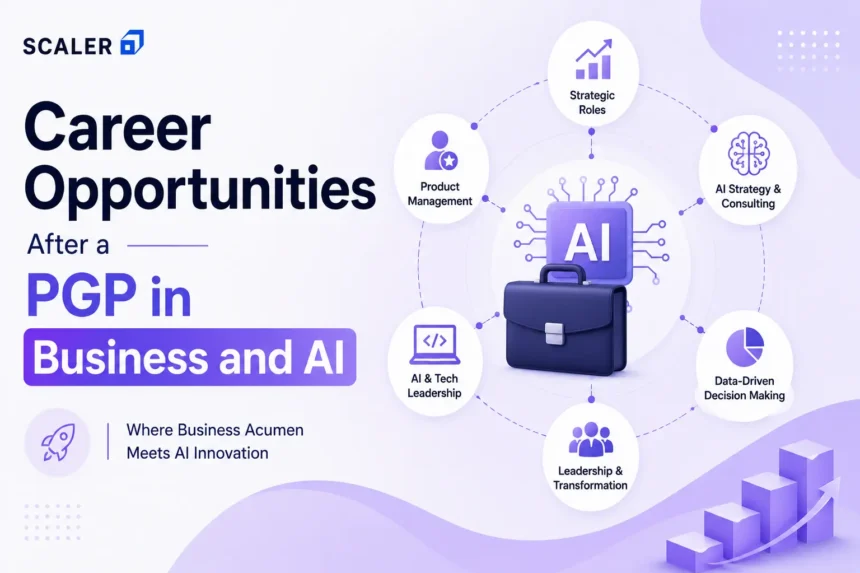
Not too long ago, you could stay focused on just your domain expertise and still grow steadily in your career. A marketing professional could focus only on campaigns, an operations manager could rely on process experience, and analysts mainly worked with reports and dashboards. But this fact is nearly changing.
Today, even non-technical roles increasingly expect you to understand AI-driven tools, automation workflows, data-backed decision-making, and how technology impacts business outcomes.
You can say that this is one of the biggest reasons more professionals are exploring career opportunities after a PGP in Business and AI. Companies are not only hiring people who can build AI systems from scratch. They also need professionals who can identify where AI fits into a business problem, evaluate whether automation is actually useful, and turn insights into decisions that teams can act on.
And that is why a business and AI course creates a very different kind of learning pathway. It prepares you for technical development roles and helps you understand how AI is being used across business functions like operations, marketing, analytics, consulting, product, and strategy.
You may already have strong business experience. The challenge now is understanding how AI, automation, and data are becoming part of everyday decision-making across teams.
Career Opportunities After a PGP in Business and AI
- A PGP in Business and AI can help professionals move toward analytics, strategy, operations, product, and AI-enabled business roles.
- The biggest advantage is learning how to combine business understanding with analytics, automation, and AI tools.
- These programs are especially useful for professionals looking for career growth, role transitions, or mid-career upskilling.
- Common career paths include business analytics, growth strategy, consulting, product management, operations leadership, and AI-assisted business functions.
- Professionals from non-technical backgrounds can also benefit because most programs focus on practical business applications and not much on deep technical engineering.
Key takeaway: Companies increasingly value professionals who understand both business operations and modern AI-enabled workflows, making this skill combination more relevant across industries.
Skills You Gain in a PGP in Business and AI
One reason career opportunities after a PGP in Business and AI are growing is that companies now expect business professionals to cater to a lot more responsibilities.
In many teams, you are now expected to:
- work with AI-assisted tools,
- understand business data,
- spot operational inefficiencies,
- and make decisions faster using insights instead of manual processes.
And don’t worry, you don’t need to go through a rigorous curriculum of a machine learning engineer for this. But you should be able to understand the best way to use AI for your role.
Here are some of the most practical skills professionals build through a modern business and AI course, and where those skills typically show up at work.
| What You Should Learn | How it can be used at Work |
| Using AI tools for reporting and research | Instead of spending hours compiling reports manually, teams now use AI tools to summarize data, generate first drafts, and speed up weekly reporting workflows. |
| Understanding customer and business data | Companies increasingly expect professionals to explain why sales dropped, churn increased, or campaigns underperformed. |
| Identifying repetitive workflows that can be automated | Operations and support teams often automate repetitive approvals, ticket categorization, documentation, and internal updates to reduce manual workload. |
| Working with generative AI tools effectively | Many professionals now use AI for market research, competitor analysis, presentation structuring, documentation, and internal communication workflows/ |
| Evaluating AI outputs instead of blindly trusting them | Businesses still need people who can identify inaccurate insights, weak recommendations, biased outputs, or incomplete analysis from AI systems. |
| Collaborating with analytics, product, and tech teams | Business roles increasingly involve cross-functional work where you need to communicate clearly with technical teams without necessarily becoming deeply technical yourself. |
| Making decisions using live business metrics | Teams today often work with real-time dashboards and performance tracking instead of waiting for static monthly reports. |
If you are exploring the best AI courses in 2026, then you should definitely be looking for this kind of applied learning because companies are increasingly valuing people who can combine business understanding with practical AI usage.
You can also check out the Generative AI syllabus if you want more clarity in terms of topics and subjects.
Also, here are some AI tools used in business workflows that are quite useful across consulting, operations, marketing, analytics, and strategy roles, so do check them out!
Jobs After a PGP Course
One of the biggest misconceptions around career opportunities after a PGP in Business and AI is that the outcome is limited to “AI jobs.” In reality, most professionals move into roles where business understanding, analytics, AI-assisted decision-making, and operational thinking overlap.
That is why a business and AI course often creates very different career paths depending on your previous experience. Someone from operations may move toward automation and process strategy. A marketing professional may shift into growth analytics or customer intelligence. Analysts may move closer to strategy, product, or AI-enabled business roles.
For many professionals exploring a PGP in Business & AI, the goal is usually not to start from scratch. It is to move into roles that involve better decision-making, higher ownership, and stronger alignment with how companies are now operating.
Career Pathways After a PGP in Business and AI
| Your Background | Roles You Can Move Into | What Changes in Your Work |
| Operations / Process Management | Business Operations Analyst, Automation Strategist, Process Excellence Associate | You’ll move from handling workflows manually to improving systems using automation, reporting tools, and operational insights |
| Marketing | Growth Analyst, Customer Insights Associate, Marketing Analytics Specialist | Your work becomes more data-driven with a focus on campaign performance, customer behavior, and AI-assisted analysis |
| Business Analyst / Reporting Roles | Strategy Analyst, Product Analyst, AI Business Analyst | Instead of only reporting numbers, you can start working closer to decision-making, forecasting, and business planning |
| Consulting / Client-Facing Roles | Business Consultant, Digital Transformation Associate, AI Strategy Analyst | You’ll work on solving business problems using analytics, workflow optimization, and AI-supported recommendations |
| Product / Tech Coordination | Product Operations Associate, AI Product Analyst, Business Product Specialist | You’ll start working across business, product, and data teams to improve user workflows and business outcomes |
| Finance / MIS Roles | Business Intelligence Analyst, Forecasting Analyst, Risk Analytics Associate | Your role expands beyond reporting into trend analysis, forecasting, and performance interpretation |
What you can notice after clearing a well-rounded online PGP course is that professionals often move into roles that include strategy inside companies instead of staying limited to execution-heavy work.
For example:
- operations professionals may start evaluating automation opportunities instead of only managing processes,
- marketing teams increasingly rely on customer analytics and AI-assisted segmentation,
- Analysts are expected to explain business impact, not just build dashboards,
- Consulting teams now use AI-supported research and workflow analysis during problem-solving.
This is also why career growth after PGP programs tends to happen gradually through role evolution. In many cases, the program helps professionals position themselves for roles that come somewhere between business strategy, analytics, AI adoption, and operational decision-making.
How Role Progression Usually Changes
| Before the Program | After Applying Business + AI Skills |
| Reporting-focused work | Insight-driven decision support |
| Manual operational processes | Workflow optimization and automation thinking |
| Static dashboard monitoring | Business interpretation and forecasting |
| Department-specific execution | Cross-functional collaboration with analytics, product, and strategy teams |
| Tool usage | Decision-making using AI-assisted systems |
If you are curious about the available courses that can help with such upskilling, then you should surely check out the Best Postgraduate courses in 2026.
Can a PGP Help You Switch Careers?
To put it in short – Yes! It can.
For many professionals, the biggest reason to pursue a PGP course is not just career growth, but a career transition. A lot of people eventually realise that their current role has limited growth, or that their industry is changing faster than their skills can keep up with.
That’s especially true in workplaces where analytics, automation, and AI tools are becoming part of daily operations.
An online PGP course focused on business, and AI can help bridge that gap because it combines business knowledge with practical exposure to analytics, AI-driven tools, and modern decision-making systems.
Some of the common transition paths professionals explore include:
- Marketing to growth strategy or marketing analytics
- Operations to business analytics or process optimization
- Sales to revenue operations or strategy roles
- Traditional management roles to AI-enabled leadership positions
- Non-technical backgrounds to product, consulting, or data-driven business functions
These transitions are possible to happen because many of the professionals are not really starting from scratch. They already understand their industry, customers, workflows, or business challenges. A business and AI course simply adds a layer of analytics and AI awareness that helps them move into more strategic roles.
Companies today also value professionals who can combine domain expertise with modern business skills. For example, someone with years of operations experience plus analytics knowledge may stand out more than a candidate who only understands technical tools.
Of course, a PGP alone does not automatically guarantee a career switch. The outcome still depends on factors like prior experience, project work, communication skills, and how effectively someone applies the learning in real-world situations.
But for professionals looking to move toward future-focused business roles, these programs often provide:
- Better positioning for AI-driven workplaces
- More flexibility across industries and job functions
- Stronger understanding of analytics and business strategy
- Exposure to modern tools and decision-making systems
That’s one of the biggest reasons career opportunities after a PGP in Business and AI continue to grow across industries. The combination of business understanding and AI awareness is becoming valuable in far more roles than people expected even a few years ago.
Is a PGP Useful for Mid-career Professionals?
For mid-career professionals, the challenge is usually not a lack of experience. The bigger problem is staying up-to-date as industries change. Many professionals with 5 to 10 years of experience have to find a change in working environments where data, automation, analytics, and AI-driven tools are becoming part of everyday business decisions.
That’s one of the biggest reasons interest in career opportunities after a PGP in Business and AI has grown among working professionals. These programs are mainly built for upskilling and hence provide a designated path to keep up with the latest practices.
Now, if you are already a mid-career professional, you must surely understand business operations, team management, customers, or industry workflows. A PGP course just adds newer capabilities that companies increasingly expect in leadership and strategy-focused roles.
Some of the biggest advantages for mid-career professionals include:
- Better understanding of analytics and AI-driven decision-making
- Stronger positioning for leadership and strategy roles
- More confidence working with cross-functional and technical teams
- Exposure to modern business tools and digital workflows
- Greater flexibility while exploring role transitions or promotions
This becomes especially useful for professionals in roles like:
- Team leads and managers
- Operations professionals
- Marketing and growth teams
- Business analysts and consultants
- Product and strategy professionals
In many companies, leadership roles are also changing. Managers are now expected to understand performance metrics, automation systems, customer analytics, and AI-assisted workflows alongside traditional business responsibilities. A business and AI course helps professionals adapt to those expectations instead of falling behind as workplaces evolve.
For some professionals, the outcome may be a promotion into larger leadership responsibilities. For others, it could mean moving into analytics, strategic, and AI-enabled business roles. In both cases, the value often comes from combining years of business experience with newer skills that are becoming increasingly important across industries.
Business Leadership Roles After AI Upskilling
One of the biggest changes happening across industries right now is that leadership roles are becoming far more technology-driven than they used to be. Managers and business leaders are no longer expected to focus only on operations, targets, or team management. They are increasingly expected to understand analytics, automation, and AI-assisted workflows.
Companies want leaders who can understand business strategy while also adapting to how technology is changing the way teams operate.
A business and AI course helps professionals build that combination of business understanding and AI awareness, which becomes especially valuable in leadership and decision-making roles.
Here are some common leadership-focused career paths professionals explore after AI upskilling:
| Current Role | Leadership Path After AI Upskilling | What Changes in the Role |
| Operations Manager | Business Operations Head / Process Transformation Lead | Takes ownership of automation, efficiency, and data-driven operational planning |
| Marketing Manager | Growth Strategy Lead / Marketing Analytics Head | Uses customer insights, performance data, and AI tools for strategic decision-making |
| Team Lead or Project Manager | Product or Cross-Functional Leadership Roles | Manages teams that work across business, analytics, and technology functions |
| Business Analyst | Strategy Manager / Business Intelligence Lead | Moves from reporting-focused work to higher-level business planning and insights |
| Sales Manager | Revenue Strategy or Sales Operations Leadership | Uses analytics and forecasting tools to improve planning and performance tracking |
| Mid-Level Business Professional | AI-Enabled Leadership Roles | Combines domain expertise with AI-driven business decision-making |
What makes these leadership roles different today is that business teams now work much more closely with analytics, automation tools, and AI systems than before. Managers are often expected to understand how these tools affect operations, customer experience, reporting, and team workflows instead of focusing only on traditional management responsibilities.
That’s also why career growth after PGP programs is often more noticeable for mid-level professionals and managers. People who already have experience handling teams, projects, or business operations become more valuable when they can also adapt to newer technologies and modern ways of working.
FAQs
1. What jobs can you target after this path?
Career opportunities after a PGP in Business and AI can depend on your previous experience and industry background. Many professionals move into roles related to business analytics, growth strategy, product management, operations, consulting, marketing analytics, and AI-enabled business functions. Some also transition into leadership roles where understanding analytics and modern business tools becomes increasingly important.
2. Can it help with a career switch?
Yes, especially for professionals trying to move toward more future-focused business roles. A pgp course can help build practical understanding of analytics, AI tools, and modern business workflows, which makes it easier to transition into roles that combine business and technology. However, the outcome also depends on prior experience, project work, and how effectively the learning is applied in real situations.
3. How does it support mid-career growth?
For mid-career professionals, the biggest advantage is usually staying relevant as industries evolve. An online pgp course helps professionals strengthen skills related to analytics, AI awareness, business strategy, and modern workflows without completely changing their career path. This often supports promotions, role expansion, and movement into more strategic responsibilities.
4. How do the skills you gain in a PGP in Business and AI influence career growth?
The skills developed through a business and AI course are useful across multiple functions, including strategy, operations, marketing, product, and consulting. Professionals learn how to work more comfortably with analytics, automation systems, and AI-assisted tools, which increasingly affect how businesses operate today. That combination often improves long-term career positioning across industries.
5. How do jobs after a PGP course differ from traditional business roles?
Many jobs after a pgp course involve closer interaction with analytics, automation tools, customer insights, and digital business systems. Instead of focusing only on traditional execution-based work, professionals may become more involved in planning, optimization, cross-functional collaboration, and technology-supported business operations.
Can a PGP help you switch careers without a technical background?
In many cases, yes. Most professionals pursuing these programs are not full-time technical experts. A PGP usually focuses on helping professionals understand how AI, analytics, and modern business systems work in practical environments. That makes it useful even for people coming from marketing, sales, operations, management, or other non-technical backgrounds.
