




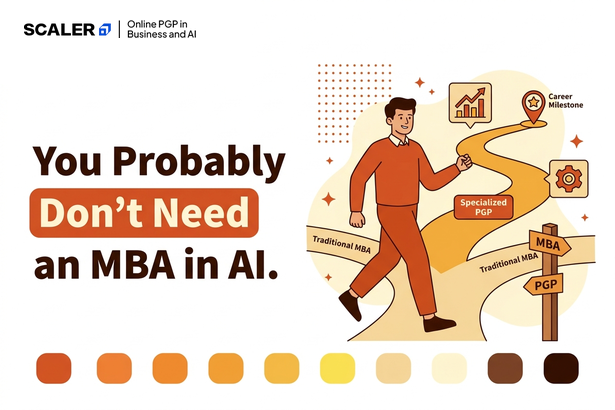
If you have been researching AI careers lately, you have probably noticed that ‘MBA in AI’ keeps coming up as the aspirational answer. They all mention two years, a prestigious campus, a degree that signals you are serious, which sounds reasonable when put like that. Except, two years out of the workforce, significant fees, and a curriculum that was likely designed before GPT-4 existed.
The real question is not whether an MBA in artificial intelligence is valuable. It often is. The question is whether it is the only way or even the best way to build the kind of AI credibility that actually moves careers. For a lot of working professionals, the honest answer is no.
This article breaks down what an MBA in AI actually gives you, what it does not, which AI skills business professionals genuinely need today, and where shorter business and AI programs fit into that picture.
The Quick Answer
• An MBA in AI is a 2-year degree combining business fundamentals with AI/ML modules, valuable, but expensive and slow.
• Shorter business and AI programs can build applied AI credibility in 6–12 months without pausing your career.
• The skills that matter for AI management roles are actually prompt engineering, AI strategy, data interpretation, product thinking and these can be learned outside a full MBA.
• An MBA makes most sense if you are targeting top-tier consulting, general management, or roles where the degree brand is the specific credential being bought.
What Is an MBA in AI, really?
An MBA in AI is a postgraduate management degree, usually the duration being two years full-time, that layers AI and data science modules onto a traditional MBA curriculum. You get strategy, finance, operations, and leadership alongside courses on machine learning fundamentals, AI ethics, data-driven decision-making, and sometimes a specialization in analytics or intelligent systems.
The degree makes sense if you want the full MBA experience, that is, campus networking, brand-name credential, consulting or general management placement, and a structured two-year academic environment. Some of the better programs in India include IIM Calcutta’s PGDM in Business Analytics, ISB’s analytics concentration, and international programs at Carnegie Mellon, MIT Sloan, and Imperial College.
Here is where it gets complicated though: the AI content in most MBA programs is still fairly introductory. You are not becoming a machine learning engineer. You are learning enough to make AI-informed business decisions which is genuinely useful, but is a narrower outcome than the ‘MBA in AI’ label suggests.
| What an MBA in AI gives you | What it typically does not give you | Worth it if… |
| Business + AI strategy framework | Deep technical ML/AI implementation skills | You want a brand-name degree and full MBA experience |
| Peer network and alumni placement | Applied AI product or engineering capability | You are targeting top consulting or C-suite roles |
| Two-year structured learning environment | Speed — most programs take 18–24 months | You can afford the time and cost trade-off |
| Academic credibility | Industry-current curriculum (AI moves faster than syllabi) | The institution’s brand is itself a career asset in your target market |
The honest cost-benefit: if you are mid-career and cannot take two years off, the MBA alternative for working professionals deserves serious consideration before you commit to a full degree program.
MBA in Artificial Intelligence vs a Faster Business + AI Path
The case for an MBA in artificial intelligence rests on one core assumption, that a two-year degree is what the market requires. In some markets and some roles, that is still true. Investment banking, strategy consulting at MBB, and certain FMCG leadership tracks, yes, the MBA brand matters.
For everything else in the AI-adjacent business world, whether it be AI product management, digital transformation leadership, AI strategy roles, or analytics management, the evidence that you specifically need a two-year MBA is shakier than the usual passed-down wisdom suggests.
What recruiters in those roles are actually looking for:
• Demonstrated ability to work with data and communicate insights clearly.
• Understanding of how AI tools fit into business workflows and where they break.
• Experience making decisions under uncertainty with imperfect data.
• Some fluency with AI concepts, enough to work with technical teams without being the bottleneck.
None of those require two years rather, they require the right structured program with real projects, good instruction, and ideally some peer cohort for the business thinking piece.
The PGDM vs MBA comparison is worth reading if you are weighing format and credential type, the differences in outcome are real but often misunderstood.
AI Management Careers: What the Roles Actually Require
‘AI management career’ is a broad phrase that covers a lot of ground. Let us be more specific, because the path to each of these roles is different and the MBA question looks different depending on which one you are targeting.
| Role | What it requires | MBA helpful? | Alternative path |
| AI Product Manager | Product thinking, AI system basics, user research, prioritization | Partially — MBA helps with strategy, not product execution | PGP in Business + AI + product portfolio |
| Digital Transformation Lead | Change management, vendor evaluation, AI roadmapping | Yes — stakeholder and leadership skills matter here | Executive PGP with transformation focus |
| Data Analytics Manager | SQL, dashboards, team management, storytelling with data | Not specifically — skills matter more than credential | Analytics program + management experience |
| AI Strategy Consultant | Frameworks, deck-writing, client communication, AI use-case mapping | Yes — consulting tracks value MBA brand strongly | MBA or top PGP with consulting placement |
| Growth / Marketing AI Roles | Campaign analytics, automation tools, attribution modeling | No — portfolio and tools count more | Short AI tools program + hands-on projects |
Mid-career professionals specifically often find that a structured PGP program accelerates the transition faster than returning to a two-year MBA all because the gap is usually in applied skills, not business fundamentals they already have.
The AI Skills Business Professionals Actually Need in 2026
Here is a more practical question than ‘should I get an MBA in AI’: what does a business professional actually need to be credible in AI-adjacent roles right now?
The list is shorter and more learnable than most people expect.
| AI skill area | What it means in practice | How to build it |
| AI fluency (not expertise) | Understanding what LLMs, ML models, and AI tools can and cannot do | Short courses, hands-on tool use, reading real case studies |
| Prompt engineering for business | Getting useful outputs from AI tools for analysis, writing, and automation | Practice with real work tasks — no course required, just repetition |
| Data interpretation | Reading dashboards, understanding statistical significance, not being fooled by vanity metrics | Analytics fundamentals + building one real dashboard project |
| AI strategy and ethics | Evaluating AI use cases, understanding bias and risk, making build-vs-buy decisions | Structured business + AI program with real case studies |
| AI tooling for business | Using Copilot, Gemini, Claude, Notion AI, etc., for actual productivity | Self-directed, tool documentation, workflow experimentation |
You can easily notice that nothing on this list requires a PhD or even a technical degree. Most of it requires structured practice, the right curriculum, and enough exposure to real AI projects to develop actual judgment.
The best AI courses for business professionals in 2026 vary significantly in depth, it is worth comparing what each one actually covers before committing.
→ Generative AI syllabus — what a good AI program should include
What a Business and AI Program Looks Like (and How to Evaluate One)
The category of ‘business and AI program’ covers everything from a 4-week online certificate to a 12-month structured cohort program with live mentorship, projects, and placement support. Quality varies enormously. The credential is not the useful signal, in fact, the curriculum, the projects, and the cohort are.
What to actually evaluate when comparing programs:
• Does the curriculum combine AI fundamentals with business application or is it one or the other?
• Are there real capstone projects, not just quizzes? Can you show the output to a recruiter?
• Is the AI content current, as in, does it cover LLMs, generative AI, and AI agents, not just 2018-era ML concepts?
• Does the cohort include working professionals, not just fresh graduates? The peer learning is part of the value.
• Is there placement or career support built in, or is that your problem to figure out separately?
A strong business and AI program should leave you with something concrete, with a project you built, a framework you can explain, and enough AI fluency to work alongside technical teams without needing translation.
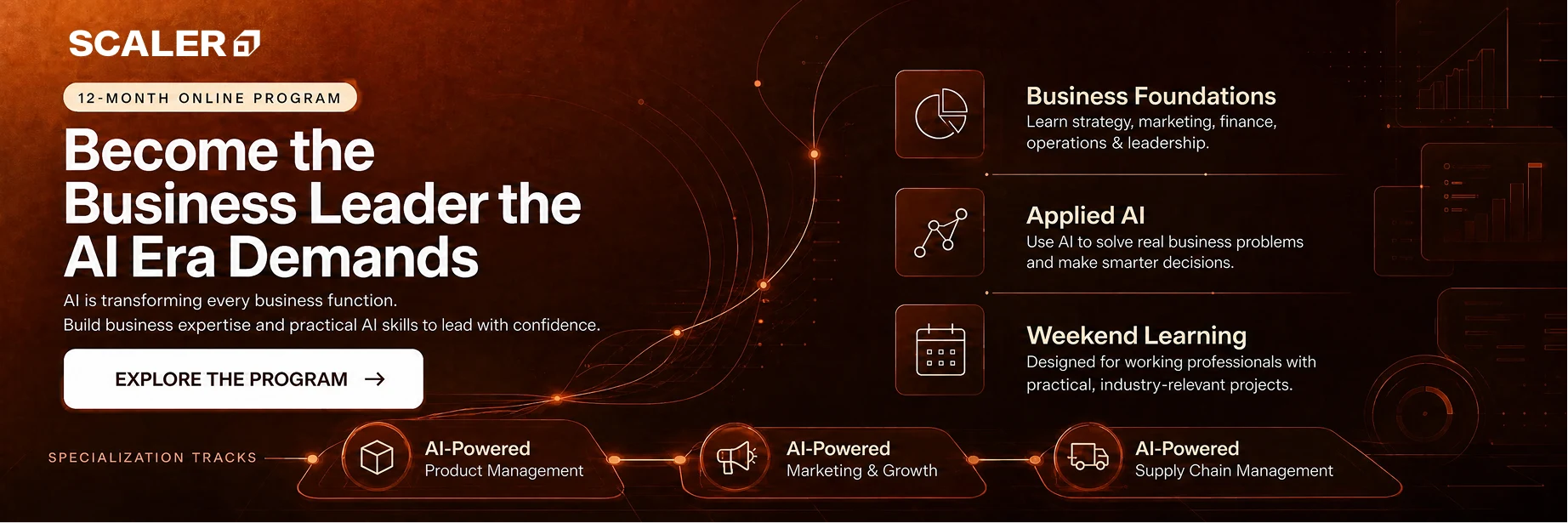
That is the core argument for programs like Scaler’s PGP in Business & AI, structured enough to be credible, applied enough to produce real outcomes, and designed for professionals who cannot spend two years off the job.
→ See what AI tools are actually being used in business workflows now
So: Do You Need an MBA in AI?
It depends on what you actually need.
If your goal is a top-tier consulting or general management track where the MBA brand is itself the asset, and you can afford the time and cost, then yes, an MBA in artificial intelligence from a strong program is worth it.
If your goal is to become genuinely useful in AI-enabled business roles such as product management, analytics, digital transformation, AI strategy, then a shorter, applied business and AI program can get you there faster, cheaper, and without pausing your career. The AI skills business professionals need today are learnable in months, not years. The gap is usually the structure and the accountability to actually build them, not the degree itself.
The MBA still carries weight. But it is no longer the only route and for a growing number of professionals, it is not even the best one.
Frequently Asked Questions
What is an MBA in AI?
An MBA in AI is a postgraduate management degree, typically two years, that combines standard business curriculum (strategy, finance, operations) with AI, data science, and analytics modules. It is designed for professionals who want business leadership credentials with applied AI knowledge, rather than technical AI engineering skills.
Who is an MBA in AI best for?
It is best for professionals targeting roles where the MBA brand matters specifically, from top consulting firms, large enterprise leadership tracks, to roles where the network and prestige of a named institution are part of the value proposition. If the target role cares more about demonstrated AI skill than degree brand, shorter programs are usually more efficient.
How does an MBA in AI compare to a shorter business and AI program?
An MBA takes 18–24 months, costs significantly more, and delivers a full academic credential. A structured PGP or business and AI program takes 6–12 months, costs less, and focuses on applied skills and projects. The MBA wins on brand and network. The shorter program wins on speed, cost, and direct skill application. The right choice depends on what your target roles actually value.
What AI skills do business professionals need today?
The practical list starts with AI fluency (understanding what AI can and cannot do), prompt engineering for business workflows, data interpretation, AI strategy and ethics, and ends with, working knowledge of current AI tools. None of these require deep technical training, they only require the right structured practice and real project experience.
Can I break into AI management without a full MBA?
Yes. Many AI product managers, analytics leads, digital transformation managers, and AI strategy professionals do not have MBAs. What they have is a combination of relevant experience, demonstrated AI skills, and often a structured program credential that shows they built those skills intentionally. The MBA is one path. It is not the only one.
