




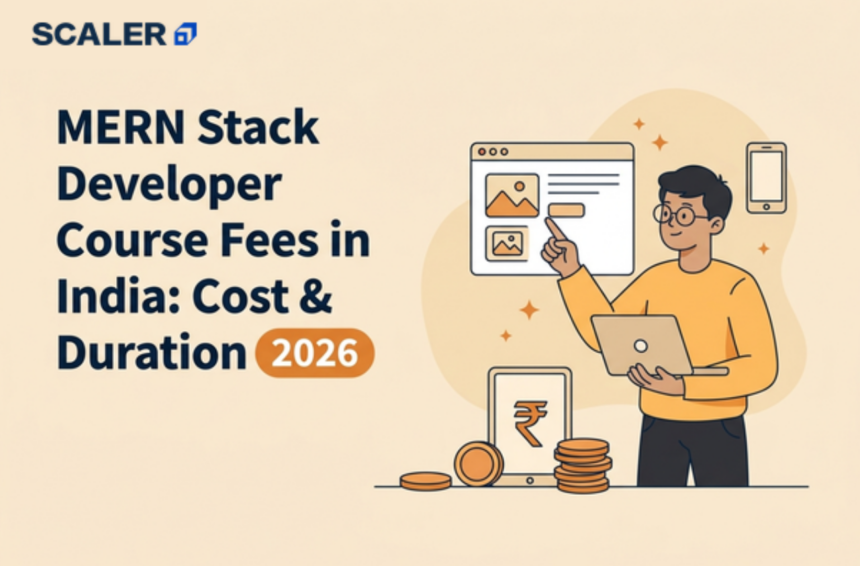
MERN stack developer course fees in India range from zero to over 25 lakh INR, and most comparison articles miss the detail that matters: MERN is four technologies stitched together (MongoDB, Express, React, Node.js), and the fee you pay depends heavily on how many of those four the course actually covers properly. A 5,000-rupee course that teaches React basics and skips deployment is not the same product as a 3.5-lakh programme that takes you through all four layers plus production deployment plus placement support. Comparing their fees without understanding this is like comparing car prices without knowing how many wheels are included.
This guide gives you honest fee ranges by format, separates free from paid paths, explains what drives the price, and frames the salary ROI. For the full career path, see the MERN stack roadmap.
To explore structured programmes, visit the full-stack developer course.
MERN Stack Developer Course Fees in India at a Glance (2026 Ranges)
| Tier | Format | Fee Range (INR) | What You Get | Best For | Key Limitation |
| 0 | Free, Self-Directed | 0 | Reference articles (e.g., React tutorials on Scaler Topics) | Looking up concepts; exploring before committing | No curriculum, certificate, projects, or feedback |
| 1 | Free-to-Low-Cost Self-Paced | 0-8,000 | Structured modules, video lessons, challenges, certificate (e.g., Free React JS Course at 0 INR; paid equivalents up to ~8,000) | Beginners wanting a cheap, structured introduction | Foundations only – no Node, MongoDB, or full-stack deployment |
| 2 | Structured Online | 8,000-50,000 | Guided curriculum, auto-graded quizzes, 1-2 small projects, light doubt support | Learners wanting guided structure at moderate cost | You learn React; you don’t become a MERN developer |
| 3 | Instructor-Led Structured Learning | 50,000-2,50,000 | Live instruction, mentor-reviewed projects, career support; MongoDB + Express + React + Node + deployment | Career-focused learners needing accountability | Huge quality variance – worst ones are recorded courses with a Slack channel |
| 3-ISA | Pay-After-Placement | 0 upfront (% of salary post-placement) | Same as Tier 3, deferred payment | Learners who can’t pay upfront | Can cost more than Tier 4 if you land a high salary; read threshold, %, duration, dropout terms |
| 4 | Premium, Outcome-Engineered | 2,50,000-4,50,000 | DSA + system design + AI-integrated full stack, 1:1 MAANG mentorship, 50+ projects, deployed capstones, 300+ hiring partners (Scaler Academy at approximately 3.5-4.0 lakh; EMI from approximately 9,811 INR/month) | Serious career switchers targeting top-tier outcomes | Significant upfront investment |
| 5A | Online Accredited Degrees | 50,000-2,50,000 (total) | UGC-DEB recognised BCA/MCA with web development focus (Manipal ~1.2-1.4L, Amity ~1.5L, IGNOU MCA from ~50K); flexibility while working | Credential on paper for jobs/immigration while working | Tier 3 pricing, but no campus immersion or placement infrastructure – the exception to the price ladder |
| 5B | Campus University Degrees | 4,00,000-25,00,000+ | Full-time UG/PG (govt: 1-2.5L total; private BTech CSE: 8-12L; premium: 20L+; Scaler SST at approximately 18.5L + hostel/mess) | Accredited credential; 18-year-olds choosing a first degree | Wrong choice if the goal is fast employability as a working adult |
Most career switchers invest in Tier 3 or Tier 4. A Tier 1 course teaches you React basics. A Tier 3 programme teaches you to build full-stack applications. A Tier 4 programme teaches you to ship production-ready software, builds a public portfolio, and connects you to hiring managers.
Transform Your Career
Choose from our industry-leading programs designed for career success
Modern Software and AI Engineering Program
Master full-stack development with AI integration


 +1000 more
AI Forward Deployed Engineer with Specialisation in AI applications
Build and deploy AI solutions for real-world business problems
+1000 more
Modern Data Science and ML with specialisation in AI
Advanced data science techniques with AI specialization
+1000 more
Advanced AIML with Specialisation in Agentic AI
Deep dive into AIML with focus on Agentic systems
+1000 more
DevOps, Cloud & AI Platform Engineering
Build and manage AI-powered cloud infrastructure
+1000 more
AI Engineering Advanced Certification by IIT-Roorkee
Premier AI engineering certification from IIT-Roorkee

What’s Included in the Fee? (What You’re Actually Paying For)
The fee difference between tiers reflects cost drivers, and one of them does not benefit you but shows up in the price anyway.
| Cost Driver | What It Means for You | Does It Affect Learning Quality? |
| Curriculum depth | React basics only vs all four MERN layers + deployment + testing | Yes. A course that covers React and skips the backend leaves you unable to build what employers ask for. |
| Full-stack vs frontend-only | Many “MERN” courses are essentially React courses with a MongoDB connection string | Yes. MERN means all four. A course that skimps on Node or Express is not a MERN course. |
| Live vs recorded instruction | Live sessions with practitioners cost providers more | Yes, especially for debugging full-stack issues and reviewing architecture across frontend and backend. |
| Project reviews and feedback | Expert review of your API design and React state management is labour-intensive | Yes. A working app is not the same as a well-architected app. |
| Placement and career support | Resume prep, mock interviews, hiring partner referrals | Indirectly. Affects whether the learning leads somewhere. |
| Provider brand and marketing spend | Some platforms charge more because they can, not because they deliver more | No. Brand awareness is not a proxy for teaching quality. |
Three things separate Tier 1 from Tier 4: project depth (nobody hires you to build a to-do list; they hire you to build applications with auth, databases, and deployment), going beyond React (MERN means MongoDB, Express, and Node too; frontend-only courses are incomplete), and career infrastructure (mock interviews, resume reviews, and hiring networks convert skills into salary).
For React resources, explore Scaler’s React topics. For structured mentorship, see Scaler Academy.
Fees by Format: Free, Self-Paced, Structured Learning & Instructor-Led
Tier 0 – Free, Self-Directed (0 INR): Hub pages like the React tutorials on Scaler Topics and NodeJS tutorials cover fundamentals, hooks, routing, REST APIs, and more. Reference material, not a curriculum. No certificate, no projects, no feedback. Best for developers looking up concepts or beginners exploring before committing.
Tier 1 – Free-to-Low-Cost Self-Paced (0-8,000 INR): For Scaler, this tier maps to free video courses like the Free React JS Course and the NodeJS course – structured modules, video lessons, and guided exercises. Other platforms charge 500-8,000 INR for similar content. The limitation: covers individual technologies. No full-stack integration, no deployment, no architecture. Best for beginners wanting a cheap, structured introduction to React or Node.
Tier 2 – Structured Online (8,000-50,000 INR): Guided curriculum, auto-graded quizzes, 1-2 small projects, light doubt support. You learn React. You do not learn to be a MERN developer. Best for learners wanting guided structure at moderate cost. See the full-stack developer roadmap for the career path.
Tier 3 – Instructor-Led Structured Learning (50,000-2,50,000 INR): Live instruction, real projects with mentor reviews, career support. Covers all four MERN layers: MongoDB (schema design, aggregation), Express (routing, middleware, auth), React (hooks, state management, routing), Node.js (REST APIs, file handling, error handling), plus deployment. The best produce job-ready developers. The worst charge structured learning prices for what is essentially a recorded course with a Slack channel.
Tier 3-ISA – Pay-After-Placement (0 Upfront): You pay nothing upfront and a percentage of salary once placed. Read terms carefully: minimum salary threshold, percentage owed, duration, and dropout clauses. Some ISAs cost more than an upfront Tier 4 programme if you land a high-paying role.
Tier 4 – Premium, Outcome-Engineered (2,50,000-4,50,000 INR): This is where Scaler’s main programme pages sit. Scaler Academy at approximately 3.5-4.0 lakh INR offers: DSA + system design + AI-integrated full stack curriculum, 1:1 mentorship with MAANG engineers, 50+ assignments plus production-deployed capstones, 300+ hiring partners and 1L+ alumni network, lifetime access. EMI from approximately 9,811 INR/month. Scholarships up to 25,000 INR. Mean placement CTC approximately 22.5 LPA. A course that does not cover all four MERN layers and at least one deployed project is incomplete for job readiness, full stop. Explore Scaler Academy and the full-stack developer course.
Tier 5A – Online Accredited Degrees (50,000-2,50,000 INR total): UGC-DEB recognised online BCA or MCA programmes from universities like Manipal, Amity, or IGNOU. These provide a legitimate degree credential while you continue working. The advantage: recognised credential for jobs that require a degree, immigration purposes, or government positions. The trade-off: Tier 3-level pricing with no campus immersion, no placement infrastructure, and no mentorship. This is the exception to the price ladder – you are paying for the credential, not the learning experience. Best for working professionals who need a degree on paper to unlock specific opportunities.
Tier 5B – Campus University Degrees (4,00,000-25,00,000+ INR): Right choice if you need an accredited credential. Wrong choice if your goal is to become employable fast. The Scaler School of Technology bridges the gap: 4-year UG programme, industry-designed AI-integrated curriculum, production projects every semester, dedicated placement cell. Tuition approximately 18.5 lakh INR plus hostel and mess.
What the Stack Covers (MongoDB, Express, React, Node)
MERN is four technologies that work together. The fee you pay should cover all four, but many courses only properly teach one or two. Here is what each layer contributes and what employers actually test for.
| Layer | Technology | What It Covers | Self-Study Difficulty | Employability Impact |
| M – Database | MongoDB | Schema design, CRUD, aggregation pipeline, indexing, Mongoose ODM | Medium | High. Most full-stack postings expect NoSQL or SQL. |
| E – Backend framework | Express.js | Routing, middleware, authentication, error handling, file uploads | Medium | High. The backbone of your Node API. |
| R – Frontend library | React | Components, hooks, state management, routing, context/redux | Medium-High | Critical. The most in-demand frontend skill in India. |
| N – Runtime | Node.js | REST APIs, async programming, file system, environment variables | Medium | High. Runs your backend. Expected alongside Express. |
| Full-stack integration | All four together | Connecting frontend to backend, auth flows, deployment | High | Critical. Employers test for end-to-end building, not individual technologies. |
A course that teaches React thoroughly and skimps on Node/Express/MongoDB is a frontend course, not a MERN course, regardless of what the marketing says. Employers test for full-stack integration: can you build an app with auth, connect it to a database, and deploy it? If your course does not cover all four layers working together, it is incomplete for job readiness, full stop.
For React learning, see the Free React JS Course. For Node resources, explore Scaler’s NodeJS topics. Official docs: React and Node.js.
Can You Learn MERN Stack Developer Skills for Free? Low-Cost Paths
Yes, for individual technologies. No, for full-stack job-readiness. The gap between learning React from a free tutorial and building a deployed MERN application with auth, database, and API is significant.
| Resource | What It Covers | Honest Assessment |
| Scaler React tutorials (Tier 0) | Articles on React fundamentals, hooks, routing | Excellent for deep-dives. Not a sequential MERN curriculum. |
| Scaler NodeJS tutorials (Tier 0) | Articles on Node fundamentals, APIs, middleware | Good for backend concepts. Not integrated with frontend. |
| Free React JS Course (Tier 1) | React fundamentals, hooks, components, video lessons | Good starting point for frontend. Does not cover backend or deployment. |
| NodeJS course (Tier 1) | Node fundamentals, REST APIs, video lessons | Good starting point for backend. Does not cover React or deployment. |
| MongoDB University free tier | MongoDB fundamentals, aggregation, schema design | Authoritative and free. No full-stack integration. |
Where free learning struggles: no full-stack integration (learning React and Node separately is not the same as building an app where they communicate), no project feedback (a working app with poor API design looks fine until you try to scale it), and no placement support. That gap is what paid programmes fill.

Free Courses by top Scaler instructors
Hidden Costs and What to Watch For
| Hidden Cost | Typical Amount (INR) | When It Hits |
| Cloud hosting for projects (AWS, GCP, Vercel, Railway) | 0-5,000/month | During and after the course |
| Domain names for portfolio projects | 500-1,500/year | If you host your own portfolio site |
| MongoDB Atlas paid tier | 0-3,000/month | When free tier limits are exceeded |
| EMI interest | 10-15% annualised on some programmes | Adds 15,000-45,000 INR on a 3-lakh course |
| “Placement guarantee” conditions | Refund only if you meet attendance/assignment thresholds | After course ends |
Red flags: “MERN course” that only properly covers React (check the curriculum hours for Node, Express, and MongoDB). “Full-stack” without deployment (running an app on localhost is not full-stack). “Placement guarantee” usually requires 90%+ attendance and minimum assessment scores. Scaler Academy publishes fee structure and EMI terms upfront.
See the full-stack developer roadmap.
Is It Worth It? MERN Stack Developer Salary & Career ROI in India
MERN stack roles are among the most available full-stack positions in India. React dominates the frontend job market, and Node.js is the most common backend runtime at startups and mid-size companies. Salary ranges based on data from AmbitionBox.
| Role | Experience | Salary Range (INR LPA) |
| Junior MERN Developer | 0-2 years | 3.5-7.0 |
| Mid-level MERN Developer | 2-5 years | 7.0-15.0 |
| Senior MERN Developer | 5-8 years | 15.0-28.0 |
| MERN Developer (product company) | 2-5 years | 10.0-22.0 |
Payback periods by tier, assuming the course leads to a developer role:
- Tier 0 (Free): immediate, but outcomes depend on discipline and portfolio quality
- Tier 1 (Self-paced at 3,000 INR): payback in under a month
- Tier 2 (Structured online at 20,000 INR): payback in roughly 1-2 months
- Tier 3 (Instructor-Led at 75,000 INR): payback in about 2-3 months
- Tier 4 (Premium at 3,50,000 INR): payback in about 7-10 months
- Tier 5A (Online accredited degree at 1,50,000 INR): payback varies – the degree itself does not directly increase salary
- Tier 5B (Campus university degree at 5,00,000+ INR): payback in 1-3 years
Product company salaries (10-22 LPA at mid-level) are significantly higher than IT services. For the full syllabus, see the full-stack developer course syllabus. Explore the full-stack developer course.
Scaler Placement Report and Statistics
Scaler learners achieved 2.5x salary growth with average post-Scaler CTC reaching ₹23L.
 Google
 Amazon
 Microsoft
 Flipkart
 Adobe
1200+ more
Adobe
1200+ more
How to Choose a MERN Stack Developer Course Worth the Money
Before paying, check these:
- Does it cover all four MERN layers? A course that teaches React thoroughly and skimps on Node, Express, or MongoDB is a frontend course, not a MERN course. Check the curriculum hours for each layer.
- Does it include full-stack integration projects? Building a React frontend and a Node backend separately is not the same as building an app where they communicate with auth and a shared database.
- Does it cover deployment? Running an app on localhost is not full-stack development. A course without deployment is incomplete for job readiness, full stop.
- Are there real projects with expert feedback? Building a to-do list and having someone review your app with auth, API design, and database schema are different experiences.
- Is placement support real or decorative? Ask for specific numbers: students placed, companies, median salary. Vague answers are a red flag.
- Is the curriculum current? A course that barely mentions React hooks, uses class components, or skips Next.js basics is teaching you to be employable in 2021.
Try the React tutorials on Scaler Topics (Tier 0) and the Free React JS Course (Tier 1) for a few weeks before paying. If you can build a simple full-stack app with React and Node on your own, you may have the discipline for the free path. If not, that tells you whether you need a structured programme.
Explore Scaler Academy and the full-stack developer roadmap.
Scaler Alumni and Their Success Stories
Explore Course Fees & Pricing
FAQs
1.How much does a MERN stack course cost in India?
Anywhere from free to 17,00,000 INR depending on tier. Tier 0 (free hub tutorials like Scaler's React topics) costs 0 INR. Tier 1 free-to-low-cost self-paced courses run 500-8,000 INR (Scaler's Free React JS Course and NodeJS course are free at this tier). Tier 2 structured online programmes sit at 8,000-50,000 INR. Tier 3 instructor-led structured learning costs 50,000-2,50,000 INR. Tier 4 premium outcome-engineered programmes cost 2,50,000-4,50,000 INR (Scaler Academy sits here). Tier 5A online accredited degrees range from 50,000-2,50,000 INR. Tier 5B campus university degrees range from 4,00,000-25,00,000+ INR (Scaler School of Technology sits here). Most career switchers invest in Tier 3 or Tier 4.
2.Can I learn MERN stack for free?
Yes, genuinely, for individual technologies. No, for full-stack job-readiness. Free resources like Scaler's React tutorials and NodeJS tutorials (Tier 0), plus the Free React JS Course and NodeJS course (Tier 1), can teach you React and Node fundamentals. But free resources rarely cover full-stack integration (connecting frontend to backend with auth and database), deployment, or provide the project feedback and placement support that convert skills into a developer job. Free is a strong starting point. Most people who get hired invest in a structured programme at some point.
3.Is MERN stack still worth learning in 2026?
Yes. React remains the most in-demand frontend skill in India by a wide margin, and Node.js is the dominant backend runtime at startups and mid-size product companies. The JavaScript ecosystem is mature, the job volume is high, and the full-stack JavaScript approach (one language across frontend and backend) reduces the learning curve compared to combining different language stacks. The caveat: frameworks like Next.js are increasingly expected alongside React, and employers want deployment and production experience, not just localhost projects. Learn MERN, then add Next.js.
4.What is a MERN stack developer's salary in India?
A junior MERN developer (0-2 years) earns 3.5-7.0 LPA on average, according to AmbitionBox data. Mid-level developers (2-5 years) earn 7.0-15.0 LPA. Senior developers (5-8 years) earn 15.0-28.0 LPA. Product company salaries are significantly higher (10-22 LPA at mid-level). The real gains come when you combine all four MERN layers with deployment and production project experience.
5.How long does a MERN stack course take?
Tier 1 free-to-low-cost self-paced courses take 2-6 weeks per technology (React or Node individually). Tier 2 structured online courses take 8-16 weeks. Tier 3 instructor-led programmes take 3-6 months. Tier 4 premium programmes require 9-15 months (Scaler Academy runs 9-15 months depending on track). Tier 5B campus university degrees take 3-4 years. Most working professionals complete a Tier 3 programme in 3-4 months with part-time study.
6.MERN or MEAN: which should I learn?
MERN, for most learners. The difference is the frontend: MERN uses React, MEAN uses Angular. React dominates the Indian job market with significantly more postings than Angular, especially at startups and mid-size product companies. Angular is more common in enterprise environments and large IT services companies. If you are choosing today, MERN gives you access to more job openings. If you already know Angular, the backend (MongoDB, Express, Node) is the same in both stacks, so switching is a matter of learning React, not starting over.
