




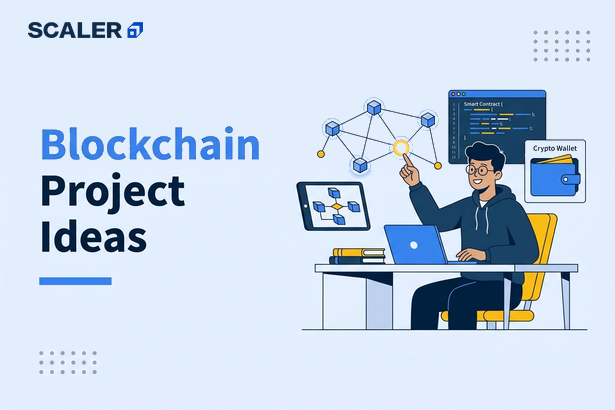
Blockchain may have been primarily used for Bitcoin in 2009, but it has now moved into areas such as digital assets, finance, gaming, payments, and decentralised applications, giving you several ways to apply the technology.
Smart contracts handle the logic behind many of these applications, while standards such as ERC-20 and ERC-721 make it possible to create tokens and digital assets that work with wallets and other applications across the Ethereum ecosystem.
The same technologies appear in blockchain job requirements. Solidity and smart contract development form the foundation, with roles also asking for EVM networks, Web3 integration, wallet connections, testing, and contract security. A project can bring these pieces together in a way that lets you work through the development process itself, from writing and deploying a contract to handling transactions and connecting it to an application.
And with so much scope, you’ll have plenty of room to build a varied blockchain portfolio. The 15 projects in this article cover smart contracts, tokens, wallets, verification systems, and dApps, with the technologies and features involved in each one. You’ll also see how a simpler project can be extended into a more complete application as you take on more of the stack.
Before You Build: Blockchain in 90 Seconds
So, what is a blockchain?
Before you start building, these blockchain basics for projects will help you understand what happens to the data your application puts on-chain. A blockchain is a shared record of transactions that stores information in blocks. Each block contains a list of transactions and a cryptographic reference to the block before it, creating a continuous record. If someone changes an earlier block, its reference changes too, so the network can detect that the record no longer matches the rest of the chain. This is what gives blockchain its immutability: once data becomes part of the confirmed chain, changing it becomes extremely difficult.
Read More At: What is Blockchain?
Transform Your Career
Choose from our industry-leading programs designed for career success
Modern Software and AI Engineering Program
Master full-stack development with AI integration


 +1000 more
AI Forward Deployed Engineer with Specialisation in AI applications
Build and deploy AI solutions for real-world business problems
+1000 more
Modern Data Science and ML with specialisation in AI
Advanced data science techniques with AI specialization
+1000 more
Advanced AIML with Specialisation in Agentic AI
Deep dive into AIML with focus on Agentic systems
+1000 more
DevOps, Cloud & AI Platform Engineering
Build and manage AI-powered cloud infrastructure
+1000 more
AI Engineering Advanced Certification by IIT-Roorkee
Premier AI engineering certification from IIT-Roorkee

How does everyone agree on what gets added to the chain?
That is the job of consensus. The network uses a set of rules to decide which transactions are valid and which block becomes the next part of the chain. Ethereum uses proof of stake, where validators propose and check blocks. Once the network finalises a block, changing its contents requires overcoming the network’s consensus and, in Ethereum’s case, can also lead to the loss of staked funds.
What can you do with this?
You can build applications where the blockchain keeps track of important state and smart contracts control what happens to it. A voting project can record votes and enforce voting rules. A token contract can track balances and transfers. An escrow contract can release funds when predefined conditions are met. These projects use the same basic blockchain properties, shared records, consensus, and difficult-to-change history to handle different problems.
Also Read: What is Cryptography?
The Zero-Cost Setup (2026 Stack)
If you don’t wish to bear any costs just yet, then you can have your Solidity development setup that consists of five parts of blockchain development: writing Solidity contracts, testing and deploying them, connecting a wallet, working on a testnet, and linking the contracts to a frontend.
- Remix: Remix is a browser-based IDE for Solidity development. You can write, compile, deploy, and interact with smart contracts directly from the IDE, making it suitable for the first projects in this guide.
- Hardhat: Hardhat provides a local development environment for projects that need more extensive testing and deployment workflows. Its current toolset includes Solidity and TypeScript testing, debugging, deployment, code coverage, and contract verification.
- MetaMask: Your blockchain applications need a wallet to connect an account and approve transactions. MetaMask provides that connection, allowing you to interact with the contracts and dApps you build.
- Sepolia: Sepolia is Ethereum’s recommended testnet for application development. Sepolia faucets provide free test ETH, which you can use for contract deployments and transactions while working through the projects.
- ethers.js: Once a project has a JavaScript frontend, Ethers.js connects the application with the deployed contracts. It lets you read blockchain data, call contract functions, and send transactions, making it particularly relevant to the full dApps in Tier 2.
If you follow older blockchain tutorials, check the network they use. Ropsten and Goerli are deprecated, while Sepolia is the current testnet recommended for smart-contract and application development.
DApp frontends use JavaScript, so you can brush up on the language with Scaler’s free JavaScript for Beginners course.
Tier 1: Smart Contract Fundamentals (Projects 1-5)
Solidity is used to write the logic that runs inside a smart contract that runs on compatible blockchain networks. The projects in this section cover a simple message contract, an ETH bank or vault, an ERC-20 token, a voting system, and an escrow contract. Together, they cover state variables, functions, mappings, events, Ether transfers, token allowances, access control, and contract states.
You can keep this Solidity documentation nearby while working through the projects.
1. Hello-Chain Contract
A message contract can store a value on the blockchain and restrict who can change it. Store a message such as Hello, Blockchain! and let the contract owner update it.
Use a string state variable for the message and a function for updates. Making the variable public creates a getter automatically. The constructor can store the deployer’s address, while a modifier can restrict the update function to that address. Add an event to record each message change.
The contract covers:
- State variables
- Functions and visibility
- Constructors
- public, view, and external
- Events
- Modifiers
- require statements
Reading the message and changing it are different operations. A view function reads the stored value without changing contract state. Updating the message writes to storage and requires a transaction.
A changeCount variable can track the number of updates. The update event can also include the previous message, the new message, the address that made the change, and the block timestamp.
Gas considerations: Updating the message changes contract storage, so each update requires a state-changing transaction.
2. Bank / Vault Contract
A bank or vault contract can keep a separate ETH balance for each address. Users should be able to deposit funds, check their balance, and withdraw an amount that does not exceed what they have deposited.
A mapping such as mapping(address => uint256) can store each user’s balance. deposit() can add msg.value to the sender’s balance, while withdraw() checks the stored balance before sending ETH back.
The withdrawal function also needs protection against reentrancy. A contract receiving ETH can call back into the vault before the original withdrawal has finished. Update the stored balance before making the external transfer and use the checks-effects-interactions pattern. OpenZeppelin’s ReentrancyGuard can be added to the withdrawal function as another layer of protection.
The Solidity concepts here include:
- mapping
- msg.sender and msg.value
- payable functions
- Ether transfers
- Balance accounting
- Events
- Custom errors or require
- Reentrancy protection
Add deposit and withdrawal events so the frontend can display when funds entered or left the vault. Test cases should include insufficient balances, repeated withdrawals, and attempts to withdraw from another user’s balance.
Gas considerations: Updating a user’s balance writes to contract storage. Deposits and withdrawals therefore cost gas, while checking a balance through a read does not create a state-changing transaction.
3. ERC-20 Token
An ERC-20 token can represent a fungible asset such as a loyalty point, marketplace credit, or in-game currency. The standard defines functions for transferring tokens, checking balances, and giving another address permission to spend tokens.
OpenZeppelin provides an ERC20 implementation with the standard functionality already written. A fixed supply can be minted during deployment and assigned to the deployer. Another version can restrict mint() to an authorised account so new tokens can be created later.
OpenZeppelin also provides extensions for common token features, including ERC20Burnable, ERC20Capped, ERC20Pausable, and ERC20Votes.
The main functions and concepts include:
- transfer
- balanceOf
- approve
- transferFrom
- Balances and allowances
- Transfer and Approval events
- Minting and burning
- Access control
- Token supply and decimals
approve() sets an allowance for another address or contract. transferFrom() can then use that allowance to move tokens on behalf of the token holder. This pattern is used when a marketplace or another smart contract needs permission to spend a user’s tokens.
For a more advanced version, you can add a maximum supply or burning mechanism. ERC20Votes can also connect the token to the voting project by using token holdings as voting power.
Gas considerations: balanceOf() only reads a stored balance. transfer() changes token balances and emits an event, so it requires a state-changing transaction.
4. Voting System
A voting contract needs rules for who can vote, how many times an address can vote, which proposal receives the vote, and when voting closes.
You can create several proposals and record the vote submitted by each address. A mapping can mark whether an address has already voted, while another mapping or an array can store the vote count for each proposal. An enum can represent the voting state, and a deadline can prevent votes after the voting period ends.
The basic version can give each address one vote. A token-based version can use ERC-20 holdings to determine voting power instead. OpenZeppelin’s ERC20Votes extension uses checkpoints to keep track of voting power at different points in time, which matters when token balances change after a proposal has been created.
The implementation involves:
- struct
- enum
- Mappings and arrays
- Boolean state
- Access checks
- Events
- Deadlines
- Vote counting
Test the contract with duplicate votes, votes after the deadline, and addresses that do not meet the eligibility rules. For token-based voting, also check what happens when a user’s token balance changes between proposal creation and voting.
Gas considerations: Store the information required to enforce the voting rules, such as whether an address has voted and the current proposal state. Events can carry information that the frontend needs without storing all of it in contract state.

Free Courses by top Scaler instructors
5. Escrow Contract
An escrow contract can hold ETH between a buyer and seller until the conditions of a transaction are met. The buyer deposits the funds, the seller completes the agreed work, and the contract releases the payment. An arbiter can handle the funds if the buyer and seller enter a dispute.
Use an enum to track the escrow state: Created → Funded → Released / Refunded
Store the buyer, seller, arbiter, and deposited amount. The contract can then restrict each function based on the address calling it. The buyer should be able to fund the escrow, while release and refund functions should only be callable under the conditions defined by the contract. Events can record deposits, releases, refunds, and dispute decisions.
The project covers:
- Multiple participant roles
- enum and contract states
- Access control
- Payable functions
- Ether transfers
- Conditional execution
- Events
- Error handling
A deadline can limit how long the escrow remains active. A dispute window can also give the buyer and seller a defined period to raise an issue before the funds are released. OpenZeppelin’s escrow contracts provide another implementation to study when comparing different approaches to holding and releasing funds.
Gas thinking: Store the buyer, seller, arbiter, amount, and state because they affect what the contract can do next. Agreement details that are not used by the contract do not need to occupy on-chain storage.
Before moving to Tier 2
At this stage, the important Solidity concepts should be clear in the context of an actual contract. The vault uses a mapping to track balances and needs protection around Ether transfers. The token uses allowances when another address needs to spend tokens. Voting uses contract state to enforce eligibility and deadlines, while escrow uses roles and state transitions to control the movement of funds.
The next five projects add the application layer. JavaScript and ethers.js will connect the contracts to a frontend, with wallet connections, contract reads, and user-submitted transactions becoming part of the dApp.
Tier 2: Full DApps (Projects 6-10)
What if you want someone to use the smart contract without opening Remix and calling its functions manually? DApp can help you with that. A dApp combines a smart contract with a frontend that lets users interact with the contract through a wallet. The contract stores the application state and enforces its rules, while JavaScript handles the interface and communicates with the blockchain. Libraries such as ethers.js provide the connection between the frontend, the user’s wallet, and the deployed contract.
The five dApp project ideas in this section cover an on-chain todo list, crowdfunding platform, lottery, NFT mint page, and a basic NFT marketplace. The projects introduce contract reads and writes, wallet connections, transaction handling, events, ERC-721 approvals, and the difference between application state and blockchain state.
For the JavaScript used in these projects, you can refer to Scaler’s JavaScript tutorial.
6. On-Chain Todo List
A todo list normally stores tasks in a database or browser storage. Moving those tasks on-chain means the smart contract becomes responsible for storing the task data and changing its status.
Create a struct for each task with fields such as an ID, description, completion status, and owner. An array can store the tasks, while functions can add a task, mark it as complete, edit its description, or remove it. Events can record these changes so the frontend can update its interface when the contract state changes.
The frontend can use ethers.js to connect to the deployed contract. A read operation can fetch the existing tasks, while adding or updating a task requires a transaction signed by the user’s wallet. In ethers v6, BrowserProvider can connect to an injected wallet such as MetaMask, while a Signer is used for state-changing operations.
The project involves:
- Solidity struct
- Arrays or mappings
- CRUD-style functions
- Events
- Contract ABI
- Contract address
- ethers.js
- Wallet connection
- Read and write operations
- Transaction confirmation
Keep the frontend display tied to the contract state. If a user marks a task as complete, the interface should not permanently show it as completed until the transaction succeeds and the blockchain reflects the change.
Gas considerations: Adding, editing, completing, and deleting tasks change contract storage and require transactions. Reading the task list does not create a state-changing transaction.
If you want to make a more advanced version of this then restrict task updates to the address that created each task. Pagination or filtering can also become useful when the number of stored tasks grows.
7. Crowdfunding Platform
A crowdfunding contract needs to track contributions, the funding target, the campaign deadline, and what happens to the money after the campaign ends. The refund or withdrawal rules should be enforced by the contract rather than left to the frontend.
Create a campaign with a funding target, deadline, beneficiary, and minimum contribution. A mapping can record how much each address has contributed, while the contract keeps track of the total amount raised. Contributions can be accepted through a payable function until the deadline.
Once the target is reached, the campaign creator or beneficiary can withdraw the funds according to the contract rules. If the deadline passes without reaching the target, contributors should be able to claim their funds back.
Events can record contributions, successful funding, withdrawals, and refunds. The frontend can then display the amount raised, contribution progress, deadline, and campaign status from the contract data.
The implementation covers:
- Structs for campaign details
- Mappings for contributor balances
- payable functions
- Funding targets
- Deadlines
- Refund logic
- Access control
- Events
- ethers.js reads and transactions
The frontend should wait for the contribution transaction to be confirmed before updating the displayed amount raised. A failed or reverted transaction should not be treated as a successful contribution. In ethers, a submitted transaction returns a transaction response, and wait() can be used to wait for its receipt.
Gas considerations: Contributions change the contributor’s stored balance and the campaign’s total, so each contribution requires a state-changing transaction. Refunds also require transactions because they change balances and transfer ETH.
Scaler Placement Report and Statistics
Scaler learners achieved 2.5x salary growth with average post-Scaler CTC reaching ₹23L.
 Google
 Amazon
 Microsoft
 Flipkart
 Adobe
1200+ more
Adobe
1200+ more
8. Lottery DApp
A lottery contract has to manage entries, the prize, the closing time, and the selection of a winner. The difficult part is not accepting entries; it is generating a winner that cannot be predicted or manipulated.
For the basic contract, accept an entry fee and store the participating addresses in an array. A defined period can determine when entries close, after which the contract selects a winner and transfers the prize. The frontend can display the entry fee, number of participants, prize amount, and current lottery state.
The contract can cover:
- Entry fees
- payable functions
- Participant arrays
- Prize accounting
- Access control
- Contract states
- Events
- Transaction handling
- Randomness considerations
Do not use block.timestamp, block.number, or another predictable blockchain value as the random source for a lottery involving real value. Blockchain data is visible to participants, so these values do not provide the unpredictability required for a secure winner selection.
For a serious implementation, a verifiable randomness service such as Chainlink VRF can provide randomness designed for smart contracts. Chainlink describes VRF as a verifiable, tamper-proof random number generator for applications such as blockchain gaming and NFTs.
The frontend also needs to account for the randomness request taking time. The lottery may move from accepting entries to waiting for the randomness result and then to announcing the winner, so those states should be visible in the interface.
Gas considerations: Every entry adds an address to the participant list, creating a storage write. A large number of entries can therefore increase the cost of managing the lottery on-chain.
If you want this to seem more complete, then you can add multiple lottery rounds with separate entry and closing periods. Each round should have its own participants, prize, state, and winner so that a completed round cannot be entered or paid out again.
9. NFT Mint Page
An NFT mint page connects an ERC-721 contract to a frontend where users can connect a wallet, view the collection, and mint an NFT. Unlike ERC-20 tokens, ERC-721 tokens are individually identified by token IDs and represent unique assets.
Create an ERC-721 contract with a mint function and a token ID for each NFT. The contract can enforce a mint price and maximum supply, while tokenURI() can associate each token with its metadata. The metadata can contain information such as the name, image, description, and attributes.
OpenZeppelin provides an ERC-721 implementation with functions such as ownerOf(), tokenURI(), approve(), and setApprovalForAll(). Its implementation also includes _safeMint() for minting tokens while checking that a contract recipient can receive ERC-721 tokens.
The frontend can include:
- Wallet connection
- Collection information
- NFT preview
- Mint price
- Mint button
- Transaction status
- Token ID
- Minted NFT details
The JavaScript side uses ethers.js to connect to the wallet, read the contract, and call the mint function. The contract ABI tells ethers.js which functions and events are available and how their inputs and outputs should be encoded and decoded.
A fixed mint price should be enforced by the contract rather than relying only on the frontend. A maximum supply can similarly prevent the collection from exceeding its intended size.
Gas considerations: Minting changes ownership and other contract state, so it requires a transaction and gas. The cost also depends on what the NFT contract stores. Keeping large amounts of metadata directly in contract storage can be much more expensive than storing a URI that points to the metadata.
10. Marketplace-Lite
Once you have the ERC-721 contract working, you can build a marketplace around it. The NFT contract can continue to handle ownership, while a separate marketplace contract can keep track of which tokens are for sale and process the purchase. Your frontend can bring these actions into one interface.
Keep the first version to fixed-price sales. When a seller chooses an NFT, the marketplace needs permission to transfer that specific token, so the seller can approve the marketplace contract through the ERC-721 contract. Store the NFT contract address, token ID, seller address, and asking price with the listing. When another user buys it, the marketplace should verify the payment and then complete both sides of the trade: transfer the NFT to the buyer and send the ETH to the seller.
ERC-721 provides approve() for approving a specific token and setApprovalForAll() for giving an operator permission to manage all of a user's NFTs. The marketplace needs one of these approvals before it can transfer an NFT on behalf of the seller.
The marketplace contract can store:
- NFT contract address
- Token ID
- Seller address
- Listing price
- Listing status
- Sale information
The frontend can display NFTs for sale, prices, seller information, and the connected wallet's ownership. ethers.js can read listing information, call the NFT's approval function, create listings, and submit purchase transactions.
Several checks need to happen before a purchase is completed. The listing should still be active, the seller should still own the NFT, the marketplace should still have permission to transfer it, and the buyer should send the required amount of ETH. Once the purchase succeeds, the listing should become inactive so the same listing cannot be purchased again.
Gas considerations: A basic sale can involve an NFT approval, listing creation, and purchase as separate transactions. Each state-changing step requires gas, so reducing unnecessary on-chain operations can make the marketplace cheaper to use.
Before moving to Tier 3
The dApp project ideas in this section covered the frontend side of blockchain applications, from reading contract data to handling wallet connections and state-changing transactions.
The next tier moves into more complex blockchain projects, where contract security, external services, and application logic need more attention.
Tier 3: Engineering-Signal Projects (Projects 11-15)
The projects in this section deal with problems that come up when a contract has to handle shared control, external data, upgrades, or deliberate attempts to break its logic. These blockchain projects for final year cover a multi-signature wallet, DAO-style governance, an oracle-fed price contract, an upgradeable contract, and a security-audit exercise.
For the cryptography concepts behind digital signatures, refer to this guide to symmetric and asymmetric cryptography.
11. Multi-Signature Wallet
Set up a wallet with three owners and require any two of them to approve a transaction before it can be executed. This gives you a 2-of-3 multi-signature wallet.
Store the owner addresses and approval threshold in the contract. Each transaction can contain the recipient, ETH amount, calldata, and a nonce. One owner can submit a transaction, while the other owners approve it. Once the required approvals have been collected, the wallet can execute the transaction.
Check what happens if the same owner approves a transaction twice. That approval should not count twice. An executed transaction should also not be executable again, and an old signed transaction should not be reusable.
Use a transaction hash to identify each transaction and include a nonce in the data being signed. The contract should verify that each signature belongs to an authorised owner and matches the transaction being executed. Safe's implementation also combines multiple signatures and verifies them against the transaction hash before execution.
The implementation involves:
- Owner addresses
- Approval thresholds
- Transaction hashes
- Nonces
- Signature verification
- ETH transfers
- Access control
- Events
- Replay protection
Start with ETH transfers and then add ERC-20 transfers or calls to another smart contract. The approval mechanism remains the same; only the transaction being approved changes.
Gas considerations: Owners can sign transaction data without sending an on-chain transaction for every approval. The transaction that submits the required signatures and executes the operation requires gas.
12. DAO-Lite Governance
A governance contract needs rules for proposal creation, voting power, quorum, voting periods, and execution.
Use the ERC-20 token from Tier 1 as the governance token and add ERC20Votes to track voting power. Create proposals that contain the contract action to be executed if the vote succeeds, then let token holders vote during a defined period.
ERC20Votes keeps checkpoints of voting power, so a proposal can use the voting power recorded for the relevant point in time instead of the holder's current token balance. This matters when a user transfers tokens after a proposal has been created. OpenZeppelin's Governor system provides modules for voting power, quorum, vote counting, proposal timing, and execution.
Use a timelock if the DAO controls funds or important contract settings. A successful proposal can then be queued and executed only after the required delay. OpenZeppelin's governance contracts provide GovernorTimelockControl for this setup.
The project involves:
- Governance tokens
- Proposal creation
- Voting power
- Vote snapshots
- Quorum
- Voting delay
- Voting period
- Vote counting
- Proposal states
- Proposal execution
- Events
You should also try to give the governance contract something concrete to control. A small treasury can hold ERC-20 tokens, with proposals deciding when those tokens can be transferred and to which address.
Gas considerations: Creating proposals and casting votes change contract state and require transactions. Reading voting power or proposal status can be done off-chain without a user-paid transaction.
13. Oracle-Fed Price Contract
How can a smart contract know the current ETH/USD price if it cannot directly call an exchange or API?
Use an oracle to bring that external data onto the blockchain.
Build a contract that reads an ETH/USD price feed and uses the value in an on-chain calculation. The basic version can return the latest price through a view function. You can then use the price to calculate the USD value of ETH deposited into a vault or check whether a collateral position meets a required value.
Chainlink Data Feeds provide price information through oracle contracts. The feed returns the price along with round and update information, which the contract can check before using the value.
Pay attention to the feed's decimals when using the price in calculations. If the feed and your contract use different levels of precision, scale the values before multiplying or dividing them.
The update time also needs to be checked when the application depends on recent data. A price-feed call can succeed even when the returned value is too old for the calculation you are making.
The implementation involves:
- Oracle contracts
- Contract interfaces
- Price-feed addresses
- Price decimals
- int256 price values
- Round information
- Timestamps
- Stale-data checks
- Contract-to-contract calls
Gas considerations: Reading the price through a view function off-chain does not require a user-paid transaction. If the oracle is called inside a state-changing function, that call becomes part of the transaction.
14. Upgradeable Smart Contract
You can make this to showcase a project that can be used for a bug fix or to add a new feature after a contract is already deployed. An upgradeable proxy keeps the contract address and storage while a separate implementation contract contains the logic. Calls made through the proxy are delegated to the implementation, so the implementation can be replaced without moving the existing state to another address.
Deploy version 1 of a small contract and store some values through the proxy. Then deploy version 2 with an additional function or corrected logic and upgrade the proxy.
Check that:
- The proxy address remains unchanged.
- Values stored through version 1 are still available.
- The new function works.
- Only the authorised account can perform the upgrade.
OpenZeppelin supports Transparent and UUPS proxy patterns. In a UUPS implementation, _authorizeUpgrade() controls access to the upgrade mechanism.
Use an initializer instead of a constructor for state that belongs to the proxy. The proxy and implementation have separate storage, so a constructor in the implementation does not initialise the proxy's state.
Storage layout needs the same care. If version 1 contains owner, balances, and supply in a particular arrangement, version 2 should not reorder or change those existing variables. New state variables should be added after the existing ones so that the implementation continues reading the proxy's storage correctly. OpenZeppelin's upgrade tools can check storage compatibility before an upgrade.
For the upgrade test, store meaningful values through version 1, perform the upgrade, and read those values through version 2. Then test the new functionality separately.
15. Smart Contract Security Audit
Take a deliberately vulnerable smart contract and review it as if it were being prepared for deployment. Find the bugs, reproduce them with tests, and then fix them.
Check the functions that handle Ether transfers, external calls, permissions, signatures, and randomness. Can an external contract call back into a function before its state has been updated? Can an unauthorised address reach an administrative function? Is tx.origin being used for authorization? Can the same signature be submitted more than once?
Solidity's security documentation covers these issues, including reentrancy and the use of tx.origin for authorization. It also recommends the checks-effects-interactions pattern, where state changes are completed before calls to external contracts.
For each finding, record:
- The affected function
- The condition that triggers the bug
- The impact
- The required fix
- A test that reproduces the vulnerability
- A test that confirms the fix
Take a withdrawal function that sends ETH before updating the user's balance. A malicious recipient contract can use that external call to enter the withdrawal function again before the balance has been changed. Solidity's security documentation uses this pattern to demonstrate a reentrancy vulnerability.
Fix the function by completing the required checks and updating the stored balance before making the external call. Then run the attack test again and confirm that the second withdrawal fails.
Signature verification gives you another useful case to audit. Check what was signed, who signed it, and whether the same signature can be submitted again.
The final report should explain the vulnerability, show how the test triggers it, and describe why the fix prevents it. Include both the failing security test and the test that passes after the fix.
Before you finish the portfolio
These final projects cover shared transaction approval, governance, external price data, contract upgrades, and security testing. Keep the contracts and tests together with a short explanation of the architecture and the decisions that affect security.
For blockchain projects for final year, document the important implementation choices alongside the code. The repository should make it possible to see how the contract works, how you tested it, and how you handled the problems specific to the project.
Scaler Alumni and Their Success Stories
Gas Thinking: Why Every Line Costs Money
When a Solidity function runs as a transaction, the user pays for the computation and blockchain resources it consumes. On Ethereum, a basic ETH transfer uses 21,000 gas. The fee is calculated from the gas used and the current base and priority fees. For example, at 10 gwei base fee and a 2 gwei priority fee, 21,000 gas costs 0.000252 ETH.
The bigger difference appears when a contract writes to storage. State variables are stored permanently on-chain, and writing a 32-byte value to a previously empty storage slot can cost 22,100 gas. At 12 gwei, that is about 0.000265 ETH for one storage write.
That is why you should not store data simply because it is convenient. If a value can be calculated when it is needed, or emitted as an event for the frontend instead of being kept as contract state, you can avoid a storage operation. Memory is temporary and is generally much cheaper than persistent storage.
Loops need the same attention. A loop over ten fixed items has a predictable cost. A loop over an array that users can keep growing does not. If a state-changing function has to process hundreds or thousands of entries in one transaction, it can eventually become too expensive to execute.
For gas optimization Solidity, start with the expensive operations: unnecessary storage writes, repeated storage reads, unbounded loops, and data that does not need to be kept on-chain. Then use the compiler optimizer and profile the contract before making readability trade-offs for small savings.
So, it is not really about making the lines as short as possible. It is to make sure the contract is not paying to do work it does not need to do.
The Honest Career Context (and Next Steps)
So, where can you actually use these blockchain projects?
Smart contract development is one route, but current roles also cover blockchain security, infrastructure, tokenisation, custody, and enterprise applications. In India, job listings include work on digital-asset platforms, public and permissioned blockchains, Solidity and DAML smart contracts, and blockchain systems used in financial applications. Some roles combine Solidity with backend development, APIs, oracles, and EVM-based systems rather than treating smart contracts as a standalone skill.
You can also consider Security as a field. A production contract can control assets directly, so security roles involve reviewing contract logic, finding vulnerabilities, writing tests, and checking issues such as reentrancy, access control, signature handling, and gas usage. The projects in Tier 3 give you a starting point for this kind of work rather than stopping at contract deployment.
Enterprise and BFSI work also uses blockchain for areas such as tokenisation, custody, digital assets, and financial infrastructure. These roles often combine blockchain knowledge with the skills you would use elsewhere in software engineering: backend development, APIs, distributed systems, databases, cryptography, and security.
The market itself is volatile, so don't treat Solidity as a guarantee of a particular job title. Build the underlying engineering skills alongside it. If blockchain hiring slows down, knowledge of distributed systems, cryptography, JavaScript, backend development, testing, and security still transfers to other software roles.
For a more detailed blockchain developer career path, see How to Become a Blockchain Developer. You can also explore Scaler Academy if you want to strengthen the broader software engineering skills behind this work.
FAQs
Q1. What blockchain projects can a beginner build?
You can start with a simple Solidity contract in Remix, such as a message contract, then move to a bank or vault and an ERC-20 token. Once you are comfortable with contract state and transactions, you can use Hardhat to build projects such as voting or crowdfunding dApps. You can also test and deploy these projects on Sepolia without using real ETH.
Q2. Do blockchain projects cost money to build?
Not if you are learning and testing on a testnet. Remix, Hardhat, MetaMask, and ethers.js can be used without paying for the tools, while Sepolia test ETH is available through faucets. You only need real ETH when you deploy or transact on a live network, so blockchain projects for students can be built without spending money on mainnet gas.
Q3. What stack should I use for blockchain projects in 2026?
For Solidity projects, you can use Solidity, Remix, or Hardhat, MetaMask, Sepolia, and ethers.js for frontend integration. If you are following an older tutorial, check the network and development tools it uses. Ropsten and Goerli are deprecated, and Truffle has been sunset, so current projects should use the tools and networks supported today.
Q4. Are blockchain projects good for final year?
Yes, particularly when the project demonstrates actual engineering rather than only displaying a blockchain feature. A voting or crowdfunding dApp can include the smart contract, frontend, wallet connection, tests, transaction handling, and a discussion of security considerations. That gives you more to explain during a viva and more useful work to show in your portfolio.
Q5. Is blockchain still worth learning in 2026?
Blockchain is still a specialised field, with work in areas such as smart contract security, infrastructure, tokenisation, digital assets, and enterprise applications. The market is volatile, so it is better to build blockchain skills alongside transferable skills such as distributed systems, cryptography, JavaScript, backend development, testing, and security.
Q6. Do I need to know JavaScript for blockchain development?
You need JavaScript if you want to build the frontend of a dApp. Solidity handles the logic deployed on the blockchain, while JavaScript connects the user interface and wallet to the deployed contract. Libraries such as ethers.js let the frontend read contract data, call functions, and send transactions to the network.
