




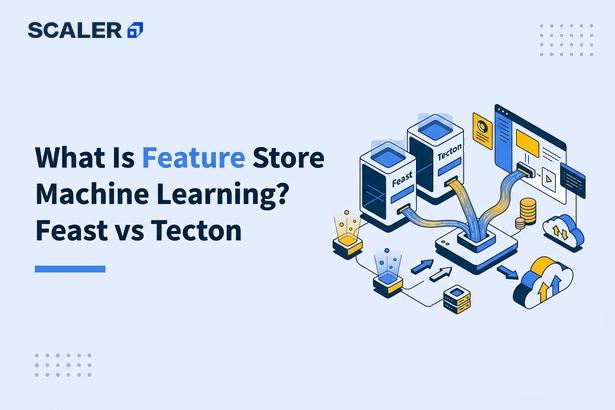
A feature store is a centralized system that helps machine learning teams define, manage, store, and serve features consistently across model training and production inference. Instead of allowing feature logic to remain scattered across notebooks, SQL queries, and application code, a feature store provides a shared layer for feature definitions, historical data, and low-latency serving. This helps reduce training-serving skew, improve feature reuse, and simplify production ML workflows.
A typical feature store uses separate offline and online storage. The offline store provides historical feature values for training, while the online store serves the latest values quickly when a model makes predictions. Feature registries and materialization pipelines connect these layers and keep feature definitions consistent.
Feast and Tecton are two popular approaches. Feast is an open-source option suited to teams that want flexibility and control over their infrastructure, while Tecton is a managed platform designed for real-time, production-focused workloads. Choosing between them depends on factors such as latency requirements, streaming needs, operational capacity, and cost.
Understanding feature stores is also closely connected to Feature engineering in machine learning, because well-designed features need to remain consistent from experimentation through production.
What Is a Feature Store in Machine Learning? Feast vs Tecton Compared
Before a feature store makes sense, it helps to be clear on what is feature engineering in the first place. Feature engineering in machine learning is the process of transforming raw data into the input variables, features, that a model actually trains on. A raw timestamp might become ‘day of week’ and ‘hour of day’; a customer’s raw transaction history might become ‘average purchase value over the last 7 days.’
Feature engineering is often the single highest-leverage part of building a good model, a well-engineered feature can matter more to accuracy than switching to a fancier algorithm. But engineering a feature once, for one model, in one notebook, is only half the problem. The moment you need that same feature to power a live production model, consistently, at low latency, for every new prediction request, you run into an operational challenge that feature engineering alone doesn’t solve. That’s precisely the gap a feature store exists to close.
What Is a Feature Store, and Why Does It Exist?
A feature store is a centralized repository for storing, managing, and serving machine learning features. It sits between your raw data sources and your ML models, providing one consistent layer where data scientists and engineers define, compute, and retrieve features, instead of every team and every model reinventing that pipeline independently.
A feature store machine learning team adopts typically solves two related but distinct problems, both stemming from the same root cause: feature logic that lives in disconnected places.
The Core Problem: Training-Serving Skew
The single most cited reason teams adopt a feature store is training-serving skew. During model training, a feature might be computed via a batch SQL query or a Python notebook. At inference time, in production, that same feature often gets recomputed by an entirely different code path, a real-time API call, a different service, written by a different engineer, possibly months later.
How training-serving skew actually breaks a model:
The training pipeline computes ‘average order value’ using a slightly different date-window definition than the production serving pipeline. The model trained on one distribution, but is now scoring live traffic on a subtly different one. No error is thrown, the model just quietly performs worse than its offline evaluation predicted, and nobody notices until business metrics slip.
A feature store machine learning pipeline addresses this by putting both training and serving behind the exact same feature definition and the same underlying API, there’s no second, drifted code path for the skew to hide in. A closely related second problem is feature reuse: without a shared feature store, competing teams often compute the same feature (say, a customer’s 7-day purchase count) separately and inconsistently, when a shared, versioned definition would prevent the duplication entirely.
Build Production-Ready Machine Learning Systems
Take your machine learning skills further with Scaler’s Data Science & ML Program. Learn feature engineering, MLOps, and production ML workflows through hands-on projects and industry-focused learning.
How a Feature Store Machine Learning Pipeline Actually Works
Every modern ml feature store, regardless of vendor, is built around the same core architecture, two storage layers serving two very different access patterns:
| Component | Purpose | Typical Technology |
| Offline store | Historical feature values for training, supports large batch reads | Data warehouse (BigQuery, Snowflake, S3 + Parquet) |
| Online store | Low-latency lookups for live inference, supports single-key reads | Redis, DynamoDB, or a specialized key-value store |
| Registry | The shared, versioned definitions of every feature | A metadata service tracking ownership, lineage, and schema |
| Materialization | The job that computes features and writes them into both stores | Batch jobs (Spark) or streaming jobs (Kafka/Flink) |
A model training job reads from the offline store to build a full historical dataset; the same model in production reads from the online store for a single, fast lookup at prediction time, both pulling from the exact same underlying feature definitions in the registry, which is precisely what eliminates training-serving skew.
Feast: The Open-Source Standard
Feast (short for Feature Store) is the leading open-source feature store, designed around a code-first philosophy: features are defined in Python, decoupling your ML models from any specific storage or compute backend so teams can plug it into infrastructure they already run.
- Feast 0.10 (2026) added enhanced streaming data source support, improved data governance, and better integration with Azure and AWS
- Benchmarked performance is strong when paired with Redis as the online store, a Java gRPC server plus Redis has shown notably lower latency than alternative online-store configurations like Google Cloud Datastore or DynamoDB in cited 2026 tests
- Feast is fully self-hosted, giving complete control over infrastructure and cost, but that control comes with real operational responsibility; one 2026 industry estimate puts the ongoing maintenance burden at roughly 0.3 FTE for running Feast well in production
- Best fit: teams with engineering bandwidth who want open-source flexibility, cost control, and no vendor lock-in, less ideal if you need first-class streaming or a polished, ready-made user interface
Tecton: The Managed, Real-Time Platform
Tecton is the leading managed feature store, built by the team that previously built Uber’s Michelangelo ML platform, and that lineage shows clearly in Tecton’s product design, which treats real-time, streaming features as a first-class concern rather than an afterthought.
- Stream processing is native: point a transformation directly at a Kafka or Kinesis topic, and Tecton handles ingestion, computation, and serving, with a meaningfully different latency profile for freshness-sensitive features compared to Feast’s more batch-oriented default
- Feature monitoring is built in: freshness alerts, data quality checks, and drift detection come out of the box, rather than needing to be assembled separately
- Vendor-reported serving latency: sub-10ms p99, positioned as essential for latency-sensitive use cases like real-time fraud detection, dynamic pricing, and, increasingly in 2026, RAG retrieval and agentic AI tool-calling context
- Best fit: enterprises needing rapid time-to-production, guaranteed SLAs, and genuinely real-time feature freshness, where the cost of a managed platform is justified by reduced operational risk
Feast vs Tecton: Direct Comparison
| Dimension | Feast | Tecton |
| Model | Open-source, self-hosted | Fully managed, commercial |
| Streaming support | Added in 0.10 (2026), less mature | First-class, native from the ground up |
| Operational burden | High, real MLOps expertise required (~0.3 FTE) | Low, the platform handles infrastructure |
| Latency profile | Strong with Redis, but requires tuning | Sub-10ms p99 out of the box (vendor-reported) |
| Monitoring | Not built in, assemble separately | Freshness, quality, and drift monitoring included |
| Cost model | Pay for your own infrastructure directly | Platform subscription plus usage |
| Best for | Cost-sensitive teams with engineering capacity | Real-time, mission-critical use cases needing SLAs |
The clearest way to frame the decision: if your priority is cost control, open-source flexibility, and avoiding vendor lock-in, and you have the engineering bandwidth to operate it, Feast is the stronger fit. If your priority is rapid time-to-production and guaranteed reliability for a mission-critical, freshness-sensitive use case, Tecton’s managed model reduces operational risk in a way that’s hard to replicate cheaply in-house.
Other Options Worth Knowing
- Hopsworks: positioned as the middle ground, more capable than Feast out of the box, significantly cheaper than Tecton, available either self-hosted or as a managed service (Hopsworks.ai)
- Vertex AI Feature Store / Amazon SageMaker Feature Store: cloud-native options tightly integrated with their respective ecosystems (GCP, AWS), a natural default if your ML infrastructure already lives entirely within one cloud provider
- Databricks Feature Store: a strong fit specifically for teams already standardised on the Databricks/Spark ecosystem for their broader data platform
Which Should You Choose?
The right ml feature store depends less on a feature checklist and more on two honest questions: how real-time do your features genuinely need to be, and how much operational capacity does your team actually have to run infrastructure?
- Choose Feast if you’re cost-sensitive, want full control, and your features are mostly batch-computed with occasional streaming needs
- Choose Tecton if your use case is genuinely latency-sensitive (fraud detection, dynamic pricing, real-time personalisation) and you’d rather pay for a managed SLA than build that reliability yourself
- Choose Hopsworks if you want more capability than Feast without Tecton’s price tag, and are comfortable with a less mature but actively developing ecosystem
- Choose your cloud provider’s native option if your entire ML stack already lives in one cloud and minimising integration friction matters more than cross-cloud portability
Ready to Build Production ML Systems?
Scaler’s Data Science & ML Program covers feature engineering, MLOps, and production ML infrastructure hands-on, with real projects and 1:1 mentorship from engineers building ML systems at scale.
FAQs: Feature Store Machine Learning
Q1. What is a feature store in machine learning?
A feature store machine learning teams use is a centralized system for storing, managing, and serving features consistently across both model training and production inference.
Q2. What is feature engineering in machine learning?
What is feature engineering: the process of transforming raw data into the input variables a model trains on, often the highest-leverage step in building an accurate model.
Q3. What is Tecton used for?
Tecton is used as a fully managed feature store with first-class streaming support and sub-10ms serving latency, built for real-time, mission-critical ML use cases.
Q4. Should I use Feast or Tecton for my ML pipeline?
Use Feast if you want open-source flexibility and cost control with the engineering bandwidth to run it; use Tecton if you need guaranteed real-time performance and are willing to pay for a managed platform.
Q5. What problem does a feature store actually solve?
A feature store primarily solves training-serving skew, where feature logic used during training and during live inference drift apart, plus feature duplication across teams.
Q6. Is an ml feature store necessary for every machine learning project?
No, an ml feature store earns its complexity once you have multiple models or teams sharing features, or a production system where feature freshness and consistency genuinely matter; smaller, single-model projects can often skip it.
