MBA for Non-Tech
Career Options After BA: Jobs, Study & How to Choose
Explore the best career options after BA, including jobs, higher studies, certifications, government exams and entrepreneurship, with guidance on choosing the right path based on your strengths, skills and timeline.
Team SSB
5 min. read

If you have a BA, you have almost certainly heard some version of the same discouraging line: that arts is a “no scope” degree, that engineers go into tech and commerce grads go into finance while you are left with nothing. It is worth saying plainly, at the very start, that this is wrong. The pessimism confuses two different things: scope, of which a BA has plenty, and readiness, which is where the real work lies.
The honest picture is that career options after BA are wide and genuinely strong, spanning corporate roles, government service, media, law, teaching and more, and the difficulty is not a lack of paths but choosing among them and adding the skills that turn a degree into a job. This guide maps the five broad routes open to you, shows what each looks like for an arts graduate specifically, and then helps you narrow them down, so you leave with a direction rather than a longer list.
At a glance. A BA opens five routes: a job now, higher studies, professional certifications, government and competitive exams, and entrepreneurship. The “no scope” story is a myth, the scope is real. What separates graduates who do well from those who stall is not the degree but the skill they add on top of it: writing, digital marketing, data literacy, a portfolio of real work. |
The Five Routes After BA
Rather than face a flat list of a dozen jobs, it helps to see your options as five clear directions. Almost everything open to a BA graduate falls into one of them, and naming them makes the choice far less daunting.
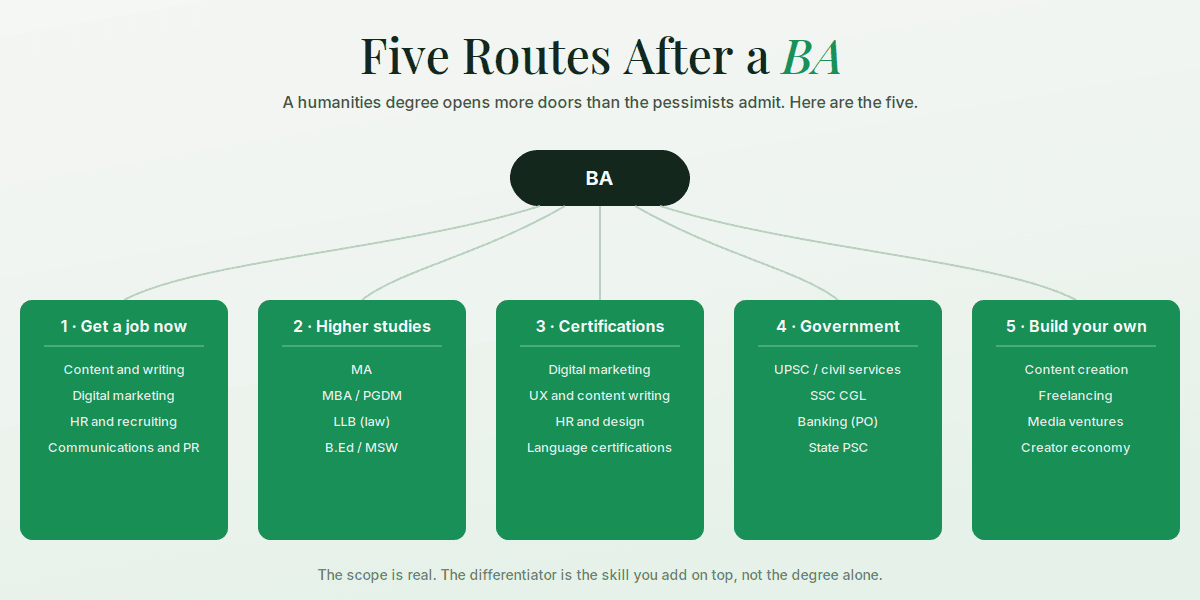
Those five directions are: taking a job straight away, going on to higher study, adding a professional certification, sitting for government and competitive exams, or building something independent of your own. Each is walked through below with the roles and requirements that apply to an arts graduate, before we turn to how you choose between them.
Route by Route, What Each Looks Like After BA
Route 1: Get a job now
A BA graduate is more employable straight away than the “no scope” story suggests, precisely because a humanities degree trains the thing most workplaces run on: communication. The strongest immediate roles play to that.
Content and writing. Content writer, copywriter and editor roles across companies, agencies and media. Strong language skills plus a small portfolio and basic search-optimization knowledge are often enough to start, no further degree required.
Digital marketing. Social media, SEO, performance and content-marketing roles, one of the fastest on-ramps for a BA graduate. A three-to-six-month certification plus a portfolio lands the first job, and pay grows quickly with results.
HR and recruiting. Recruiter, HR executive and people-operations roles suit graduates who are good with people and organization, a natural fit for many arts backgrounds.
Communications and PR. Public relations, corporate communications and brand-communication roles reward exactly the writing and persuasion an arts degree builds, and often pay better than entry-level journalism.
The honest catch. On its own, a BA with nothing attached is harder to place than the prospectus lets on, and that, not the degree itself, is what people really mean by "no scope." The graduates who move fast are the ones carrying proof: a folder of published writing, a completed marketing course, a project someone actually used. Throughout this guide, that added skill, not the degree, is the thing doing the work. |
Route 2: Higher studies
If you want to deepen your subject or change direction, further study is a strong route, and a BA feeds several of them naturally.
MA. It deepens your subject, English, history, political science, psychology, toward academia, research or subject-specialist roles, and is the standard step toward college teaching alongside the NET exam.
MBA or PGDM. The corporate pivot, and a genuinely powerful one for a BA graduate, especially into HR, marketing and communications where humanities strengths shine. Your undergraduate subject matters far less than most people assume. It is worth understanding how a PGDM differs from an MBA before choosing, and if a national entrance exam is your worry, there are recognized routes to an MBA without CAT as well.
LLB (law). A three-year law degree after a BA, a natural progression for political-science, economics and English graduates, opening corporate law, litigation and legal-advisory careers.
B.Ed or MSW. A B.Ed leads to school teaching; a Master of Social Work leads into the NGO and development sector, a strong fit for sociology and psychology graduates.

Route 3: Professional courses and certifications
Often the fastest way to convert a BA into a job, a focused certification takes months rather than years and targets exactly what employers test for. The strongest options for an arts graduate include digital marketing (which pairs naturally with communication strengths and can lead toward roles like business analyst or marketing analyst), UX and content writing, HR certifications, graphic and UI-UX design for the creatively inclined, and language certifications for those with a foreign-language background. Each adds a practical, job-ready layer on top of the degree you already hold.
Route 4: Government and competitive exams
This is one of the genuine strengths of a BA, not a filler option, because the humanities curriculum aligns closely with what these exams actually test.
Civil services. The UPSC Civil Services Examination for IAS, IPS and IFS roles is arguably where a BA graduate has a real edge: history, polity and economics, core to many arts degrees, map directly onto the syllabus. State PSC exams open state administrative posts on the same strengths.
Staff selection. SSC CGL opens roles like income-tax inspector and assistant section officer across central ministries, valuing the comprehension and reasoning a BA builds.
Banking. IBPS PO, SBI PO and RBI Grade B are open to any graduate and offer stable, well-paid careers with clear progression from probationary officer upward.
Route 5: Entrepreneurship and independent paths
A communication-strong graduate is unusually well placed for the independent economy, where the ability to write, tell a story and understand an audience is the product itself. Content creation, freelancing in writing or design or social media, and building a small media or services venture are all real paths, and the creator economy in particular rewards exactly what an arts degree sharpens. For those who want to add a business and network layer to an idea, an MBA for entrepreneurs is one option, though many start simply with a skill and an audience.
Job Now, or Study More?
This is the fork most people skip, and for a BA graduate it deserves an honest answer rather than a default.
A job now makes sense more often than the pessimists suggest. If you can pair your degree with a short, practical skill, a digital-marketing certification, a writing portfolio, an HR course, you can start earning and building experience within months, not years. Starting work does not close the study door; many people do an MBA or a specialized master’s later, with a clearer goal and sometimes an employer’s backing.
More study makes sense when the path you want requires it: law needs an LLB, college teaching needs an MA and NET, a clean corporate pivot is often smoother with an MBA, and academia needs a research degree. Study is worth it when it is the actual gate to where you want to go, rather than a way to postpone deciding.
Here is the part the "study more" advice keeps skirting: an arts graduate who can show one real skill is in a stronger position than one who stacks a second qualification on top of the first and still has nothing to demonstrate. Further study is valuable when it builds something you can show and use, not when it is simply more time in a classroom.
How to Choose Your Path: A Filter
With five routes in front of you, the way to narrow them is to answer a few honest questions. Each one points toward some routes and away from others.
Are your strengths communication and creativity, people, or analysis? Writing and creativity point to content, marketing and media; people point to HR and communications; analysis and comprehension point to civil services, banking and law.
Stability, or growth and creativity? If security matters most, the government route is built for it. If you want faster growth or creative work, private-sector and independent paths fit better.
Use your subject, or pivot? Staying with your subject favors an MA, teaching or civil services; pivoting favors an MBA, a marketing or design certification, or a startup.
Earn now, or build credentials first? If you can add a quick skill and want income and experience, a job now is defensible. If your goal genuinely requires a further qualification, study first.
Do you want to argue your value, or demonstrate it? If you would rather show real work, a portfolio, a project, a result, than defend a humanities background on paper, lean toward the skill-and-portfolio routes and roles that hire on demonstrated ability.
Answer these and the five routes usually narrow to one or two that genuinely fit, which is a far better starting point than a list of everything an arts graduate could theoretically do.
Salaries at a Glance
What a BA graduate earns swings hard on role, added skill and city, so read the figures below as rough starting points, not fixed rates, and trust a role's typical middle far more than its headline high.
Route / role | Indicative entry range (India) | Notes |
|---|---|---|
Content, writing, PR | ~₹2.5–5 LPA | Rises fast with a strong portfolio |
Digital marketing | ~₹3–6 LPA | Grows quickly with results |
HR and communications | ~₹3–5 LPA | Higher with an MBA in HR |
Government and banking | ~₹4–10 LPA | Plus security and allowances |
Post MBA / LLB | ~₹4 LPA and up | Wide range; tier- and firm-dependent |
The pattern is consistent across routes: the graduates who added a demonstrable skill, a portfolio, a certification, a cleared exam, out-earn those who relied on the degree alone, whichever path they chose.
The Skills That Actually Get You Hired
If you take one idea from this guide, take this one, because it is also the honest answer to the “no scope” myth. The recurring finding in India's graduate-employability research is a blunt one: roughly half of graduates are rated job-ready, and what holds the rest back is almost never the degree, it is having no concrete skill to show for it. For an arts graduate, that gap is also the easiest to close, because the foundational strength, communication, is already there.
In practice that means concrete, showable skills: writing and a content portfolio; a digital-marketing certification and a live campaign; basic data literacy for the analytically inclined; design tools for the creative; a cleared exam for the government track. A focused three-to-six-month certification plus a small body of real work moves an arts graduate past most of the field faster than another untargeted year of study. If your aim is corporate growth specifically, our guide to using an MBA for career growth covers how the management route compounds those skills.
If your aim is to move firmly into business, management or product rather than stay on a creative or administrative track, one newer kind of program is worth knowing about: the sort that admits on your profile rather than an entrance exam and puts you to work building and running real ventures instead of studying them. For a humanities graduate, that converts communication and people strengths into results you can point to rather than assert. Scaler School of Business is one example, an 18-month, build-first program in Management and Technology in Bengaluru. It grants a PGP certificate, not a UGC degree, so it fits people who would rather be judged on what they can do than on a formal qualification, and it sits alongside the routes above as one option, not the answer. For an arts graduate specifically, a build-first model settles the "can you actually operate?" question more directly than another lecture-based course does.

Frequently Asked Questions
Q1. Is a BA really a “no scope” degree?
A: No. That reputation confuses scope with readiness. A BA opens genuinely strong paths in corporate roles, government service, media, law and teaching. What the pessimism is really pointing at is the skills gap: a bare degree with nothing added is hard to place, but a BA paired with a demonstrable skill competes very well.
Q2. Can I get a job immediately after a BA?
A: Yes. Content writing, digital marketing, HR and recruiting, communications and customer-facing roles are open to fresh BA graduates, especially with strong communication and a small portfolio. A short certification often turns the degree into a job within months, no further degree required.
Q3. Which BA subject has the best scope?
A: Economics and political science lean toward analysis, civil services and law; psychology and sociology toward HR, social work and counseling-adjacent roles; English and mass communication toward media, content and PR. That said, scope depends more on the skills you add than on the subject alone.
Q4. What can I do after a BA without further study?
A: A great deal: content and copywriting, digital marketing, social media, HR and recruiting, PR and communications, and preparation for government and banking exams, all open to a fresh graduate. A focused certification rather than a full degree is often enough to become job-ready quickly.
Q5. What government jobs can I get after a BA?
A: A BA makes you eligible for UPSC Civil Services, SSC CGL, and banking exams like IBPS and SBI PO, all open to any graduate. The civil-services route is a genuine BA strength, since the history, polity and economics in many arts degrees align closely with the syllabus.
Q6. Should I do an MA, an MBA or an LLB after a BA?
A: It depends on your goal. Choose an MA to deepen your subject toward academia or teaching, an MBA or PGDM to pivot into corporate management, marketing or HR, and an LLB to move into law. Match the qualification to the direction you want, not to which sounds most impressive.
Q7. What is the average salary after a BA?
A: It varies widely by role and skill. Entry-level content, HR and communications roles often start around ₹2.5 to ₹5 LPA, digital marketing a little higher, and government and post-MBA roles higher still. In every route, added skills and a track record raise the figure well above the base.
Q8. Can I switch to a corporate or business career after a BA?
A: Yes, and many do. An MBA or PGDM opens management, marketing and HR roles; digital and analytics certifications open data and marketing careers; and profile-based, build-first programs let you demonstrate business capability directly. A humanities background is a foundation to build on, not a barrier.
The Bottom Line
The “no scope” story about a BA is simply wrong. The options are wide, corporate, government, media, law, teaching and more, and the real task is not finding a path but choosing among them and adding the skill that makes your chosen one real. Let your strengths and your timeline point you toward one or two of the five routes, decide honestly whether to earn now or study more, and then commit to building something you can show. A BA is a genuine foundation. What you build on it is what turns it into a career, and that has always been within your control, not your critics’.
Non-IIM MBA
Top Non-IIM MBA Colleges in Bangalore (2026): Fees, Placements & How to Choose
5 min. read
MBA for Professionals
Is an MBA Worth It for Working Professionals? An Honest 2026 Guide
5 min. read

MBA for Engineers
MBA After B.Tech (2026): Eligibility, Specializations, Salary & Is It Worth It?
5 min. read
MBA for Engineers
MBA After Engineering (2026): Eligibility, Specializations, Salary & Is It Worth It?
5 min. read