MBA for Professionals
Career Options After Graduation: Jobs, Higher Study, Salaries and How to Choose
Most articles quote an average MBA salary, but the reality is far more nuanced. Your salary after an MBA in India depends on factors like your business school, specialization, prior work experience, skills, location, and the role you land. This guide breaks down what you can realistically expect at different career stages, explains why salaries vary so widely, and helps you understand what actually drives earning potential after an MBA.
Team SSB
5 min. read

Some graduates seem to have always known what came next. If you are not one of them, and you have finished your degree facing the entire field of options at once with no obvious direction, this guide is written for you. And it starts with a genuinely freeing idea: in 2026, what you studied matters far less than it used to.
Your degree opened the door, but it no longer dictates which room you walk into. The highest-growth paths, technology, data, product, digital, management, government, are increasingly open to graduates of any stream who build the right skill. That is why the real question is less “what did I study” and more “what am I good at, and where do I want to go.” This guide maps the five broad routes open to any graduate, helps you narrow them by your own aptitude rather than your stream, and points you to more specific guidance where your background does give you an edge.
At a glance. Every graduate has five routes: a job now, higher studies, professional certifications, government and competitive exams, and entrepreneurship. The defining reality of 2026 is that stream matters less than skill: only around half of graduates are rated job-ready, and the ones who do well are those who picked a direction and built a demonstrable skill for it. If you already know your stream, the degree-specific guides linked below go deeper.
The Five Routes After Graduation
Rather than sorting options by stream, which does not help if you are switching direction or unsure, it is clearer to see them as five routes open to any graduate. Nearly every path falls into one of them.
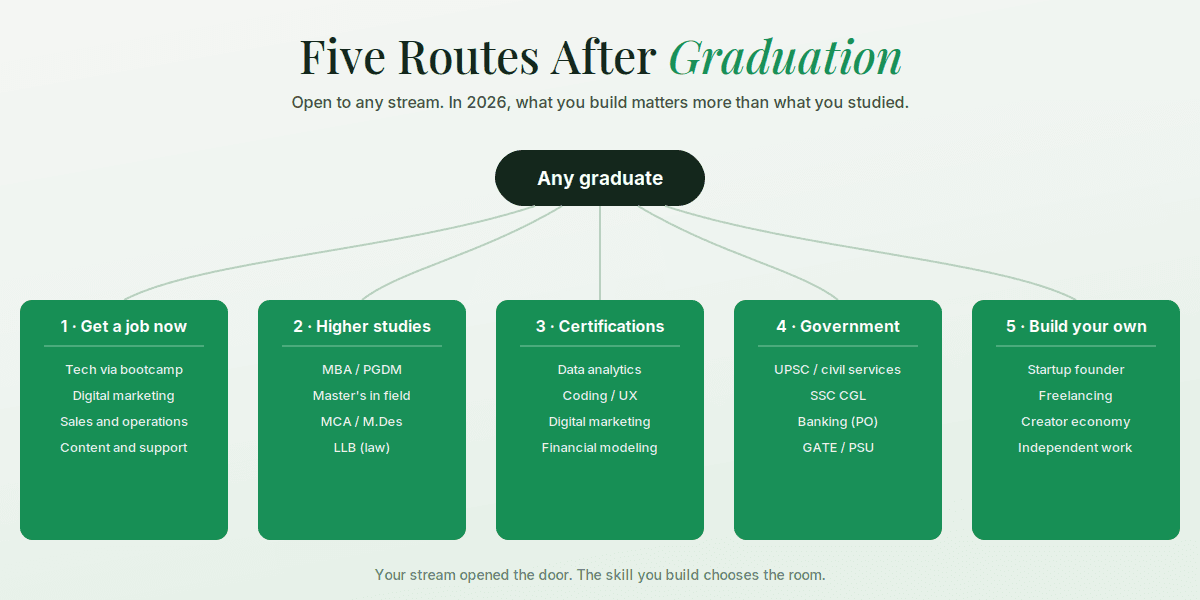
Those five are: taking a job now, going on to higher study, adding a professional course or certification, sitting for government and competitive exams, or building something of your own. Each is covered below in a way that holds whatever you studied, with pointers to the stream-specific guides where your degree does tilt the odds.
Route by Route, What Each Looks Like
Route 1: Get a job now
The most important shift in the modern job market is that many high-growth entry roles now hire on skill rather than on the specific degree. That opens real work to graduates of any stream, provided you bring something demonstrable.
Technology, through a skill route. Software and web development are now reachable from any stream through a structured coding course or bootcamp plus a portfolio, not only through a computing degree. It remains one of the strongest-paying entry points available.
Data and analytics. Data and business analytics reward the numerically comfortable from any background, and lead toward roles like business analyst, one of the most accessible high-growth pivots for a general graduate.
Digital marketing, sales and operations. Digital marketing, sales, business development and operations roles hire heavily on aptitude and communication rather than degree, and offer fast learning curves and quick promotion for strong performers.
Content and support roles. Content, customer-facing and coordination roles are accessible entry points that build workplace experience while you decide on a longer-term direction.
The honest note. “Open to any stream” does not mean “open with the degree alone.” What unlocks these roles for a graduate outside the obvious background is a demonstrable skill, a coding project, an analytics portfolio, a marketing certification with real results. The degree gets you considered; the skill gets you hired. That single idea runs through this whole guide. |
Route 2: Higher studies
Further study is a strong route when it is the genuine gate to where you want to go. The main cross-stream options each serve a different goal.
MBA or PGDM. Open to graduates of any stream and the standard route into management, strategy and business roles. It is worth understanding how a PGDM compares with an MBA, and if a national entrance exam is your concern, there are recognized routes to an MBA without CAT.
A master's in your field. Deepens the subject you already studied, toward specialist, research or academic roles, the natural choice if you want to go further into your degree rather than pivot away from it.
MCA, M.Des or LLB. Focused routes into software (MCA), design (M.Des) and law (a three-year LLB after any degree), each opening a distinct professional field.
If you already know your stream, the degree-specific guides in this series go deeper into the higher-study options that suit your particular background.
Route 3: Professional courses and certifications
Given how often a degree alone falls short, a focused certification is one of the most effective moves a graduate can make, and most are open to any stream. Data analytics, coding, UX design, digital marketing and financial modeling each take months rather than years and target exactly what employers test for. For a graduate unsure of direction, a certification is also a low-cost way to test whether a field suits you before committing to it fully.
Route 4: Government and competitive exams
This is the route where “any bachelor’s degree” is often the literal eligibility, which makes it especially relevant to a general graduate.
Open to any graduate. UPSC Civil Services (IAS, IPS, IFS), SSC CGL, and banking exams like IBPS PO, SBI PO and RBI Grade B are open to graduates of any discipline and offer stability, structure and social standing.
Stream-specific exams. Some routes reward a particular background: GATE and PSU technical roles for engineers, the Indian Economic Service for economics graduates, statistical services for statistics graduates. If your degree fits one of these, it is a genuine edge worth using.
Route 5: Entrepreneurship and independent paths
Independent work is more accessible than ever, and open to any graduate with a skill and initiative. Freelancing in writing, design, development or marketing lets you build a portfolio and income together; the creator economy rewards communication and consistency; and starting a venture, or joining an early-stage one, is a real path for those who would rather build than apply. For those who want to add business structure and a network to an idea, an MBA for entrepreneurs is one option, though many simply start with a skill and an audience.
Job Now, or Study More?
With no single stream to point the way, this fork matters even more, so here is the honest version.
A job now, plus a skill, is the right first move for many. Because the modern market hires on demonstrable ability, you can often start earning and building experience faster by pairing your degree with a focused certification than by adding another two-year qualification. Starting work also gives you the one thing an undecided graduate most needs: real information about what you actually enjoy and are good at.
More study makes sense when it is the genuine gate. Law needs an LLB, academia needs a research degree, a clean management pivot is often smoother with an MBA, and some technical fields need a master's. Study is worth it when the door you want does not open without it, rather than as a way to defer the harder question of direction.
The honest thread running through all of it: for a graduate without a fixed stream to lean on, a degree carried by a skill you can show tends to outperform a degree stacked on another degree with nothing demonstrable attached. Study further to build capability you can actually use, not to defer the decision.
How to Choose Your Path: A Filter
This is the most important section on the page, because when your degree does not point the way, you have to choose by who you are and what you want instead. Work through these honestly, in order, and the wide field narrows fast.
Start with aptitude
Are you analytical, creative, social, or structured? Analytical minds fit data, finance, engineering and analysis. Creative minds fit design, content, marketing and media. Social, people-first strengths fit sales, HR, communications and consulting. Structured, process-minded thinkers fit operations, management and government. This single question rules whole routes in or out.
Depth, or breadth? If you want to be the expert in one thing, lean toward specialist paths, a professional course, a technical master's, a deep skill. If you want range and options, lean toward generalist paths like management, consulting or general corporate roles.
Then weigh your constraints and goals
How long can you invest before earning well? If you need income soon, a job plus a skill is the route. If you can invest years for a higher ceiling, a professional course, an MBA or a competitive-exam track becomes viable.
Stability, or growth and risk? If security matters most, the government and banking route is built for it. If you want faster growth and can accept variance, private-sector roles, startups and entrepreneurship fit better.
Compensation, or impact and autonomy? Be honest about what you actually optimize for. The highest-paid route is not the right one if it does not match what you value, and the reverse is equally true.
The graduates who do best are rarely the ones who chased the highest-paid field on a list. They are the ones who matched a route to a genuine strength and then worked hard at it. Aptitude plus effort beats an average effort in a hot sector, every time. Work honestly through those and the wide field usually settles into one or two routes that actually suit you, which is a far better place to start than the whole list at once.
Salaries at a Glance
Pay after graduation varies enormously by field, skill and city, so treat these as indicative starting points, and read the high figures in the field as top-end-with-experience, not day-one.
Route / field | Indicative entry range (India) | Notes |
|---|---|---|
Technology (via skill route) | ~₹6 LPA and up | Wide; product firms pay most |
Data and analytics | ~₹4–12 LPA | Rises fast with a portfolio |
Digital, sales, operations | ~₹3–7 LPA | Quick growth on performance |
Government and banking | ~₹4–12 LPA | Plus security and benefits |
Post MBA / management | ~₹6 LPA and up | Strongly tier-dependent |
The consistent pattern across every route is that a demonstrable skill and a strong early track record raise the figure well above the base, regardless of which degree you started with.
The Skills That Actually Get You Hired
Here is the single most important idea for any graduate, whatever your stream. India's employability studies, the annual India Skills Report among them, have for years put the share of graduates considered job-ready at only around half. What holds the rest back is rarely raw ability; it is the absence of direction and of a specific, demonstrable skill. The good news is that this is the most fixable problem you have.
Whatever route you choose, the lever is the same: a concrete, showable skill, a coding project, an analytics portfolio, a marketing campaign with real numbers, a cleared exam, and ideally an internship that proves you can operate. A focused certification plus real work moves you past most of the field faster than another untargeted qualification. If you are weighing whether a management route is worth it for your goals specifically, our guide on whether an MBA is worth it works through that honestly.
There is also a route worth naming for the graduate, from any stream, who wants to head toward business, product or building rather than a purely technical or administrative track.
A newer kind of program leads with practice over theory: it admits on your profile rather than a single entrance exam, and has students build and run real products and ventures. Because selection is by profile rather than degree title, it tends to suit people whose real strengths never showed up on their transcript. Scaler School of Business is one of these, an 18-month, build-first program in Management and Technology in Bengaluru.
To be candid about what it is, the credential is a PGP certificate, not a UGC degree, so it fits those who would rather be judged on what they can do than on a formal qualification, and it stands as one route among the several above, most relevant to the graduate pivoting toward business and building.

Frequently Asked Questions
Q1. Does my stream limit my career after graduation?
A: Far less than it used to. Many high-growth fields, technology, data, digital, product, management, hire on demonstrable skill rather than on the specific degree. Your stream may give you an edge in some routes, but it rarely closes off others, provided you build the relevant skill.
Q2. Can I switch fields after graduation?
A: Yes, and it is common. A focused certification or a skill-based bootcamp, plus a portfolio of real work, is usually enough to pivot into a new field such as tech, data or digital marketing. Many people find their degree and their eventual career are only loosely related, and that is normal, not a failure.
Q3. What are the best career options after graduation?
A: There is no single best; it depends on your aptitude and goals. The five broad routes, a job now, higher study, professional certifications, government exams, and entrepreneurship, cover almost everything. The right one is the route that matches a genuine strength of yours with real market demand, which the filter in this guide helps you find.
Q4. Should I take a job or study more after graduation?
A: For many graduates, a job plus a focused skill is the stronger first move: you start earning, gain real experience, and learn what you actually enjoy. Study more when it is the genuine gate to your goal, law, academia, a management pivot, rather than a way to postpone deciding.
Q5. Which government exams are open to any graduate?
A: UPSC Civil Services, SSC CGL, and banking exams like IBPS PO, SBI PO and RBI Grade B are open to graduates of any discipline. Some exams reward a specific background, such as GATE for engineers or the Indian Economic Service for economics graduates, so check eligibility against your degree.
Q6. Is an MBA worth it after graduation?
A: It can be, when it is a deliberate route into management for a clear reason, ideally with some work experience behind it. It is a weaker choice when taken simply as the expected next step. Whether it is worth it depends on your goals, the program's outcomes, and what you would otherwise be doing.
Q7. What is the highest-paying option after graduation?
A: Software engineering, data and AI, investment banking and finance, product management and top-tier consulting sit at the high end, though most of the biggest figures come after years of experience and a strong track record, not at entry. The highest-paying route is only right for you if it also matches your aptitude.
Q8. What is the best option after graduation for an average student?
A: Aptitude, not marks, determines fit. A focused skill, data analytics, digital marketing, coding, a government-exam track, or a job with a fast learning curve can build a strong career regardless of your academic record. Consistent effort in a route that suits you matters far more than grades over time.
The Bottom Line
Graduating without a fixed plan is not the disadvantage it feels like. In 2026, your degree opened the door, but it does not decide which room you enter, the five routes are open to graduates of every stream, and the paths that pay and grow are increasingly reachable through skill rather than through a specific background. So do not sort yourself by what you studied. Sort yourself by what you are good at and what you want, narrow the field to one or two routes that genuinely fit, and then build the demonstrable skill that turns a direction into a career. And if you already know your stream, use the degree-specific guides in this series to go deeper. What you build after graduation matters more than what you studied before it.
Non-IIM MBA
Top Non-IIM MBA Colleges in Bangalore (2026): Fees, Placements & How to Choose
5 min. read
MBA for Professionals
Is an MBA Worth It for Working Professionals? An Honest 2026 Guide
5 min. read

MBA for Engineers
MBA After B.Tech (2026): Eligibility, Specializations, Salary & Is It Worth It?
5 min. read
MBA for Engineers
MBA After Engineering (2026): Eligibility, Specializations, Salary & Is It Worth It?
5 min. read