Business Management Glossary
Importance of Business Environment: How It Shapes Every Decision
Understand why the business environment matters, including how reading external forces helps firms spot opportunities, identify threats, use resources better, cope with change, plan effectively and improve performance.
Team SSB
5 min. read

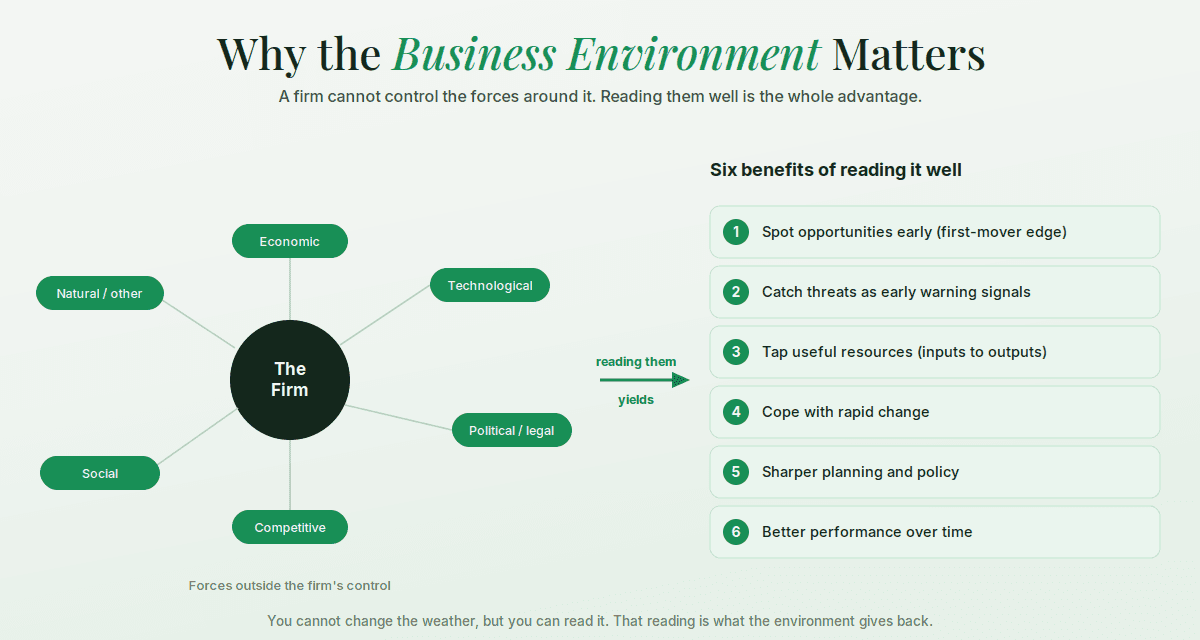
The business environment is the total of all the outside forces and institutions, economic, social, technological, political, legal, competitive and natural, that affect a business but sit largely beyond its control. The importance of the business environment is what a firm gains by reading those forces well: an enterprise cannot change the weather around it, but it can read it, and that reading is the whole advantage.
No business is an island. It survives, adapts and grows inside the conditions around it, and the managers who understand those conditions can identify, assess and respond to them rather than being caught out. This entry sets out the six benefits that make the environment worth reading, the features that make it hard to read, and how a single decision runs through all of them.
Short answer. The business environment matters because reading it well lets a firm do six things: spot opportunities early and gain a first-mover edge, catch threats as early warning signals, tap useful resources, cope with rapid change, plan and set policy on better information, and improve performance over time. The environment is a set of forces the firm cannot control but must respond to, so understanding it is the difference between adapting in time and being overtaken. |
Why the Business Environment Matters: Six Benefits
The value of understanding the environment is best seen as six concrete benefits. They are the reason environmental awareness is treated as a core management skill rather than background reading.
1. It helps identify opportunities and gain a first-mover advantage
The environment constantly throws up openings, a new technology, an unmet need, a shift in what customers want. A firm that spots one early can move on it before rivals do and capture the first-mover advantage. When telecom operators read the demand for faster mobile internet early, the first to roll out the newer network standard took share before the others caught up. The opportunity was in the environment; the advantage went to whoever read it first.
2. It helps identify threats and gives early warning
The same awareness that surfaces opportunities also flags danger. A new competitor, a substitute product, a coming regulation or a change in taste is easier to handle when seen coming. When a fast-growing challenger brand reshaped a consumer-goods category around natural ingredients, established firms that were scanning the environment treated it as an early warning and launched their own natural ranges, while those who were not lost ground. Reading the environment turns a surprise into a signal.
3. It helps tap useful resources
A business draws its inputs, finance, raw materials, technology, power, labor, from the environment, and returns outputs, goods, services, taxes, returns to investors, back into it. Understanding the environment means understanding where those inputs are, how their availability and cost are changing, and what outputs it now rewards. As demand shifts toward newer products, firms that read it redirect their sourcing toward the resources those products need rather than the ones the old products used.
4. It helps cope with rapid change
Markets today move fast: shorter product cycles, weaker brand loyalty, fragmenting audiences, changing tastes and global competition. A firm that watches the environment stays flexible and adapts, while one that does not is left defending a position the market has already moved past. Founders who saw the potential of e-commerce early built for a shift others were still ignoring. Coping with change starts with noticing it.
5. It helps in planning and policy formulation
Every plan is a bet on what the environment will do, so the quality of a plan depends on the quality of the reading behind it. Awareness of the forces at work, and of the opportunities and threats they carry, is what lets managers set realistic objectives and sound policies. This is where scanning the environment feeds directly into the planning function; the types of planning a firm uses all rests on how well it has read the conditions those plans must survive.
6. It helps improve performance
Pulling the first five together, the firms that monitor the environment and adjust to it consistently outperform those that do not, and often become the leaders of their field. Sustained success tracks the ability to read the surroundings and keep adapting the offer to them. Performance, in the end, is what a good reading of the environment converts into.
The Features That Make the Environment Hard to Read
If the environment were simple and stable, reading it would be trivial. It is neither, and its features are exactly what make the six benefits above a genuine managerial achievement rather than a given.
It is the totality of external forces. The environment is the sum of everything outside the firm, taken together. Any one force can be an opportunity for one business and a threat for another at the same moment.
It has specific and general forces. Specific forces, customers, suppliers, competitors, investors, act directly on one firm. General forces, the economy, society, technology, politics and law, act on all firms indirectly. Both matter, but they are read differently.
Its forces are inter-related. The parts move together. A social shift toward health awareness feeds an economic shift in what sells, which feeds a technological shift in what is produced. You cannot read one force in isolation.
It is dynamic. It never stops changing, through new technology, new tastes and new entrants, so a reading is never final. The scan has to be continuous.
It is uncertain. Because the future is unknown, changes cannot be predicted with confidence, only anticipated in ranges. This is why environmental awareness reduces surprise rather than removing it.
It is complex, and relative. The forces are many, interlinked and hard to separate, and their weight differs by place: a condition that is an advantage in one country or region is a constraint in another. Reading the environment always means reading a specific environment.
The Dimensions Managers Actually Watch
In practice the general environment is scanned along a handful of standard dimensions. The point here is not to define each in depth but to show what a manager keeps an eye on, and why each can carry both an opportunity and a threat.
Dimension | What it covers | Why it cuts both ways |
|---|---|---|
Economic | Inflation, interest rates, incomes, demand | A downturn shrinks spending; a recovery expands it |
Social | Values, tastes, demographics, lifestyles | A health trend hurts some products and creates others |
Technological | New tools, automation, digital shifts | It obsoletes old methods and opens new ones |
Political and legal | Policy, regulation, tax, stability | A new rule is a cost to some, a moat to others |
Competitive | Rivals, substitutes, new entrants | A new entrant threatens share but signals a live market |
Reading these dimensions in a structured way is what formal scanning tools are built for. Those tools are a method rather than the point of this entry, and the discipline of watching all of these at once is part of the wider nature of management as a continuous, all-pervasive activity.
One Decision, Traced Through the Environment
The benefits are easier to trust when followed through a single choice. Take a mid-sized Indian packaged-foods company deciding whether to launch a range of low-sugar snacks.
Opportunity and threat, read together. Scanning the social dimension, the firm sees rising health awareness (an opportunity) and, in the competitive dimension, a challenger brand already moving on it (a threat and an early warning). Both point the same way: act, and soon.
Resources, checked. It looks at whether the inputs exist, natural sweeteners, suppliers, the production capability, and finds the sourcing is available but pricier, an economic reading that shapes the cost plan.
Change, coped with. It reads the pace of the shift and decides a fast, limited launch beats a slow, perfect one, because the taste is moving now.
Plan and policy, set. On that reading it sets a realistic target, a launch timeline and a pricing policy that carries the higher input cost, planning built on the scan rather than on hope.
Performance, the payoff. If the reading was sound, the firm enters early, adapts as tastes move, and the range lifts overall performance. The environment supplied every input to the decision; management supplied the reading.
Terms People Often Mix Up
Business environment and internal environment
The business environment in this sense means the external forces around the firm. The internal environment, its people, culture, resources and structure, is largely within the firm's control. The importance discussed here is chiefly about reading what the firm cannot control.
Micro (specific) and macro (general) environment
The micro or specific environment, customers, suppliers, competitors, touches one firm directly. The macro or general environment, economic, social, technological, political and legal forces, touches all firms indirectly. Confusing the two leads to watching the wrong signals.
Opportunity and strength
An opportunity is an outward-facing opening in the environment. A strength is an inward capability of the firm. Environmental awareness surfaces opportunities and threats; a separate internal look surfaces strengths and weaknesses. A scan that mixes them misreads both.
Environmental awareness and environmental scanning
Awareness is the general understanding that the environment matters and shapes the firm. Scanning is the deliberate, structured process of monitoring it. Awareness is the mindset; scanning is the method that turns it into the six benefits.
Reading the Environment Before It Is Your Job To
Reading a business environment well is a practiced skill, not a fact to memorize. It comes from watching real markets move and making real calls under uncertainty, which is hard to rehearse from a textbook and usually waits for a job that puts a live business in front of you.
This is the gap Scaler School of Business is built to close. Its 18-month, full-time program in Bengaluru lets students run real ventures on real capital and take go-to-market projects with established brands, so they are reading actual economic, competitive and consumer signals and acting on them, rather than only studying cases about firms that did.
Admission to Scaler School of Business is based on your profile rather than one entrance test, and the qualification is a full-time, on-campus PGP certificate in management and technology, not a conventional degree. It suits people ready to learn by making calls in a live setting, which is exactly where a feel for the environment is built.

Frequently Asked Questions
Q1. Why is the business environment important?
Because a firm cannot control the outside forces around it but must respond to them. Reading the environment well lets a business spot opportunities early, catch threats as early warnings, tap the right resources, cope with rapid change, plan on better information, and improve performance over time. It is the difference between adapting in time and being overtaken.
Q2. What are the main benefits of understanding the business environment?
Six: identifying opportunities and gaining a first-mover advantage, identifying threats and getting early warning, tapping useful resources, coping with rapid change, planning and policy formulation, and improving performance. The first five compound into the sixth, so environmental awareness ultimately shows up as better results.
Q3. What are the features of the business environment?
It is the totality of external forces, made up of specific and general forces, inter-related, dynamic, uncertain, complex, and relative to place. These features are why reading it is a genuine managerial skill: the environment has many moving, linked, unpredictable forces that mean something different in different places.
Q4. What is the difference between the specific and general business environment?
The specific (micro) environment, customers, suppliers, competitors, investors, affects a single firm directly. The general (macro) environment, economic, social, technological, political and legal forces, affects all firms indirectly. Managers watch both, but read them differently, since specific forces call for direct responses and general forces for adaptation.
Q5. How does the business environment help in planning?
Every plan is a bet on what the environment will do, so awareness of the forces at work and the opportunities and threats they carry lets managers set realistic objectives and sound policies. Scanning the environment feeds directly into the planning function, and the types of planning a firm uses all depend on how well it has read the conditions those plans must survive.
Q6. Can a business control its environment?
Only rarely, and only partly. Most external forces, the economy, technology, regulation, social change, are beyond a single firm's control, which is why the emphasis is on reading and responding rather than controlling. A firm can influence its immediate, specific environment somewhat, but the general environment it must largely adapt to.
Q7. Why is the business environment described as dynamic and uncertain?
Dynamic because it never stops changing, through new technology, shifting tastes and new competitors, so any reading is provisional. Uncertain because the future cannot be predicted with confidence, only anticipated in ranges. Together these mean environmental awareness reduces surprise rather than removing it, and scanning has to be continuous.
Q8. What is the relationship between the business environment and management?
Management is largely the work of reading the environment and responding to it. The environment supplies the opportunities, threats and resources; management supplies the reading and the decisions. This is why environmental awareness runs through the whole nature of management as a continuous, all-pervasive activity rather than a one-time exercise.

Non-IIM MBA
Top Non-IIM MBA Colleges in Bangalore (2026): Fees, Placements & How to Choose
5 min. read

MBA for Professionals
Is an MBA Worth It for Working Professionals? An Honest 2026 Guide
5 min. read

MBA for Engineers
MBA After B.Tech (2026): Eligibility, Specializations, Salary & Is It Worth It?
5 min. read

MBA for Engineers
MBA After Engineering (2026): Eligibility, Specializations, Salary & Is It Worth It?
5 min. read