




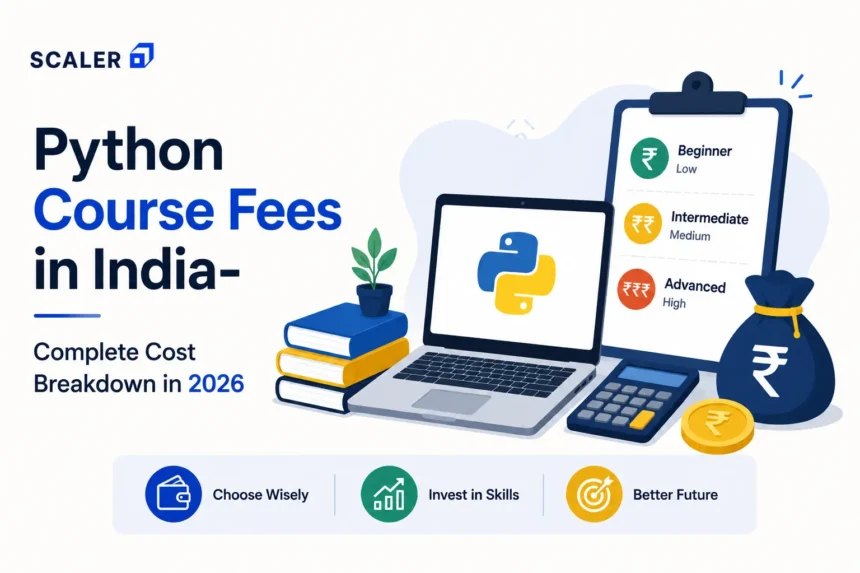
Should you learn Python through a free online course, pay for a certification program, or invest in a full career-track bootcamp in 2026?
This dilemma persists for every student or learner, especially when you want your skills to be credible. You will find beginner Python courses available for free, self-paced certifications priced affordably, mentor-led online programs that cost more, and specialized Python tracks in data science or AI that move into premium pricing territory. The differences in pricing involve elements that are added along with the basic learning, such as projects, mentorship, industry exposure, career support, and practical application.
In 2026, Python course fees in India vary more by learning format and career outcome than by the programming language itself. A short beginner course may only help you understand syntax and fundamentals, while a structured bootcamp can prepare you to work on real-world applications in analytics, automation, backend development, or machine learning. That is why whenever you check out the course prices, it is always best to check what resources and guidance you will gain from the learning.
This guide will help you understand how much different Python course types cost in India, what you actually get at each pricing level, and when free learning is enough and when a structured learning path is better suited.
For learners planning to apply Python in analytics or data-focused roles, specialized programs like Python and SQL for Data Science can offer more practical exposure through datasets, projects, and business-oriented workflows. And if your goal eventually expands toward AI, machine learning, or full-scale data science careers, structured career-track programs may become worth considering later in your learning journey.
So, let’s get into detail on Python course fees and how they vary from course to course.
Transform Your Career
Choose from our industry-leading programs designed for career success
Modern Software and AI Engineering Program
Master full-stack development with AI integration


 +1000 more
AI Forward Deployed Engineer with Specialisation in AI applications
Build and deploy AI solutions for real-world business problems
+1000 more
Modern Data Science and ML with specialisation in AI
Advanced data science techniques with AI specialization
+1000 more
Advanced AIML with Specialisation in Agentic AI
Deep dive into AIML with focus on Agentic systems
+1000 more
DevOps, Cloud & AI Platform Engineering
Build and manage AI-powered cloud infrastructure
+1000 more
AI Engineering Advanced Certification by IIT-Roorkee
Premier AI engineering certification from IIT-Roorkee

Quick Cost Snapshot: Python Course Fees in India in 2026
Python course fees in India can vary widely in 2026, depending on the learning format, specialization, and level of career support included in the program. While some learners begin with free Python courses, others invest in mentor-led bootcamps, analytics tracks, or AI-focused programs for more structured career growth.
Here is a quick breakdown of the average Python course cost in India across different learning formats:
- Free Python courses: Nil
- Budget self-paced certificate courses: ₹2,000 – ₹15,000
- Live online beginner Python classes: ₹10,000 – ₹35,000
- Python + data analytics programs: ₹15,000 – ₹60,000
- Python bootcamps and mentor-led career tracks: ₹40,000 – ₹2,00,000+
- Diploma or university-linked Python programs: ₹50,000 – ₹5,00,000+ depending on institution and duration
Python Course Fees in India: Detailed Comparison by Course Type
The cost of a Python course usually reflects the learning experience it offers. Some courses focus only on beginner concepts, while others include live mentorship, projects, analytics tools, interview preparation, and specialization tracks in data science or AI.
The table below compares different Python course types in India based on fees, duration, learning outcomes, and the kind of learners they are best suited for.
| Course Type | Typical Fee Range (India) | Duration | Best For | What Learners Usually Get |
| Free Python courses | ₹0 | 8-15 hours or flexible | Absolute beginners exploring Python | Basics, short projects, self-paced learning, beginner certificate |
| Self-paced paid certificate courses | ₹2,000-₹15,000 | 10-60 hours | Budget learners who want structured learning | Recorded lessons, quizzes, assignments, a certificate, and limited support |
| Live online beginner Python classes | ₹10,000-₹35,000 | 1-3 months | Learners who need accountability and instructor guidance | Live sessions, trainer interaction, assignments, and doubt-solving |
| Python + SQL or analytics courses | ₹15,000-₹60,000 | 1-4 months | Learners targeting data analytics or BI roles | Python, SQL, pandas, visualization tools, beginner projects |
| Python bootcamps and job-oriented programs | ₹40,000-₹2,00,000+ | 2-9 months | Career switchers and placement-focused learners | Structured curriculum, projects, mentorship, and interview preparation |
| Classroom or local institute programs | ₹8,000-₹50,000 | 1-4 months | Learners preferring offline training | Trainer-led sessions, lab access, and classroom support |
| Python for Data Science or AI specializations | ₹20,000-₹1,50,000+ | 2-8 months | Learners pursuing analytics, ML, or AI pathways | Advanced Python libraries, ML basics, projects, guided specialization |
| Diploma or university-affiliated programs | ₹50,000-₹5,00,000+ | 6-24 months | Learners seeking academic credentials | Longer-format curriculum, assessments, broader theoretical coverage |
As you compare these options, you will notice that different Python courses are designed for very different learning goals and career paths. Let’s now understand the key factors that influence Python course fees in India in 2026.
What Affects Python Course Fees in India?
Many Python courses in India teach similar beginner concepts, yet their pricing can vary from free to several lakhs. The difference usually comes from how the course is taught, who it is designed for, and what happens after the learning phase.
Some of the biggest factors that influence Python course fees in India in 2026 include:
| Learning Format | Average Fees | Flexibility | Mentorship | Best Suited For |
| Free Python Courses | Nil | High | Minimal | Beginners exploring Python |
| Self-Paced Paid Courses | ₹2,000-₹15,000 | High | Limited | Budget learners want structure |
| Live Online Classes | ₹10,000-₹35,000 | Medium | Moderate | Learners needing accountability |
| Python Bootcamps | ₹40,000-₹2,00,000+ | Medium | Strong | Career switchers and job-focused learners |
| Diploma / Degree Programs | ₹50,000-₹5,00,000+ | Low | Varies | Learners seeking formal credentials |
This is also why many learners end up paying for the course title instead of evaluating the actual learning value attached to it. Before choosing a Python course, you should always compare the structure, support, and career relevance alongside the pricing.
Free Python Courses in India: What You Really Get
If you are a beginner and want to start learning Python from scratch, starting with a free course is completely fine. In fact, many learners use free Python courses in India to understand whether coding genuinely interests them before spending time and money on certifications or larger programs.
Most free Python courses usually cover –
- Basic syntax and programming concepts
- Variables, loops, and functions
- Beginner coding exercises
- Introductory projects
- Flexible self-paced learning
So if you are thinking of going ahead with a free python course, then start when –
- You are learning Python for the first time
- You are unsure whether coding interests you long-term
- You want flexible learning without financial pressure
- You only want beginner-level programming familiarity initially
You can also begin with a free Python course with certificate if you want structured beginner-level learning without financial risk.
And if you later want to explore how Python is applied in analytics or data-focused workflows, a free data science course can help you understand the broader applications of Python in terms of DS.
Self-Paced Paid Python Courses: Good for Budget Learners?
Self-paced paid Python courses are often chosen by learners who want more structure than free resources but still prefer a flexible learning schedule. If you are balancing college, work, or other commitments, these courses can help you learn at your own pace without attending fixed live sessions.
Compared to free Python courses, low-cost paid certifications usually offer:
- More organized learning paths
- Longer course access
- Practice assignments and quizzes
- Beginner projects
- Completion certificates
Most self-paced Python course fees in India range between ₹2,000 and ₹15,000, depending on the platform, course duration, and included features.
However, you should keep in mind that these courses are only best if you genuinely commit the time on your own accord. After enrolling, you’ll have to be dedicated enough to initiate some projects and look through sources for guidance. And that is why, as long as you are consistent, these difficulties can be dealt with.

Free Courses by top Scaler instructors
Live Online Python Classes: When Paying More Makes Sense
We have seen that not every learner enjoys studying through recorded lessons alone. Some people learn faster when they have their doubts solved as they study, follow a schedule, and stay accountable throughout the course. And if you think this system suits you well, then live lessons can help you!
Most live online Python courses usually include:
- Scheduled interactive classes
- Live doubt-solving sessions
- Assignments and coding practice
- Trainer guidance
- Peer-based learning environments
So, if you are interested in such programs, then you should consider paying for Structured Mentorship If –
- You struggle with consistency while learning alone
- You prefer getting your doubts cleared in real-time
- You learn better through deadlines and accountability
- You want guided projects or instructor feedback
- You are preparing for career-oriented learning paths later on
Since these programs involve instructor access and structured delivery, online Python course fees are usually higher than low-cost recorded certifications.
Python + SQL / Data Analytics Courses: Higher ROI for Data Roles
Learning Python alone can help you understand programming fundamentals, but many data-related roles require you to have knowledge and practice in advanced-level subjects. If your goal involves analytics, reporting, business intelligence, or data-driven decision-making, you will eventually need to work with databases, datasets, and visualization workflows alongside Python.
Hence, you can choose Python + SQL courses in such cases. So, along with covering the basics, these programs introduce you to practical analytics skills such as querying data, cleaning datasets, and working with tools commonly used in entry-level data roles.
And having a proper role-based learning is also one reason why Python for data analytics course fees are usually higher than beginner Python certifications. The curriculum becomes broader, the projects become more application-focused, and the learning starts aligning more closely with industry workflows.
If you want to explore this direction further, then a Python and SQL for Data Analyst program can help you understand how both tools are used together in analytics environments.
Python for Data Science and AI: Why Fees Jump
You might have noticed how the Python course fees increase quite a bit once the learning involves data science and AI. That happens because these programs are usually built around career-oriented skills after your programming fundamentals are done.
With these, you’ll start learning how Python is used for working with datasets, automation, machine learning models, analytics workflows, and business problem-solving. The curriculum will include more projects, which is why many of these courses are longer and more structured than beginner Python certifications.
At the same time, this does not mean every learner should directly invest in a premium AI program. If you are still figuring out whether this field interests you, starting with a free data science course is a good step to begin with.
Once you gain clarity on your interests and career direction, you can move toward more structured learning paths, like a Data Science Course for guided projects and deeper specialization.
If you are curious about the pricing of these courses, then do check out the AI & Machine Learning Course Fees in 2026
Here is a way to understand the difference between each, check this table out –
| Course Type | What You Mainly Learn | Where It Usually Leads |
| Beginner Python Courses | Syntax, logic building, basic scripting | Programming foundations and automation basics |
| Python + SQL Courses | Working with databases, queries, and datasets | Data analytics and reporting workflows |
| Python + Data Science Programs | Data analysis, visualization, and machine learning basics | Data science and analytics projects |
| Python + AI / ML Specializations | Model-building, AI workflows, advanced ML concepts | AI, machine learning, and advanced data roles |
Python Bootcamps vs Degree/Diploma Programs
If you are looking into Python course fees in India, then you must be wondering about these options: should you choose a shorter industry-led bootcamp or invest in a longer degree or diploma program?
The answer here will really depend on your learning goals, timeline, and career expectations. While bootcamps are often designed around faster skill-building and practical exposure, degree or diploma programs may offer broader academic coverage and institutional recognition.
| Factor | Python Bootcamps | Degree / Diploma Programs |
| Duration | Usually 2-9 months | Can range from 1-3 years |
| Learning Style | Industry-focused and project-heavy | Academic and theory-oriented |
| Curriculum Updates | Updated more frequently based on industry tools | Updates may happen more slowly |
| Projects & Practical Work | Strong focus on portfolios and implementation | Varies by institution |
| Mentorship | Often includes guided support and doubt-solving | Depends on the college or institute structure |
| Career Focus | Designed for job-readiness and skill application | Broader educational qualification |
| Flexibility | Many programs are online and flexible | Often fixed schedules and semesters |
| Fees | ₹40,000 to ₹2,00,000+ | ₹50,000 to several lakhs, depending on the institution |
For learners who already know the kind of role they want to target, shorter project-based learning paths are a better option than spending multiple years in a broad academic program. On the other hand, some learners may still prefer a degree or diploma for formal credentials and long-term academic value.
And so, if you like to work with guided projects, mentorship, and industry-oriented learning, then a structured Data Science Course can be a good option for you as well.
Hidden Costs Beyond the Tuition Fee
While checking Python course fees in India, it is easy to focus only on the number shown on the course page. But before spending your money, you should always try to understand what the fee actually covers and what it does not.
Before Paying More Than ₹25,000, Check Whether the Course Includes:
- Guided projects or portfolio work
- Live doubt-solving or mentor access
- Updated curriculum and tools
- Career support or interview preparation
- Certificate credibility
- Flexible learning access
- Practical assignments instead of only recorded lectures
Looking at these details early can help you understand whether the higher course fee is genuinely adding value or simply increasing the price tag.
For example, some learners later realize they may need a better laptop, paid certification exams, project tools, stable internet access, or even extra interview preparation outside the course itself. And if you are choosing a premium program through EMI options, understanding the long-term financial commitment becomes equally important. Looking at these details early can help you avoid paying more later for things you assumed were already included.
Scaler Placement Report and Statistics
Scaler learners achieved 2.5x salary growth with average post-Scaler CTC reaching ₹23L.
 Google
 Amazon
 Microsoft
 Flipkart
 Adobe
1200+ more
Adobe
1200+ more
Which Python Course Type Gives the Best ROI in 2026?
The best Python course in 2026 is not necessarily the most expensive one. In most cases, the right choice depends on what you want to achieve after learning Python and how much structure or guidance you realistically need while learning.
Here is a simple way to think about ROI based on different learner goals:
| Learner Type | Python Course Type That Usually Makes Sense |
| Beginners exploring coding | A free Python course is often enough to build basic familiarity before investing in paid learning |
| College students | Self-paced or live online Python classes can help build practical programming foundations alongside academics |
| Data and analytics aspirants | Python + SQL programs usually offer better role alignment for analytics and BI pathways |
| Career switchers | Structured bootcamps or guided learning tracks may provide better accountability, projects, and career support |
| Working professionals | Flexible online programs with specialization options often work better alongside full-time jobs |
Someone exploring Python casually may not need a premium bootcamp, while a learner targeting analytics or AI roles may benefit more from structured project-based learning.
If you are just starting, a free Python course can help you test your interest before committing financially.
Learners moving toward analytics workflows can explore Python and SQL for Data Science, while those aiming for deeper specialization may prefer a structured Data Science Course later on.
How to Choose the Right Python Course Based on Budget
Your budget can help narrow down the type of Python learning experience that fits your current goals. Instead of directly aiming for the most expensive course, it is usually better to choose a learning path based on how deeply you want to use Python and how much guidance you need while learning.
If you do not wish to invest from the get-go, starting with a free Python course is completely reasonable. This works well for beginners who want to understand basic programming concepts before deciding whether Python is something they genuinely want to pursue further.
With a budget under ₹15,000, self-paced paid certifications and beginner-level live online classes become more accessible. These courses are usually suitable if you want structured learning without making a major financial commitment early on.
In the ₹15,000-₹60,000 range, the learning often becomes more role-focused. This is where you can start exploring analytics, SQL, automation, and data-oriented workflows. You can check out programs like Python and SQL for Data Science, which usually fit into this category.
Premium Python programs are generally more suitable for learners targeting long-term career transitions, advanced specialization, or structured mentorship. These python with data science courses may include guided projects, career support, and broader data science or AI exposure, which makes them more outcome-oriented than beginner certification programs.
Scaler Alumni and Their Success Stories
Explore Course Fees & Pricing
FAQs
1. What is the average Python course fee in India in 2026?
Python course fees in India can range from free beginner courses to premium career-track programs costing over ₹2 lakh. Self-paced certifications usually range between ₹2,000 and ₹15,000, while live online classes, analytics programs, and Python bootcamps can cost significantly more depending on the learning format and specialization.
2. Are free Python courses with certificates worth it?
Yes, free Python courses with certificates are a good option for beginners who want to understand programming fundamentals before investing in paid learning. These courses are usually best suited for exploring Python basics, syntax, and beginner-level coding concepts.
3. How long does it take to complete a Python course?
Python course duration in India can vary based on the course type and learning depth. Beginner-level courses may take a few weeks, while structured analytics, data science, or AI-focused programs can continue for several months.
4. Is Python alone enough for data analytics jobs?
Python can help you build programming fundamentals, but many entry-level analytics roles also require SQL, data handling, visualization, and reporting skills. That is why many learners move toward Python + SQL or analytics-focused learning paths later on.
5. Which is better: self-paced Python courses or live online classes?
Self-paced Python courses are usually more flexible and affordable, while live online classes are often better for learners who need accountability, instructor guidance, and regular doubt-solving support.
