




If you are employed and considering a PGDM, the first problem you run into is not the curriculum or the cost, rather, it is the format. Most PGDM programs are designed for people who can show up every day. You cannot. And yet the pressure to get a management credential does not pause just because your job does not.
This article is for mid-career professionals who are weighing the PGDM against programs that are actually built around their constraints. We will cover PGDM career scope, what the format differences mean in practice, which skills actually matter for management roles in 2026, and why a PGP in Business & AI is increasingly the more practical answer for working professionals who want growth without a two-year career gap.
The Quick Answer
• A PGDM (Post Graduate Diploma in Management) is a 1–2 year management program offered by autonomous institutions, broadly equivalent to an MBA in outcomes.
• Most full-time PGDM programs require you to pause work which is a real cost that compounds over time.
• Working professionals need management education that fits around their job, not the other way around.
• PGDM career scope covers analytics, product, operations, consulting, and general management, all of which are now increasingly AI-adjacent.
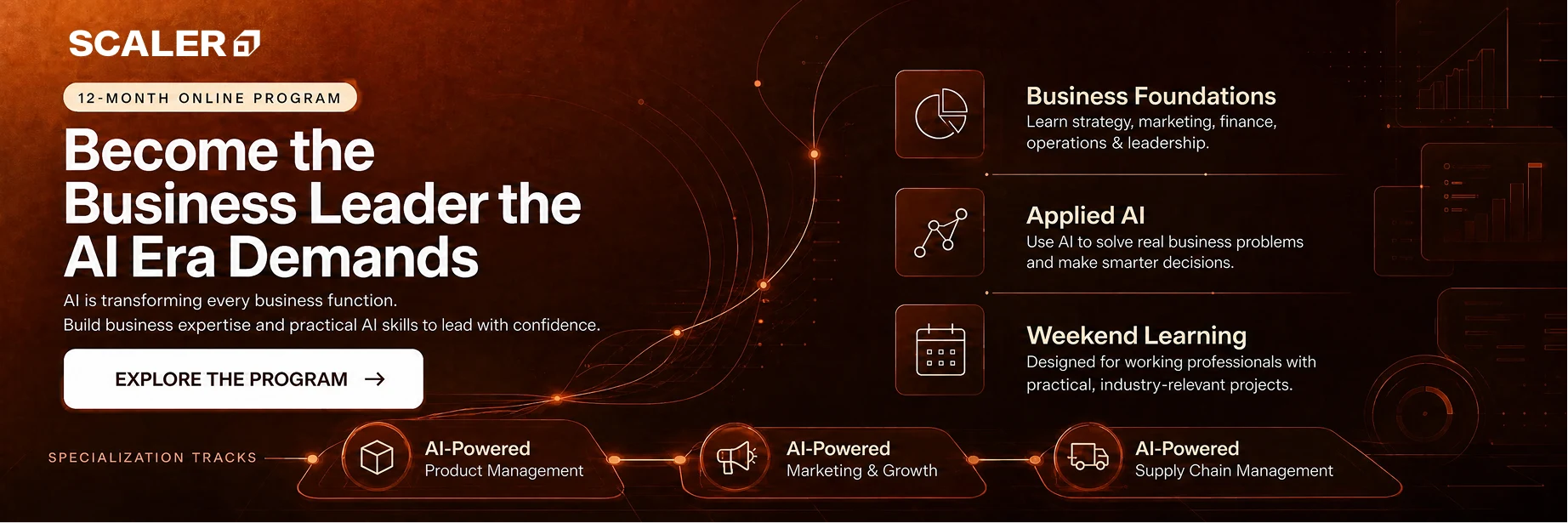
• A PGP in Business & AI is a structured alternative: designed for employed professionals, AI-integrated, and outcome-focused. You can see how it compares to a traditional PGDM.
PGDM Career Scope: Where It Actually Takes You
A PGDM course opens doors across a reasonably wide range of management roles, more so than people give it credit for. The credential is often compared directly to an MBA in terms of industry acceptance, and in many cases the practical outcomes are similar.
The PGDM career scope for working professionals specifically tends to cluster around roles where domain experience plus management credentials is the combination employers want. You are not starting over, instead, you are levelling up.
| PGDM career area | Typical roles | What the credential adds | AI-readiness gap |
| Analytics & Data | Analytics Manager, Business Intelligence Lead, Data Strategy | Management framing for data work | High — most programs light on AI/ML application |
| Product & Technology | Product Manager, Digital Transformation Lead, Tech Strategy | Business context and stakeholder management | Medium — depends on electives chosen |
| Operations & Supply Chain | Operations Manager, Process Excellence, Consulting | Frameworks and cross-functional leadership | Low — traditional PGDM rarely integrates AI ops |
| Marketing & Growth | Growth Manager, Category Lead, Marketing Analytics | Strategic marketing thinking | High — AI tools now central to marketing workflows |
| General Management | Business Unit Head, P&L Owner, Management Consulting | Breadth and leadership credential | Medium — depends on AI elective availability |
The gap column matters because PGDM benefits are real, since the programs were mostly built before AI became a core management skill. A working professional in 2026 who completes a traditional PGDM course may still find themselves needing to separately learn AI tools, data interpretation, and AI strategy, all the things their junior colleagues already know.
If you are evaluating postgraduate options broadly, the top postgraduate courses comparison is worth a look before committing to any single format.
What to Actually Evaluate Before Joining Any Management Program
Most professionals approach program selection backwards, that is, they start with brand and format before asking whether the curriculum actually builds what they need. Understanding what a PGP course is helps clarify what to look for, starting structured outcomes, and not just credential prestige.
Here is the evaluation checklist that actually matters for working professionals:
| Evaluation criterion | What to look for | Red flags |
| Schedule flexibility | Weekend / evening batches, async content, live session recordings | 5-day campus attendance, no remote option |
| AI integration in curriculum | Dedicated AI modules, GenAI for business, AI strategy | AI mentioned once in a single elective |
| Practical projects | Real capstone projects, case competitions, industry datasets | Only exams and case studies from textbooks |
| Mentor and industry access | Live mentorship, alumni network, guest practitioners | Academic faculty only, no industry practitioners |
| Career support | Placement support, career coaching, alumni referrals | Career support listed as ‘available on request’ |
| Cohort quality | Mix of experienced working professionals | Mostly fresh graduates — peer learning suffers |
| Credential recognition | AICTE-approved or equivalent, employer-visible credential | Unrecognized certificate with no employer visibility |
The schedule flexibility question is where most PGDM programs fail working professionals first. If attending means taking leave, rearranging client calls, or explaining absences to your manager every weekend, then the friction compounds over a year and dropout rates show it.
→ Explore the PGP in Business & AI program
Why Practical Learning Matters More Than Classroom Hours
The traditional PGDM course was built around case studies, lectures, and examinations and that model worked when the pace of business change was slower. It is less effective when the skills you need, such as AI fluency, data-driven decision-making, product thinking, are best developed by doing, not listening. This is exactly what separates a well-designed PGP from a legacy PGDM. See what a PGP course actually involves if the distinction is unclear.
For working professionals specifically, practical learning has a second benefit, and it is the fact that it transfers immediately. A project you build during the program is something you can apply to your current job the same week. A lecture on Porter’s Five Forces is useful context; a live AI audit of your team’s workflow is useful output.
What practical learning looks like in a well-structured program:
• Capstone projects on real business problems, not sanitized case study simulations.
• Mentorship from practitioners who are currently working in the roles you are targeting.
• AI tool workshops where you actually use the tools, and not just hear about them.
• Peer cohort with working professionals who bring real functional context to discussions.
• Career coaching that starts from your existing experience, not a blank resume.
The PGDM benefits argument usually rests on the network and the credential and both are real. But for a working professional who already has professional relationships and a functioning career, the marginal value of a classroom network is lower than the marginal value of immediately applicable skills. That calculation shifts the balance toward programs that prioritize outcomes over experience.
How Business & AI Is Reshaping PGDM Career Scope
The management roles that PGDM graduates have historically targeted are changing faster than the programs themselves. Mid-career growth through a PGP increasingly depends on whether the program builds AI-relevant skills, not just business fundamentals.
Here is what is actually shifting in management careers and what it means for program choice:
| Management function | What AI is changing | Skills that now matter alongside PGDM |
| Strategy & Consulting | AI-driven market research, scenario modeling, competitor analysis | AI strategy frameworks, prompt-driven research, data interpretation |
| Marketing & Growth | AI content generation, campaign automation, attribution modeling | Generative AI tools, marketing analytics, A/B testing at scale |
| Operations | Predictive maintenance, supply chain optimization, process automation | Workflow AI, RPA basics, data-driven ops decision-making |
| Product & Tech | AI feature prioritization, LLM product integration, AI roadmapping | AI product thinking, AI ethics, technical fluency with product tools |
| Finance & Analytics | Automated reporting, AI-driven forecasting, anomaly detection | AI tool literacy, dashboard interpretation, financial modeling with AI |
| HR & People | AI-assisted hiring, attrition prediction, performance analytics | HR analytics, AI fairness, people data interpretation |
A traditional PGDM course does not cover most of this and it is not a criticism because it was built for a different moment. But a working professional evaluating programs in 2026 needs to ask, does this credential leave me needing another credential to cover AI, or does it build both together?
The PGP in Business & AI is designed around that second question. The management fundamentals are there clearly, strategy, finance, marketing, operations. The AI layer is integrated, not bolted on as an elective. For professionals already mid-career, that combination is usually more useful than a traditional PGDM followed by a separate AI upskilling program.
Is a PGDM for Working Professionals the Right Call?
A PGDM is a solid credential if you can find a program that fits your schedule, covers AI-relevant skills, and has placement support that applies to your career stage. Those programs exist but they are not the majority.
The more honest answer for most working professionals is that the PGDM label matters less than what the program actually builds. If a PGP in Business & AI covers the same management fundamentals, integrates AI skills from day one, and is designed around your schedule rather than requiring you to work around it, and suddenly, the credential question becomes secondary to the outcome question.
The question worth asking is not ‘is this a PGDM?’ rather it is ‘does this get me where I want to go, in the time I have, without pausing the career I have already built?’
Frequently Asked Questions
What is a PGDM for working professionals?
A PGDM (Post Graduate Diploma in Management) for working professionals is a management program designed to be completed while employed, typically through weekend batches, evening sessions, or blended online formats. It covers business fundamentals similar to an MBA: strategy, finance, marketing, operations, and leadership, with varying depth depending on the institution.
Who is a PGDM course best for?
A traditional PGDM is best suited for professionals who can manage the schedule demands, are targeting roles where the PGDM brand from a specific institution matters, and whose target employers specifically value the credential. For professionals whose gap is applied skills such as, AI, analytics, product thinking, rather than academic credentials, a structured PGP may be a more efficient path.
What is the PGDM career scope?
PGDM career scope covers analytics and data management, product and technology roles, operations and consulting, marketing and growth, and general management. The scope is broad, but increasingly the roles within it require AI fluency alongside traditional management skills, which most standard PGDM programs do not yet integrate deeply.
How should I evaluate a PGDM program as a working professional?
You should start with schedule flexibility, if the format does not fit your work life, attrition is likely. Then evaluate curriculum depth, AI integration, project quality, mentor access, cohort composition, and career support. A program that scores well on credential brand but poorly on practical outcomes and AI relevance is a poor trade for a working professional in 2026.
Why does practical learning matter in postgraduate education?
For working professionals, practical learning transfers immediately, and a project you build during the program can apply to your current role the same week. Classroom theory is useful context, but applied projects, real business problems, and AI tool fluency are what differentiate candidates in interviews and in roles. The programs built around practical output tend to produce more usable skills in shorter timeframes.
How is Business & AI changing PGDM career scope?
AI is reshaping every management function, from strategy and marketing to operations and HR. The PGDM career scope now requires AI fluency as a baseline, not an add-on. Professionals who complete a management program without AI integration may find themselves needing additional upskilling immediately after graduating. Programs like the PGP in Business & AI are built to address both needs together.
