




Ask ten network engineers how they got into the field, and a majority of them will tell you that CCNA helped them. This is because CCNA is one of the most recognized networking certification programs in the world. Passing the exam does not automatically make you a network engineer. A network engineer is someone who is responsible for the design, maintenance, and troubleshooting of the network.
Most beginners commit that exact mistake. For several months, they prepare to take a number of exams and obtain a number of certifications, but they never build their fundamental knowledge. Consequently, passing the exam doesn’t always mean being able to apply the theoretical knowledge to practice.
In contrast to many other roadmaps, this network engineer roadmap follows a different approach. We begin by developing fundamental knowledge: OSI, TCP/IP, subnetting, routing, switching, and Linux Networking are the subjects you should learn before thinking about any certification. After making sure you know the basics well, you’ll be able to understand when exactly you need to take some tests and start working with labs, Python, and network automation.
.
What Does a Network Engineer Do?
Every single time you send an e-mail, watch videos on YouTube, or browse any website, you do it using a network. The role of the network engineer lies in designing, installing, securing, and maintaining the network in such a manner that there would be no interruptions for its users or organizations.
As you gain experience, your responsibilities become broader and more strategic. A typical networking career progresses like this:
Transform Your Career
Choose from our industry-leading programs designed for career success
Modern Software and AI Engineering Program
Master full-stack development with AI integration


 +1000 more
Modern Data Science and ML with specialisation in AI
Advanced data science techniques with AI specialization
+1000 more
Advanced AIML with Specialisation in Agentic AI
Deep dive into AIML with focus on Agentic systems
+1000 more
DevOps, Cloud & AI Platform Engineering
Build and manage AI-powered cloud infrastructure
+1000 more
AI Engineering Advanced Certification by IIT-Roorkee
Premier AI engineering certification from IIT-Roorkee

| Role | What You’ll Typically Work On |
| Network Operations Center (NOC) Engineer | Monitoring network performance, troubleshooting network connections, alert handling, and escalations of critical events. |
| Network Engineer | Configuring routers, switches, firewalls, virtual private networks (VPNs), and virtual local area networks (VLANs). |
| Senior Network Engineer | Design network architecture, improve performance, lead migrations, and mentor junior engineers. |
| Network Architect | Plan large-scale network infrastructure, define long-term strategy, and design secure, scalable enterprise networks. |
In India, network engineers are employed in diverse industries. Big companies use network engineers for managing corporate networks. ISPs employ network engineers for building and maintaining communication systems; GCCs employ them for managing networking needs of multinationals, and data centers employ network engineers for providing high availability, security, and performance. With increasing migration of workloads to cloud-based environments, organizations are increasingly requiring their network engineers to have expertise in automation, cloud networking, and infrastructure management.
If you’re wondering how to become a network engineer, then start with networking basics, not certifications. Once you grasp how networks work, all other things from hands-on labs to CCNA and network automation- will become easy.
The Roadmap at a Glance: 4 Phases
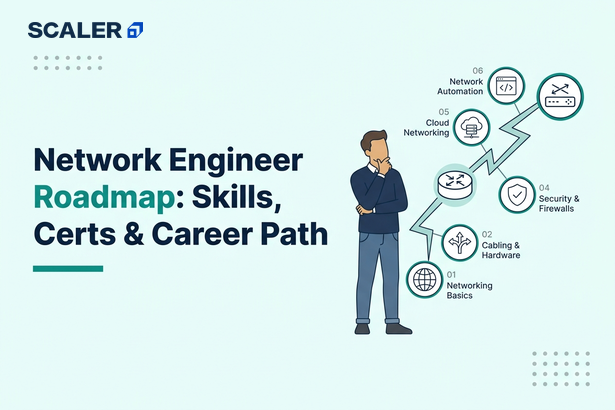
The quickest route to becoming a network engineer is not acquiring certifications, but instead acquiring the correct set of skills in the proper sequence. Start by mastering the basics, follow it up by practicing in labs to reinforce your knowledge, acquire certifications where relevant, and finish by mastering automation skills.
Here’s a practical roadmap you can follow over 18–30 months:
| Phase | Timeline | What You’ll Learn | Milestone |
| Phase 1: Network Fundamentals | Months 1 – 3 | OSI model, TCP/IP, IP addressing, subnetting, routing, switching, DNS, DHCP, and TCP vs UDP | Understand how data moves across a network and troubleshoot basic networking problems confidently. |
| Phase 2: Hands-On Labs | Months 3 – 6 | Cisco Packet Tracer, GNS3, Linux networking commands, device configuration, and troubleshooting | Build and troubleshoot virtual networks using industry-standard lab tools. |
| Phase 3: Certification Ladder | Months 6 – 12 | CCNA exam preparation, routing, switching, VLANs, NAT, ACLs, and network security fundamentals | Earn your CCNA and become ready for entry-level networking roles. |
| Phase 4: Automation & Specialization | Months 12 – 18+ | Python, Ansible, network automation, cloud networking, SDN, and security fundamentals | Automate network tasks, specialize in a domain, and prepare for senior networking roles. |
Also, do not fall into the trap of moving to certification preparation without fully comprehending basic concepts. Having a good knowledge base regarding networking basics will help in performing better in lab exercises, give you more chances of clearing the CCNA, and it will make you ready for an automation-based career in today’s world of networking.
Phase 1: Network Fundamentals Learn These Free First
Before even spending any time or money on any form of certification, spend some time understanding networking basics. All routing, firewall configuration, VLAN settings, and troubleshooting are based on certain basic networking principles. With a good grounding in the basics, it gets easier to learn advanced concepts and even pass certification exams such as CCNA.
Start by focusing on these essential networking concepts:
- OSI Model: Learn how data moves through the seven networking layers and understand where different protocols and devices operate.
- TCP/IP Protocol Suite: Understand how devices communicate with each other over a network using the protocol suite behind the internet.
- IP Addressing & Subnetting: Get proficient in assigning IP addresses, effectively dividing networks, and solving problems with confidence.
- TCP vs UDP: Know which applications require reliable transmission and which require less latency.
- DNS & DHCP: Learn how devices discover IP addresses and how domain names are translated into IP addresses.
Do not treat these as certification topics to memorize. These are concepts that you will need for your entire career whether you are working on resolving issues with connectivity, setting up a router, or planning out the network design for hundreds of people. Understanding how packets travel will make understanding routing protocols and switch configurations easy.
Learn every fundamental here with Scaler’s free Computer Networks course
Once these concepts feel natural, you’re ready to stop reading about networking and start building networks yourself.
Phase 2: Hands-On Labs, Linux & Packet Tracer
Networking is a practical field. It is good to learn things such as routing protocols and VLANs from books, but actual learning comes from configuring equipment and troubleshooting your own mistakes. This is why hands-on work needs to be a part of your learning process way before you take the CCNA certification test.
During this phase, spend most of your time working with tools that simulate real networking environments:
- Cisco Packet Tracer: Build virtual network topologies and practise configuring routers, switches, VLANs, routing protocols, and basic network services.
- GNS3: Create more advanced lab environments using real network operating system images and more realistic enterprise scenarios.
- Home Labs: Experiment with different network configurations, intentionally break them, and learn how to troubleshoot connectivity issues.
- Linux Networking: Get comfortable using commands such as ping, traceroute, ip, ss, netstat, curl, and nslookup to diagnose network problems.
It is not about memorizing the commands from the CLI; instead, it is about knowing how the commands work. It is not expected for the new employees to memorize all the commands, but to resolve network problems through logic.
At the end of this stage, you will feel confident about creating small network topologies, testing connectivity, identifying network problems, and working with Linux for problem-solving. Having such practical skills will greatly ease your preparation for the CCNA exam and help you pass interviews successfully.
Hands-on practice becomes much easier once you’re comfortable with Linux networking. The resources attached will help you get there.
Also Read: Top Linux Networking Commands
Phase 3: The Certification Ladder: What to Take, What to Skip
Certifications can be quite useful once you have a good grasp of networking basics and have some experience from lab work. It helps prove your qualifications, make your resume better, and get more interviews. It is important to have certifications at the right moment; otherwise, it will just be compensation for a lack of knowledge. This CCNA roadmap helps you decide when to prepare for the certification instead of rushing into it before mastering networking fundamentals.
| Certification | Best For | Approx. Exam Cost* | Validity |
| CompTIA A+ | General IT support roles | ₹50,000 (two exams) | 3 years |
| CompTIA Network+ | Vendor-neutral networking foundation | ₹30,000 | 3 years |
| Cisco CCNA | Entry-level network engineers | ₹30,000 | 3 years |
| Cisco CCNP | Mid-level network engineers (2–3 years’ experience) | ₹60,000 (Core + one Concentration exam) | 3 years |
| Cisco CCIE | Senior network specialists and architects | ₹2,00,000 (Written + Lab) | 3 years |
Exam fees are approximate; official prices may vary by country. Always verify the latest pricing and certification policies on the official Cisco and CompTIA websites before registering.
So, Which Certification Should You Actually Take?
If your goal is to become a network engineer, you can safely skip CompTIA A+. It’s designed primarily for help desk and general IT support roles rather than networking.
CompTIA Network+ is an excellent start for those who are new to networking. But if one has already gained knowledge about important things like the OSI model, TCP/IP, subnetting, routing, and switching through practical experience, then most people prefer to directly proceed to CCNA.
For the majority of candidates pursuing a career as network engineers, CCNA holds more significance than any other certification. This is because it is well known to companies and often mentioned among the list of requirements for entry-level positions in networking. Most importantly, what you learn in preparation for CCNA will be useful at work.
Once you’ve spent two to three years working in production environments, CCNP becomes the logical next step. It builds on the fundamentals covered in CCNA and allows you to specialise further. CCIE, meanwhile, is best viewed as a long-term career goal for experienced engineers working in enterprise networking and architecture.
Certifications may help in getting shortlisted for positions, but they cannot substitute for experience. In case of candidates who have several certifications but lack hands-on experience, a candidate with CCNA certification and lab work will always be at an advantage over other candidates. This is why we move to the next phase, which involves developing the skills that a modern-day network engineer needs.
For the most up-to-date information on certification exams, fees, and validity, refer to the official Cisco and CompTIA resources that have been linked to the table.

Free Courses by top Scaler instructors
Phase 4: Automation & Specialization The 2026 Layer
Networking is no longer about setting up routers and switches from the command line interface. Networking professionals have to perform many other activities such as automating repetitive tasks, managing cloud infrastructures, and collaborating with DevOps and security personnel due to increased complexity and size of corporate networks. This explains why network automation has emerged as one of the most important network automation skills.
Once you’ve built strong networking fundamentals and earned your CCNA, focus on these areas:
- Python for Network Automation: Learn how to automate processes like configuring devices, backing up data, and gathering logs rather than doing them manually one by one on each device.
- Ansible – Apply the concept of Infrastructure as Code while managing and configuring network devices.
- Software-Defined Networking (SDN): Learn how to configure and program networks using central management approaches, thereby reducing many legacy manual configurations.
- Cloud Networking: Learn networking concepts in cloud platforms such as AWS VPCs and Azure Virtual Networks, including routing, security groups, load balancers, and hybrid connectivity.
- Security Fundamentals: Build a working knowledge of firewalls, VPNs, access control, and network security best practices. Networking and cybersecurity increasingly overlap, making security awareness an essential skill for modern network engineers.
One of the major mistakes that network engineers commit in their career is settling down at the CCNA level and configuring through manual CLI. Although these are crucial skills for network engineers, more importance is being given to automation of repetitive tasks, solving issues within hybrid networks, and managing cloud networks.
Once you complete this phase, you will feel confident enough to write basic automation scripts, control network devices using Ansible, know cloud networking basics, and get accustomed to modern infrastructures. It is not only good for your career as a network engineer, but also allows you to become a cloud engineer or an infrastructure engineer.
If you’re planning to work with cloud infrastructure or enterprise networks, a basic understanding of networking security is no longer optional!
Career Path & Salaries in India
Network engineering provides clear career progression options, with room to progress from working on troubleshooting and monitoring networks to designing enterprise-scale infrastructure. While entry-level salaries are modest, your earning potential increases significantly as you gain experience and specialize in cloud networking, security, or automation.
| Role | Experience | Typical Annual Salary* |
| NOC Engineer | 0 – 2 years | ₹3 – 5 LPA |
| Network Engineer | 2 – 5 years | ₹5 – 10 LPA |
| Senior Network Engineer | 5 – 8 years | ₹6 – 15 LPA |
| Network Architect | 8+ years | ₹15 – 30 LPA |
The above salary range is only indicative and can vary from place to place depending on factors like certifications and specialization. Please check out the latest salary range on Glassdoor.
With growing experience in the field, you need not confine yourself to the conventional role of routing and switching. Some network engineers decide to specialize in high-growth fields, such as:
- Cloud Networking: Design and manage networking infrastructure across AWS, Azure, and Google Cloud.
- Network Security: Focus on firewalls, VPNs, intrusion prevention, Zero Trust, and secure enterprise networks.
- Network Automation: Use Python, Ansible, and infrastructure-as-code tools to automate network operations and reduce manual configuration.
- Infrastructure & DevOps: Combine networking expertise with Linux, containers, CI/CD, and cloud platforms to build and manage modern infrastructure.
The networking profession is evolving rapidly. Employers still value strong routing and switching fundamentals, but engineers who understand automation, cloud networking, and security are increasingly in demand. Building these skills alongside your networking expertise will open up more opportunities and help you progress into higher-paying infrastructure roles.
The network engineer career path offers a clear progression from NOC Engineer to Network Architect. As you gain experience, you’ll also build advanced network engineer skills in cloud networking, automation, and security.
Network automation is the bridge into cloud and DevOps roles. Explore Scaler’s DevOps Program to take your first step into your learning journey.
Scaler Alumni and Their Success Stories
Read These Important Roadmaps: More Paths to Career Success
FAQs
Q1. How do I become a network engineer step by step?
Start with networking fundamentals like the OSI model, TCP/IP, subnetting, and DNS. Then build hands-on experience using Packet Tracer, GNS3, and Linux. Once you’re comfortable with the basics, earn your CCNA and add Python and Ansible skills to prepare for modern networking roles.
Q2. Is CCNA enough to get a networking job?
For most entry-level networking roles in India, CCNA is the benchmark certification. Pair it with strong networking fundamentals and hands-on lab experience, as employers value practical skills just as much as certifications.
Q3. Do I need a degree to become a network engineer?
No. Most employers prioritize CCNA, practical networking skills, and lab experience over formal qualifications. However, a B.Tech or BCA can help during initial screening at larger organizations.
Q4. Should I do CompTIA Network+ before CCNA?
Among entry-level network engineer certifications, Network+ is a good vendor-neutral introduction, but if you’ve already mastered networking fundamentals, you can go straight to CCNA and save both time and money.
Q5. Is networking a good career in 2026?
Yes. While traditional routing and switching remain important, employers increasingly look for engineers with Python, Ansible, cloud networking, and automation skills alongside strong networking fundamentals.
Q6. How long does it take to become a network engineer?
Most learners spend 3 – 6 months building networking fundamentals, another 3 – 6 months on labs and CCNA preparation, and become job-ready within 18 – 36 months, depending on their consistency and hands-on practice.
