





Master DSA in 2026 with our comprehensive Data Structures and Algorithms roadmap! Get step-by-step guidance, expert tips, and essential resources to elevate your coding skills.
If you’re dreaming of becoming a software engineer, the first thing you’ll hear from every coder is: “Start with DSA.” The DSA roadmap is the key to excelling in problem-solving and building a strong foundation for coding interviews. Whether you’re aiming for FAANG, startups, or top service companies, a solid understanding of data structures and algorithms can open countless doors.
According to Glassdoor reports, demand for data structures and algorithms (DSA) skills in tech jobs is significantly high, especially at product-based companies, where proficiency is considered a hallmark of a good software developer.
This data structures and algorithms roadmap for beginners will help you learn DSA from scratch, understand concepts step-by-step, and prepare effectively for interviews in 2026.
We understand how tricky it gets to prepare. From coding basics to advanced algorithms, this DSA roadmap walks you through everything you need to know, including how to practice DSA daily and ace those tricky technical interviews.
Transform Your Career
Choose from our industry-leading programs designed for career success
Modern Software and AI Engineering Program
Master full-stack development with AI integration


 +1000 more
Modern Data Science and ML with specialisation in AI
Advanced data science techniques with AI specialization
+1000 more
Advanced AIML with Specialisation in Agentic AI
Deep dive into AIML with focus on Agentic systems
+1000 more
DevOps, Cloud & AI Platform Engineering
Build and manage AI-powered cloud infrastructure
+1000 more
AI Engineering Advanced Certification by IIT-Roorkee
Premier AI engineering certification from IIT-Roorkee

What is DSA and Why is it Important?
Before getting into the details of the DSA roadmap 2026, let’s quickly understand what DSA actually means. DSA stands for Data Structures and Algorithms.
Data structures focus on how data is stored and organized for efficient access and modification. Algorithms are step-by-step procedures for processing this data to solve specific problems.
Why is DSA so important?
Because every time you use a search engine, scroll through social media, or even run an app on your phone, DSA is at work behind the scenes. Efficient data structures and algorithms make these systems fast, scalable, and optimized.
For coders, a strong grasp of DSA improves logical thinking, helps you write efficient code, and prepares you for real-world problem-solving. That’s why every top company tests DSA skills during coding interviews.
Step-by-Step DSA Roadmap
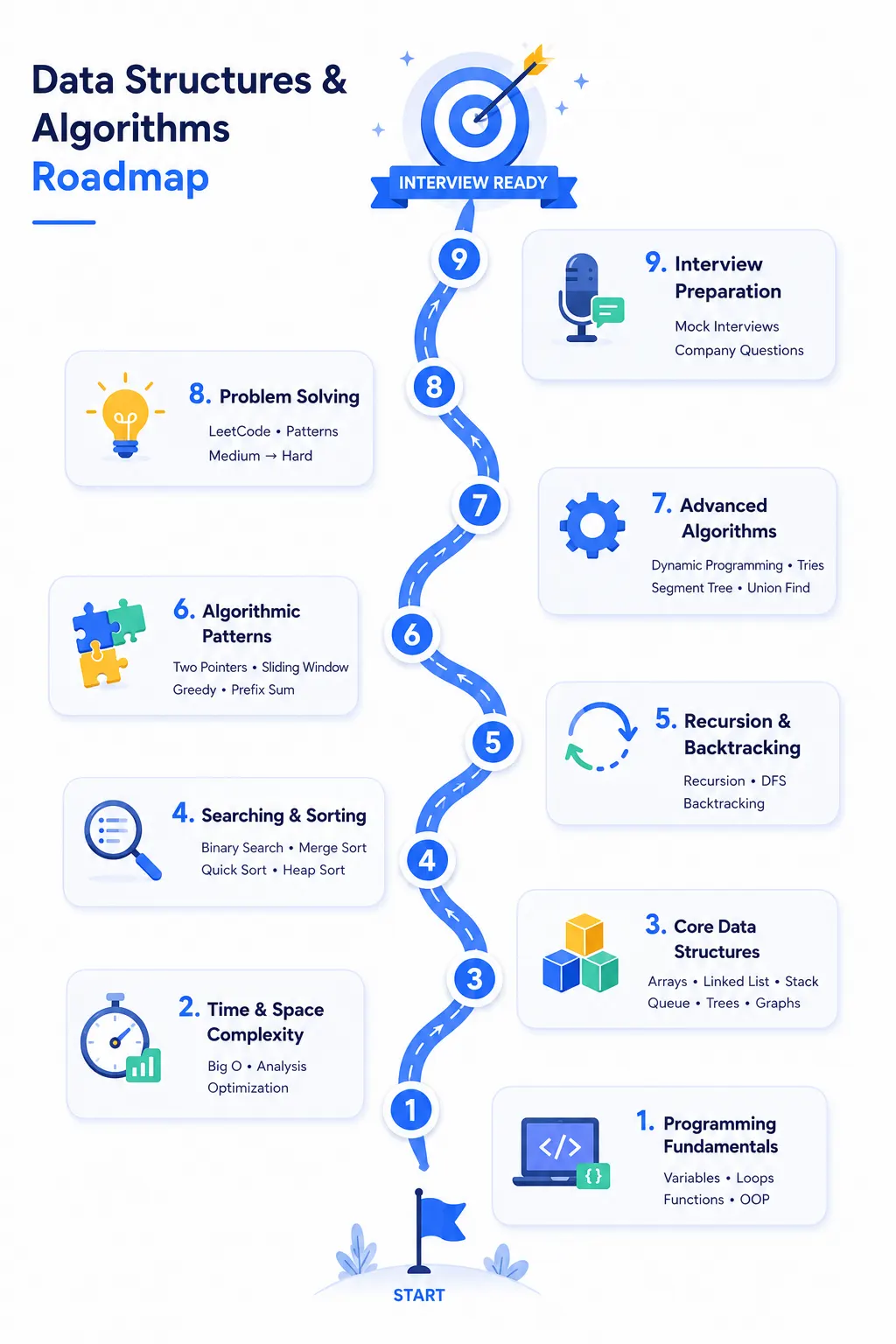
This data structures and algorithms roadmap is designed to help you learn DSA from scratch, one concept at a time, so you can move confidently from the basics to advanced problem-solving and interview preparation.
Step 1: Learn a Programming Language (Weeks 1-2)
To begin, pick one programming language: C++, Java, or Python. For beginners, Python is the most beginner-friendly, while C++ is preferred for competitive programming and Java is widely used in enterprise interviews.
Focus on mastering these basics:
- Variables, data types, and operators
- Loops and conditionals
- Functions and recursion
- Arrays and strings
- Object-Oriented Programming (OOP) concepts
- Basic memory management
Understanding your chosen programming language deeply will make your DSA journey much smoother.
Which language should you pick?
- Python: Best for beginners, readable syntax, quick to write
- Java: Industry standard, strongly typed, great for FAANG interviews
- C++: Fastest execution, essential for competitive programming
Step 2: Master Time & Space Complexity (Weeks 2-3)
The next crucial step in this DSA roadmap is understanding Big O notation, which tells you how efficient your program is as input size grows.
Common Time Complexities (Best to Worst):
Notation | Name | Example |
| O(1) | Constant | Array access by index |
| O(log n) | Logarithmic | Binary search |
| O(n) | Linear | Finding max in array |
| O(n log n) | Log-linear | Merge sort, Quick sort |
| O(n²) | Quadratic | Bubble sort, nested loops |
| O(2^n) | Exponential | Recursive Fibonacci |
| O(n!) | Factorial | Permutations |
Understanding complexity helps you write optimized solutions — a skill highly valued in coding interviews. A solution that works on small inputs might fail completely on larger datasets if you ignore time and space complexity.
Learn more: Time Complexity in Data Structures
Step 3: Core Data Structures (Weeks 4-7)
Now we arrive at the heart of this DSA roadmap — the core data structures. Master each one thoroughly before moving ahead.
1. Arrays & Strings
Arrays store elements in contiguous memory locations, allowing O(1) access by index. Strings are character arrays with special operations.
Key Operations:
- Access: O(1) | Search: O(n) | Insert/Delete: O(n)
- Practice: Two Sum, Maximum Subarray, Reverse String, Valid Palindrome, Longest Common Prefix
2. Linked Lists
Linked lists store elements as nodes connected by pointers, enabling efficient insertions and deletions.
Types: Singly Linked, Doubly Linked, Circular Linked List
Key Operations: Insert/Delete at head: O(1) | Search: O(n)
Practice: Reverse Linked List, Detect Cycle, Merge Two Sorted Lists, Remove Nth Node From End
3. Stacks & Queues
- Stack (LIFO): Last In, First Out — used in recursion, undo operations, expression evaluation
- Queue (FIFO): First In, First Out — used in BFS, task scheduling, caching
Practice: Valid Parentheses, Min Stack, Implement Queue Using Stacks, Sliding Window Maximum
4. Hash Tables (HashMaps / HashSets)
Hash tables provide O(1) average-time lookups, making them essential for frequency counting and fast data retrieval.
Practice: Two Sum, Group Anagrams, Longest Consecutive Sequence, Subarray Sum Equals K
5. Trees & Binary Trees
Trees are hierarchical data structures. Binary trees have at most two children per node. Key Concepts:
- Binary Search Trees (BST): Left < Root < Right
- Tree Traversals: Inorder, Preorder, Postorder, Level Order
- Height, Depth, Balance Factor
Practice: Maximum Depth, Validate BST, Lowest Common Ancestor, Binary Tree Level Order Traversal
6. Heaps & Priority Queues
Heaps are complete binary trees that maintain a specific ordering property.
Types: Min-Heap (smallest at root), Max-Heap (largest at root)
Practice: Kth Largest Element, Merge K Sorted Lists, Top K Frequent Elements, Median of Data Stream
7. Graphs
Graphs model relationships between entities using nodes (vertices) and edges.
Key Algorithms: BFS, DFS, Dijkstra's, Bellman-Ford, Floyd-Warshall, Topological Sort
Practice: Number of Islands, Course Schedule, Clone Graph, Word Ladder, Network Delay Time

Free Courses by top Scaler instructors
DSA Cheat Sheet — Quick Reference
| Data Structure | Insert | Delete | Search | Space | Best Use Case |
| Array | O(n) | O(n) | O(1) access, O(n) search | O(n) | Fixed-size data, random access |
| Linked List | O(1) at head | O(1) at head | O(n) | O(n) | Frequent insertions/deletions |
| Stack | O(1) | O(1) | O(n) | O(n) | Undo, DFS, expression parsing |
| Queue | O(1) | O(1) | O(n) | O(n) | BFS, task scheduling |
| Hash Map | O(1) avg | O(1) avg | O(1) avg | O(n) | Fast lookup, frequency count |
| BST | O(log n) avg | O(log n) avg | O(log n) avg | O(n) | Sorted data, range queries |
| Heap | O(log n) | O(log n) | O(1) peek | O(n) | Top-K, priority scheduling |
| Graph | O(1) | O(V+E) | O(V+E) | O(V+E) | Networks, pathfinding |
| Algorithm | Best Case | Average Case | Worst Case | Space |
| Binary Search | O(1) | O(log n) | O(log n) | O(1) |
| Bubble Sort | O(n) | O(n²) | O(n²) | O(1) |
| Merge Sort | O(n log n) | O(n log n) | O(n log n) | O(n) |
| Quick Sort | O(n log n) | O(n log n) | O(n²) | O(log n) |
| BFS | O(V+E) | O(V+E) | O(V+E) | O(V) |
| DFS | O(V+E) | O(V+E) | O(V+E) | O(V) |
| Dijkstra's | O(E log V) | O(E log V) | O(E log V) | O(V) |
Step 4: Core Algorithms (Weeks 8-10)
Once you understand data structures, it's time to master the algorithms that operate on them.
1. Searching Algorithms
- Linear Search: O(n) — check each element sequentially
- Binary Search: O(log n) — divide and conquer on sorted data
- Practice: Search in Rotated Sorted Array, Find Peak Element, First and Last Position
2. Sorting Algorithms
- Bubble Sort: O(n²) — simple but inefficient
- Merge Sort: O(n log n) — divide and conquer, stable
- Quick Sort: O(n log n) average — in-place, widely used
- Heap Sort: O(n log n) — uses heap data structure
- Practice: Sort an array of 0s, 1s, and 2s; Merge Intervals; Kth Largest Element
3. Recursion & Backtracking
- Recursion: Function calling itself with a base case
- Backtracking: Explore all possibilities, prune invalid paths
- Practice: Permutations, N-Queens, Sudoku Solver, Combination Sum, Word Search
Scaler Placement Report and Statistics
Scaler learners achieved 2.5x salary growth with average post-Scaler CTC reaching ₹23L.
 Google
 Amazon
 Microsoft
 Flipkart
 Adobe
1200+ more
Adobe
1200+ more
4. Greedy Algorithms
Make the locally optimal choice at each step, hoping for a global optimum. Practice: Activity Selection, Huffman Coding, Fractional Knapsack, Jump Game
5. Divide & Conquer
Break problems into smaller subproblems, solve independently, combine results. Practice: Merge Sort, Quick Sort, Strassen's Matrix Multiplication
6. Dynamic Programming (DP) — The Interview Game Changer
DP is the most feared DSA topic and often the deciding factor in FAANG interviews. It solves complex problems by breaking them into overlapping subproblems and storing results to avoid redundant computation.
DP Patterns You Must Know:
| Pattern | Classic Problems | Key Idea |
| 1D DP | Climbing Stairs, House Robber, Jump Game | dp[i] depends on previous states |
| 2D DP | Unique Paths, Minimum Path Sum, Edit Distance | dp[i][j] based on grid neighbors |
| 0/1 Knapsack | Knapsack, Partition Equal Subset Sum | Include or exclude each item |
| Unbounded Knapsack | Coin Change, Rod Cutting | Items can be reused |
| LCS | Longest Common Subsequence, Palindrome | Match or skip characters |
| Interval DP | Matrix Chain Multiplication, Burst Balloons | Try all split points |
| Tree DP | Tree Diameter, House Robber III | Bottom-up on trees |
How to Approach Any DP Problem:
- Identify if the problem has overlapping subproblems and optimal substructure
- Define the state (what variables change?)
- Write the recurrence relation
- Determine base cases
- Choose: Memoization (top-down) or Tabulation (bottom-up)
- Optimize space if possible
Must-Practice DP Problems: Fibonacci, Climbing Stairs, House Robber, Coin Change, 0/1 Knapsack, Longest Common Subsequence, Edit Distance, Longest Increasing Subsequence, Matrix Chain Multiplication, Unique Paths
Step 5: Advanced Topics (Weeks 11-12)
Once you've mastered the basics, these advanced topics will give you a competitive edge:
Advanced Graph Algorithms
- Dijkstra's Algorithm: Shortest path in weighted graphs (O(E log V))
- Floyd-Warshall: All-pairs shortest path (O(V³))
- Kruskal's & Prim's: Minimum Spanning Tree
- Bellman-Ford: Shortest path with negative weights
- Topological Sort: Ordering for DAGs (Kahn's Algorithm)
- Union-Find (DSU): Efficient cycle detection and connectivity
Advanced Dynamic Programming
- Matrix Chain Multiplication
- Longest Increasing Subsequence (O(n log n))
- DP with Bitmasking
- Digit DP
Advanced Data Structures
- Segment Trees: Range queries in O(log n)
- Fenwick Trees (BIT): Prefix sum queries
- Tries (Prefix Trees): String searching and autocomplete
- Disjoint Set Union (DSU): Efficient set operations
Step 6: Practice & Problem-Solving (Ongoing)
Theory alone won't cut it — you need consistent practice!
Best Platforms for DSA Practice:
- LeetCode — Industry standard for interview prep
- Codeforces — Competitive programming
- HackerRank — Beginner-friendly
- Scaler Problems — Curated challenges
Daily Practice Routine:
| Difficulty | Time Per Problem | Problems Per Week | Focus |
| Easy | 20-30 mins | 10-15 | Build fundamentals |
| Medium | 45-60 mins | 7-10 | Interview-level |
| Hard | 60-90 mins | 3-5 | Advanced problem-solving |
Popular Structured Problem Sheets:
- Striver's A2Z DSA Sheet — Comprehensive, highly recommended for Indian placements
- NeetCode 150 — Curated by patterns, great for FAANG prep
- Blind 75 — Essential 75 problems covering all patterns
- Scaler DSA Problem Sets — Topic-wise practice with solutions
Focus on patterns, not random problems: Arrays & Strings → Two Pointers → Sliding Window → Binary Search → Trees → Graphs → Dynamic Programming → Backtracking.
DSA Roadmap for Placements: 3-Month vs 6-Month Plan
3-Month Intensive Plan (For Campus Placements)
| Month | Focus Areas | Daily Hours | Target Problems |
| Month 1 | Arrays, Strings, Linked Lists, Stacks, Queues | 3-4 hrs | 60-80 (Easy-Medium) |
| Month 2 | Trees, Graphs, Binary Search, Hashing | 3-4 hrs | 50-60 (Medium) |
| Month 3 | Dynamic Programming, Greedy, Advanced Topics + Mock Interviews | 4-5 hrs | 40-50 (Medium-Hard) + 5 mocks |
6-Month Comprehensive Plan (For Deep Mastery)
| Phase | Duration | Focus | Target |
| Foundation | Weeks 1-4 | Language basics, Arrays, Strings, Complexity | 40 Easy problems |
| Core DS | Weeks 5-10 | Linked Lists, Stacks, Queues, Trees, Hash Maps | 60 Medium problems |
| Algorithms | Weeks 11-16 | Sorting, Searching, Recursion, Backtracking, Greedy | 50 Medium problems |
| Advanced | Weeks 17-22 | Graphs, DP, Tries, Segment Trees | 40 Hard problems |
| Interview Prep | Weeks 23-26 | Mock interviews, Company-specific questions, System Design basics | 20+ mocks |
Scaler Alumni and Their Success Stories
DSA Interview Questions — Pattern-Wise Breakdown
Understanding concepts is one thing, but applying them under interview pressure is what truly matters. Here are the most commonly asked DSA interview questions organized by pattern:
Arrays & Strings
Two Pointers
- Two Sum II (Input Array is Sorted)
- 3Sum (Find all triplets that sum to zero)
- Container With Most Water
- Trapping Rain Water
- Valid Palindrome II
Sliding Window
- Longest Substring Without Repeating Characters
- Minimum Window Substring
- Sliding Window Maximum
- Longest Repeating Character Replacement
- Find All Anagrams in a String
Binary Search
- Binary Search (Basic)
- Search in Rotated Sorted Array
- Find First and Last Position of Element in Sorted Array
- Koko Eating Bananas
- Median of Two Sorted Arrays
Linked List
- Reverse a Linked List
- Detect Cycle in Linked List
- Merge Two Sorted Lists
- Remove Nth Node From End
- Add Two Numbers
Trees & Binary Search Trees (BST)
- Maximum Depth of Binary Tree
- Validate Binary Search Tree
- Lowest Common Ancestor
- Binary Tree Level Order Traversal
- Serialize and Deserialize Binary Tree
Graphs
- Number of Islands
- Course Schedule (Topological Sort)
- Clone Graph
- Word Ladder
- Network Delay Time (Dijkstra’s Algorithm)
Dynamic Programming
- Climbing Stairs
- House Robber I & II
- Coin Change
- Longest Common Subsequence
- 0/1 Knapsack Problem
Tips to Master DSA Faster
Learning DSA is not a sprint; it's a marathon. Here are proven tips to accelerate your journey:
- Don't rush fundamentals — Understanding why an algorithm works is more important than memorizing it
- Maintain a problem journal — Log every problem you solve with approach, complexity, and key learnings
- Learn by teaching — Explain concepts to peers or write blog posts; teaching reveals gaps in your understanding
- Mix theory and practice daily — Study concepts in the morning, solve problems in the evening
- Follow the 30-minute rule — Try solving a problem for 30 minutes before checking the solution
- Track your patterns — Note which problem types trip you up and revisit them weekly
- Participate in contests — Weekly LeetCode contests simulate real interview pressure
Career Opportunities After Learning DSA
Mastering DSA opens doors to high-paying roles across the tech industry. Here's why companies invest heavily in DSA assessments:
DSA skills are the foundation for:
- Technical interview rounds at FAANG and top product companies
- Competitive programming and coding contests
- System design thinking for large-scale applications
- Real-world problem-solving in production environments
Roles Where DSA is Essential
| Role | DSA Topics Tested | Companies |
| Software Engineer | Arrays, Trees, Graphs, DP, System Design | Google, Amazon, Microsoft, Meta |
| Data Engineer | SQL, Arrays, Hashing, Optimization | Uber, Airbnb, Netflix |
| Backend Developer | Trees, Graphs, Hash Maps, Caching | Stripe, Shopify, Zomato |
| AI/ML Engineer | Graphs, Optimization, Matrix Operations | OpenAI, DeepMind, Tesla |
| SDE Intern | Arrays, Strings, Basic Trees/Graphs | All top tech firms |
Salary Insights (India, 2026)
| Experience Level | Salary Range (LPA) | Top Companies |
| Entry Level (0-2 yrs) | ₹5-12 LPA | Startups, Service companies |
| Mid Level (2-5 yrs) | ₹12-25 LPA | Product companies, Unicorns |
| Senior Level (5+ yrs) | ₹25-50+ LPA | FAANG, Top product firms |
Source: Glassdoor India
Pro Tip: Bangalore, Hyderabad, and Pune typically offer 15-25% higher salaries for DSA-skilled developers compared to other Indian tech hubs.
System Design Roadmap — What Comes After DSA?
Once you've mastered DSA, the natural next step is system design. This is crucial for senior roles and FAANG interviews.
When to Start System Design:
- After completing 100+ DSA problems comfortably
- When you can solve Medium-level problems in 30-40 minutes
- Typically in your 2nd year of preparation or before senior-level interviews
Key System Design Topics:
- Load Balancing & Caching (Redis, Memcached)
- Database Design (SQL vs NoSQL, Sharding, Replication)
- Microservices Architecture
- Message Queues (Kafka, RabbitMQ)
- CDN & Content Delivery
- Rate Limiting & Consistent Hashing
- CAP Theorem & Distributed Systems
Resources: System Design Primer (GitHub), Grokking System Design, Alex Xu's books
Conclusion
Your complete DSA roadmap for 2026:
- Learn a programming language (C++/Java/Python) — Weeks 1-2
- Master time & space complexity — Weeks 2-3
- Core data structures (Arrays → Linked Lists → Trees → Graphs) — Weeks 4-7
- Core algorithms (Searching → Sorting → Recursion → DP) — Weeks 8-10
- Advanced topics (Advanced Graphs, Tries, Segment Trees) — Weeks 11-12
- Practice & interview prep — Ongoing
Start small, stay consistent, and remember: every expert was once a beginner. DSA isn't inherently difficult — it just requires structured learning and daily practice.
Ready to accelerate your DSA journey? Explore Scaler's Data Structures & Algorithms Program for mentorship-led learning and real-world problem-solving.
Read These Important Roadmaps: More Paths to Career Success
FAQs
1.What should I learn first: data structures or algorithms?
Start with data structures — specifically arrays, strings, linked lists, stacks, queues, and hash maps. Once comfortable with how data is organized, move to algorithms like searching, sorting, recursion, and dynamic programming. Data structures are the building blocks; algorithms are the techniques that process them.
2.How long will it take to master DSA?
With consistent daily practice of 2-3 hours, you can build strong DSA fundamentals in 3-4 months. However, "mastery" is ongoing — even experienced engineers continue learning. Focus on solving 150-200 quality problems across all major topics rather than rushing through concepts.
3.Can I learn DSA without a CS degree?
Absolutely! Many self-taught developers have cracked top tech jobs by following a structured DSA roadmap. The key is consistent practice, understanding patterns (not memorizing solutions), and building projects that demonstrate your skills. Platforms like Scaler offer structured courses with mentorship support.
4.Which programming language is best for DSA?
- C++: Best for competitive programming (fast execution, rich STL)
- Java: Ideal for interviews (strongly typed, widely accepted at FAANG)
- Python: Perfect for beginners (readable syntax, quick implementation)
Choose based on your comfort level and career goals. Don't switch languages mid-preparation.
5.How many problems should I solve before interviews?
Aim for 150-200 quality problems covering all major patterns: Arrays, Strings, Two Pointers, Sliding Window, Binary Search, Trees, Graphs, Dynamic Programming, and Backtracking. Focus on understanding patterns deeply rather than solving hundreds of similar problems.
6.What is the best DSA sheet for placements in India?
Popular choices include Striver's A2Z DSA Sheet (comprehensive, free), NeetCode 150 (pattern-based, excellent for FAANG), and the Blind 75 (essential problems). Choose one sheet and complete it thoroughly rather than jumping between multiple resources.
7.How do I approach dynamic programming problems?
Follow this 5-step framework:
- Identify if it has overlapping subproblems and optimal substructure,
- Define the state,
- Write the recurrence relation,
- Determine base cases,
- Choose memoization or tabulation.
Practice recognizing common DP patterns — most interview DP problems fall into 5-6 categories.
8.When should I start system design after DSA?
Begin system design preparation after solving 100+ quality DSA problems and feeling comfortable with medium-difficulty questions. For freshers, DSA takes priority. For experienced professionals (3+ years), start system design alongside advanced DSA topics.
9.Is DSA required for data science or AI careers?
Yes! DSA builds the logical thinking and efficiency skills needed for handling large datasets, optimizing algorithms, and writing production-grade code. While data science roles may emphasize statistics and ML more, strong DSA fundamentals give you a significant edge in technical interviews and real-world problem-solving.
