




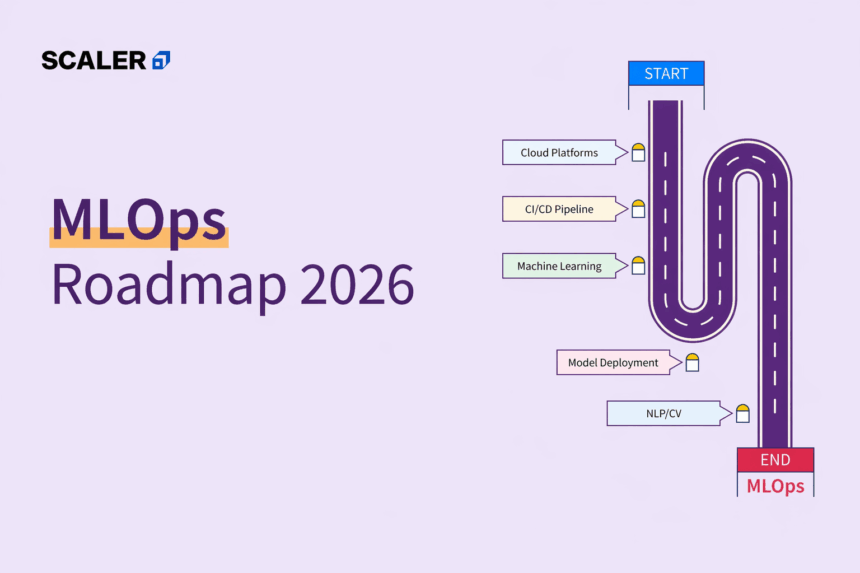
Machine learning (ML) is transforming industries worldwide, yet deploying and managing ML models in production remains a significant challenge. The rapidly evolving landscape of MLOps (Machine Learning Operations) addresses these issues by streamlining the development, deployment, and management of ML models. The demand for MLOps solutions is projected to surge from $3.8 billion in 2021 to an impressive $21.1 billion by 2026, highlighting its essential role in the future of AI.
This MLOps Roadmap delves into the entire machine learning lifecycle, guiding you through each critical phase and providing the skills needed to excel as an MLOps engineer. By following this MLOps Roadmap, organizations can tackle common obstacles such as slow deployment cycles, model drift, and the complexities of scaling ML, ensuring more robust and reliable AI deployments.
Ready to accelerate your MLOps career? Explore Scaler’s Data Science & Machine Learning program, designed to take you from fundamentals to production-ready ML systems with hands-on projects and expert mentorship.
What is MLOps?
MLOps, short for Machine Learning Operations, is a framework that merges principles from DevOps (software development and IT operations) with the specialized needs of the machine learning lifecycle. It encompasses practices, tools, and processes aimed at automating and streamlining the deployment, monitoring, and maintenance of ML models in production. By integrating machine learning, software engineering, and operations, MLOps enables a seamless workflow that accelerates ML project delivery and reliability.

The primary objective of MLOps is to bridge the gap between data scientists and IT teams, ensuring that models can be deployed quickly, consistently, and at scale. This approach is essential for organizations seeking to leverage AI and ML effectively in their operations, allowing them to unlock the full potential of machine learning while minimizing operational challenges and maximizing model performance.
Transform Your Career
Choose from our industry-leading programs designed for career success
Modern Software and AI Engineering Program
Master full-stack development with AI integration


 +1000 more
Modern Data Science and ML with specialisation in AI
Advanced data science techniques with AI specialization
+1000 more
Advanced AIML with Specialisation in Agentic AI
Deep dive into AIML with focus on Agentic systems
+1000 more
DevOps, Cloud & AI Platform Engineering
Build and manage AI-powered cloud infrastructure
+1000 more
AI Engineering Advanced Certification by IIT-Roorkee
Premier AI engineering certification from IIT-Roorkee

Key Components of MLOps
- Version Control & CI/CD: Tracking code, data, and model changes with version control. CI/CD (Continuous Integration/Continuous Delivery) automates builds, testing, and deployment.
- Orchestration: Managing complex workflows and dependencies in the MLOps process.
- Experiment Tracking & Model Registries: Recording experiments, hyperparameters, and results. Model registries store and manage different model versions.
- Data Lineage & Feature Stores: Tracking data sources and transformations for auditability. Feature stores manage and share processed data for model training and serving.
- Model Training & Serving: Automating model (re)training, packaging, and deployment for real-time or batch predictions.
- Monitoring & Observability: Monitoring model performance, data drift, and system health to detect issues and maintain model accuracy.
- Infrastructure as Code: Managing and provisioning infrastructure (servers, storage, etc.) using code for consistency and ease of scaling.

Exploring your roadmap? Enhance it with a free live masterclass by industry experts.
What Does an MLOps Engineer Do?
An MLOps engineer sits at the intersection of data science, software engineering, and IT operations. While data scientists focus on building and training models, and software engineers focus on application development, the MLOps engineer ensures that ML models actually work reliably in production — at scale.
Day-to-day responsibilities include:
- Building and maintaining data and ML pipelines that automate the flow from raw data to model predictions
- Containerising models and deploying them as APIs (real-time) or batch jobs
- Setting up monitoring systems to track model performance, data drift, and system health
- Automating model retraining when performance degrades or new data arrives
- Collaborating across data science, engineering, and operations teams to ensure smooth handoffs
- Managing version control for code, data, models, and configurations
- Optimising infrastructure costs while maintaining low-latency inference
- Increasingly, operationalising LLMs and building RAG (Retrieval-Augmented Generation) pipelines in production
How is this different from related roles?
| Role | Primary Focus | Overlap with MLOps |
| Data Scientist | Building models, feature engineering, experimentation | MLOps takes their models to production |
| ML Engineer | Model development, training pipelines, algorithm selection | MLOps focuses on deployment, monitoring, and automation |
| DevOps Engineer | CI/CD, infrastructure, system reliability | MLOps extends DevOps to handle data, models, and retraining |
| Data Engineer | Data pipelines, warehouses, ETL processes | MLOps consumes their data pipelines and adds ML-specific monitoring |
Phases of MLOps

The MLOps Engineer Learning Roadmap (7 Phases)
This is the structured, month-by-month path to becoming a job-ready MLOps engineer in 2026. Each phase builds on the previous one, with a concrete milestone project to prove your skills.
| Phase | Duration | What to Learn | Key Tools | Milestone Project |
| 1: Foundations | 4–6 weeks | Python, Bash, Git, SQL, Linux basics | Python, Git, Linux, SQLite | Versioned data-processing script with Git |
| 2: ML Fundamentals | 4–6 weeks | ML paradigms, model training, evaluation, feature engineering | scikit-learn, NumPy, Pandas, PyTorch/TensorFlow | Trained and evaluated ML model with cross-validation |
| 3: DevOps Core | 6 weeks | Docker, CI/CD, cloud basics (AWS/GCP/Azure), Linux admin | Docker, GitHub Actions, AWS/GCP/Azure | Containerised app with automated CI/CD pipeline |
| 4: MLOps Core | 6–8 weeks | Experiment tracking, data/model versioning, ML pipelines, model registry | MLflow, DVC, Kedro | Tracked experiments with versioned models in a registry |
| 5: Orchestration & Serving | 6–8 weeks | Kubernetes, workflow orchestration, model serving (real-time + batch) | Kubeflow, Apache Airflow, BentoML, KServe | ML pipeline orchestrated on K8s with live model serving |
| 6: Monitoring & Production | 4 weeks | Drift detection, observability, automated retraining, A/B testing | Prometheus, Grafana, Evidently, Argo Workflows | Drift-monitored pipeline with automatic retraining triggers |
| 7: LLMOps (2026) | 4–6 weeks | LLM serving, RAG pipelines, prompt management, LLM evaluation, guardrails | LangChain/LangGraph, LangSmith, vLLM, Pinecone/Chroma/Weaviate | Production RAG application with monitoring and evaluation |
Total timeline: 6–12 months depending on your starting point and weekly time commitment.
🚀 Prefer guided learning with mentorship? Scaler's Data Science & Machine Learning program covers Phases 1–6 in a structured curriculum with hands-on projects, expert review, and career support.

Free Courses by top Scaler instructors
Phase-by-Phase Skill Breakdown
Phase 1: Building Foundational Skills
MLOps draws on expertise across multiple fields. Mastering these foundational skills is a crucial first step:
Programming Proficiency
- Python: Focus on data manipulation libraries (NumPy, Pandas) and model-building frameworks (scikit-learn, TensorFlow, PyTorch)
- Go: Learn basics for building high-performance MLOps services (Cobra for CLIs, GoCD for CI/CD)
- IDEs: PyCharm, VS Code with debugging, code completion, and visualisation features
- Bash & Command Line: Essential for server interaction, automation scripts, and infrastructure management
Containerization and Orchestration
- Docker: Package ML applications as portable, self-contained containers for consistent deployment across environments
- Kubernetes: Understand pods, deployments, services, and autoscaling for managing containerised MLOps at scale
Data Management
- SQL: Develop proficiency in relational databases — joins, aggregations, and optimisation for efficient data retrieval
- Data Manipulation & Cleaning: Master Pandas for real-world data preparation, transformation, and feature engineering
Version Control & CI/CD Pipelines
- Git: Track changes to code, data, and models; enable collaboration and rollback
- CI/CD: Automate builds, testing, and deployment with Jenkins, CircleCI, or GitHub Actions


Phase 2: Machine Learning Fundamentals
- Core Concepts: Supervised, unsupervised, and reinforcement learning paradigms; algorithm selection for specific problems
- Practical Implementation: Data splitting, model training, hyperparameter tuning, cross-validation, and performance evaluation
- Frameworks: scikit-learn for classical ML; TensorFlow or PyTorch for deep learning
Phase 3: DevOps for ML
- Linux Administration: Server management, networking basics, shell scripting
- Cloud Platforms: AWS, GCP, or Azure — focus on compute, storage, and ML services
- CI/CD for ML: Adapt traditional pipelines to handle data validation, model testing, and automated deployment
- Infrastructure as Code: Terraform, CloudFormation for reproducible ML infrastructure
Phase 4: MLOps Core Practices
- Experiment Tracking: Log parameters, metrics, and artefacts; compare runs systematically
- Model Registry: Store, version, and manage model artefacts for deployment
- Data Versioning: Track dataset changes alongside code changes for reproducibility
- Pipeline Automation: Chain data prep → training → evaluation → deployment into reproducible workflows
Phase 5: Orchestration & Serving
- Kubernetes for ML: Deploy and scale model serving endpoints; manage resource allocation
- Workflow Orchestration: Schedule and monitor complex multi-step ML pipelines
- Model Serving: Real-time APIs (FastAPI, BentoML) and batch prediction jobs
- A/B & Canary Deployments: Safely roll out new model versions with traffic splitting
Phase 6: Monitoring & Production
- Performance Monitoring: Track latency, throughput, error rates, and resource utilisation
- Drift Detection: Identify data drift and concept drift before model quality degrades
- Automated Retraining: Trigger retraining pipelines when drift thresholds are crossed
- Observability Dashboards: Visualise model health, prediction distributions, and system metrics



Phase 7: LLMOps (The 2026 Evolution)
This phase is new but essential. The MLOps landscape in 2026 has shifted significantly toward operationalising large language models:
- LLM Serving & Scaling: Deploy LLMs with tools like vLLM, TGI, or BentoML; manage GPU allocation and inference optimisation
- RAG Pipelines in Production: Build retrieval-augmented generation systems with vector databases (Pinecone, Chroma, Weaviate), chunking strategies, and embedding models
- Prompt & Version Management: Track prompt iterations, A/B test different prompts, and maintain prompt versioning alongside model versions
- LLM Evaluation: Use frameworks like RAGAS, LLM-as-judge, and LangSmith to evaluate output quality, factuality, and safety
- Guardrails & Safety: Implement content filtering, hallucination detection, and compliance monitoring for production LLMs
- Cost & Latency Monitoring: Track token usage, inference costs, and response times — critical for LLM economics
MLOps Tools — Categorized Comparison (2026)
Rather than learning every tool, focus on one strong option per category. Here's the modern MLOps stack:
| Category | Tools | What It Does |
| Experiment Tracking | MLflow, Weights & Biases | Log parameters, metrics, and artefacts; compare model runs |
| Data & Model Versioning | DVC, LakeFS | Version datasets and models alongside Git for reproducibility |
| Orchestration | Apache Airflow, Kubeflow, Prefect | Define, schedule, and monitor complex ML pipelines |
| ML Pipelines | TensorFlow Extended (TFX), Kedro | Production-ready pipeline components with built-in validation |
| Model Serving | BentoML, KServe, SageMaker, Triton | Package and serve models as real-time APIs or batch endpoints |
| Monitoring & Observability | Prometheus, Grafana, Evidently, WhyLabs | Track system health, model performance, and detect drift |
| Feature Stores | Feast, Tecton, Hopsworks | Manage, store, and serve features consistently across training and inference |
| LLMOps (2026) | LangChain, LangSmith, vLLM, LlamaIndex | Serve, orchestrate, evaluate, and monitor LLM systems and RAG pipelines |
| Vector Databases | Pinecone, Chroma, Weaviate, Milvus | Store and retrieve embeddings for RAG and similarity search |
Pro tip: Start with MLflow + DVC + Docker + GitHub Actions for your first projects. Add Kubernetes and orchestration once you're comfortable with the basics.
Scaler Placement Report and Statistics
Scaler learners achieved 2.5x salary growth with average post-Scaler CTC reaching ₹23L.
 Google
 Amazon
 Microsoft
 Flipkart
 Adobe
1200+ more
Adobe
1200+ more
Scaler Placement Report and Statistics
Scaler learners achieved 2.5x salary growth with average post-Scaler CTC reaching ₹23L.
Google
Amazon
Microsoft
Flipkart
Adobe
1200+ more
Gaining Practical Experience: MLOps Projects
Theory gets you interviews. Projects get you offers. Build these to demonstrate real MLOps competence:
Named MLOps Projects for Your Portfolio
| Project | Stack | What It Demonstrates |
| End-to-End Model Deployment | Scikit-learn + FastAPI + Docker + AWS/GCP | Model packaging, containerisation, cloud deployment, API serving |
| CI/CD for ML Pipeline | GitHub Actions + DVC + MLflow + pytest | Automated testing, data versioning, experiment tracking, reproducible builds |
| Drift-Monitored Prediction Service | Evidently + Prometheus + Grafana + Airflow | Real-time drift detection, alerting dashboards, automated retraining triggers |
| Kubeflow Pipeline on Kubernetes | Kubeflow + K8s + Minikube | Workflow orchestration, distributed training, scalable model serving |
| Feature Store Implementation | Feast + Redis + PostgreSQL + scikit-learn | Feature engineering at scale, consistent training/serving features |
| RAG Application with LLMOps | LangChain + Pinecone + vLLM + LangSmith | LLM serving, vector search, prompt management, evaluation, and monitoring |

Where to Find Projects
- Kaggle: Explore datasets and competitions; deploy winning models and showcase MLOps proficiency
- Open-Source Contributions: Contribute to MLOps tools on GitHub — learn from maintainers and build your reputation
- Personal Projects: Choose a domain you're passionate about and apply the full MLOps lifecycle
- Scaler Projects: Guided, production-grade projects as part of the Data Science & ML program
MLOps Certifications & Training Programs (2026)
Certifications validate your skills and signal commitment to employers. Here's a recommended progression:
| Certification | Provider | Level | Approx. Cost | Best For |
| AWS Certified Machine Learning – Specialty | Amazon Web Services | Intermediate | $300 USD | Cloud-based MLOps on AWS |
| Google Cloud Professional ML Engineer | Google Cloud | Intermediate | $200 USD | GCP MLOps, AutoML, Vertex AI |
| Azure AI Engineer Associate | Microsoft | Intermediate | $165 USD | Azure ML, cognitive services |
| Certified Kubernetes Administrator (CKA) | CNCF | Intermediate | $395 USD | K8s-based model serving and orchestration |
| TensorFlow Developer Certificate | TensorFlow | Beginner | $100 USD | Deep learning pipeline development |
| MLflow Certified Developer | MLflow/Databricks | Intermediate | Varies | Experiment tracking and model registry |
| Databricks Certified ML Practitioner | Databricks | Intermediate | $200 USD | Managed MLflow, Spark ML, Delta Lake |
Recommended learning order: Cloud ML cert → CKA → Tool-specific certs (MLflow/Databricks)
Industry Networking & Community
MLOps thrives on collaboration and knowledge exchange. Engage actively with the community:
Where to Connect:
- Online Forums: Reddit (r/MLOps, r/MachineLearning), Stack Overflow, MLOps Community Slack, Discord servers
- Meetups: Local MLOps meetups via Meetup.com; virtual meetups for broader networking
- Conferences: KubeCon + CloudNativeCon, MLOps World, ODSC, NeurIPS workshops, AWS re:Invent ML tracks
- Open Source: Contribute to MLflow, DVC, Kubeflow, or LangChain — visibility in these communities leads to job opportunities
Benefits:
- Learn from practitioners who've solved problems you're facing
- Discover new tools and best practices before they hit mainstream
- Find mentors who can guide your career progression
- Connect with hiring managers and recruiters in the MLOps space
MLOps Engineer Salary in India (2026)
MLOps has become one of the highest-paying specialisations in tech, commanding a premium over generic DevOps roles due to the combination of ML knowledge and production engineering skills.
| Experience | Role | Salary Range (India) | Top Hiring Cities |
| 0–2 years | Junior MLOps Engineer | ₹6–12 LPA | Bangalore, Hyderabad, Pune |
| 2–5 years | MLOps Engineer | ₹12–25 LPA | Bangalore, Mumbai, Hyderabad |
| 5–8 years | Senior MLOps Engineer | ₹25–45 LPA | Bangalore, Remote |
| 8+ years | MLOps Lead / Platform Lead | ₹45–70+ LPA | Bangalore, Remote |
| Any (Global Remote) | MLOps Engineer (US/EU) | $100K–$200K+ | Remote |
Scaler Alumni and Their Success Stories
Conclusion
Embarking on the MLOps Roadmap is no longer optional for anyone serious about a career in machine learning engineering. The field has matured significantly, and in 2026, LLMOps has become an essential extension of traditional MLOps practices. Here's your action plan:
- Build a Strong Foundation: Master Python, SQL, Git, Docker, and Linux basics
- Learn ML Fundamentals: Understand algorithms, training, evaluation, and feature engineering
- Adopt DevOps Practices: Implement CI/CD, containerisation, and cloud infrastructure
- Master MLOps Tools: Start with MLflow + DVC, then add orchestration and serving tools
- Gain Hands-On Experience: Build end-to-end projects and contribute to open source
- Get Certified: Validate your skills with cloud and tool-specific certifications
- Stay Current: Learn LLMOps practices for production LLM deployment
- Network & Collaborate: Engage with the MLOps community for growth and opportunities
The demand for skilled MLOps professionals continues to grow. With the addition of LLMOps to the skill set, the market is even more competitive — and the opportunities are greater than ever. The time to start your MLOps journey is now.
Read These Important Roadmaps: More Paths to Career Success
FAQs
Q: Is MLOps the future of machine learning development?
Yes. As more companies deploy ML models in production, MLOps practices become essential for ensuring reliability, scalability, and continuous improvement. In 2026, the field has expanded to include LLMOps for large language models, making MLOps skills even more valuable and future-proof.
Q: What is LLMOps and how is it different from MLOps?
LLMOps applies MLOps principles to large language models. Beyond classic model deployment, it adds LLM-specific concerns: serving and scaling large models, building RAG pipelines, managing prompts and versions, evaluating outputs (RAGAS, LLM-as-judge), adding guardrails, and monitoring cost, latency, and tokens. It's widely seen as the 2026 evolution of MLOps.
Q: How long does it take to become an MLOps engineer?
Typically 6–12 months if you already know some programming or ML.
A structured path runs foundations → ML basics → DevOps → MLOps core → orchestration/serving → monitoring → LLMOps.
Most learners become job-ready in 6–9 months with hands-on projects. The portfolio matters more than raw study time.
Q: What does an MLOps engineer do day to day?
They build and maintain pipelines that take ML models from notebooks to production — automating training, deployment, and retraining; versioning data and models; setting up monitoring for drift and performance; and collaborating across data science, engineering, and operations teams. Increasingly, the role also covers operationalising LLMs (LLMOps).
Q: Which tools should I learn for MLOps in 2026?
Core: Git, Docker, Kubernetes, MLflow, DVC, Airflow or Kubeflow, and a cloud platform (AWS/GCP/Azure). For monitoring: Prometheus, Grafana, Evidently. For the 2026 LLMOps layer: LangChain/LangGraph, LangSmith, a vector database, and an LLM serving tool like vLLM or BentoML.
Q: What are common MLOps interview questions?
Expect questions on MLOps vs DevOps, data/model versioning, batch vs real-time serving, model drift detection and handling, retraining strategies, and tool comparisons (MLflow vs Kubeflow). See the interview questions section above for 13 detailed questions with answers.
Q: What is the salary of MLOps professionals in India?
MLOps salaries in India range from ₹6–12 LPA for junior roles (0–2 years) to ₹25–45+ LPA for senior roles (5–8 years), with MLOps leads earning ₹45–70+ LPA. MLOps typically commands a 20–35% premium over generic DevOps roles due to the specialised skill set combining ML and production engineering.
Q: What are the main differences between MLOps and DevOps?
MLOps extends DevOps to handle the unique challenges of machine learning: managing data dependencies, tracking experiments, model-specific monitoring, handling model drift, and automated retraining cycles. While DevOps focuses on code deployment and system reliability, MLOps must also manage models, data pipelines, and the continuous learning loop that keeps models accurate over time.
