




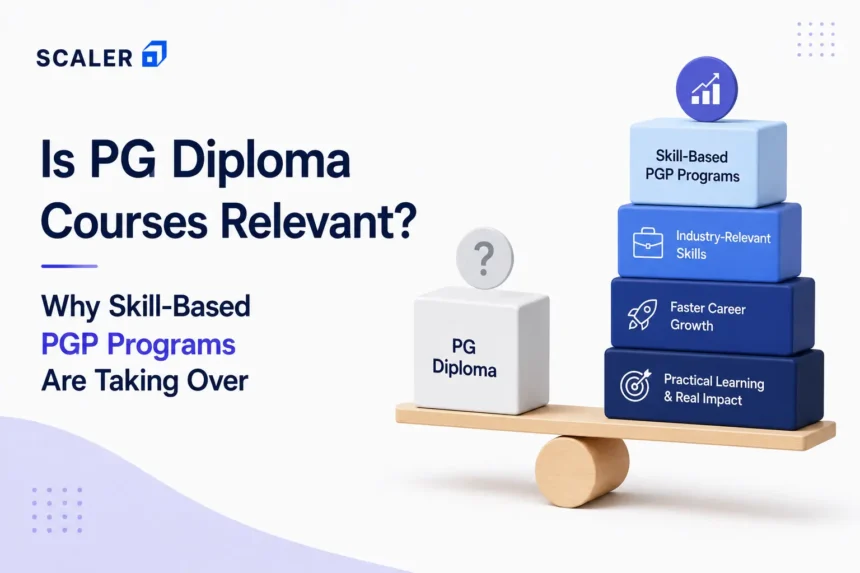
Searching for pg diploma courses and one that can be useful may seem tedious and rightfully so, so many options to choose from, and the one you do end up choosing has to be worth spending all your time and efforts.
Also, given the fact that every course promises better careers, industry-ready learning, placements, flexibility, and faster growth, but once you start comparing them properly, the differences become much harder to understand.
And in all honesty, that in itself is the hardest part to figure out. To think whether the PG diploma courses are still worth it in 2026, or are newer skill-focused postgraduate programs becoming the better option for working professionals?
When you see the hiring trends today, your credentials/certifications only become valid when you either have proof of work or provide experience in the industry.
But there’s that, right now, what you should look into is traditional mba vs PG Diploma courses, because in the end, it should mean to support you best. Some professionals still benefit from structured diploma programs. Others may find that shorter, applied, and role-focused learning formats align better with the kind of jobs companies are currently hiring for.
And for working individuals, this decision becomes extremely crucial, and we get that. The best postgraduate options for working professionals today are usually the ones that balance flexibility, practical learning, and real workplace relevance instead of only adding another qualification to the resume.
Are PG Diploma Courses Still Worth It in 2026?
- PG diploma courses can still work well for learners looking for structured postgraduate learning in a shorter format.
- You can choose traditional diploma programs or newer skill-focused alternatives, depending on which one can support you in your career.
- The value you should look for completely depends on how practical, industry-relevant, and workplace-focused the learning actually feels.
- Skill-based postgraduate programs often focus more on projects, operational workflows, analytics exposure, and real business applications.
- For working professionals, especially, flexibility and practical usefulness have become much bigger deciding factors than the diploma title alone.
PG Diploma Courses
For a long time, pg diploma courses were seen as one of the safest postgraduate options after graduation or even after a few years of work experience. And honestly, they still work well in many situations. The problem is that the market around them has changed much faster than most course structures have.
And we know how getting a diploma was enough to open doors before, but now the scene has changed, and it’s only right that you plan out your courses accordingly.
For example, some diploma programs still cover:
- theory-heavy curriculum
- semester-style exams
- generic business subjects
- limited practical exposure
- outdated case studies
At the same time, newer skill-focused programs are moving more toward:
- industry projects
- business problem-solving
- analytics and operational workflows
- portfolio-based learning
- role-specific skills
- practical tools and workplace scenarios
That doesn’t automatically mean traditional diploma programs aren’t valid. In many cases, they still help with foundational business understanding, career continuity, and structured postgraduate learning.
And we can understand when you ask: Are PG diploma courses still worth it in 2026? For this exact reason.
If the program stays too broad, too theoretical, or disconnected from actual workplace requirements, then the value can feel limited later. But programs that stay closely aligned with analytics, business operations, product thinking, AI-assisted workflows, or industry-specific skills usually tend to feel much more relevant in today’s job market.
And once you start comparing programs properly, you’ll notice that the biggest difference is often not the diploma title itself, but how practical the learning actually becomes. Hence, always look for programs that provide you with essential skills and practices in accordance with current skill set demand.
Postgraduate Diploma Courses
A lot of postgraduate diploma courses still follow the same structure they did years ago. You join the program, attend lectures, complete assignments, write exams, and eventually earn the qualification. But yes, we agree that there’s nothing completely wrong with that approach if the goal is simply structured postgraduate education.
But if you are someone who wishes to join a postgraduate diploma course to apply for better roles or just to upskill for your own line of work, then you may find some problems if the curriculum is not updated.
And you know about companies, they will only and only see if you have the skills to get the job done. And for that, practice and projects are necessary.
So, if you are contemplating between a skill based postgraduate programs vs traditional diplomas, then do check if the program has projects, are the skills alined to the current industry demand, will the learning be useful post exam, will there be enough work-place problem solving involved, if the skills you learn and practices be actually applied and if the program structure is flexible enough since you’ll be working if you choose to not take a career break.
You can add more to the list, and all the more because going in-depth with your research is the only way to avoid wasting your precious time!
You’ll find the best postgraduate options for working professionals today. They make sure to combine structured learning with practical exposure, industry relevance, and skills that actually help you grow.
Skill-based Postgraduate Programs
You might be feeling frustrated during course research, and that can be because of how broad some management programs still feel, even when your actual goal is very specific.
You may already know the kind of work you want to move toward:
- analytics
- operations
- growth
- product
- strategy
- customer insights
But then you open the curriculum and suddenly everything is mixed together again, multiple management subjects, theory-based modules, semester-style structure, long academic coverage.
So, if you are someone who knows what kind of roles you wish to move on to, or better yet, in which field, then these skill-based programs can certainly help you with it.
You can expect these programs to have their curriculum set centred around the area of work you wish to do, like someone from marketing may want stronger reporting and growth analysis skills, someone from operations may want to learn forecasting, workflow tracking, or process improvement, or someone moving toward strategy may want more exposure to business reviews, stakeholder discussions, or decision-making situations.
That changes the learning experience quite a bit because the course no longer feels completely separate from the work itself.
You’ll probably notice this difference in the coursework, too. You can expect them to revolve around:
- business reviews
- operational discussions
- reporting tasks
- portfolio projects
- presentations
- and messy situations where there isn’t one fixed answer already waiting
You’ll find these programs to be more practical if you are already a working professional, and you’ll be able to connect with the structure well since you already have familiarity with the kind of conversations, tools, and responsibilities.
Professional Diploma Courses
Two professional diploma courses can look almost identical in the brochure and still prepare you for completely different kinds of work afterward.
One program may stay heavily focused on classroom structure, written submissions, and semester-style evaluation throughout. Another may move much faster into analytics workflows, reporting systems, operational thinking, AI-assisted tools, business reviews, or execution-heavy projects from the beginning.
That difference becomes much easier to notice here:
| Program Type | Usually Focuses More On | Best Suited For |
| Traditional PG Diploma Courses | Academic structure, theory-heavy learning, semester evaluations | Learners looking for structured postgraduate education |
| Business Analytics Programs | Reporting, forecasting, analytics workflows, business insights | Professionals moving toward analytics or strategy roles |
| Business & AI Programs | AI-assisted workflows, operations, and modern business tools | Professionals trying to stay relevant in changing industries |
| Product or Growth-Focused Programs | Customer behavior, experimentation, business strategy | Marketing, growth, and product-oriented roles |
| Executive / Working Professional Programs | Flexible learning alongside work responsibilities | Mid-career professionals balancing jobs and upskilling |
And once you return to work, the difference between these programs usually becomes very easy to spot.
In some cases, the learning stays limited to assignments and coursework itself. In others, you start recognizing the same situations during actual work discussions, forecasting reviews, reporting conversations, operational bottlenecks, customer performance discussions, or planning meetings, and suddenly they become much easier to follow because the course has already exposed you to similar thinking patterns earlier.
That is why professional diploma courses have become much harder to judge. The programs may offer similar-looking credentials, but the experience and the kind of work they prepare you for afterward can feel completely different once you are actually back inside a team environment.
PG Courses After Graduation
Right after graduation, postgraduate courses start sounding like the obvious next step. You’ll probably hear people talking about MBAs, diplomas, certifications, analytics programs, finance courses, marketing specializations, and sometimes all at once. And that’s usually where the confusion begins.
Because the decision is no longer just about continuing education. If you are a graduate, then you’re probably trying to figure out which direction gives you a stronger career relevance in the next few years.
Some people choose pg diploma courses because they want structured learning before entering the job market properly. Others look for shorter skill-focused programs because they want faster exposure to practical tools, projects, and workplace-style learning instead of another heavily academic setup.
The tricky part is that two courses can sound very similar online while leading to completely different learning experiences later.
A few things graduates should start comparing are:
| You should check for | Why It Matters Later |
| Practical projects | Helps during interviews and role transitions |
| Industry-focused curriculum | Makes the learning feel more relevant |
| Flexibility and course format | Easier to manage alongside internships or jobs |
| Portfolio or case-study exposure | Improves practical confidence |
| Career alignment | Helps avoid learning skills that feel outdated quickly |
| Role-specific learning | Stronger fit for analytics, operations, marketing, or strategy roles |
After the course ends, you will go back to the same meetings, same reviews, and same work discussions again. But now, with a newer skill set and fuller understanding of your field.
FAQs
1. What are PG diploma courses?
PG diploma courses are postgraduate programs that help learners build specialized knowledge after graduation. These courses can focus on areas like management, analytics, finance, marketing, operations, or business strategy, depending on the specialization.
2. Who are pg diploma courses best suited for?
Pg diploma courses can work well for fresh graduates, working professionals, or people looking for role transitions. Some pursue them for specialization, while others use them to improve career growth, practical exposure, or industry relevance. The right fit for you will completely depend on your career goals and the structure of the program.
3. How should readers evaluate whether a postgraduate program fits their goals?
Before choosing a program, you should check:
- whether the curriculum feels industry-relevant
- If the course includes practical projects
- How flexible the learning format is
- whether the skills can be applied at work
- If the program supports long-term career growth
4. How do pg diploma courses fit into the decision?
Pg diploma courses still remain relevant for many learners, especially when the program combines structured learning with practical exposure. The bigger factor now is whether the skills stay useful in real workplace situations instead of remaining limited to theory-heavy coursework.
5. How do postgraduate diploma courses fit into the decision?
Postgraduate diploma courses can work well for professionals looking for focused postgraduate learning without committing to longer academic pathways. Some programs stay traditional in structure, while others are becoming much more applied and skill-oriented, depending on industry demand.
6. How do skill-based postgraduate programs fit into the decision?
Skill-based postgraduate programs are becoming more popular because they focus more on practical learning, projects, analytics, operational workflows, and workplace-oriented skills. For many professionals, this feels more aligned with how companies currently hire and evaluate talent.
