




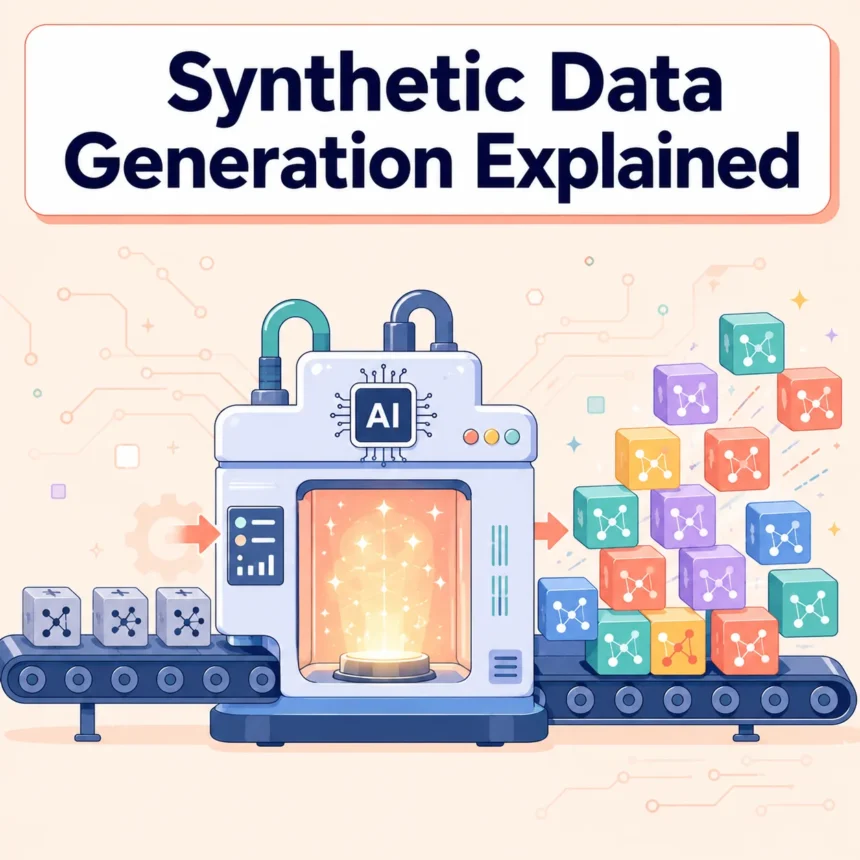
What is synthetic data? It’s artificially generated data, produced by an algorithm, a generative model, or a simulation, rather than captured from real-world events or real people, designed to mirror the statistical properties, structure, and patterns of genuine data.
The synthetic data meaning is easy to lose in hype, so it’s worth being precise: synthetic data isn’t fake in the sense of being random or meaningless. Good synthetic data preserves the statistical relationships that make the original data useful, the correlations, distributions, and edge cases, while containing no real individual’s actual information. Think of it as a carefully constructed digital twin of your data: retaining the analytical value without the privacy risk of the original records.
What Is a Synthetic Dataset, Concretely?
What is synthetic dataset, in practical terms? It’s the organised output of synthetic data generation, a structured collection of artificial records (rows in a table, images, conversations, or sensor readings) assembled so a training pipeline or test suite can actually use it, the same way it would use real data.
A synthetic dataset can take many forms depending on the domain: a table of fake but statistically realistic customer transactions for fraud-detection model training, thousands of simulated street scenes for training an autonomous vehicle’s perception system, or a set of AI-generated conversations used to fine-tune a customer support chatbot. What unifies all of these is that no real individual record was used to produce the final dataset directly, the data was generated, not collected.
Transform Your Career
Choose from our industry-leading programs designed for career success
Modern Software and AI Engineering Program
Master full-stack development with AI integration


 +1000 more
Modern Data Science and ML with specialisation in AI
Advanced data science techniques with AI specialization
+1000 more
Advanced AIML with Specialisation in Agentic AI
Deep dive into AIML with focus on Agentic systems
+1000 more
DevOps, Cloud & AI Platform Engineering
Build and manage AI-powered cloud infrastructure
+1000 more
AI Engineering Advanced Certification by IIT-Roorkee
Premier AI engineering certification from IIT-Roorkee

Why Synthetic Data Generation Has Exploded in 2026
Synthetic data generation was, until recently, a niche tool used mostly by privacy-conscious banks for software testing. By 2026, it has become foundational infrastructure across the AI industry, and three forces explain why. 75% of businesses projected to use generative AI for synthetic data by 2026 Up from under 5% in 2023, Gartner, cross-verified across multiple 2026 sources
- Privacy regulation: GDPR, HIPAA, and the evolving EU AI Act make using real customer data for testing and model training a genuine legal risk, synthetic data offers a compliant alternative that preserves analytical value
- Data scarcity: for rare events (fraud, equipment failure, medical emergencies) or edge cases (rare driving scenarios), real examples are too infrequent to train robust models on, synthetic data generation can produce as many examples as needed
- LLM capability jump: frontier models can now generate contextually rich text, tool-calling traces, and structured tabular data with minimal prompting overhead, making high-quality synthetic data dramatically cheaper and faster to produce than it was even two years ago
The practical result: teams building fraud detection systems, autonomous vehicles, medical AI, and conversational agents increasingly treat synthetic data generation as a first-class part of their data pipeline, not a fallback for when real data runs out.
How Synthetic Data Generation Actually Works
Synthetic data generation follows a general pipeline, regardless of which specific technique produces the final output:
| Step | What Happens |
| 1. Define the target | Decide what the synthetic dataset needs to represent, a table schema, image category, or conversation type |
| 2. Choose a generation method | Pick rule-based, statistical/generative, or LLM-based generation depending on data type and fidelity needs |
| 3. Generate the data | Run the chosen method to produce the artificial records, images, or text at the required volume |
| 4. Validate statistical fidelity | Compare the synthetic dataset’s distributions and correlations against a real reference dataset |
| 5. Filter and quality-check | Remove low-quality, unrealistic, or duplicate synthetic records before they enter a training pipeline |
| 6. Use in training or testing | Feed the validated synthetic dataset into model training, software testing, or evaluation pipelines |
The validation step is where most immature synthetic data generation efforts fall short, generating data is comparatively easy; generating data that is statistically faithful enough to actually improve downstream model performance requires deliberate checking, not just visual inspection that the output ‘looks okay.’
Data Algorithms Behind Synthetic Data Generation
The specific data algorithms used in synthetic data generation vary by data type and required fidelity, here are the three approaches that cover most production work in 2026:
| Method | How It Works | Best For |
| Rule-based generation | Fields are filled according to predefined rules (e.g., a valid postal code range, a date within a window) | Simple, structured test data, fast and predictable, but limited to what the rules encode |
| Statistical / generative models | GANs, Variational Autoencoders (VAEs), and diffusion models learn the joint distribution of a real training set and sample new synthetic examples from it | Tabular data, images, and cases where preserving complex statistical relationships matters |
| LLM-based generation | Frontier language models generate synthetic text, conversations, or structured records directly from a prompt or seed examples | Conversational data, synthetic prompts, tool-calling traces, and rich unstructured text |
Each of these data algorithms trades off differently between generation speed, statistical fidelity, and how much real data is needed as a starting point. Rule-based generation needs no real data at all but produces output only as rich as the rules written; generative models need a real training set to learn from but can capture far more nuanced patterns; LLM-based generation sits in between, often needing only a handful of seed examples to produce large volumes of plausible synthetic output.
Synthetic Data Generation Tools: The 2026 Landscape
The synthetic data generation tools market has matured substantially, shifting from single-column rule-based generators toward AI-powered platforms that generate, validate, and operationalise synthetic data as part of a full development or ML pipeline.
| Tool | Best For | Notable Feature |
| Gretel | ML teams needing privacy-safe tabular and text data | Strong differential privacy guarantees built in |
| MOSTLY AI | Enterprise tabular data generation | High statistical fidelity synthetic tables at scale |
| YData (Fabric) | Data science teams profiling and augmenting training data | Built specifically for balancing and improving ML training sets |
| Tonic (Fabricate) | Full-spectrum synthetic data across dev and AI pipelines | Generates from scratch or models existing data, operationalised via APIs |
| K2view | Enterprise entity-based synthetic data | Generates synthetic data around business entities (customers, orders) for referential integrity |
| Faker / Mockaroo | Lightweight developer test data | Fast, simple, rule-based, ideal for quick prototyping, not high-fidelity ML training |
| NVIDIA Omniverse Replicator / CARLA | Simulation-based synthetic data for robotics and autonomous vehicles | Perfect ground-truth labels generated directly from the simulation |
The right synthetic data generation tools depend heavily on your use case: lightweight libraries like Faker are fine for quick developer test data, but ML training pipelines that depend on statistical fidelity need platforms like Gretel, MOSTLY AI, or YData that are purpose-built to preserve the relationships that make training data useful.
Build AI Systems with High-Quality Synthetic Data
Learning about synthetic data generation is only the first step. The real impact comes from knowing how to generate, validate, and use synthetic datasets to build privacy-preserving, scalable AI and machine learning applications. Develop the practical skills to work with modern data pipelines and production-ready ML workflows. Explore Now
Real-World Use Cases for Synthetic Data
Synthetic data generation is already embedded across a wide range of production AI systems in 2026:
| Use Case | How Synthetic Data Helps |
| Fraud detection model training | Generates realistic transaction patterns including rare fraud scenarios that are too infrequent in real data to train on directly |
| Autonomous vehicle perception | Simulates rare, dangerous scenarios (pedestrian dart-outs, snowstorms) that are hard or unsafe to capture from real driving |
| Healthcare AI | Trains models on synthetic patient records that preserve clinical patterns without exposing real patient data (HIPAA-sensitive) |
| Software testing | Provisions realistic test data at scale without waiting weeks for manually curated or anonymised datasets |
| Conversational AI / chatbots | Generates synthetic dialogue and tool-calling traces to fine-tune assistants for specific domains |
| Robotics | Trains robots on thousands of simulated physical scenarios (e.g., object manipulation) that would be slow or costly to capture physically |
| Rare-event modelling | Produces sufficient examples of low-frequency events (equipment failure, medical emergencies) for robust model training |
Across nearly every one of these use cases, the common thread is the same: synthetic data generation solves a scarcity or privacy problem that real data alone can’t address, either because the real examples are too rare, too sensitive, or too expensive to collect at the volume a model actually needs.

Free Courses by top Scaler instructors
The Risks: Model Collapse and Other Failure Modes
Synthetic data generation is not risk-free, and the most serious failure mode has a name: model collapse (sometimes called AI inbreeding).
What is model collapse?
Model collapse happens when models are trained repeatedly on synthetic data with no real-data anchor. Generated data carries less variety than real data, each new generation drops more edge cases, and small errors compound across successive rounds, causing the model to become confidently wrong on data it was never properly exposed to.
Beyond model collapse, teams working with synthetic data generation run into a few other recurring problems:
- Over-smoothed distributions: synthetic data can quietly erase the messy edge cases that make real-world data hard, producing a model that appears confident but fails on genuine outliers
- Unvalidated volume generation: producing millions of synthetic rows and feeding them directly into training because the output ‘looked okay’ on a quick sample, without rigorous statistical validation
- Bias amplification: if the generative model or seed data carries bias, synthetic data generation can amplify that bias at scale rather than correcting for it
- Provenance loss: without tracking which records are synthetic versus real, teams lose the ability to audit or debug where a model’s odd behaviour originated
Best Practices for Responsible Synthetic Data Generation
Multiple 2026 industry guides converge on a consistent set of practices for avoiding the risks above while still capturing the real benefits of synthetic data generation:
- Keep real human data in the training mix, never fully replace real data with synthetic data; use synthetic data to expand and stress-test the real core, not substitute for it entirely
- Add synthetic data, don’t swap it in, supplementing real datasets with synthetic examples preserves the genuine edge cases that generation tends to smooth away
- Track data provenance, maintain clear records of which rows or examples in a dataset are synthetic versus real, so debugging and auditing remain possible
- Check for distribution drift before training, validate that synthetic data statistically resembles the real distribution it’s meant to represent, rather than assuming visual plausibility is sufficient
- Use human-in-the-loop review for high-stakes domains, healthcare, finance, and safety-critical applications benefit from human review of synthetic data samples before they enter a training pipeline
The organisations getting real value from synthetic data generation in 2026 are the ones treating it as a disciplined engineering practice, with validation, provenance tracking, and human oversight built in, rather than a shortcut that lets them skip the harder work of understanding their data.
Scaler Placement Report and Statistics
Scaler learners achieved 2.5x salary growth with average post-Scaler CTC reaching ₹23L.
 Google
 Amazon
 Microsoft
 Flipkart
 Adobe
1200+ more
Adobe
1200+ more
Synthetic Data vs Real Data: When to Use Which
Deciding when synthetic data generation is the right call, versus relying on real data, comes down to a few practical questions:
| Situation | Better Choice | Why |
| Real data contains sensitive PII | Synthetic data | Avoids privacy and compliance risk while preserving analytical value |
| Rare events (fraud, failures) | Synthetic data (supplementing real) | Real examples are too infrequent to train on alone |
| Establishing ground-truth model behaviour | Real data | Synthetic data can't replace the definition of what 'correct' looks like |
| Software/QA testing at scale | Synthetic data | Fast, cheap, no need to anonymise real production data |
| Final model evaluation before launch | Real data | Validating real-world performance requires real-world data, not simulated approximations |
The pattern across these situations is consistent: synthetic data generation is a powerful tool for expanding, protecting, and stress-testing your data, but real human data still does the essential work of defining what 'good' actually looks like. The strongest AI systems in 2026 combine both deliberately, rather than treating synthetic data as a full replacement for the real thing.
Ready to Build Data Pipelines for Real Production ML Systems?
Scaler's Data Science & ML Program covers data engineering, model training, and responsible AI practices hands-on, with real projects and 1:1 mentorship from engineers building production ML systems. Explore the Program
Scaler Alumni and Their Success Stories
FAQs
Q1. What is synthetic data generation used for?
Synthetic data generation is used to train AI models, test software, and expand rare or sensitive datasets without exposing real personal information.
Q2. What is synthetic data meaning in simple terms?
Synthetic data meaning, simply: data created by an algorithm or model rather than recorded directly from real people or events, but designed to mirror real data's statistical patterns.
Q3. What is a synthetic dataset in machine learning?
What is synthetic dataset in ML: a structured collection of artificially generated records, tabular, image, or text, used to train or test a model in place of, or alongside, real collected data.
Q4. What data algorithms are used to generate synthetic data?
Common data algorithms for synthetic data generation include rule-based generators, GANs and VAEs for statistical modelling, and frontier LLMs for generating synthetic text and conversations.
Q5. What are the best synthetic data generation tools in 2026?
Leading synthetic data generation tools in 2026 include Gretel, MOSTLY AI, YData, K2view, and Tonic for enterprise use, and Faker or Mockaroo for lightweight developer test data.
Q6. Can synthetic data fully replace real data in AI training?
No, synthetic data should supplement, not replace, real data; training exclusively on synthetic data risks model collapse, where quality degrades across successive generations.
