




Getting into .Net might have given you discussions around Node.js, Python, or Go. This is why many beginners think that .NET is obsolete. However, the hiring statistics paint a completely different picture. From enterprises to banks, from Global Capability Centres (GCCs) to IT service providers, .NET continues to be one of the most popular technologies to develop enterprise applications.
If you are wondering about how to become a .NET developer, the most challenging part is not deciding whether it’s worth it to learn .NET but rather where to begin with such an extensive and diverse array of languages such as C# and frameworks including ASP.NET Core, Entity Framework Core, auth, cloud, Docker, etc.
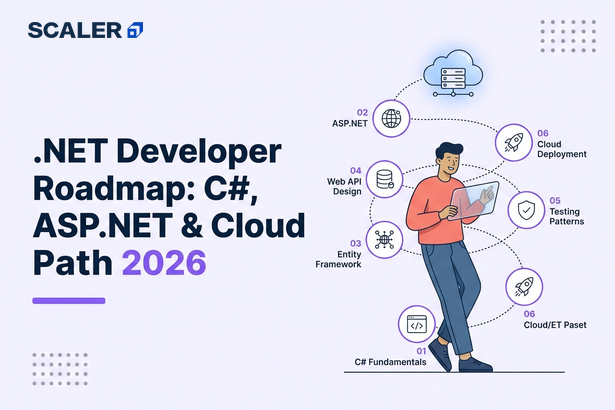
This .NET roadmap will help you study the right concepts in the right sequence. In this case, rather than going through all the technologies in the stack, you will start from C#, develop REST APIs through ASP.NET Core, interact with databases through Entity Framework Core, do security and testing of your applications, and then deploy them to the cloud. This .NET developer roadmap is structured in such a way that you are continually using what you have studied earlier rather than switching to different subjects.
Why .NET in 2026 (Especially in India)
It’s no surprise that those searching for “backend roadmap” have also encountered the following question: “Is .NET still in demand?” This is a legitimate question, especially since Node.js, Python, and Go get more attention on the Internet than .NET. Nevertheless, trends observed on social networks do not necessarily mean anything in terms of demand from employers.
Transform Your Career
Choose from our industry-leading programs designed for career success
Modern Software and AI Engineering Program
Master full-stack development with AI integration


 +1000 more
Modern Data Science and ML with specialisation in AI
Advanced data science techniques with AI specialization
+1000 more
Advanced AIML with Specialisation in Agentic AI
Deep dive into AIML with focus on Agentic systems
+1000 more
DevOps, Cloud & AI Platform Engineering
Build and manage AI-powered cloud infrastructure
+1000 more
AI Engineering Advanced Certification by IIT-Roorkee
Premier AI engineering certification from IIT-Roorkee

In today’s era, .NET is an open-source, cross-platform software development framework utilized in the creation of web applications and APIs, as well as desktop applications, cloud-based solutions, and enterprise systems. The modern-day .NET has brought uniformity in the development platform and made it interoperable on Windows, Linux, and MacOS platforms alike.
The strongest point of using the .NET programming language in India is not due to its popularity but due to the demand. The big companies, GCCs, IT services firms, BFSI, healthcare, insurance, and retail firms continue using the .NET programming language in their business critical applications. These applications are usually developed by companies over several years, and hiring developers to work on them using .NET is very common.
Performance is another factor that contributes to .NET’s continued relevance. Modern ASP.NET Core always performs very well in various benchmark tests, including TechEmpower, and thus is ideal for developing high performance back-end services such as APIs. This, together with the predictable release schedule from Microsoft and LTS versions, makes the platform ideal for long-term development.
However, if your objective is to forge a career path in backend development, then you would definitely want to consider learning .NET as a good bet. In contrast to the constant pursuit of every emerging framework that comes out, you would be building your skill set around technologies that will always stay relevant.
To learn more about the .NET platform and its latest features, refer to the official Microsoft documentation: Microsoft .NET.
The .NET Roadmap at a Glance: 5 Stages
The .NET framework consists of a lot of frameworks, libraries, and other tools; however, you will not need to know all of this information in advance while developing applications. It’s important to concentrate on the basics first and then get to know more about different technologies with the development of more complex projects. This .NET roadmap divides this learning process into five stages.
| Stage | Timeline | What You’ll Learn | Milestone Project |
| Stage 1: C# Fundamentals | Weeks 1-6 | C# syntax, OOP, collections, LINQ basics, and async/await | Build a console-based Library Management System |
| Stage 2: ASP.NET Core Web APIs | Weeks 6-10 | Routing, controllers, dependency injection, middleware, and REST APIs | Develop a REST API for a Book Store or Task Manager |
| Stage 3: Entity Framework Core | Weeks 10-14 | EF Core, database migrations, LINQ queries, and SQL integration | Create a database-backed API with CRUD operations |
| Stage 4: Authentication, Testing & Architecture | Weeks 14-18 | JWT authentication, Identity, unit testing, logging, and clean architecture | Secure and test your API using JWT and xUnit |
| Stage 5: Cloud, Docker & Deployment | Weeks 18-24 | Azure deployment, Docker, CI/CD basics, and application deployment | Deploy a containerized .NET application to Azure |
By following this plan, you will be able to get yourself ready for employment within a period of 6-9 months, based on how fast you learn. More importantly, with each phase building up from the other, once you’re done with everything, you won’t be showing off a collection of tutorial assignments but a collection of working projects.
Stage 1: C# Fundamentals
Every C# roadmap begins with the same foundation learning: the language before moving to frameworks like ASP.NET Core. There are many beginners who jump into ASP.NET Core prematurely without being aware of the fact that they are dealing with problems that are not related to web programming at all.
First, you need to learn about the structure of C# programs and how the language operates. Once you have understood this well enough, proceed to learn about OOP because this is what most of the applications in the .NET platform are based upon. You will then proceed to learn about collections, LINQ queries, and asynchronous programming.
Focus on these core concepts:
- C# Syntax – Variables, data types, operators, control statements, methods, and exception handling.
- Object-Oriented Programming (OOP) – Understand the four pillars: encapsulation, inheritance, polymorphism, and abstraction.
- Collections – Work with commonly used collection types such as List<T>, Dictionary<TKey, TValue>, and HashSet<T>.
- LINQ Basics – Learn how to filter, sort, and transform data using Language Integrated Query instead of writing repetitive loops.
- Async and Await – Understand the basics of asynchronous programming and why modern applications use it to improve performance and responsiveness.
There is no need to have perfect knowledge of all the advanced concepts in C# at this point. What is needed is to know how to write neat and clear code. After that becomes natural, learning ASP.NET Core and Entity Framework would be much easier.
In terms of milestones, make either a Console Library Management System or a Console Student Management System. There is no need for a graphic user interface or a database in this project. Concentrate on the implementation of concepts that you have learned through class creation, collection manipulation, user interaction, and method organization. Successful completion of such a project will make you feel confident about the development of web APIs in the next step.
Start here if you’re completely new to C# and want to build a strong foundation: C# Tutorial.
Stage 2: ASP.NET Core Web APIs
This part of the ASP.NET Core roadmap is where you start building REST APIs and backend applications. It’s this framework that you will be using to develop RESTful APIs, handling requests coming from those APIs and exposing data to various web/mobile applications. For all of you who want to work on the backend of .NET, this is where you will see software development.
Here, you should concentrate on comprehending the mechanism behind a request from the time it is sent by the client until the API gives a response. After learning that mechanism, everything else will become easy.
As you work through this stage, focus on these concepts:
- Project Structure – Learn where everything belongs so your application stays organized as it grows.
- Routing – Understand how a request reaches the correct API endpoint.
- Controllers and Minimal APIs – Build endpoints that handle CRUD operations, and learn when to use each approach.
- Dependency Injection – One of the biggest strengths of ASP.NET Core. It keeps your code cleaner, easier to test, and easier to maintain.
- Middleware – Every request passes through middleware before reaching your API. This is where features like authentication, logging, exception handling, and routing are plugged in.
If you have used ASP.NET before, you should also try to understand the differences between the older request lifecycle and the one used in new ASP.NET Core because this way, you will be able to see why the new framework is better than the old one.
At the completion of this phase, you should strive to develop a REST API for applications like a task management app, a bookstore, or an employee management app. Do not focus on databases; just use in-memory data storage. The aim is to get used to developing endpoints, processing HTTP requests, and designing the back-end application before proceeding to the next phase.
Also Read: ASP.NET Page Life Cycle
Stage 3: Data with Entity Framework Core
A REST API will be useless if it cannot hold data and access it. In-memory storage works fine for a learning phase but not in real-world situations where the database has to preserve data even when the application is restarted. And that’s when Entity Framework Core steps in.
EF Core stands for Entity Framework Core, which is the ORM provided by Microsoft. Rather than writing each query in SQL for all operations, EF Core provides the capability to interact with C# objects and performs most of the operations related to database management in the background.
No need to learn everything about EF Core at first go; the important thing is knowing how your app uses databases for storing, accessing, and modifying data. Once you have covered this basic requirement, learning other aspects of EF Core becomes much simpler.
You’ll primarily work with:
- DbContext and Entity Models – Define your application’s data structure and how it maps to database tables.
- Migrations – Create and update your database schema as your application evolves without manually modifying tables.
- LINQ Queries – Retrieve, filter, sort, and update data using C# instead of writing raw SQL for everyday operations.
- SQL Server or PostgreSQL – Learn to connect your application to a relational database and perform CRUD operations.
- Repository Pattern (Awareness) – Understand why many enterprise applications separate data access from business logic, even if you don’t implement the pattern in every project.
Now that you have your API integrated into a database, go back to the REST API you developed in the last phase, and use Entity Framework Core for the in-memory data. Provide full CRUD operations along with input validation and ensure that the persistence is retained even after restarts.
In addition to having your own API backed by the database, you will have come to the point when you will have the most important step completed – creating the backend application that is similar to the applications created in the professional .NET environment. It is an ideal basis for the next phase.

Free Courses by top Scaler instructors
Stage 4: Auth, Testing & Architecture
Think about the projects you’ve built so far. They probably work, but would you trust them in production? Could other developers understand the code? Is user data protected? Can you confidently make changes without breaking existing features? These are the questions you’ll start answering in this stage.
Start with authentication and authorization via JWT or ASP.NET Core Identity. Authentication is used to verify the user’s identity, while authorization is responsible for deciding what the user can access. It is a core part of almost all contemporary web applications, be it e-commerce, bank software, or any kind of internal business app.
When your API becomes secure, you should consider unit testing through the use of tools such as xUnit. Testing becomes necessary since it allows you to be sure about how your business logic behaves and ensures that there will be no issues in terms of bugs arising during the development process. Although it is not necessary to test all lines of code, it is crucial for backend development.
It is also an ideal phase for incorporating Clean Architecture principles. You may not have to incorporate a sophisticated enterprise architecture immediately, but it helps to know how to segregate business logic, data access, and presentation layers, making future scaling of projects more manageable. Together with this, incorporate logging in your system, allowing you to monitor requests and know what happens when problems arise.
Go back to the API that you have developed until now and begin treating it as a production project. Add protection for your endpoints using JWT authentication, implement unit testing for your basic services, clean up your code by structuring it well, and add logging so that debugging will be easier. All of these things will not alter your application’s functionality, but they will make it extremely reliable.
Want to explore authentication in more detail? Here’s a guide to start with: Types of Authentication in Asp.Ne.t
Stage 5: Cloud, Docker & Deployment
Building applications is just one half of the job description. In order to be a competent backend engineer, you need to know how to release and run that software efficiently. Be it for an internal business application or for a customer API, knowledge of how software gets deployed to production is a crucial requirement.
Deploy your application to Azure App Service, which is one of the most frequently used hosting services for .NET applications. By learning how to deploy your API on the cloud and configuring environment variables and app settings, you will understand how the deployment works in a production environment.
After that, learn Docker. The containerization technology enables you to pack everything required for your application’s execution into a single unit, making it easy to run your app everywhere, whether during development or production stages. Even if you don’t apply for DevOps positions, Docker will become a good addition to your skills if you want to develop backend applications.
Learn More: Docker Roadmap: Going from Zero to Production-Ready 2026
Lastly, learn about CI/CD (Continuous Integration and Continuous Delivery) basics. There is no need to set up your own sophisticated deployment workflows from scratch; however, knowledge of how to transfer code from a Git repository into a production application will be useful when you work in a development team.
Instead of kicking off a fresh project, take advantage of this milestone and finish off the project that you have been working on through this roadmap. Package your API in Docker, deploy it on Azure, and ensure that it’s accessible through a public endpoint. Nothing beats having an actual application to demonstrate compared to yet another half-finished tutorial project, and something for recruiters to assess in interviews.
Cloud computing or DevOps piques your curiosity? It is time for you to learn more about these topics. This Cloud Computing and Docker Roadmaps will serve you well in this regard.
Interested in cloud development? You can start your journey with: Cloud Computing Roadmap 2026: 6-Month Step-by-Step Plan
Choose Your Path: Backend API vs Blazor vs Full-Stack
When comparing Blazor vs ASP.NET Core, remember that you’re choosing between different career paths rather than competing technologies. Some learners go into the niche of creating APIs and microservices, some leverage Blazor for creating web applications with C#, while other learners learn ASP.NET Core with React and Angular to become full-stack developers.
| Career Path | Best For | What You’ll Build | Job Outlook |
| Backend API Development | Developers who enjoy server-side programming and business logic | REST APIs, microservices, enterprise applications, cloud services | Largest job market across enterprises, GCCs, BFSI, and product companies |
| Blazor Development | Developers who prefer staying within the C# ecosystem | Interactive web applications using C# for both front-end and back-end | Growing adoption, especially in Microsoft-focused organizations |
| Full-Stack (.NET + React/Angular) | Developers who want to build complete web applications | ASP.NET Core backend with React or Angular front-end | Most versatile option with opportunities across startups and product companies |
If your goal is to maximize job opportunities, backend API development is the strongest starting point. Most .NET roles in India focus on building APIs, enterprise applications, and cloud-based services, making backend development the largest hiring segment.
If you enjoy working entirely in C#, Blazor is an excellent choice. It allows you to build modern web interfaces without switching to JavaScript, and its adoption continues to grow in organizations that already rely on Microsoft’s technology stack.
If you want the flexibility to work across both front-end and back-end development, combining ASP.NET Core with React or Angular is a great option. It requires learning additional technologies, but it also opens the door to a wider range of full-stack development roles.
The good news is that you don’t need to decide immediately. Build a strong foundation in C#, ASP.NET Core, and backend development first. Once you’re comfortable with those fundamentals, you’ll find it much easier to branch into Blazor or full-stack development based on your interests and career goals.
Scaler Placement Report and Statistics
Scaler learners achieved 2.5x salary growth with average post-Scaler CTC reaching ₹23L.
 Google
 Amazon
 Microsoft
 Flipkart
 Adobe
1200+ more
Adobe
1200+ more
Skills Checklist, Interviews & Next Steps
By now, you've covered the complete learning path from C# fundamentals to building, securing, and deploying a production-ready .NET application. Before you start applying for jobs, take a step back and make sure you've built the core skills employers expect from an entry-level .NET developer. Think of this as your final readiness check rather than another learning phase.
Think of this checklist as your .NET developer skills path before you start applying for backend roles:
- Write clean, object-oriented code in C#
- Build REST APIs using ASP.NET Core
- Work with databases using Entity Framework Core and LINQ
- Implement JWT authentication and role-based authorization
- Write unit tests using xUnit
- Understand dependency injection and middleware
- Apply clean architecture principles in small projects
- Containerize applications with Docker
- Deploy .NET applications to Azure
If you'd like a more detailed breakdown of the technical and professional skills employers look for, read our .NET Developer Skills guide. It complements this roadmap and explains the technologies, tools, and best practices you'll use throughout your career.
Once you start interviewing, expect discussions that go beyond syntax. Recruiters and hiring managers often focus on how you think through backend problems rather than whether you remember every API method. Common interview topics include dependency injection, async/await, Entity Framework Core performance, database design, REST API best practices, and authentication using JWT. You may also be asked to improve existing code, debug simple issues, or explain the architectural decisions you made in your projects.
Also Read: Top 11 .NET Developer Skills in Demand.
Entry-level .NET developer salaries in India vary depending on the company, location, and your project portfolio. Product companies and Global Capability Centres (GCCs) generally offer higher compensation than service-based organizations, while candidates with strong backend projects and internship experience often have an advantage during the hiring process. Update this section with the latest verified salary data before publishing.
The most important thing to remember is that becoming a .NET developer isn't about learning every library in the ecosystem. It's about building a solid foundation, creating practical projects, and understanding how real applications are designed, secured, and deployed.
Enterprise backend engineering is a system-design game; level up with Scaler's Software Development Program: Software & AI Engineering Course.
Scaler Alumni and Their Success Stories
Read These Important Roadmaps: More Paths to Career Success
FAQs
Q1. Is .NET worth learning in 2026?
Yes. Modern .NET is open-source, cross-platform, and one of the fastest frameworks for building web applications and APIs. It also continues to see strong demand across enterprises, BFSI, GCCs, and product companies in India.
Q2. What should I learn first for .NET development?
Start with C# fundamentals, including OOP, collections, LINQ, and async/await. Once you're comfortable with the language, move on to ASP.NET Core Web APIs before exploring Entity Framework Core, authentication, and cloud deployment.
Q3. How long does it take to become a .NET developer?
With consistent learning and hands-on projects, most beginners can become job-ready in 6-9 months by following a structured path: C# to ASP.NET Core to Entity Framework Core to Authentication & Testing to Cloud Deployment.
Q4. What is the difference between .NET Framework and .NET?
.NET Framework is Microsoft's legacy, Windows-only platform, while modern .NET (formerly .NET Core) is cross-platform, open-source, and the recommended platform for all new .NET application development.
Q5. Should I learn Blazor or a JavaScript frontend?
It depends on your career goals. Blazor lets you build both the front-end and back-end using C#, while learning React or Angular alongside ASP.NET Core opens up more full-stack opportunities. If you're just starting, focus on backend development first and specialize later.
Q6. Does .NET pay well in India?
Yes. .NET developers earn salaries comparable to Java backend developers at similar experience levels, with particularly strong opportunities in enterprise organizations, GCCs, and product companies. Your salary will ultimately depend on your skills, projects, experience, and the type of company you join.
